Foreword by Max Horkheimer and Herbert Marcuse, Introduction by Alberto Toscano
Good to see this reissued by Verso. Among other things it’s an important link between the Frankfurt School and French Marxism, as Guterman was a long-term friend and sometime co-author with Henri Lefebvre.
A classic book that analyzes and defines media appeals specific to American pro-fascist and anti-Semite agitators of the 1940s, such as the application of psychosocial manipulation for political ends. The book details psychological deceits that idealogues or authoritarians commonly used. The techniques are grouped under the headings “Discontent”, “The Opponent”, “The Movement” and “The Leader”. The authors demonstrate repetitive patterns commonly utilized, such as turning unfocused social discontent towards a targeted enemy. The agitator positions himself as a unifying presence: he is the ideal, the only leader capable of freeing his audience from the perceived enemy. Yet, as the authors demonstrate, he is a shallow person who creates social or racial disharmony, thereby reinforcing that his leadership is needed. The authors believed fascist tendencies in America were at an early stage in the 1940s, but warned a time might come when Americans could and would be “susceptible to … [the] psychological manipulation” of a rabble rouser. A book once again relevant in the Trump era, as made clear by Alberto Toscano’s new introduction.
Stuart Elden and Adam David Morton – Henri Lefebvre, From the Rural: Economy, Sociology, Geography – a new collection of writings forthcoming with University of Minnesota Press, 2022
[update: the University of Minnesota Press page for On the Rural is here]
Perhaps granted much less attention than it merits, Henri Lefebvre in The Production of Space directly draws the reader’s attention to Marx’s Capital, Vol.3, and a focus on the ‘trinity’ formula (land, labour, capital) that transcends the capital-labour binary. Lefebvre asks us: ‘What of the part played by land, as concept and reality, in this context?’. By so doing, he engages Marx on a cluster of factors revolving around land, the landowning class, ground-rent and agriculture, engaging the latter’s reflections not simply on the ownership of land but also underground and submarine resources as well as livestock breeding and construction. ‘What excuse could there be today’, Lefebvre then asks, ‘for not going back to this exemplary if unfinished work─not with a view to consecrating it in any way but in order to put questions to it?’.
The import of these interventions by Lefebvre on a Marxist theory of ground-rent travel widely and easily beyond the magnum opus that is The Production of Space. It is for these reasons that we have collaborated for the first time in bringing together an anthology by Lefebvre collecting his writings on the rural. Entitled From the Rural: Economy, Sociology, Geography (forthcoming with University of Minnesota Press, 2022), the book reveals just how reductive it would be to treat Lefebvre solely as a critic of the historically unfolding dialectic of urban space. With a total of twelve chapters, all but two translated for the first time from French and some newly discovered, we believe the book will deliver to readers a thinker that moves across the unity of the rural and the urban in addressing the uneven development of the production of space.
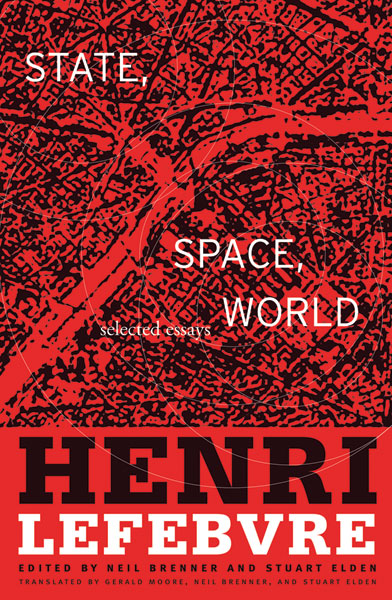
Ten of the texts are translated by Robert Bononno, with one chapter each translated by Matthew Dennis and Sîan Rosa Hunter Dodsworth. We have edited the translations, adding explanatory editorial notes, completing Lefebvre’s often incomplete references and comments. The volume also includes a major interpretative co-authored introduction. One way to receive From the Rural: Economy, Sociology, Geography is as a companion piece to State, Space, World: Selected Essays, edited by Neil Brenner and Stuart Elden, or to sit alongside his better-known Writings on Cities, The Urban Revolutionor Marxist Thought and the City.
What treats are in store? The translations include the first half of Lefebvre’s book Du rural à l’urbain, including his crucial essays ‘Problems of Rural Sociology’ and ‘Perspectives on Rural Sociology’, along with ‘The Theory of Ground Rent and Rural Sociology’ (which we previously edited for publication in Antipode, and available open access), and the essays tracking the twin processes of urbanisation and industrialisation. We have supplemented these essays with some additional texts, including two pieces published in France which were not included in Du rural à l’urbain, a conference paper delivered in Milan, and a long text only published in Spanish. The last two texts are largely unknown and are not discussed in the literature on Lefebvre, but add crucial empirical and conceptual detail. The volume concludes with some crucial chapters from Lefebvre’s study of the Pyrenean valley of Campan.
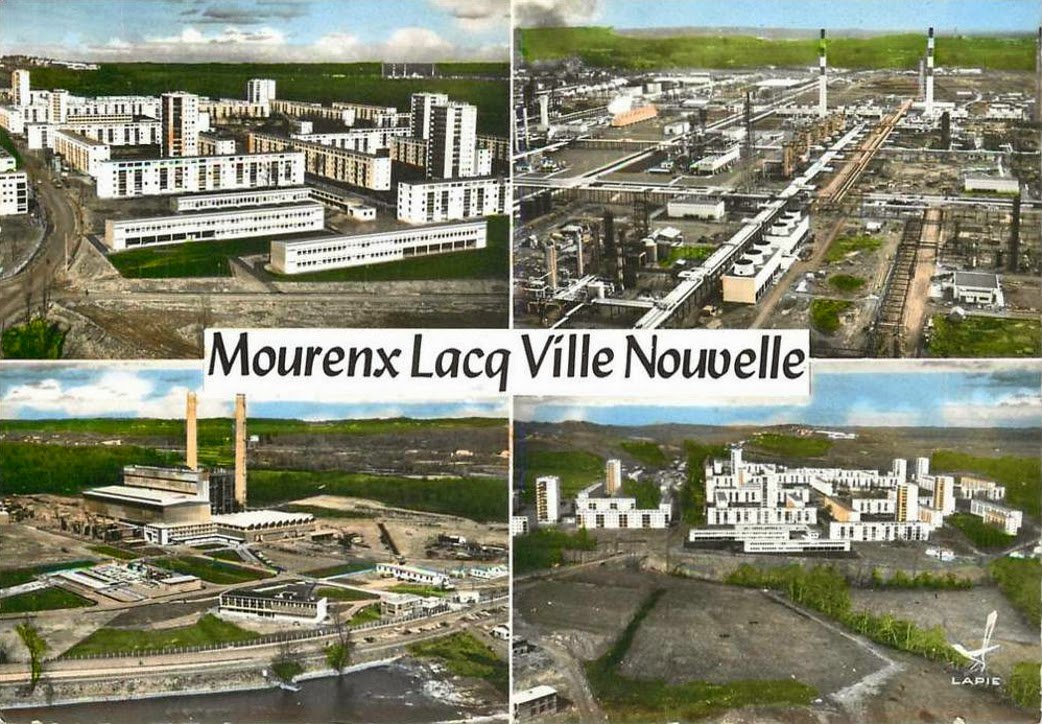
Embedded within his reflections on rural sociology, historical sociology, and a Marxist theory of ground-rent is the ‘limit case’ of Lacq-Mourenx (pictured), a ‘new town’ development from the 1950s in the French province of Béarn, in the Pyrenees mountains. With the frontier of capital accumulation commissioning gas production units, housing plans, and factory structures, Lefebvre viewed the urbanisation process there as a ‘Béarnasian Texas’:
‘It is the transition from the rural to the urban that is taking place, is being prepared before our very eyes and for our consideration’.
Through recourse to a historical sociology method attuned to the condition of uneven development, agrarian reform, the transformation of the peasantry and class formation, and the remnants, residues, and sediments embedded in everyday life, these essays bring forth the struggle for land and the centrality of territory. The essays also ripple in complex forms across agrarian structures confronted by contending conditions of uneven development and the survivals and revivals of everyday life. Ground-rent as a precapitalist survival, underdevelopment, dispossession through extra-economic pressure, and arrested and deflected development pervade these essays, which relationally connect and ripple through the conditions of agrarian reform across Europe, Latin America, North Africa, and Asia.
Presaging current debates led by figures such as Kevin Anderson in Marx at the Margins, on the late writings by Marx covering non-Western and precapitalist societies, Lefebvre writes in his 1964 essay ‘The Marxist-Leninist Theory of Ground-Rent’ in relation to Marx that: ‘just before his death he had already begun researching a huge number of documents in reference to Russia’, to thus focus on the multilinear conditions of social development.
It is for that reason that with this volume we hope readers of Lefebvre will further appreciate that today, more than ever, class struggle is inscribed in urban and rural space. We are excited to see this book move into production and look forward to seeing it ripple in new ways to continue to reshape the futures of Lefebvre and his intellectual and political legacy.
Best known as the author of On Liberty, John Stuart Mill remains a canonical figure in liberalism today. Yet according to his autobiography, by the mid-1840s he placed himself “under the general designation of Socialist.” Taking this self-description seriously, John Stuart Mill, Socialist reinterprets Mill’s work in its light.
Helen McCabe explores the nineteenth-century political economist’s core commitments to egalitarianism, social justice, social harmony, and a socialist utopia of cooperation, fairness, and human flourishing. Uncovering Mill’s changing relationship with the radicalism of his youth and his excitement about the revolutionary events of 1848, McCabe argues that he saw liberal reforms as solutions to contemporary problems, while socialism was the path to a better future. In so doing, she casts new light on his political theory, including his theory of social progress; his support for democracy; his feminism; his concept of utility; his understanding of individuality; and his account of “the permanent interests of man as a progressive being,” which is so central to his famous harm principle.
As we look to rebuild the world in the wake of financial crises, climate change, and a global pandemic, John Stuart Mill, Socialist offers a radical rereading of the philosopher and a fresh perspective on contemporary meanings of socialism.
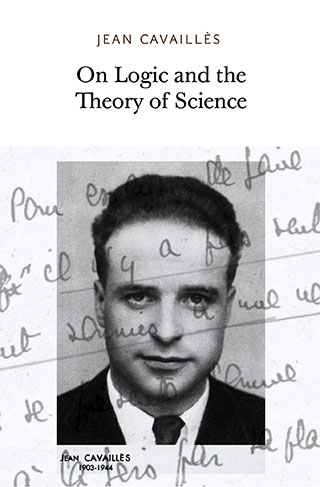
Translated by Knox Pedenand Robin Mackay. Preface by Gaston Bachelard. Introductory notice by Georges Canguilhem and Charles Ehresmann. Introduction by Knox Peden.
In this short, dense essay, Jean Cavaillès evaluates philosophical efforts to determine the origin—logical or ontological—of scientific thought, arguing that, rather than seeking to found science in original intentional acts, a priori meanings, or foundational logical relations, any adequate theory must involve a history of the concept.
Beginning with an account of Kant’s legacy and its internal bifurcations, the text then turns to a critique of logical positivism, and a detailed engagement with Husserl’s attempt to ground mathematical abstractions in intentional acts.
Finding these positions untenable, Cavaillès insists on a historical epistemology that is more conceptual than strictly phenomenological, and a logic that is dialectical rather than transcendental. His famous call (cited by Foucault) to abandon ‘a philosophy of consciousness’ for ‘a philosophy of the concept’ was crucial in displacing the focus of philosophical enquiry from aprioristic foundations toward structural historical shifts in the conceptual fabric.
This new translation of Cavaillès’s final work, completed in 1942 during his imprisonment for Resistance activities, presents an opportunity to reencounter an original and lucid thinker. Cavaillès’s subtle adjudication between positivistic claims that science has no need of philosophy, and philosophers’ obstinate disregard for actual scientific events, speaks to a dilemma that remains pertinent for us today. His affirmation of the authority of scientific thinking combined with his commitment to conceptual creation yields a radical defence of the freedom of thought and the possibility of the new.
Computational models of urbanism—smart cities that use data-driven planning and algorithmic administration—promise to deliver new urban efficiencies and conveniences. Yet these models limit our understanding of what we can know about a city. A City Is Not a Computer reveals how cities encompass myriad forms of local and indigenous intelligences and knowledge institutions, arguing that these resources are a vital supplement and corrective to increasingly prevalent algorithmic models.
Shannon Mattern begins by examining the ethical and ontological implications of urban technologies and computational models, discussing how they shape and in many cases profoundly limit our engagement with cities. She looks at the methods and underlying assumptions of data-driven urbanism, and demonstrates how the “city-as-computer” metaphor, which undergirds much of today’s urban policy and design, reduces place-based knowledge to information processing. Mattern then imagines how we might sustain institutions and infrastructures that constitute more diverse, open, inclusive urban forms. She shows how the public library functions as a steward of urban intelligence, and describes the scales of upkeep needed to sustain a city’s many moving parts, from spinning hard drives to bridge repairs.
Incorporating insights from urban studies, data science, and media and information studies, A City Is Not a Computer offers a visionary new approach to urban planning and design.
The story of how a much-contested legal category—statelessness—transformed the international legal order and redefined the relationship between states and their citizens.
Two world wars left millions stranded in Europe. The collapse of empires and the rise of independent states in the twentieth century produced an unprecedented number of people without national belonging and with nowhere to go.Mira Siegelberg’s innovative history weaves together ideas about law and politics, rights and citizenship, with the intimate plight of stateless persons, to explore how and why the problem of statelessness compelled a new understanding of the international order in the twentieth century and beyond.
In the years following the First World War, the legal category of statelessness generated novel visions of cosmopolitan political and legal organization and challenged efforts to limit the boundaries of national membership and international authority. Yet, as Siegelberg…
I don’t believe I shall ever forget the spring of 1937. Every day, except Friday and Saturday when I held the class and seminar at the university, I sat down at my desk immediately after lunch, at two o’clock. If I had any articles to write that day, I wrote them first; then I began working on Hasdeu, writing from five to fifteen pages (of introduction, annotation, or bibliography) until 10:00 or 11:00 P.M. After that, I cleared the desk and returned to the novel. I wrote until 3:00 or 4:00 A.M., fifteen or eighteen pages, which – sometimes without even reading them over – I put into an envelope and left beside the entryway door so the boy from the print shop could pick them up in the morning. Each day he collected the chapter I had written the night before.
Mircea Eliade, Autobiography Volume I: 1907-1937 Journey East, Journey West, translated by Mac Linscott Ricketts, 321.
In In Exile, Jessica Dubow situates exile in a new context in which it holds both critical capacity and political potential. She not only outlines the origin of the relationship between geography and philosophy in the Judaic intellectual tradition; but also makes secular claims out of Judaism’s theological sources.
Analysing key Jewish intellectual figures such as Walter Benjamin, Isaiah Berlin and Hannah Arendt, Dubow presents exile as a form of thought and action and reconsiders attachments of identity, history, time, and territory. In her unique combination of geography, philosophy and some of the key themes in Judaic thought, she has constructed more than a study of interdisciplinary fluidity. She delivers a striking case for understanding the critical imagination in spatial terms and traces this back to a fundamental – if forgotten – exilic pull at the heart of Judaic thought.