Indo-European Thought project update 3: Paris – Foucault, Canguilhem, Dumézil

I had a good two-week visit to Paris, where I worked at both the Mitterand and Richelieu sites of the Bibliothèque nationale, the Collège de France and the École normale supérieure. It was something of a transitional trip, doing a little with some loose ends on the Foucault work, an article, the Mitra-Varuna editing, and beginning to think more seriously about the wider Indo-European project.

The Richelieu site of the BnF is in the final stages of a massive renovation. It’s been a building site for all the years I’ve been working there. The manuscripts room was closed for a period earlier this year, which meant I wasn’t able to do a final visit when finishing The Archaeology of Foucault. While I’d done all the key work on the 1960s, there were a couple of small things I wanted to check, and there is lot more relating to the later periods of Foucault’s career that wasn’t available when I wrote Foucault’s Last Decade. The allure of the archive… always more to explore.

I looked at a few things from the 1970s and 1980s, but what I can say is that if you are interested in the later Foucault, there is so much to be done. There are substantial materials relating to abandoned and unfinished books – the project on technologies of the self, the manuscript on the medieval church under the title of La Chair et le corps, all Foucault’s materials relating to Les Aveux de la chair published in 2018, substantial fragments of La croisade des enfants on the campaign against childhood masturbation, the project on hermaphrodites… 

None of this material was accessible (at least to me) when I did the research for Foucault’s Last Decade, but it is a rich and largely untapped resource. I don’t know what plans there are for publishing from this material but what I have seen seems to me often to be as developed as some of the material from the 1950s and 1960s currently being edited for the Gallimard/Seuil/EHESS series ‘Cours et travaux avant le Collège de France’.

Excellent work has been done on Foucault archival material, by among others, Daniel Defert, Henri-Paul Fruchaud, Frédéric Gros, Daniele Lorenzini, Philippe Sabot, Elisabetta Basso, Arianna Sforzini, Orazio Irrera, Bernard Harcourt, Claude-Olivier Doron, Philippe Chevallier… I know some PhD and post-docs have done work that is waiting to be published – including  Luke Ilott, Aner Barzilay, Valentina Antoniol… but fascinating PhDs, articles and books are just waiting to be written. To my mind this is all much more interesting than some of the debates dominating anglophone Foucault studies.

At the École normale supérieure, I was again using the Georges Canguilhem collection, held at CAPHÉS. This was to look at some books in his library, especially with dedications from Jean Hyppolite and one from Georges Dumézil, and a few drafts of pieces about Hyppolite. I discuss the Canguilhem, Dumézil, Hyppolite connections in a piece for a theme issue of Revue internationale de philosophie on Canguilhem, edited by Federico Testa, which will be discussed at a workshop on 16 May. I wasn’t able to get to this archive when drafting that piece, so there were a number of things I wanted to check and a couple of things to correct.

At the Collège de France, this was a preliminary visit to the Dumézil archive. I’d only been here once before to look at some of the Dumézil-Foucault correspondence when I was writing The Early Foucault. I plan to come here a lot for the Indo-European project, but on this trip I just consulted two lecture courses and a small file of papers about the Mitra-Varuna book. This is intended to help with the work for the Introduction to the new edition of that text. There is a huge amount of material here, and it’s going to be a lot of work. One major challenge is his awful handwriting – and I thought Foucault was difficult. Of course, nearly everything here was written only for him to read, but even so….

At the BnF Mitterand, I did some work on the references for the Mitra-Varuna text, checking more of Dumézil’s references and adding some detail to the Introduction. I am now down to about a dozen of Dumézil’s references which I’ve been unable so far to verify. Six of those are to texts which I don’t think have been translated from Sanskrit, a couple are secondary works which I hope I can resolve at the British Library this week, and some are, I think, simple errors. One is a really hard-to-find text. At some point I will probably share the remaining reference problems, hoping someone can help. 

Having found Foucault’s Collège de France course summaries so useful – his reflective thoughts on a course and its themes, usually written a few months after their conclusion – I was hoping that the ones for Dumézil and Émile Benveniste would be similarly interesting. Each issue of the Annuaire de Collège de France lists the forthcoming year’s courses, and each Professor reports on the year just gone and their publications. But they are sadly rather perfunctory, and Dumézil in particular seems to lose interest in doing this task. Nonetheless, they still offer some valuable information as I seek to reconstruct their work. [Update: I’ve since found a reference to Dumézil being reluctant to share too much in his summaries for fear of the ideas being stolen before he had a chance to publish them.]

I am hoping that I can wrap up the editing work on Mitra-Varuna in the next few weeks, and then shift to a long-delayed article.

A bit more on this project can be found here; and all the updates on the Foucault work here.

Posted in Georges Canguilhem, Georges Dumézil, Jean Hyppolite, Michel Foucault, The Archaeology of Foucault | 2 Comments

Books received – Merriman, Tyner, Highley, le Goff, Maynooth Philosophical Papers, della Dora

Peter Merriman, Space, James Tyner, The Alienated Subject: On the Capacity to Hurt, Christopher Highley, Blackfriars in Early Modern London: Theater, Church and Neighborhood, Philippe le Goff, Auguste Blanqui and the Politics of Popular Empowerment, Maynooth Philosophical Papers 11, with two interesting articles on Foucault, and Veronica della Dora’s Where Light in Darkness Lies: The Story of the Lighthouse.

Philippe and Veronica kindly sent the copies of their books, I endorsed Peter’s book, and am on the board of the OUP Early Modern Literary Geographies series. University of Minnesota Press sent James Tyner’s book, and Philipp W. Rosemann sent the issue of Maynooth Philosophical Papers. Thanks to all.

Posted in Uncategorized | 1 Comment

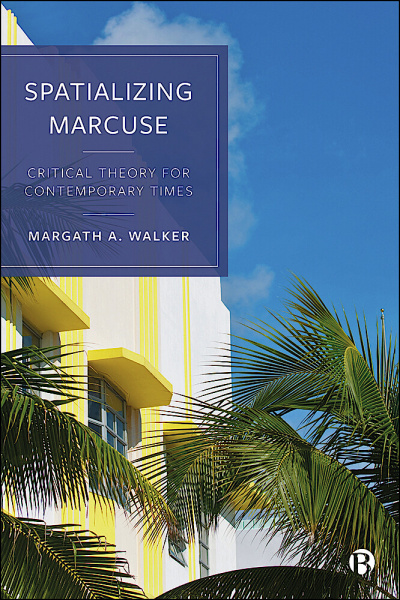
Margath Walker, Spatializing Marcuse: Critical Theory for Contemporary Times – Bristol University Press, July 2022

Margath Walker, Spatializing Marcuse: Critical Theory for Contemporary Times – Bristol University Press, July 2022

This  fresh  appraisal of philosopher Herbert Marcuse’s work foregrounds the geographical aspects of one of the leading social and political theorists of the 20th  century.    

Margath A. Walker  considers  how Marcusean philosophies  might  challenge the way we think about space and politics and create new sensibilities. Applying them to  contemporary  geopolitics, digital infrastructure and  issues  like resistance and immigration, the book shows how social change  has been  stifled, and how Marcuse’s philosophies could provide the tools to overturn the status quo. 

She demonstrates Marcuse’s relevance to individuals and society, and finds this important theorist of opposition can point the way to resisting oppressive forces within contemporary capitalism.

“Moving clearly between philosophy, social theory and a range of contemporary examples, this is a compelling political and geographical account of why Herbert Marcuse’s work remains of enduring importance today.” Stuart Elden, University of Warwick

Posted in Herbert Marcuse | Leave a comment

Georges Canguilhem Beyond Epistemology, online event, 16 May 2022 [postponed]

Georges Canguilhem Beyond Epistemology, online event, 16 May 2022 new date to be arranged

Georges Canguilhem was one of the most influential historians and philosophers of science of 20th-century France. Michel Foucault, Louis Althusser, Alain Badiou and other important thinkers of the stressed the importance of Canguilhem’s ideas and methods for the development of their own thinking as well as for shaping the intellectual field in which they positioned themselves. There is, however, much more to Canguilhem’s work than a series of delimited and specialised studies in epistemology and the history of science. The workshop will explore the wider philosophical implications of Canguilhem’s historical epistemology and reveal a more nuanced and complex picture of this author. Our aim will be to present Canguilhem as a ‘philosopher’, exploring a variety of topics, from his engagements with the history of philosophy to his ethical and political reflections, passing through his reflections on technology and society.

Giuseppe Bianco (Università Ca’ Foscari Venezia)

Cristina Chimisso (Open University)

Stuart Elden (University of Warwick)

Maria Muhle (Akademie der Bildenden Künste München)

Samuel Talcott (University of the Sciences in Philadelphia)

Charles T. Wolfe (Université Toulouse II Jean Jaurès)

Federico Testa (University of Bristol)

The event is free, but please register your attendance via Eventbrite here.

This is an interesting event, organised by Federico Testa, in which the speakers present someone else’s paper and raise some initial questions for discussion. My paper explores the links between Canguilhem, Georges Dumézil and Jean Hyppolite. The programme is below:


Posted in Uncategorized | 1 Comment

Michel Foucault, Madness, Language, Literature, edited by Henri-Paul Fruchaud, Daniele Lorenzini, and Judith Revel, translated by Robert Bononno, University of Chicago Press, February 2023

Michel Foucault, Madness, Language, Literature, edited by Henri-Paul Fruchaud, Daniele Lorenzini, and Judith Revel, translated by Robert Bononno, University of Chicago Press, February 2023

Newly published lectures by Foucault on madness, literature, and structuralism.
 
Perceiving an enigmatic relationship between madness, language, and literature, French philosopher Michel Foucault developed ideas during the 1960s that are less explicit in his later, more well-known writings. Collected here, these previously unpublished texts reveal a Foucault who undertakes an analysis of language and experience detached from their historical constraints. Three issues predominate: the experience of madness across societies; madness and language in Artaud, Roussel, and Baroque theater; and structuralist literary criticism. Not only do these texts pursue concepts unique to this period such as the “extra-linguistic,” but they also reveal a far more complex relationship between structuralism and Foucault than has typically been acknowledged.

I make a lot of use of the French version of these materials, Folie, langage, littérature (Vrin 2019) in the forthcoming The Archaeology of Foucault.

Posted in Michel Foucault, The Archaeology of Foucault, Uncategorized | Leave a comment

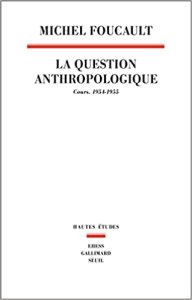
Michel Foucault, La Question anthropologique. Cours, 1954-1955 (2022)

Michel Foucault, La Question anthropologique. Cours, 1954-1955 (2022), edited by Arianna Sforzini. The third of the lengthy manuscripts from the 1950s to be published in the last couple of years, this one a course delivered in Lille and Paris.

Publisher site – Seuil; the link below goes to Amazon unfortunately.

I discuss this in The Early Foucault and it appears Elisabetta Basso does so in much more detail in the forthcoming Young Foucault. The text’s editor Arianna Sforzini discusses it in a piece in a forthcoming issue of Theory, Culture and Society. The link to her article is here (requires subscription).

Clare O'Farrell's avatarFoucault News

Michel Foucault, La Question anthropologique. Cours, 1954-1955, EHSS, Gallimard Seuil, 10 juin 2022

Qu’est-ce que l’homme ? Michel Foucault, au mitan des années 1950, consacre une partie de son enseignement, dispensé à l’université de Lille et à l’École normale supérieure, à comprendre comment cette interrogation a traversé et transformé la philosophie. Ces leçons sont rassemblées dans un manuscrit, dont nous proposons ici l’édition complète.

Foucault déroule son parcours en une dramaturgie impeccable. Premier acte : montrer pourquoi la philosophie classique (Descartes, Malebranche, Leibniz) demeurait sourde à cette question. Son idée infinie de « nature » empêchait que l’homme puisse nouer un rapport immédiat à sa propre vérité. Deuxième acte : exposer comment, après le renversement kantien, le point de gravitation de la philosophie moderne, de Feuerbach à Dilthey en passant par Hegel et Marx, devient cet homme vrai qui déploie un monde de significations et de pratiques révélant son…

View original post 129 more words

Posted in Michel Foucault, The Early Foucault | Leave a comment

14 tips for academics who are worried about Musk’s Twitter but don’t want to leave entirely – Mark Carrigan

14 tips for academics who are worried about Musk’s Twitter but don’t want to leave entirely – Mark Carrigan

Interesting thoughts from Mark, author of the excellent Social Media for Academics (Sage, 2nd edition 2019)

Posted in Uncategorized | Leave a comment

Stuart Hall’s Bibliography (1957-2015) by Catherine Hall, Bill Schwarz and Nick Beech

Stuart Hall’s Bibliography (1957-2015) by Catherine Hall, Bill Schwarz and Nick Beech

The project for a bibliography that would capture the breadth and depth of Stuart Hall’s work was initiated by Catherine Hall and Bill Schwarz in the wake of Stuart’s death in 2014. I was honoured to be invited by them to prepare the bibliography—initially with a view to including this with the volumes of Hall’s work, published by Duke University Press under their general editorship. I began work on the bibliography in April 2014 and it was largely completed by November of that year. By then it was clear that the scale of the bibliography, and its utility for anyone working with Hall’s ideas, mitigated against publication in its full form. In discussion, Catherine, Bill and I agreed that publication in the most open and accessible form possible was desirable. Larry Grossberg suggested that the bibliography should be released online, through the Stuart Hall Foundation. We hope that this can become a fully serviceable, online resource for all those who are interested in Hall’s prolific output.

The following bibliography substantially adds to any previously published. I have included all the publicly available material that I could find, using the British Library, London; the Centre for Contemporary Cultural Studies Archive, Cadbury Research Library, University of Birmingham; UNESCO Digital Archive, Paris; BBC Genome, online; the Raphael Samuel Archive, Bishopsgate Institute, London; and Stuart Hall’s private papers. As a result, the full scope of Hall’s writings can be seen for the rst time—including poetry, short fiction, interviews, journalism, literary criticism and much else—spanning 60 years of continuous production.

As well as expected political, cultural, and academic writing, I have tried to capture Hall’s teaching material, radio and television broadcasts, major public lectures and seminars, and contributions to public enquiries.

full details here; bibliography here

Posted in Uncategorized | Leave a comment

Andrea Mubi Brighenti and Mattias Kärrholm (eds.), Territories, Environments, Politics, Explorations in Territoriology – online book launch, 10 May 2022, 1-3pm CEST

Andrea Mubi Brighenti and Mattias Kärrholm (eds.), Territories, Environments, Politics, Explorations in Territoriology – online book launch, 10 May 2022, 1-3pm CEST

https://lu-se.zoom.us/j/68646989904

Details of the book follow:

Andrea Mubi Brighenti and Mattias Kärrholm (eds.), Territories, Environments, Politics, Explorations in Territoriology – Routledge, April 2022

This collection seeks to illustrate the state of the art in territoriological research, both empirical and theoretical. The volume gathers together a series of original, previously unpublished essays exploring the newly emerging territorial formations in culture, politics and society. 

While the globalisation debate of the 1990s largely pivoted around a ‘general deterritorialisation’ hypothesis, since the 2000s it has become apparent that, rather than effacing territories, global connections are added to them, and represent a further factor in the increase of territorial complexity. Key questions follow, such as: How can we further the knowledge around territorial complexities and the ways in which different processes of territorialisation co-exist and interact, integrating scientific advances from a plurality of disciplines? Where and what forms does territorial complexity assume, and how do complex territories operate in specific instances to be studied in-depth? Which technological, political and cultural facets of territories should be tackled to make sense of the life of territories? How and by what different or combined methods can we describe territories, and do justice to their articulations and meanings? How can the territoriological vocabulary relate to contemporary social theory advancements such as ANT, the ontological turn, the mobilities paradigm, sensory urbanism, and atmospheres research? How can territorial phenomena be studied across disciplinary boundaries? Territories, Environments, Politics casts a fresh perspective onto a number of key contemporary socio-spatial phenomena. Refraining from the attempt to ossify territoriology into some disciplinary straightjacket, the collection aims to illustrate the scope of current territoriological research, its domain, its promises, its theoretical advancements, and its methodological reflection in the making. 

Scholars interested in social research will find in this collection a rich and imaginative theoretical-methodological toolkit. Students in human geography, anthropology and sociology, socio-legal studies, architecture and urban planning will find Territories, Environments, Politics of interest.

Posted in Uncategorized | 2 Comments

Brandon Terry, Cornel West, and Bernard E. Harcourt discuss Malcolm X (video)

Brandon Terry, Cornel West, and Bernard E. Harcourt discuss Malcolm X – essays and resources at this page

Part of Columbia’s 13/13 series on Revolution

Posted in Bernard E. Harcourt, Cornel West | Leave a comment