
Michel Foucault’s journalism and interviews about the Iranian revolution are well known. The Italian newspaper Corriere della Sera commissioned him to write reports on what was happening during the revolution, based on two visits to the country in September and November 1978. He also met exiled Iranians outside the country. One of these pieces was published in French during his lifetime – the reports were generally published only in Italian. Foucault also gave interviews at the time, some of which were published in French, and one in Farsi. Other material appeared posthumously. He also responded to some of the criticisms of his views.
Foucault thought the early stages of the revolution showed a new political collective emerging, which he described as political spirituality. He was interested in a non-Marxist form of revolution and its opposition to state power and the Western-friendly regime of the Shah. This was during the détente period of the Cold War, before the Soviet invasion of Afghanistan, and Foucault was interested in a challenge to either Western or Soviet models. He was accused of being politically naïve when the revolution took its own repressive form, especially in terms of the treatment of women. The Iran commentaries were written during the time Foucault was lecturing on governmentality and neoliberalism, and while he was writing parts of his History of Sexuality. He was interested in a different form of government which he thought was emerging in the revolution. The relation between the commentary on a political moment and his more historical concerns is much debated.
Foucault’s writings on Iran have been collected in various places. In French, the writings published during his lifetime were included in Dits et écrits in 1994, with some translated back into French. A few texts are included in English collections of his work. Some other texts were published posthumously. In English, Janet Afary and Kevin Anderson, Foucault and the Iranian Revolution (University of Chicago Press, 2005) includes many of Foucault’s texts in an appendix.
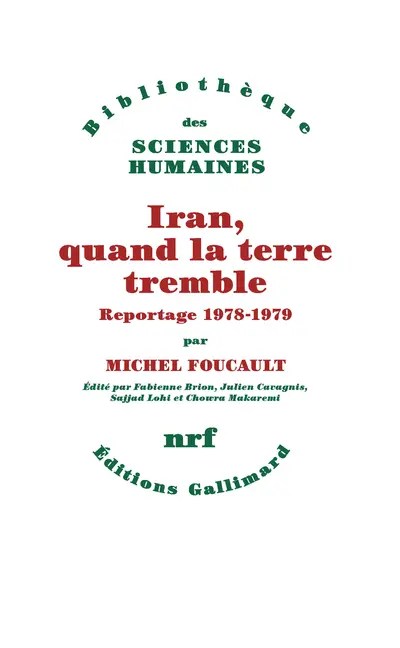
Iran, quand la terre tremble: reportage 1978-1979, edited by Fabienne Brion, Julien Cavagnis, Sajjad Lohi and Chowra Makarem brings together Foucault’s writings from this period. Some are familiar texts in improved editions, others are the lesser-known posthumous writings, and there are some texts from Foucault’s archive. This book therefore provides all the necessary source material for a more considered view of Foucault’s relation to Iran. Its editorial introduction, other material and notes give some important contextual indications and provide a very useful basis for further analysis. Almost all the texts in the first part of the book will be familiar, though they are reedited on the basis of the manuscripts, which include some different passages, and the editors have reverted to Foucault’s own titles, rather than those under which they were published. Most of part II has been previously published in French, and much of that is in English translation. The shorter part III has not been previously published. The editorial material is unique to this volume. There is therefore quite a bit of new material, and what has been previously published is reedited and contextualised. The third part gives a sense of how Foucault worked, and provides more on his understanding of the geopolitics of what was happening in Iran, in the context of the wider Cold War. The editorial matter provides a lot of very valuable context, and positions the texts much more usefully and less critically than Afary and Anderson. The book therefore replaces the fragmentary publication of this material as well as providing new texts. This is an edition which will surely be definitive. An English translation is forthcoming.
In the meantime, this listing of what is included, its previous publication and translation might be useful. Because the editors have reverted to Foucault’s titles, rather than the more familiar ones under which they appeared, it isn’t immediately obvious where texts have appeared before. I’ve listed the Dits et écrits text number [DE#]; and the Afary & Anderson, Foucault and the Iranian Revolution [A&A], pages. Other references are to title/journal, but there are other reprints of some of these texts.
Editorial Introduction, notes, repères [previously unpublished]
I. Le Reportage
Introduction [previously unpublished]
- “L’armée, quand la terre tremble – 28 septembre 1978”, DE#241; “The Army – When the Earth Quakes”, A&A 189-94
- “Le poids mort de la modernisation – 1 octobre 1978”, = “Le chah a cent ans de retard”, DE#243; “The Shah is a Hundred Years Behind the Times”, A&A 194-98
- “Dans l’attente de l’Imam – 8 octobre 1978”, = “Téhéran: la foi contre le chah”, DE#244; “Tehran: Faith against the Shah”, A&A 198-203
- “Le gouvernement islamique – 22 octobre 1978” = variant of “À quoi rêvent les Iraniens”, DE#245; “What are the Iranians Dreaming About?” A&A 203-9
- “Grève à la politique – 5 novembre 1978”, one version as “Une révolte à mains nues”, DE#248; “A Revolt with Bare Hands”, A&A 210-13; text in Iran, quand la terre tremble is a critical edition of variant versions
- “L’ordre a ses dangers/Le week-end de Téhéran – 7 novembre 1978” =”Défi à l’opposition”, DE#249; “The Challenge to the Opposition”, A&A 213-15
- “Les reportages d’idées – 12 novembre 1978”, DE#250; untranslated
- “La révolte iranienne se propage sur les rubans des cassettes – 19 novembre 1978”; DE#252; “The Revolt in Iran Spreads on Cassette Tapes”, A&A 216-20
- “La folie de l’Iran – 26 novembre 1978”; = “Le chef mythique de la révolte de l’Iran”, DE#253; “The Mythical Leader of the Iranian Revolt”, A&A 220-23
- “Une poudrière appelée Islam – 13 février 1979”; DE#261; “A Powder Keg Called Islam”, A&A 239-41
II. Le Débat
Introduction [previously unpublished]
- “Entretien entre Michel Foucault et Baqer Parham”; not in DE, previously unpublished in French; “Dialogue with Baqir Parham”, A&A 183-89
- “«Une Iranienne écrit»: letter d’Atoussa H.”; not in DE; “An Iranian Woman Writes by ‘Atoussa H.’”, A&A 209-10
- “Réponse de Michel Foucault à une lectrice iranienne” DE#251; “Foucault’s Response to Atoussa H.” A&A 210
- “«L’ésprit d’un monde sans esprit»: entretien entre Michel Foucault, Claire Brière et Pierre Blanchet”, DE#259; “Iran: The Spirit of a World without Spirit”, Politics, Philosophy, Culture, 211-24; A&A 250-60
- “Entretien entre Michel Foucault et Jean-Paul Enthoven”; not in DE; “Political Spirituality as the Will for Alterity: An Interview with the Nouvel Observateur”, trans. Sabina Vaccario Bremner, Critical Inquiry 47 (1), 2020, 121-34.
- “‘A quoi rêvent les philosophes? Michel Foucault s’est-il trompé sur la revolution iranienne?’”, Claudie and Jacques Broyelle; not in DE; “What re the Philosophers Dreaming About? Was Michel Foucault Mistaeken about the Iranian Revolution?” A&A 247-49
- “Michel Foucault et l’Iran”, DE#262; “Foucault’s Response to Claudie and Jacques Broyele”, A&A 249-50
- “Iran: la revolution au nom de Dieu de Claire Brière et Pierre Blanchet”, Paul-Jean Franceschi; not in DE
- “Ébauche de réponse de Foucault à Franceschi”; unpublished
- “Letter ouverte à Mehdi Bazargan”, DE#265; “Open Letter to Prime Minister Mehdi Bazargan”, A&A 260-63
- “Iran: la vengeance du Prophète”, Bernard Ullmann; not in DE
- “Échange épistolaire entre Foucault et L’Express”; unpublished
- “‘Inutile de se soulever?’”, DE#269; “Is it Useless to Revolt?”, Religion and Culture, ed. Jeremy Carrette, 131-34; A&A 263-67
- “Entretien entre Michel Foucault et Farès Sassine”; not in DE; published in Rodéo, 2013; “There Can’t Be Societies without Uprisings”, trans. Alex J. Feldman, Foucault Studies 25, 2018, 324-50; also included in Laura Cremonesi, Orazio Irrera, Daniele Lorenzini and Martina Tazzioli eds., Foucault and the Making of Subjects, London: Rowman & Littlefield, 2016, 25-51
III. L’Atelier
Introduction [previously unpublished]
Notes and drafts by Foucault [all previously unpublished]
- Carnet d’entretiens
- Fragments
- « Les partis traditionnels ont été démantelés… » (Texte 1)
- « Beaucoup d’hommes politiques… » (Texte 2)
- Lettre à l’Association pour la défense et la promotion des droits de l’homme en Iran
- Ébauche de lettre aux journalistes
Afary and Anderson also include a few texts by others which are not in Iran, quand la terre tremble. The editors of the latter volume say they only included texts by others if Foucault was responding directly to them. This seems justified, as the literature responding to Foucault on Iran is extensive. A comprehensive companion volume would be an interesting undertaking, but it’s beyond the remit of Iran, quand la terre tremble.
Additions or corrections welcome.
Although more of a research resource than a history, this is the 97th post of a weekly series, posted every Sunday throughout 2025, and so far through 2026. The posts are short essays with indications of further reading and sources. They are not as formal and developed as something I’d try to publish more conventionally, but are hopefully worthwhile as short sketches of histories and ideas. They are usually tangential to my main writing focus, a home for spare parts, asides, dead-ends and possible futures. I hope there is some interest in them. They are provisional and suggestions are welcome. A few, usually shorter, pieces in a similar style have been posted mid-week.
I discuss what I am doing in this series in “Writing the ‘Sunday histories’ – an experiment in sharing short pieces on a blog”, my contribution to the Northern Ireland Legal Quarterly “Reflections on Writing” Series – all pieces are open access.
The full chronological list of ‘Sunday histories’ is here, with a thematic ordering here.
Discover more from Progressive Geographies
Subscribe to get the latest posts sent to your email.


