Grégoire Chamayou, The Ungovernable Society: A Genealogy of Authoritarian Liberalism – Polity, March 2021

Grégoire Chamayou, The Ungovernable Society: A Genealogy of Authoritarian Liberalism – Polity, translated by Andrew Brown, March 2021

Rebellion was in the air. Workers were on strike, students were demonstrating on campuses, discipline was breaking down. No relation of domination was left untouched – the relation between the sexes, the racial order, the hierarchies of class, relationships in families, workplaces and colleges. The upheavals of the late 1960s and early 1970s quickly spread through all sectors of social and economic life, threatening to make society ungovernable. This crisis was also the birthplace of the authoritarian liberalism which continues to cast its shadow across the world in which we now live.

To ward off the threat, new arts of government were devised by elites in business-related circles, which included a war against the trade unions, the primacy of shareholder value and a dethroning of politics. The neoliberalism that thus began its triumphal march was not, however, determined by a simple ‘state phobia’ and a desire to free up the economy from government interference. On the contrary, the strategy for overcoming the crisis of governability consisted in an authoritarian liberalism in which the liberalization of society went hand-in-hand with new forms of power imposed from above: a ‘strong state’ for a ‘free economy’ became the new magic formula of our capitalist societies.

The new arts of government devised by ruling elites are still with us today and we can understand their nature and lasting influence only by re-examining the history of the conflicts that brought them into being.

Posted in Grégoire Chamayou | 1 Comment

Colm McAuliffe on the 1973 ICA festival that sparked British interest in Francophone structuralist and post-structuralist thought – Verso blog

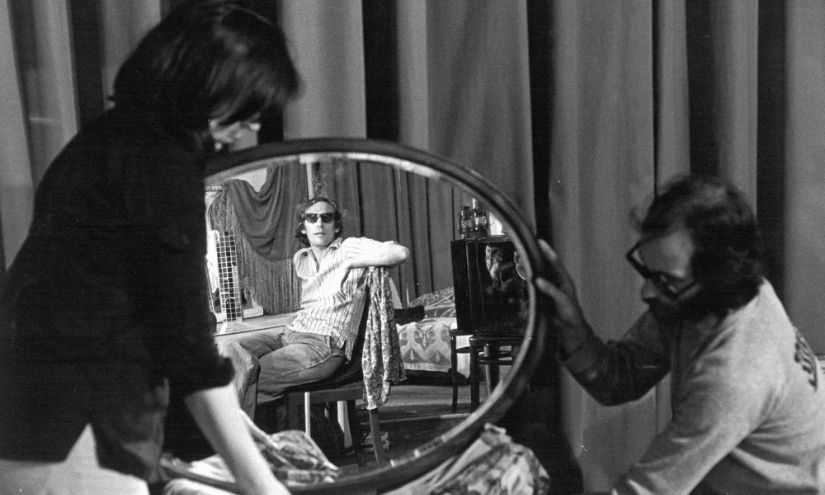
The French Programme: How Theory Came to London – Colm McAuliffe on the 1973 ICA festival that sparked British interest in Francophone structuralist and post-structuralist thought.

March 1973: two months after Britain joins the European Economic Community, the French historian of ideas Michel Foucault is scheduled to give a lecture in London. Foucault is one of the star attractions of the French Programme, a month-long series of lectures and screenings at the Institute of Contemporary Arts. Jacques Derrida, Gilles Deleuze, Felix Guattari, and Tzvetan Todorov are among the other avatars of Francophone structuralist and post-structuralist thought appearing throughout the month, described in the French newspaper Combat as “the most important French cultural event ever organised in Britain”, and one which has been almost entirely funded by the British Government, eager to foster positive cultural relations between Britain and its sister nations in the Common Market. [continues here]

Posted in Uncategorized | 1 Comment

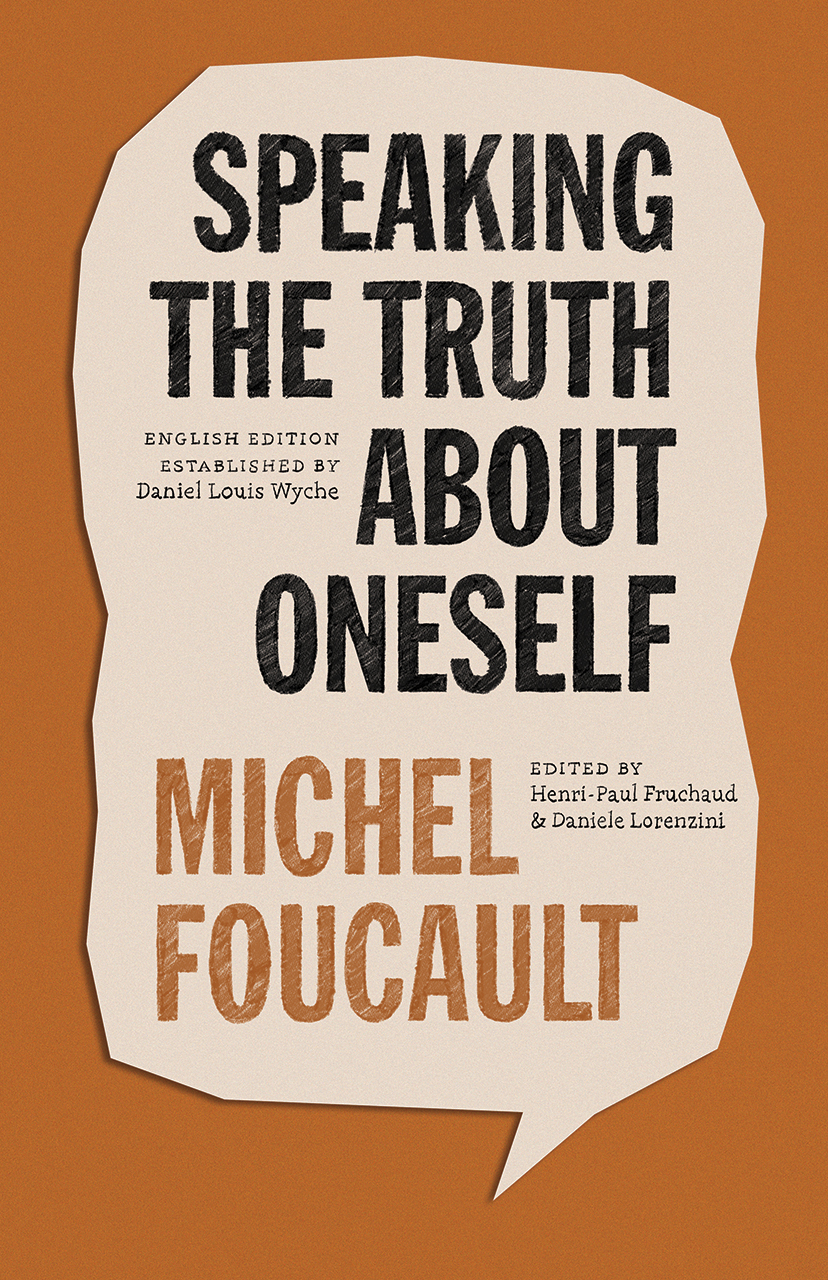
Michel Foucault, Speaking the Truth about Oneself: Lectures at Victoria University, Toronto, 1982 – University of Chicago Press, October 2021

Michel Foucault, Speaking the Truth about Oneself: Lectures at Victoria University, Toronto, 1982 – University of Chicago Press, October 2021, edited by Henri-Paul Fruchaud and Daniele Lorenzini, English edition established by Daniel Louis Wyche

A collection of Foucault’s lectures that trace the historical formation and contemporary significance of the hermeneutics of the self.
 
Just before the summer of 1982, French philosopher Michel Foucault gave a series of lectures at Victoria University in Toronto. In these lectures, which were part of his project of writing a genealogy of the modern subject, he is concerned with the care and cultivation of the self, a theme that becomes central to the second, third, and fourth volumes of his History of Sexuality. Throughout his career, Foucault had always been interested in the question of how constellations of knowledge and power produce and shape subjects, and in the last phase of his life, he became especially interested not only in how subjects are formed by these forces, but in how they ethically constitute themselves.

In this lecture series and accompanying seminar, Foucault focuses on antiquity, starting with classical Greece, the early Roman empire, and concluding with Christian monasticism in the fourth and fifth centuries AD. Foucault traces the development of a new kind of verbal practice—“speaking the truth about oneself”—in which the subject increasingly comes to be defined by its inner thoughts and desires. He deemed this new form of “hermeneutical” subjectivity important not just for historical reasons, but also due to its enduring significance in modern society. Is another form of the self possible today?

Stuart Elden, University of Warwick “This is a crucial text in the development of Foucault’s ideas about technologies of the self and the question of parrēsia, especially for his contrast of Greco-Roman antiquity and early Christianity. Particularly notable is that as well as a partial record of his Toronto lectures, this volume also includes a rare record of how he conducted his seminars. Skillfully edited from surviving materials, this is a valuable addition to our understanding of Foucault’s final projects.“

David Halperin, University of Michigan “These newly recovered lectures and seminars constitute an important chapter in Foucault’s work on what he called ‘the history of subjectivity in the West.’ They show Foucault poring over the details of texts from classical antiquity so as to describe how the philosophical schools that flourished at the height of the Roman Empire produced distinctive practices of self-examination and self-cultivation. He thereby expands our sense of the possible relations among truth, speech, desire, and the self. The seminars in particular cast new light on Foucault’s late work on sexuality, parrhesia, and early Christianity.”

Updated May 2021 with revised publication date and the two endorsements

Posted in Michel Foucault | Leave a comment

Philosophical Inquiries, Vol 9 No 1, 2021 – special section on Ian Hacking

Philosophical Inquiries, Vol 9 No 1, 2021 – special section on Ian Hacking

Introduction open access, other papers require subscription

Introduction. Ian Hacking and the Historical Reason of the Sciences Matteo Vagelli, Marica Setaro115-120

Naturalism, pragmatism and historical epistemology David Hyder121-144

Ian Hacking’s metahistory of science Manolis Simos, Theodore Arabatzis145-166

Were experiments ever neglected? Ian Hacking and the history of the philosophy of experiments Massimiliano Simons, Matteo Vagelli167-188

Understanding stability in cognitive neuroscience through Hacking’s lens Jacqueline Sullivan189-208

Posted in Ian Hacking | Leave a comment

Does Attention to Language Matter Anymore? Philology, Translation, Criticism – special issue of boundary 2, 2021

Does Attention to Language Matter Anymore? Philology, Translation, Criticism – special issue of boundary 2, 2021 (requires subscription)

Paul A. Bové / Editor’s Note / 1

Jonathan Arac / Ways of Working with Language / 3

David Golumbia / The Deconstruction of Philology / 17

Howard Eiland / Language Matters / 35

Susan H. Gillespie / The Possibility of Translation / 49

Jeffrey Sacks / The Philological Thesis: Language without Ends / 65

Tanıl Bora / Excerpts from Zamanın Kelimeleri: Yeni Türkiye’nin Siyasî Dili (Words of Our Times: The Political Language of New Turkey) / 109

Joe Cleary / The English Department as Imperial Commonwealth, or The Global Past and Global Future of English Studies / 139

Marc Nichanian / Philology from the Point of View of Its Victims / 177 Andrew Warren / Between Form and Formalization: Angus Fletcher’s

The Topological Imagination / 207
Howard Eiland / The Fate of Philology / 237

Intervention

Lindsay Waters / To Become What One Is: Why I Seek the Revival of Criticism / 251

Contributors / 265

Posted in Uncategorized | Leave a comment

Sasha Engelmann, Sensing Art in the Atmosphere: Elemental Lures and Aerosolar Practices – Routledge, September 2020

Sasha Engelmann, Sensing Art in the Atmosphere: Elemental Lures and Aerosolar Practices – Routledge, September 2020

This book engages artistic interventions in the aerial elements to investigate the aesthetics and politics of atmosphere.

Sensing Art in the Atmosphere: Elemental Lures and Aerosolar Practices traces the potential of artistic, community-driven experiments to amplify our sensing of atmosphere, marrying attentions to atmospheric affect with visceral awareness of the materials, institutions and processes hovering in the air. Drawing on six years of practice-led research with artistic and activist initiatives Museo Aero Solar and Aerocene, initiated by artist Tomás Saraceno, each chapter develops creative relations to atmosphere from the studio to stratospheric currents. Through narrative-led writing, the voices of artists and collaborators are situated and central. In dialogue with these aerographic stories and sites, the book develops a notion of elemental lures: the sensual and imaginative propositions of aerial, atmospheric and meteorological phenomena. The promise of elemental lures, Engelmann suggests, is to reconcile our sensing of atmosphere with the myriad social, cultural and political forces suspended in it. Through tales of floating journeys, shared envelopes of breath and surreal levitations, the book foregrounds the role of art in crafting alternative modes of perceiving, moving and imagining (in) the air.

The book ends with a call for elemental experiments in the geohumanities. It makes an important and original contribution to elemental geographies, the geohumanities and interdisciplinary scholarship on air and atmosphere.

Posted in Uncategorized | Leave a comment

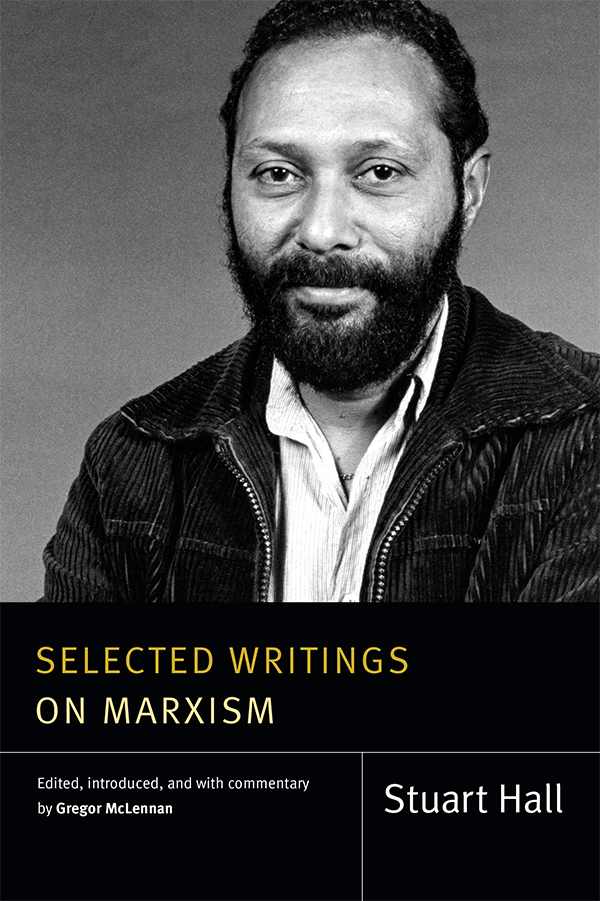
Stuart Hall, Selected Writings on Marxism, Duke University Press, 2021 (open access introduction by Gregor McLennan)

Stuart Hall, Selected Writings on Marxism, Duke University Press, 2021 – the introduction by Gregor McLennan is open access here

Throughout his career Stuart Hall engaged with Marxism in varying ways, actively rethinking it to address the political and cultural exigencies of the moment. This collection of Hall’s key writings on Marxism surveys the questions central to his interpretations of and investments in Marxist theory and practice. It includes Hall’s readings of canonical texts by Marx and Engels, Gramsci, and Althusser; his exchanges with other prominent thinkers about Marxism; his use of Marxist frameworks to theorize specific cultural phenomena and discourses; and some of his later work in which he distanced himself from his earlier attachments to Marxism. In addition, editor Gregor McLennan’s introduction and commentary offer in-depth context and fresh interpretations of Hall’s thought. Selected Writings on Marxism demonstrates that grasping Hall’s complex relationship to Marxism is central to understanding the corpus of his work.

This is part of Hall’s Selected Works. As previously posted, Selected Writings on Race and Difference, edited by Paul Gilroy and Ruth Wilson Gilmore is also published at the same time. The open access introduction by Paul Gilroy is here.

[updated to correct the spelling of the editor’s name, with apologies]

Posted in Stuart Hall | Leave a comment

BBC Radio 3 Free Thinking ‘Foucault: The History of Sexuality, Volume 4’ – Shahidha Bari with Lisa Downing, Stuart Elden and Stephen Shapiro, 25 February 2021

This discussion was broadcast last night, and is available to listen here – and download here.

stuartelden's avatarProgressive Geographies

BBC Radio 3 Free Thinking – ‘Foucault: The History of Sexuality, Volume 4‘ – Shahidha Bari with Lisa Downing, Stuart Elden, and Stephen Shapiro, 25 February 2021, 10pm (and new available online)

On the day the final volume of The History of Sexuality is published in English, over 36 years after Foucault’s death in 1984, Shahidha Bari and her panel assess its influence.

Shahidha Bari is joined by Lisa Downing, Stuart Elden, and Stephen Shapiro to look volume 4 of Foucault’s History of Sexuality at, translated into English for the first time, which examines beliefs and practices among the early Christians in Medieval Europe. Although he had specified in his will that his works shouldn’t be published after he died (in 1984), the rights holders of Foucault decided that these ideas could now be made public. So what do they tell us and how influential has his…

View original post 171 more words

Posted in Uncategorized | 3 Comments

Michael J. Shapiro, Writing Politics: Studies in Compositional Method – Routledge, June 2021

Michael J. Shapiro, Writing Politics: Studies in Compositional Method – Routledge, June 2021

Writing Politics is a methods book designed to instruct on politically focused literary inquiry.

Exploring the political sensibilities that arise from the way literary fiction re-textualizes historical periods and events, the book features a series of violence-themed inquiries that emphasize forms of writing as the vehicles for politically attuned historiography. Each investigation treats the way the literary genre, historiographic metafiction enables political inquiry. It’s a form of writing that inter-articulates history and fiction to rework a textual past and unsettle dominant understandings of events and situations. Central to the diverse chapter are fictional treatments of authoritarian, fascist, or zealous mentalities. Featured, for example, are Radovan Karadzic (the architect of the Bosnian genocide), Reinhard Heydrich (the architect of the Holocaust’s “final solution”), and the Trotsky assassin Ramon Mercader.

Michael J. Shapiro has produced another original and sophisticated bookshelf staple; the only contemporary investigation in Political Studies that instructs on method in this way.

“Michael J. Shapiro’s novel method of bringing fiction to bear upon the question of the political is sure to explode the limits of traditional social-scientific discourses, modes of aesthetic inquiry, and the uncertain relation between them. With impressive interdisciplinary scope and the author’s characteristic exactitude, Writing Politics: Literary Method and Political Theory incisively renders literature’s potential for resistance or radical subversion in the face of the worst instances of mass violence. This is a welcome and refreshing addition to the long-standing and ever-renewing problem of the politics of form.”

Nathan Gorelick, Associate Professor, Utah Valley University

Writing Politics builds on Mike Shapiro’s formidable body of transdisciplinary scholarship to carefully de-reify and refigure the notion of violence for political thinking. Examining aesthetic explorations of historically situated forms of violent mentalities, this essential book broadens the methodological capacity of political analysis and sharpens our ability to critique violence in our contemporary circumstances.”

Matt Davies, Newcastle University and Pontifícia Universidade Católica do Rio de Janeiro

“Mike Shapiro exemplifies the master’s sensitivity needed to approach novels as sites for political experimentation, to interrogate political being, and to explore opportunities for the re-textualisation of history. Writing Politics sensitises us through the Barthes-inspired approach of writerly-reading, where as readers, we become the producers of text (thought). True to his erudite and pedagogical style, Shapiro prioritises the imagination of the reader as the vehicle for thought. Highly recommended as fundamental methodology for Political Scientists and students of power.”

Luis Lobo-Guerrero, Professor of History and Theory of International Relations, University of Groningen

“Writing Politics, a timely meditation on authoritarian and fascist rhetoric conducted via an examination of the under-recognized genre of historiographic metafiction, is at the same time what has traditionally been called a defense of poetry—an argument that the devices of literary fiction often get to the heart of political matters in a way that social and psychological theory cannot. It is provocative, deeply thoughtful, and brilliantly executed.”

John Rieder, University of Hawaii

“In Writing Politics Shapiro discusses the power of writing focusing on “mentalities” and the production of intimate violence in the examples spanning from the Balkan war, the Holocaust, to assassinations. Combining literary works – concerned with how events are experienced – and political theory, Shapiro showcases the power of his method. Here philosophical ideas turn from dry concepts to rich reservoirs of emotions, complexities and layers of character enriching social and political analysis. Writing Politics is an outstanding book written in Shapiro’s unique style.”

Andreja Zevnik, Senior Lecturer in International Politics, University of Manchester

Posted in Uncategorized | Leave a comment

Michael J. Shapiro, The Phenomenology of Religious Belief: Media, Philosophy, and the Arts – Bloomsbury, June 2021

Michael J. Shapiro, The Phenomenology of Religious Belief: Media, Philosophy, and the Arts – Bloomsbury, June 2021

In The Phenomenology of Religious Belief, the renowned philosopher Michael J. Shapiro investigates how art – and in particular literature and film – can impact upon both traditional interpretations and critical studies of religious beliefs and experiences. 

In doing so, he examines the work of prolific and award-winning writers such as Toni Morrison, Philip K. Dick and Robert Coover. By placing their work in conjunction with critical analyses of media by the likes of Ingmar Bergman and Pier Paolo Pasolini and combining it with the work of groundbreaking thinkers such as George Canguilhem, Giorgio Agamben and Slavoj Žižek, Shapiro takes a truly interdisciplinary approach to the question of how life should be lived. His assessment of phenomenological subjectivity also leads him to question the nature of political theology and extend the criticism of Pauline theology.

““Who is eligible to enter the inexhaustible conversation about how to experience life”? asks Michael Shapiro in this brilliant and wide-ranging book. Like a 21st century William James, Shapiro restages traditional questions of theology in connection with theatricality, cinema, and phenomenology. Focused on “media-involved disruptive events, either actual or imagined,” Shapiro moves from scenes of personal despair to worldly challenges like climate change. Following an itinerary both quirky and necessary, the Phenomenology of Religious Belief is a must-read for those working in religious studies, political theory, cinema studies, and phenomenology.” –  Bonnie Honig, Nancy Duke Lewis Professor, Modern Culture and Media (MCM) and Political Science, Brown University, USA

“In this book, apostle Paul, Ingmar Bergman, Philip Dick, and William James hold dialogues about theophanies and the will to believe. Participating in their unexpected encounters brings striking insights in how genres and media impact narratives of religious experience and situate religious communities. A seminal approach to phenomenology of belief.” –  Martin Nitsche, Institute of Philosophy, Czech Academy of Sciences, Prague

Posted in Uncategorized | Leave a comment