The worldwide social and ecological unravelling of the 21st century presents an unprecedented challenge for thinking and practising liveable economies. As life support systems are annihilated in view of the sustainable accumulation of capital, social and economic alternatives are rapidly emerging to shelter possibilities for life amidst the ruins. Postcapitalism has gained increasing attention as an invitation to amplify existing alternatives to systemic scale. The transformations required are the focus of social movements, political projects and academic research that demand the theorisation and organisation of alternatives to capitalist realism today. What has often received less attention is how such emancipatory alternatives are burdened with problematic legacies living on within, in the epistemic heritage enabling and organising societal transformation. The ‘post-’ prefix, and the break from capitalism that it announces, has largely been treated as a given. This study resists such temptations of the affirmative in order to ask how restrictive and counterproductive burdens are carried along in emancipatory thought and practice, and how their continuous negotiation might have to redefine postcapitalism itself. Taking the ‘post-’ seriously demands critical and theoretical skills capable of examining the complexity of our inherited troubles.
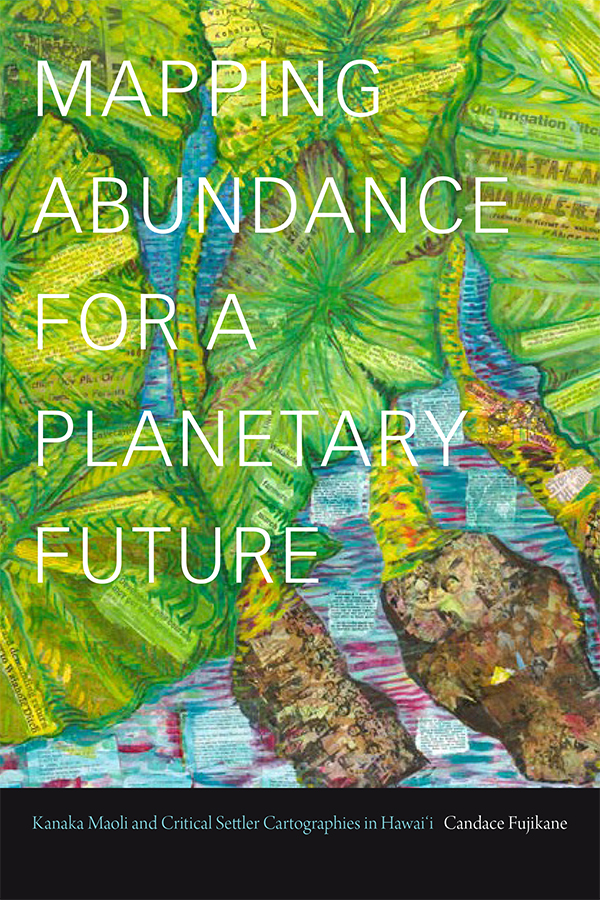
In Mapping Abundance for a Planetary Future, Candace Fujikane contends that the practice of mapping abundance is a radical act in the face of settler capital’s fear of an abundance that feeds. Cartographies of capital enable the seizure of abundant lands by enclosing “wastelands” claimed to be underdeveloped. By contrast, Kanaka Maoli (Native Hawaiian) cartographies map the continuities of abundant worlds. Vital to restoration movements is the art of kilo, intergenerational observation of elemental forms encoded in storied histories, chants, and songs. As a participant in these movements, Fujikane maps the ecological lessons of these elemental forms: reptilian deities who protect the waterways, sharks who swim into the mountains, the navigator Maui who fishes up the islands, the deities of snow and mists on Mauna Kea. The laws of these elements are now being violated by toxic waste dumping, leaking military jet fuel tanks, and astronomical-industrial complexes. As Kanaka Maoli and their allies stand as land and water protectors, Fujikane calls for a profound attunement to the elemental forms in order to transform climate events into renewed possibilities for planetary abundance.
“Mapping Abundance for a Planetary Future slays settler colonial cartographies that diminish life. The book breathes with the voices of Hawaiian communities, lands, movements, elements, and Candace Fujikane herself, at her best. Saturated in the abundance of Kanaka Maoli mappings and mo‘olelo, this book is a spear and a spade, medicine and masterpiece, a diagnosis and a portal, a lei and a ho‘okupu.” — Noelani Goodyear-Ka‘opua, author of The Seeds We Planted: Portraits of a Native Hawaiian Charter School
“With intellectual verve, analytical agility, and ethnographic gracefulness, Candace Fujikane unpacks the perversity of settler capitalism, which produces scarcity in order to claim its toxic surplus, as she amplifies Kanaka Maoli support of an earth cartography of abundant healing and protection. A groundbreaking work; a must-read.” — Elizabeth A. Povinelli, author of The Inheritance
My 2019 Dialogues in Human Geography lecture, ‘Terrain, Politics, History‘ has been published online first (open access). The responses are beginning to appear too.
Why do conflict-generated diasporas mobilize in contentious and non-contentious ways or use mixed strategies?
This book develops a theory of socio-spatial positionality and its implications for the individual agency of diaspora entrepreneurs. A novel typology features four types of diaspora entrepreneurs—Broker, Local, Distant, and Reserved—depending on the relative strength of their socio-spatial linkages to host-land, original homeland, and other global locations. A two-level typological theory captures nine causal pathways unravelling how diaspora entrepreneurs operate in transnational social fields and interact with host-land foreign policies, homeland governments, parties, non-state actors, critical events, and limited global influences. Non-contention often occurs when diaspora entrepreneurs act autonomously and when host-state foreign policies converge with their goals. Dual-pronged contention is common under the influence of homeland governments, non-state actors, and political parties. The most contention occurs in response to violent events in the original homeland or adjacent to it fragile states. The book is informed by 300 interviews among the Albanian, Armenian, and Palestinian diasporas connected to de facto states, Kosovo, Nagorno-Karabakh, and Palestine respectively. Interviews were conducted in the UK, Germany, France, Netherlands, Sweden, Switzerland, Brussels in Belgium, as well as Kosovo and Armenia in the European neighbourhood.
updated 28 May 2021 with new description and table of contents
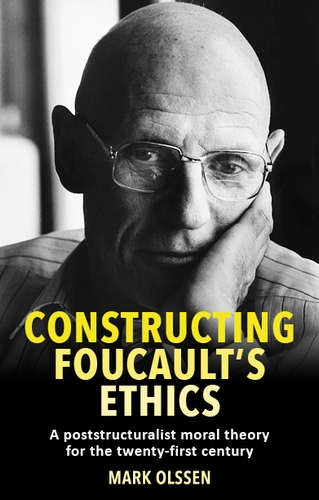
In popularizing the term ‘speaking truth to power’, now widely used throughout the world, Michel Foucault established the basis upon which a new ethics can be constructed. This is the thesis that Mark Olssen advances in Constructing Foucault’s ethics. Olssen not only ‘speaks truth’ to existing moral and ethical theories that have dominated western philosophy since Plato, but also shows how, by using Foucault’s insights, an alternative ethical and moral theory can be established that both avoids the pitfalls of postmodern relativism and simultaneously grounds ethical, moral, and political discourse for the present age.
Taking the late ‘ethical turn’ in the philosopher’s thought as its starting point, this ambitious study seeks to construct an ethics beyond anything Foucault ever attempted while remaining consistent with his core postulates. In doing so it advances the concept of ‘life continuance’, which expresses a normative orientation to the future in terms of the quest for survival and well-being, giving rise to irreducible normative values as part of the discursive order of events. This approach is explored in contrast with a range of other, established systems, from the Kantian to the Marxist to contract ethics and utilitarianism.
Introduction
1 Foucault and normativity
2 Life and error: Foucault, Canguilhem, Jacob
3 Nietzsche’s life philosophy: naturalism, will to power, normativity
Mark Olssen is one of the leading social scientists writing in the world today. Inspired by the writings of Michel Foucault, Olssen’s writings traverse philosophy, politics, education, and epistemology. This book comprises a selection of his papers published in academic journals and books over twenty-five years. Taken as a whole, the papers represent a redirection of the core axioms and directions of western ontology and philosophy in relation to how history, the subject, and education are theorised within the western philosophical tradition. Olssen’s writings not only contain a powerful critique and revision of western liberalism from a poststructuralist perspective, they both explicate and extend Michel Foucault’s challenge to the core axioms and assumptions underpinning western thought. As Stephen Ball suggests in his Foreword to this volume, “Olssen uses Foucault to explore issues… Olssen’s Foucault is not a lonely nihilist but a troubled provocateur who encourages in us toward the political project of self-formation – our relation to ourselves and always, to others.”
I missed this when it was published last year, but this looks a major undertaking. There is a review in the New York Review by Adam Kirsch here (opening part readable, rest requires subscription).
Ernst Cassirer occupies a unique space in twentieth-century philosophy. A great liberal humanist, his multi-faceted work spans the history of philosophy, the philosophy of science, intellectual history, aesthetics, epistemology, the study of language and myth, and more. Cassirer’s thought also anticipates the renewed interest in the origins of analytic and continental philosophy in the Twentieth Century and the divergent paths taken by the ‘logicist’ and existential traditions, epitomised by his now legendary debate in 1929 with the philosopher Martin Heidegger, over the question “What is the Human Being?”
The Philosophy of Symbolic Forms is Cassirer’s most important work. It was first published in German in 1923, the third and final volume appearing in 1929. In it Cassirer presents a radical new philosophical worldview – at once rich, creative and controversial – of human beings as fundamentally “symbolic animals”, placing signs and systems of expression between themselves and the world.
This major new translation of all three volumes, the first for over fifty years, brings Cassirer’s magnum opus to a new generation of students and scholars. Taken together, the three volumes of The Philosophy of Symbolic Forms are a vital treatise on human beings as symbolic animals and a monumental expression of neo-Kantian thought.
Correcting important errors in previous English editions, this translation reflects the contributions of significant advances in Cassirer scholarship over the last twenty to thirty years. Each volume includes a new introduction and translator’s notes by Steve G. Lofts, a foreword by Peter E. Gordon, a glossary of key terms, and a thorough index.