
University Of London Institute In Paris videos – Étienne Balibar, Deborah Cowen, Achille Mbembe

Shannon Mattern, A City Is Not a Computer: Other Urban Intelligences – Princeton University Press, August 2021
Computational models of urbanism—smart cities that use data-driven planning and algorithmic administration—promise to deliver new urban efficiencies and conveniences. Yet these models limit our understanding of what we can know about a city. A City Is Not a Computer reveals how cities encompass myriad forms of local and indigenous intelligences and knowledge institutions, arguing that these resources are a vital supplement and corrective to increasingly prevalent algorithmic models.
Shannon Mattern begins by examining the ethical and ontological implications of urban technologies and computational models, discussing how they shape and in many cases profoundly limit our engagement with cities. She looks at the methods and underlying assumptions of data-driven urbanism, and demonstrates how the “city-as-computer” metaphor, which undergirds much of today’s urban policy and design, reduces place-based knowledge to information processing. Mattern then imagines how we might sustain institutions and infrastructures that constitute more diverse, open, inclusive urban forms. She shows how the public library functions as a steward of urban intelligence, and describes the scales of upkeep needed to sustain a city’s many moving parts, from spinning hard drives to bridge repairs.
Incorporating insights from urban studies, data science, and media and information studies, A City Is Not a Computer offers a visionary new approach to urban planning and design.
Isadora Dullaert reviews this at the LSE Review of Books –

Mira L. Siegelberg, Statelessness: A Modern History – Harvard University Press, 2020
The story of how a much-contested legal category—statelessness—transformed the international legal order and redefined the relationship between states and their citizens.
Two world wars left millions stranded in Europe. The collapse of empires and the rise of independent states in the twentieth century produced an unprecedented number of people without national belonging and with nowhere to go.Mira Siegelberg’s innovative history weaves together ideas about law and politics, rights and citizenship, with the intimate plight of stateless persons, to explore how and why the problem of statelessness compelled a new understanding of the international order in the twentieth century and beyond.
In the years following the First World War, the legal category of statelessness generated novel visions of cosmopolitan political and legal organization and challenged efforts to limit the boundaries of national membership and international authority. Yet, as Siegelberg…
View original post 106 more words
I don’t believe I shall ever forget the spring of 1937. Every day, except Friday and Saturday when I held the class and seminar at the university, I sat down at my desk immediately after lunch, at two o’clock. If I had any articles to write that day, I wrote them first; then I began working on Hasdeu, writing from five to fifteen pages (of introduction, annotation, or bibliography) until 10:00 or 11:00 P.M. After that, I cleared the desk and returned to the novel. I wrote until 3:00 or 4:00 A.M., fifteen or eighteen pages, which – sometimes without even reading them over – I put into an envelope and left beside the entryway door so the boy from the print shop could pick them up in the morning. Each day he collected the chapter I had written the night before.
Mircea Eliade, Autobiography Volume I: 1907-1937 Journey East, Journey West, translated by Mac Linscott Ricketts, 321.
There will be a virtual book launch for Jessica Dubow, In Exile: Philosophy, Geography and Judaic Thought (Bloomsbury, November 2020) on 17 March 2021, 6:00 pm–8:00 pm (UK time)
IAS Book Launch – In Exile: Geography, Philosophy and Judaic Thought – Jessica Dubow (Sheffield) with responses from Jacqueline Rose (Birkbeck) and Michael Steinberg (Brown), and chaired by Tamar Garb (UCL). Registration free, but required to get the link.

In In Exile, Jessica Dubow situates exile in a new context in which it holds both critical capacity and political potential. She not only outlines the origin of the relationship between geography and philosophy in the Judaic intellectual tradition; but also makes secular claims out of Judaism’s theological sources.
Analysing key Jewish intellectual figures such as Walter Benjamin, Isaiah Berlin and Hannah Arendt, Dubow presents exile as a form of thought and action and reconsiders attachments of identity, history, time, and territory. In her unique combination of geography, philosophy and some of the key themes in Judaic thought, she has constructed more than a study of interdisciplinary fluidity. She delivers a striking case for understanding the critical imagination in spatial terms and traces this back to a fundamental – if forgotten – exilic pull at the heart of Judaic thought.
The Introduction can be read open access here.
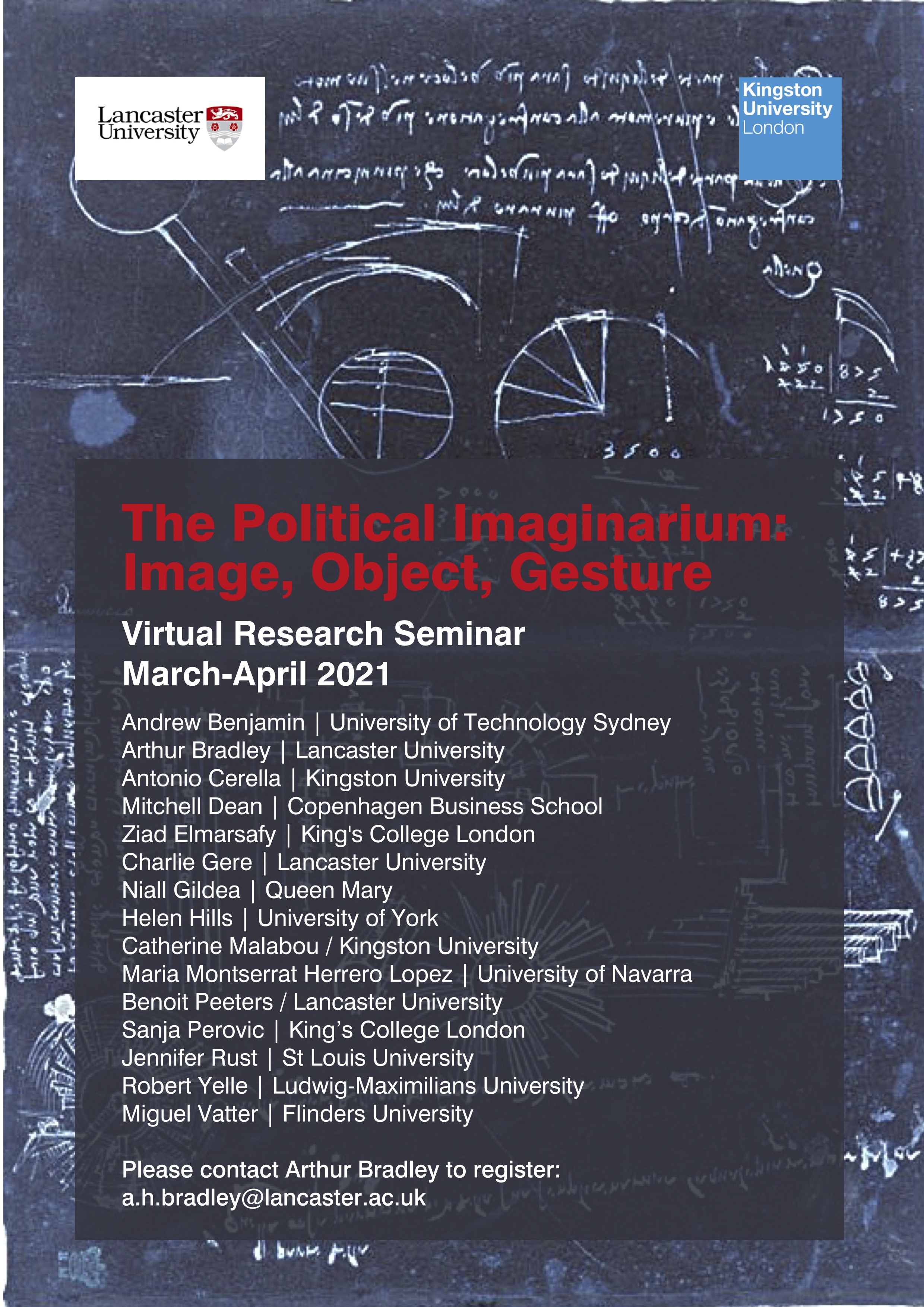
The Political Imaginarium: Image, Object, Gesture
In his book Le Portrait du roi (1981), Louis Marin famously claims that “The king is only truly king, that is, monarch, in images.” To be sure, Marin’s work explicitly refers back to a premodern political theology of the image, but it arguably also inaugurates a modern genre of political iconography that brings together political theory, history, philosophy, sociology, religious studies, art and literary studies to explore the bond between the power of the image and the images of power. But what would it mean to speak of politics as a privileged place or site for making images? How far does politics consist in the power of the image or, conversely, the imageof power? To what extent do paintings, sculpture, literary texts and artifacts represent, perform, critique or resist the “reality” of political power? In short, what is the relation between the power to represent and the representation of power? In this series of webinars (March/April 2021), experts in political theory, sociology, history, philosophy, theology, art history and comparative literature explore the past and present of our “political imaginarium”.
Organisers: Arthur Bradley (Lancaster University) and Antonio Cerella (Kingston University).
For infomation, contact Arthur Bradley at: a.h.bradley@lancaster.ac.uk
Microhistory and Global History – discussion between Carlo Ginzburg and Francesca Trivellato
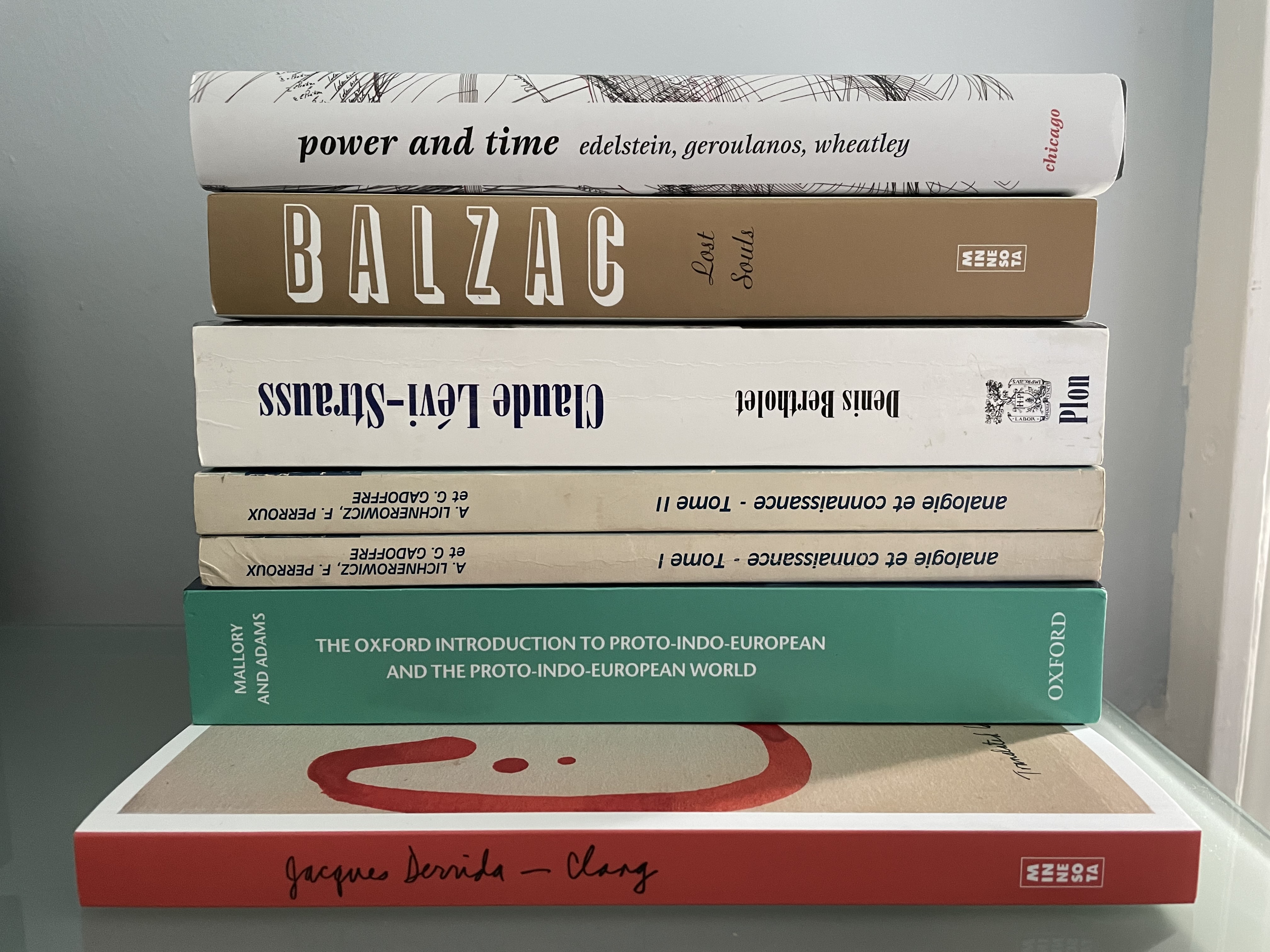
A mix of recently received books – the new translations of Balzac’s Lost Souls and Derrida’s Clang from University of Minnesota Press in recompense for review work, and Dan Edelstein, Stefanos Geroulanos & Natascha Wheatley (eds.), Power and Time: Temporalities in Conflict and the Making of History, sent by University of Chicago Press. The others were bought second-hand, mainly for the Foucault work.
Grégoire Chamayou, The Ungovernable Society: A Genealogy of Authoritarian Liberalism – Polity, translated by Andrew Brown, March 2021

Rebellion was in the air. Workers were on strike, students were demonstrating on campuses, discipline was breaking down. No relation of domination was left untouched – the relation between the sexes, the racial order, the hierarchies of class, relationships in families, workplaces and colleges. The upheavals of the late 1960s and early 1970s quickly spread through all sectors of social and economic life, threatening to make society ungovernable. This crisis was also the birthplace of the authoritarian liberalism which continues to cast its shadow across the world in which we now live.
To ward off the threat, new arts of government were devised by elites in business-related circles, which included a war against the trade unions, the primacy of shareholder value and a dethroning of politics. The neoliberalism that thus began its triumphal march was not, however, determined by a simple ‘state phobia’ and a desire to free up the economy from government interference. On the contrary, the strategy for overcoming the crisis of governability consisted in an authoritarian liberalism in which the liberalization of society went hand-in-hand with new forms of power imposed from above: a ‘strong state’ for a ‘free economy’ became the new magic formula of our capitalist societies.
The new arts of government devised by ruling elites are still with us today and we can understand their nature and lasting influence only by re-examining the history of the conflicts that brought them into being.
The French Programme: How Theory Came to London – Colm McAuliffe on the 1973 ICA festival that sparked British interest in Francophone structuralist and post-structuralist thought.
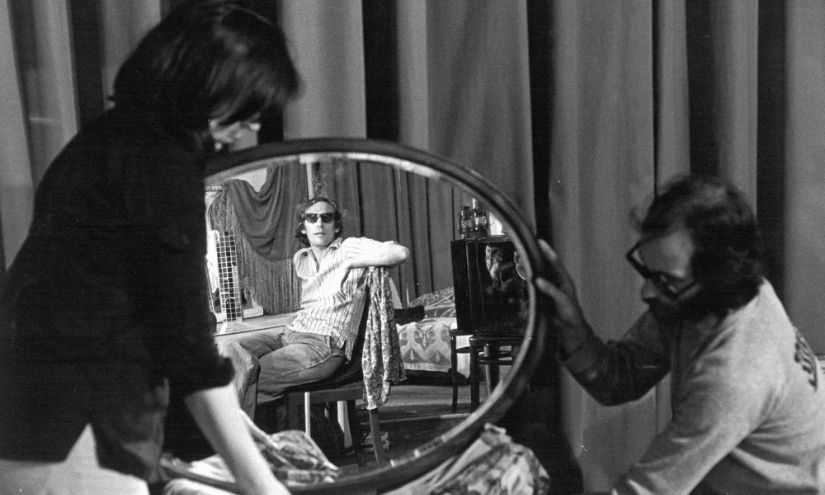
March 1973: two months after Britain joins the European Economic Community, the French historian of ideas Michel Foucault is scheduled to give a lecture in London. Foucault is one of the star attractions of the French Programme, a month-long series of lectures and screenings at the Institute of Contemporary Arts. Jacques Derrida, Gilles Deleuze, Felix Guattari, and Tzvetan Todorov are among the other avatars of Francophone structuralist and post-structuralist thought appearing throughout the month, described in the French newspaper Combat as “the most important French cultural event ever organised in Britain”, and one which has been almost entirely funded by the British Government, eager to foster positive cultural relations between Britain and its sister nations in the Common Market. [continues here]


