In Spacing Debt Christopher Harker demonstrates that financial debt is as much a spatial phenomenon as it is a temporal and social one. Harker traces the emergence of debt in Ramallah after 2008 as part of the financialization of the Palestinian economy under Israeli settler colonialism. Debt contributes to processes through which Palestinians are kept economically unstable and subordinate. He draws extensively on residents’ accounts of living with the explosion of personal debt to highlight the entanglement of consumer credit with other obligatory relations among family, friends, and institutions. Harker offers a new geographical theorization of debt, showing how debt affects urban space, including the movement of bodies through the city, localized economies, and the political violence associated with occupation. Bringing cultural and urban imaginaries into conversation with monetized debt, Harker shows how debt itself becomes a slow violence embedded into the everyday lives of citizens. However, debt is also a means through which Palestinians practice endurance, creatively adapting to life under occupation.
“The first in-depth ethnographic research on debt formation in the contemporary Palestinian context, this groundbreaking work proposes a host of new ways for social geographers to rethink debt at multiple scales. Spacing Debt ambitiously engages theoretical debates across a wide array of disciplinary approaches and effectively links it with fascinating and carefully treated ethnographic cases and interview materials.” — Deborah James, author of Money from Nothing: Indebtedness and Aspiration in South Africa
What is the role of critical theory today and who is it for? What kind of maps can theory provide in the context of entrenched capitalist crisis? These are some of the questions posed by this seminar series.
In the aftermath of various mutations of twentieth-century ‘critical theory’ (Frankfurt School, ‘French Theory’, etc.), proponents of ‘postcritique’ have argued that critical theory has ‘run out of steam’. Instead, this seminar series starts from the premise that 21st-century crisis has also generated dynamic new ways of reconsidering these questions. A critical theory of the present is necessarily a crisis theory.
In this session, Etienne Balibar will give a talk entitled ‘Critical Reflections on the New Definition of the Human Species’:
The pandemic is crystallizing a new understanding of the Human as a “Species-being”, as well as the very category of the “species” itself, which connects biological, medical, anthropological definitions. A new material unity, a new commonality with other species, but also a destructive character and a rising to the extremes of anthropological differences themselves. As a consequence, biopolitics, cosmopolitics, and necropolitics become a single problem, which calls for a genealogy and a critical reflection
Etienne Balibar teaches at Columbia every Fall semester. He is Professor Emeritus of moral and political philosophy at Université de Paris X – Nanterre and Professor Emeritus of Humanities at the University of California, Irvine. He also holds a part-time Anniversary Chair in Modern European Philosophy at Kingston University, London. He has published widely in the areas of epistemology, Marxist philosophy, and moral and political philosophy in general. His works include Lire le Capital (with Louis Althusser, Pierre Macherey, Jacques Rancière, Roger Establet) (1965); The Philosophy of Marx (1995); Spinoza and politics (1998); Politics and the Other Scene (2002); We, the People of Europe? (2003) ; Equaliberty (2014); Violence and Civility. On the Limits of Political Philosophy (2015); Citizen Subject. Foundations for Philosophical Anthropology (2017); Secularism and Cosmopolitanism (2018).
Part of the Theory in Crisis series – details here
In an interview at the Chronicle Review with the writer and teacher Maggie Doherty about academic humanities and public writing, I encountered a term for the first time that described in a new way what felt very familiar: “Intellectual Journalism.” The interviewer used it to gesture toward the book reviews, trade titles and essays that authors — or readers — with graduate training might write (or read) outside of their own formal disciplines and the peer-reviewed journals and book series that sustain them. My experience turning over the category of “Intellectual History” on its many sides to better understand how it held together led me to wonder about this congruent term. [continues here]
THE CELEBRATORY CLAMOR surrounding President Joe Biden’s 100-day deportation moratorium was short-lived, as a federal judge in Texas temporarily blocked the pause on deportation within a few days of its announcement. Even though the court order did not require the Biden administration to proceed with deportations, U.S. Immigration and Customs Enforcement swiftly deported hundreds of people to Guatemala, Honduras, and Jamaica anyway. [continues here]
The fourth and final volume in Michel Foucault’s acclaimed History of Sexuality, completed just before his death in 1984 and finally available to the public
One of the most influential thinkers of the twentieth century, Michel Foucault made an indelible impact on Western thought. The first three volumes in his History of Sexuality—which trace cultural and intellectual notions of sexuality, arguing that it has been profoundly shaped by the power structures applied to it—constitute some of Foucault’s most important work. This fourth volume posits that the origins of totalitarian self-surveillance began with the Christian practice of confession. The manuscript had long been secreted away, in accordance with Foucault’s stated wish that there be no posthumous publication of his unpublished work.
With the sale of the Foucault archives in 2013, Foucault’s nephew felt that the time had come to publish this final volume in Foucault’s seminal history. Philosophically, it is a chapter in his hermeneutics of the desiring subject. Historically, it focuses on the remodeling of subjectivity carried out by the early Christian Fathers, who set out to transform the classical Logos of truthful human discourse into a theologos—the divine Word of a pure sovereign.
What did God will in the matter of righteous sexual practice? Foucault parses out the logic of the various responses proffered by theologians over the centuries, culminating with Saint Augustine’s fascinating discussion of the libido. Sweeping and deeply personal, Confessions of the Flesh is a tour de force from a philosophical master.
My review essay on the French text is here; other links and reports on the initial reception of the French edition here. My book Foucault’s Last Decadewas published before this text was available, but it situates it in an intellectual context of the development of Foucault’s project on sexuality.
Mainly second-hand books for the ongoing Foucault research and related projects, but also a copy of Mark Neocleous, A Critical Theory of Police Power, and Etienne Balibar, Passions du concept, sent by their authors.
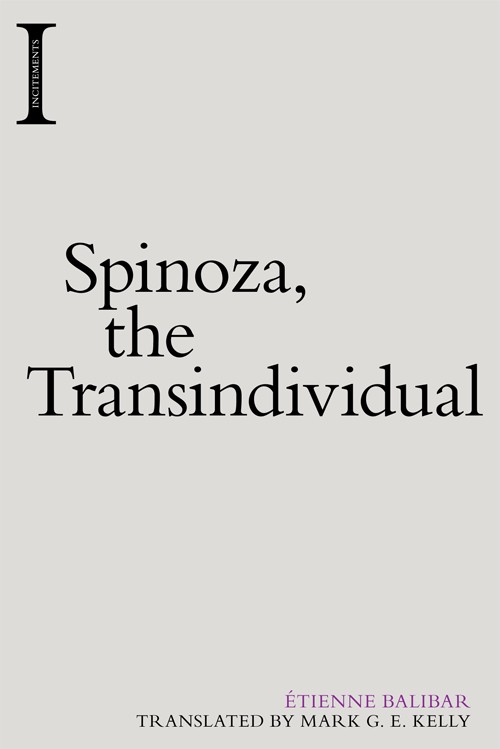
Etienne Balibar, Spinoza, the Transindividual, translated by Mark G. E. Kelly, Edinburgh University Press, September 2020
One of the most important books on Spinoza to appear in the last 30 years, written by one of the foremost living French philosophers
Includes a rare engagement by Balibar with psychoanalysis and Freud’s social thought
Offers new readings of Spinoza, a canonical figure in the history of philosophy
Intervenes in a growing discourse around the notion of transindividuality
Étienne Balibar, one of the foremost living French philosophers, builds on his landmark work Spinoza and Politics with this exploration of Spinoza’s ontology. Balibar situates Spinoza in relation to the major figures of Marx and Freud as a precursor to the more recent French thinker Gilbert Simondon’s concept of the transindividual. Presenting a crucial development in his thought, Balibar takes the concept of transindividuality beyond Spinoza to show it at work at both the…
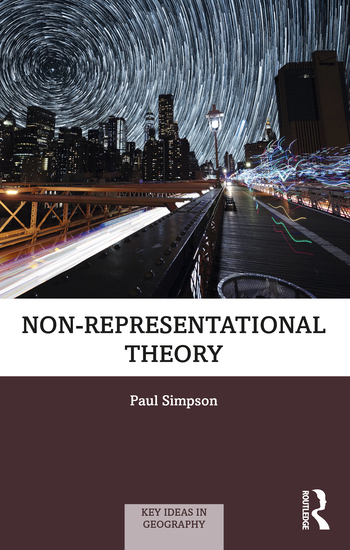
Non-representational Theory explores a range of ideas which have recently engaged geographers and have led to the development of an alternative approach to the conception, practice, and production of geographic knowledge. Non-representational Theory refers to a key body of work that has emerged in geography over the past two and a half decades that emphasizes the importance of practice, embodiment, materiality, and process to the ongoing formation of social life. This title offers the first sole-authored, accessible introduction to this work and its impact on geography.
Without being prescriptive the text provides a general explanation of what Non-representational Theory is. This includes discussion of the disciplinary context it emerged from, the key ideas and themes that characterise work associated with Non-representational Theory, and the theoretical points of reference that inspires it. The book then explores a series of conjunctions of ‘Non-representational Theory and…’, taking an area of geographic enquiry and exploring the impact Non-representational Theory has had on how it is researched and understood. This includes the relationships between Non-representational Theory and Practice, Affect, Materiality, Landscape, Performance, and Methods. Critiques of Non-representational Theory are also broached, including reflections on issues on identity, power, and difference.
The text draws together the work of a range of established and emerging scholars working on the development of non-representational theories, allowing scholars from geography and other disciplines to access and assess the animating potential of such work. This volume is essential reading for undergraduates and post-graduate students interested in the social, cultural, and political geographies of everyday living.
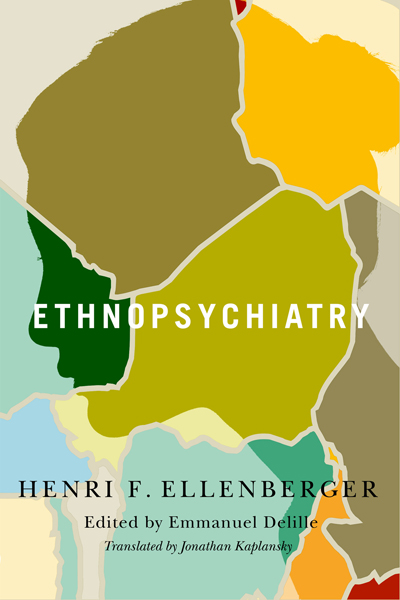
Henri F. Ellenberger, Ethnopsychiatry, edited by Emmanuel Delille, translated by Jonathan Kaplansky, McGill-Queen’s University Press, 2021
What is the relationship between culture and mental health? Is mental illness universal? Are symptoms of mental disorders different across social groups? In the late 1960s these questions gave rise to a groundbreaking series of articles written by the psychiatrist Henri Ellenberger, who would go on to publish The Discovery of the Unconscious: The History and Evolution of Dynamic Psychiatry in 1970. Fifty years later they are presented for the first time in English translation, introduced by historian of science Emmanuel Delille.
Ethnopsychiatry explores one of the most controversial subjects in psychiatric research: the role of culture in mental health. In his articles Ellenberger addressed the complex clinical and theoretical problems of cultural specificity in mental illness, collective psychoses, differentiations within cultural groups, and biocultural interactions. He was especially attuned to the correlations between rapid cultural transformations in postwar society, urbanization, and the frequency of mental illness. Ellenberger drew from a vast and varied primary and secondary literature in several languages, as well as from his own findings in clinical practice, which included work with indigenous peoples. In analyzing Ellenberger’s contributions Delille unveils the transnational and interdisciplinary origins of transcultural psychiatry, which grew out of knowledge networks that crisscrossed the globe. The book has a rich selection of appendices, including Ellenberger’s lecture notes on a case of peyote addiction and his correspondence with anthropologist and psychoanalyst Georges Devereux.
These original essays, and their masterful contextualization, provide a compelling introduction to the foundations of transcultural psychiatry and one of its most distinguished and prolific researchers.
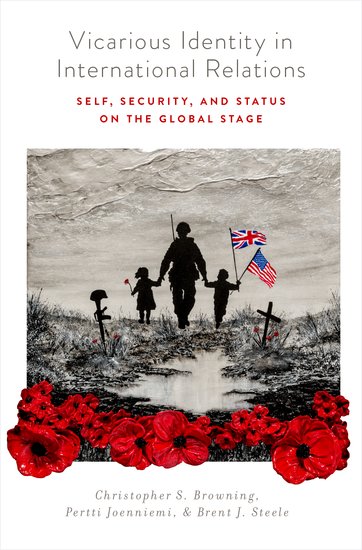
Vicarious identification, or “living through another” is a familiar social-psychological concept. Shaped by insecurity and a lack of self-fulfilment, it refers to the processes by which actors gain a sense of self-identity, purpose, and self-esteem through appropriating the achievements and experiences of others. As this book argues, it is also an under-appreciated and increasingly relevant strategy of international relations.
According to this theory, states identify and establish special relationships with other nations (often in an aspirational way) in order to strengthen their sense of self, security, and status on the global stage. This identification is also central to the politics of citizenship and can be manipulated by states to justify their global ambitions. For example, why might the United States look at Israel as a model for its own foreign policies? What shaped the politics of Brexit and why is the United Kingdom so attached to its transatlantic “special relationship” with the United States? And, why did Denmark so enthusiastically ally with the United States during the global War on Terror? Vicarious identity, as the authors argue, is at the core of these international dynamics.
Vicarious Identity in International Relations examines the ways in which vicarious identity is relevant to global politics: across individuals; between citizens and states; and across states, regional communities, or civilizations. It looks at a range of cases (the United States, the United Kingdom, and Denmark), which illustrate that vicarious political identity is dynamic and emerges in different contexts, but particularly when nations face crisis, both internally and externally. In addition, the book outlines a qualitative methodology for analyzing vicarious identity at the collective level.
“This is a path-breaking work. Its focus on vicarious identity and identification takes the discussion on subjectivity and ontological (in)security in International Relations to new dimensions by offering a theoretically sophisticated and powerful reading of the relationship between vicarious identification and foreign policy strategies. In paying attention to the vicarious bonding of US-Israel, US-UK, and Denmark and the world, the authors insightfully address some of the most pressing issues of our times.” – Catarina Kinnvall, Professor of Political Science, Lund University
“Built on sophisticated engagement with a range of theoretical literature and a nuanced discussion of contemporary case studies, this important book introduces the IR community to the concept of vicarious identity. In the process, the authors manage the impressive achievement of shining a light on what is hidden in plain sight in contemporary IR, pointing to the relevance of dynamics of vicarious identity in making sense of foreign policy, interstate relations, and identity politics. A crucial book for any scholar of identity in IR, and an important book for any scholar of IR.” – Matt McDonald, Reader in International Relations, University of Queensland
“Vicarious Identity in International Relations contends not only that a phenomenon common in everyday life is also prevalent in relations between states, but that it does some surprisingly significant work in global politics. Developing a sophisticated new approach for the study of vicarious identity at the state and international levels, Browning, Joenniemi, and Steele offer an erudite and accessible analysis of how ‘living through others’ matters in international relations. This fascinating study will no doubt ignite a fruitful and welcome new research agenda in IR.” – Ty Solomon, Senior Lecturer in Politics and International Relations, University of Glasgow





 Etienne Balibar,