THE CELEBRATORY CLAMOR surrounding President Joe Biden’s 100-day deportation moratorium was short-lived, as a federal judge in Texas temporarily blocked the pause on deportation within a few days of its announcement. Even though the court order did not require the Biden administration to proceed with deportations, U.S. Immigration and Customs Enforcement swiftly deported hundreds of people to Guatemala, Honduras, and Jamaica anyway. [continues here]
The fourth and final volume in Michel Foucault’s acclaimed History of Sexuality, completed just before his death in 1984 and finally available to the public
One of the most influential thinkers of the twentieth century, Michel Foucault made an indelible impact on Western thought. The first three volumes in his History of Sexuality—which trace cultural and intellectual notions of sexuality, arguing that it has been profoundly shaped by the power structures applied to it—constitute some of Foucault’s most important work. This fourth volume posits that the origins of totalitarian self-surveillance began with the Christian practice of confession. The manuscript had long been secreted away, in accordance with Foucault’s stated wish that there be no posthumous publication of his unpublished work.
With the sale of the Foucault archives in 2013, Foucault’s nephew felt that the time had come to publish this final volume in Foucault’s seminal history. Philosophically, it is a chapter in his hermeneutics of the desiring subject. Historically, it focuses on the remodeling of subjectivity carried out by the early Christian Fathers, who set out to transform the classical Logos of truthful human discourse into a theologos—the divine Word of a pure sovereign.
What did God will in the matter of righteous sexual practice? Foucault parses out the logic of the various responses proffered by theologians over the centuries, culminating with Saint Augustine’s fascinating discussion of the libido. Sweeping and deeply personal, Confessions of the Flesh is a tour de force from a philosophical master.
My review essay on the French text is here; other links and reports on the initial reception of the French edition here. My book Foucault’s Last Decadewas published before this text was available, but it situates it in an intellectual context of the development of Foucault’s project on sexuality.
Mainly second-hand books for the ongoing Foucault research and related projects, but also a copy of Mark Neocleous, A Critical Theory of Police Power, and Etienne Balibar, Passions du concept, sent by their authors.
Etienne Balibar, Spinoza, the Transindividual, translated by Mark G. E. Kelly, Edinburgh University Press, September 2020
One of the most important books on Spinoza to appear in the last 30 years, written by one of the foremost living French philosophers
Includes a rare engagement by Balibar with psychoanalysis and Freud’s social thought
Offers new readings of Spinoza, a canonical figure in the history of philosophy
Intervenes in a growing discourse around the notion of transindividuality
Étienne Balibar, one of the foremost living French philosophers, builds on his landmark work Spinoza and Politics with this exploration of Spinoza’s ontology. Balibar situates Spinoza in relation to the major figures of Marx and Freud as a precursor to the more recent French thinker Gilbert Simondon’s concept of the transindividual. Presenting a crucial development in his thought, Balibar takes the concept of transindividuality beyond Spinoza to show it at work at both the…
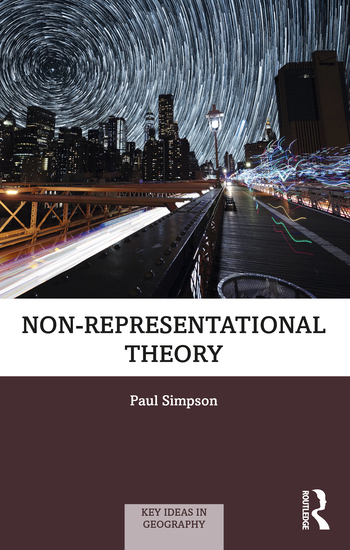
Non-representational Theory explores a range of ideas which have recently engaged geographers and have led to the development of an alternative approach to the conception, practice, and production of geographic knowledge. Non-representational Theory refers to a key body of work that has emerged in geography over the past two and a half decades that emphasizes the importance of practice, embodiment, materiality, and process to the ongoing formation of social life. This title offers the first sole-authored, accessible introduction to this work and its impact on geography.
Without being prescriptive the text provides a general explanation of what Non-representational Theory is. This includes discussion of the disciplinary context it emerged from, the key ideas and themes that characterise work associated with Non-representational Theory, and the theoretical points of reference that inspires it. The book then explores a series of conjunctions of ‘Non-representational Theory and…’, taking an area of geographic enquiry and exploring the impact Non-representational Theory has had on how it is researched and understood. This includes the relationships between Non-representational Theory and Practice, Affect, Materiality, Landscape, Performance, and Methods. Critiques of Non-representational Theory are also broached, including reflections on issues on identity, power, and difference.
The text draws together the work of a range of established and emerging scholars working on the development of non-representational theories, allowing scholars from geography and other disciplines to access and assess the animating potential of such work. This volume is essential reading for undergraduates and post-graduate students interested in the social, cultural, and political geographies of everyday living.
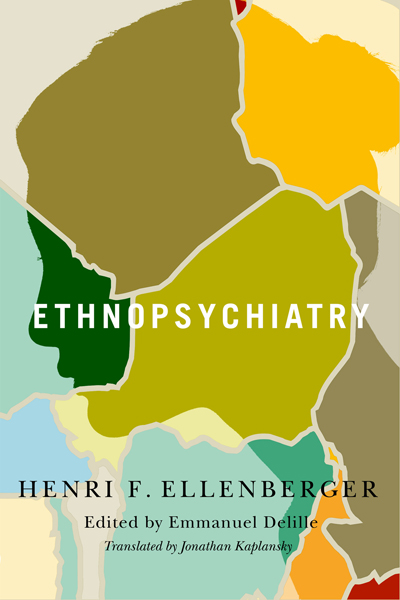
Henri F. Ellenberger, Ethnopsychiatry, edited by Emmanuel Delille, translated by Jonathan Kaplansky, McGill-Queen’s University Press, 2021
What is the relationship between culture and mental health? Is mental illness universal? Are symptoms of mental disorders different across social groups? In the late 1960s these questions gave rise to a groundbreaking series of articles written by the psychiatrist Henri Ellenberger, who would go on to publish The Discovery of the Unconscious: The History and Evolution of Dynamic Psychiatry in 1970. Fifty years later they are presented for the first time in English translation, introduced by historian of science Emmanuel Delille.
Ethnopsychiatry explores one of the most controversial subjects in psychiatric research: the role of culture in mental health. In his articles Ellenberger addressed the complex clinical and theoretical problems of cultural specificity in mental illness, collective psychoses, differentiations within cultural groups, and biocultural interactions. He was especially attuned to the correlations between rapid cultural transformations in postwar society, urbanization, and the frequency of mental illness. Ellenberger drew from a vast and varied primary and secondary literature in several languages, as well as from his own findings in clinical practice, which included work with indigenous peoples. In analyzing Ellenberger’s contributions Delille unveils the transnational and interdisciplinary origins of transcultural psychiatry, which grew out of knowledge networks that crisscrossed the globe. The book has a rich selection of appendices, including Ellenberger’s lecture notes on a case of peyote addiction and his correspondence with anthropologist and psychoanalyst Georges Devereux.
These original essays, and their masterful contextualization, provide a compelling introduction to the foundations of transcultural psychiatry and one of its most distinguished and prolific researchers.
Vicarious identification, or “living through another” is a familiar social-psychological concept. Shaped by insecurity and a lack of self-fulfilment, it refers to the processes by which actors gain a sense of self-identity, purpose, and self-esteem through appropriating the achievements and experiences of others. As this book argues, it is also an under-appreciated and increasingly relevant strategy of international relations.
According to this theory, states identify and establish special relationships with other nations (often in an aspirational way) in order to strengthen their sense of self, security, and status on the global stage. This identification is also central to the politics of citizenship and can be manipulated by states to justify their global ambitions. For example, why might the United States look at Israel as a model for its own foreign policies? What shaped the politics of Brexit and why is the United Kingdom so attached to its transatlantic “special relationship” with the United States? And, why did Denmark so enthusiastically ally with the United States during the global War on Terror? Vicarious identity, as the authors argue, is at the core of these international dynamics.
Vicarious Identity in International Relations examines the ways in which vicarious identity is relevant to global politics: across individuals; between citizens and states; and across states, regional communities, or civilizations. It looks at a range of cases (the United States, the United Kingdom, and Denmark), which illustrate that vicarious political identity is dynamic and emerges in different contexts, but particularly when nations face crisis, both internally and externally. In addition, the book outlines a qualitative methodology for analyzing vicarious identity at the collective level.
“This is a path-breaking work. Its focus on vicarious identity and identification takes the discussion on subjectivity and ontological (in)security in International Relations to new dimensions by offering a theoretically sophisticated and powerful reading of the relationship between vicarious identification and foreign policy strategies. In paying attention to the vicarious bonding of US-Israel, US-UK, and Denmark and the world, the authors insightfully address some of the most pressing issues of our times.” – Catarina Kinnvall, Professor of Political Science, Lund University
“Built on sophisticated engagement with a range of theoretical literature and a nuanced discussion of contemporary case studies, this important book introduces the IR community to the concept of vicarious identity. In the process, the authors manage the impressive achievement of shining a light on what is hidden in plain sight in contemporary IR, pointing to the relevance of dynamics of vicarious identity in making sense of foreign policy, interstate relations, and identity politics. A crucial book for any scholar of identity in IR, and an important book for any scholar of IR.” – Matt McDonald, Reader in International Relations, University of Queensland
“Vicarious Identity in International Relations contends not only that a phenomenon common in everyday life is also prevalent in relations between states, but that it does some surprisingly significant work in global politics. Developing a sophisticated new approach for the study of vicarious identity at the state and international levels, Browning, Joenniemi, and Steele offer an erudite and accessible analysis of how ‘living through others’ matters in international relations. This fascinating study will no doubt ignite a fruitful and welcome new research agenda in IR.” – Ty Solomon, Senior Lecturer in Politics and International Relations, University of Glasgow
Companion website with some open access material, discount codes and a lot of endorsements.
The word ‘data’ has entered everyday conversation, but do we really understand what it means? How can we begin to grasp the scope and scale of our new data-rich world, and can we truly comprehend what is at stake?
In Data Lives, renowned social scientist Rob Kitchin explores the intricacies of data creation and charts how data-driven technologies have become essential to how society, government and the economy work.
Creatively blending scholarly analysis, biography and fiction, he demonstrates how data are shaped by social and political forces, and the extent to which they influence our daily lives.
He reveals our data world to be one of potential danger, but also of hope.
Founded by Michel Foucault and others in 1970–71, the Prisons Information Group (GIP) circulated information about the inhumane conditions within the French prison system. Intolerable makes available for the first time in English a fully annotated compilation of materials produced by the GIP during its brief but influential existence, including an exclusive new interview with GIP member Hélène Cixous and writings by Gilles Deleuze and Jean Genet.
These archival documents—public announcements, manifestos, reports, pamphlets, interventions, press conference statements, interviews, and round table discussions—trace the GIP’s establishment in post-1968 political turmoil, the new models of social activism it pioneered, the prison revolts it supported across France, and the retrospective assessments that followed its denouement. At the same time, Intolerable offers a rich, concrete…
Killer Cities uses a combination of social theory, polemic and close attention to empirical detail to tell the story of how and why cities cause mass animal death and, in the process, hasten the destruction of the planet. This book is not just a lament, however. It is an attempt to navigate out of this mess of planned and unplanned violence towards a world in which cities no longer act as killers but become aligned with the lives of other beings. It offers pragmatic ways of diminishing the death toll and changing mindsets without ever minimizing the dilemmas that inevitably will have to be faced. Killer cities can be rehabilitated so that they offer brighter paths towards the future – for animals, for human beings, and for the planet. A new urban geography could be within our grasp. Indeed, it has to be, for all of our sakes.
You can’t change the world without first seeing it through new lenses. Killer Cities shines a light on the ecocidal underbelly of urban life in a capitalist world. Using animals as a focus, Nigel Thrift advances concepts, arguments and evidence that might inspire us to make a very different urban future. The book is creative and hopeful in the face of formidable forces of mental and practical inertia. Noel Castree University of Manchester (England) and University of Wollongong (Australia)
This epic compendium on the ravages of planetary urbanism from one of geography’s most generative thinkers is above all, as the title suggests, a provocation. Whether it inspires or infuriates, it cannot fail to force thought. Sarah Whatmore Professor of Environment and Public Policy, University of Oxford
People love cities. New York, Paris, Barcelona, London: These are the places where modern life has thrived. So much so that, by 2050, the United Nations predicts that almost 70 percent of the global population will live in cities. In the process, cities have become selfish places for humans to think only of themselves. In Killer Cities, Nigel Thrift invites us to include a broader menagerie into cities—many of which are already there anyway, but pinned under the boot of humanity. The result is liberatory—for people and creatures of all kinds, but also for cities themselves. Ian Bogost Georgia Institute of Technology
Killer Cities documents the long histories of violence done by cities, the killings, displacements and neglect. It also holds out the hope that cities can be reimagined as unfolding sites of experimental cohabitation. Thrift draws from a vast range of sources, celebrating those who recognize the multiple knots of obligation that human beings have to each other, to other-than-human beings and to the planet itself. It is a book for our time, as pandemics, climate change and the anthropocene increasingly unsettle the category of the human. Penny Harvey Professor Social Anthropology, University of Manchester
The breath-taking thesis of this book is that the re-cognition of cities and the future of humanity requires not only thinking about but with animals. To use a term the book itself employs, this is social theory as enjambment. In Killer Cities, thinking runs on and over – from species to species – without terminal punctuation. Celia Lury Director, Centre for Interdisciplinary Methodologies, University of Warwick




 Etienne Balibar,