In a fascinating interview about Foucault, ‘The Materiality of a Working Life‘ (open access; original French), Daniel Defert talks about his daily routines, and how these were similar year round:
No no, weekends didn’t exist! We would go to see art exhibitions on the Saturday afternoon, certainly, but the very notion of the weekend didn’t exist… Especially a public holiday, a Christmas day without writing, that was impossible! Foucault rarely put dates on his writings, but he would have been quite capable of putting “December 25th” on something, that being a day when, as he said, “nothing has happened for several thousand years.”
I pick up on this story in The Early Foucault, but it’s not a model I try to follow. Although the winter sun and cycling won’t happen this year, I will be taking a few days off. Happy Christmas and I’ll be back before the New Year with some lists of books and music I liked.
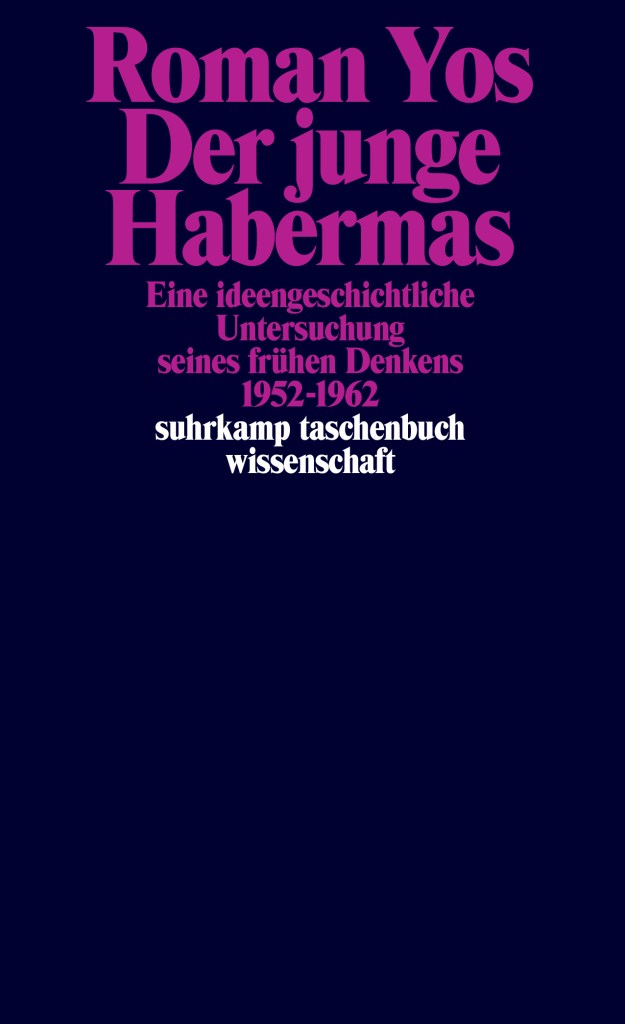
Roman Yos is a researcher at the Institute of Philosophy at the University of Potsdam. His research focuses on the history of German Philosophy in the early and mid-20th century. In 2017, he co-edited Mensch und Gesellschaft zwischen Natur und Geschichte, a volume that investigates the relationship between Philosophical Anthropology and Critical Theory. Contributing editor Jonas Knatz spoke with him about his new book Der junge Habermas (Suhrkamp, 2019), an intellectual biography of German philosopher and sociologist Jürgen Habermas.
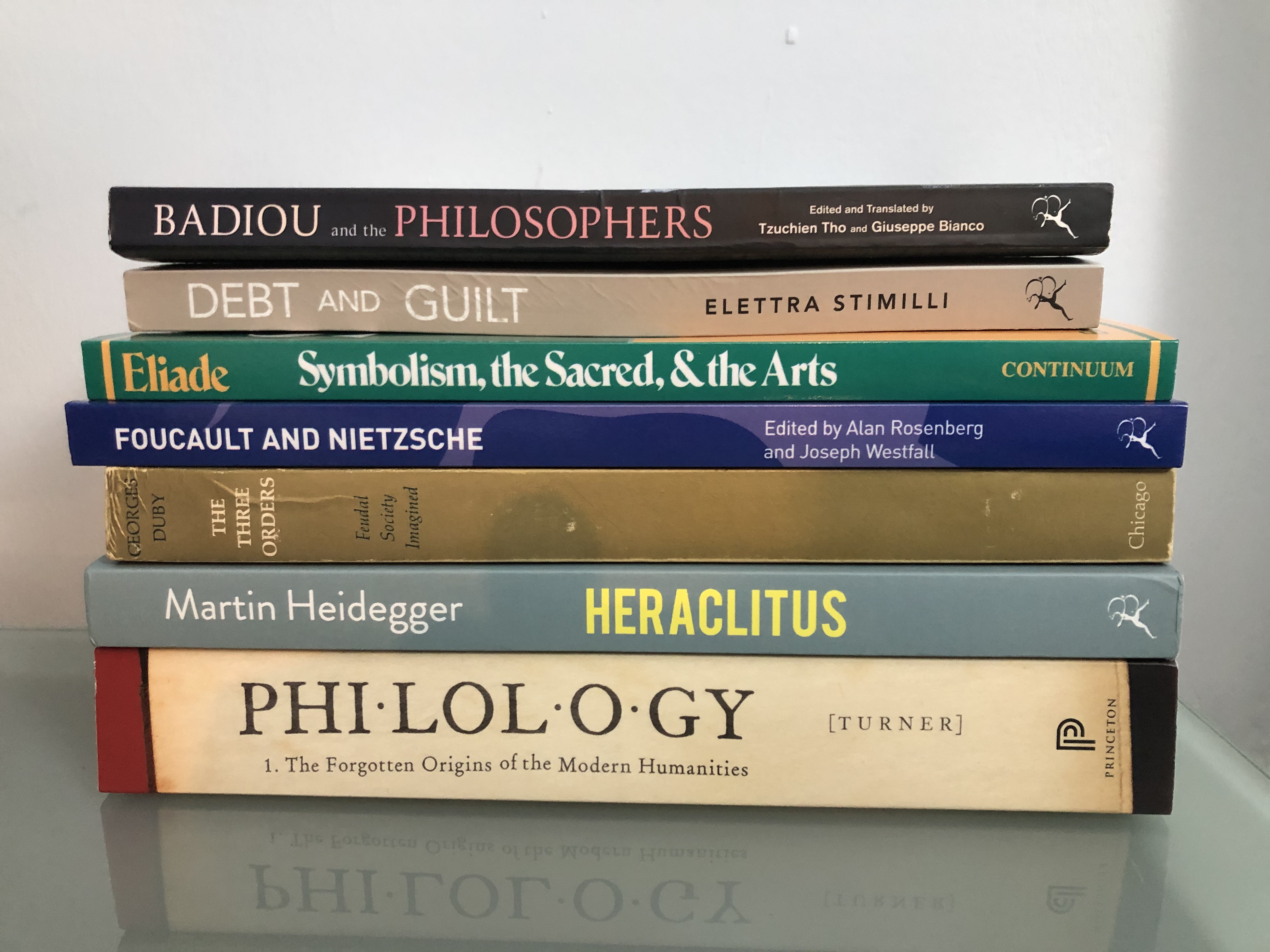
The papers from Hyppolite’s final seminar (including pieces by Derrida and Althusser), Marcel Mauss, Sociologie et anthropologie, Mary Wollstonecraft, A Vindication of the Rights of Woman, some works by Emile Benveniste, Fredric Jameson’s The Prison-House of Language, Jennifer Forestal and Menaka Philips (eds.), The Wives of Western Philosophy: Gender Politics in Intellectual Labor, Catherine Besteman, Militarized Global Apartheid.
Most of these are connected to ongoing research projects, though I’ll be teaching Wollstonecraft for the first time in 2021, and wanted this edition. The Routledge collection was pre-ordered in recompense for review work, and Duke University Press sent Catherine Besteman’s book.
Ten years ago, I posted an article on this blog with the exact same title as this one. It was enjoyable, at the time, to create a list of ten books I found both most personally influential and most significant in the intersectional study of ecology and culture. The list resonated fairly widely, attracting one of the highest number of visits on the blog to that point. (The blog looked different back then; you can see that in a screen shot here.)
Reviewing that list today, I can reaffirm the significance of each of its “top ten,” even if my ordering might be different in retrospect. Arturo Escobar’s Territories of Difference (second on that list) strikes me as the most forward-looking in terms of how it anticipated the most important stream of ecocultural thinking over the past ten years (the decolonial, though that term covers a great deal of complexity, which I will touch on below). Karen Barad’s Meeting the Universe Halfway (#4) is, of the ten, the book that has appeared on the greatest number of reading lists and graduate theses since then, in the areas that I read and advise in. And while the book I listed in first place, William Connolly’s Neuropolitics, has perhaps not aged as well as some of Connolly’s other books (so much has been written about “neuropolitics” since then), its intervention at the time of its writing was substantial and the author’s ongoing productivity merits great respect.
It’s not as easy to write a similar list today, in part because of the dynamics of the “present moment”: this year, in particular, with its global pandemic, its racial-justice convulsions, and its political insanity (here in the United States) has left me with a certain abyssal feeling of the loss of bearings. Can anyone today feel confident that they know what’s going on and what the future holds? (Other than that things will get much worse before they get any better.) [continues here]
This illuminating monograph examines analytical and practical aspects of the relationship between international law and international politics, providing a comprehensive analysis of the foundations on which both the international legal system and international politics rest.
With an interdisciplinary perspective, Alexander Orakhelashvili compares and contrasts the methods of international legal reasoning with international relations as a discipline, focusing on timeless and central issues that connect the past, present and future. The book examines, through the use of both disciplines’ methodology, some more specific areas such as public authority, global space, and peace, with the overall outcome that political contempt towards the international legal system could have unexpected and costly adverse political consequences.
Examining a broad range of theories and literature, International Law and International Politics will be an invigorating read for academics, students and practitioners of international law, international relations, politics, and diplomacy.
Hardback and e-book only at present, but Intro and Chapter 1 are available to read open access.
Thanks to Dave for the invitation to be part of this excellent podcast again.
What can Shakespeare tell us about territory, and what can territory tell us about Shakespeare?
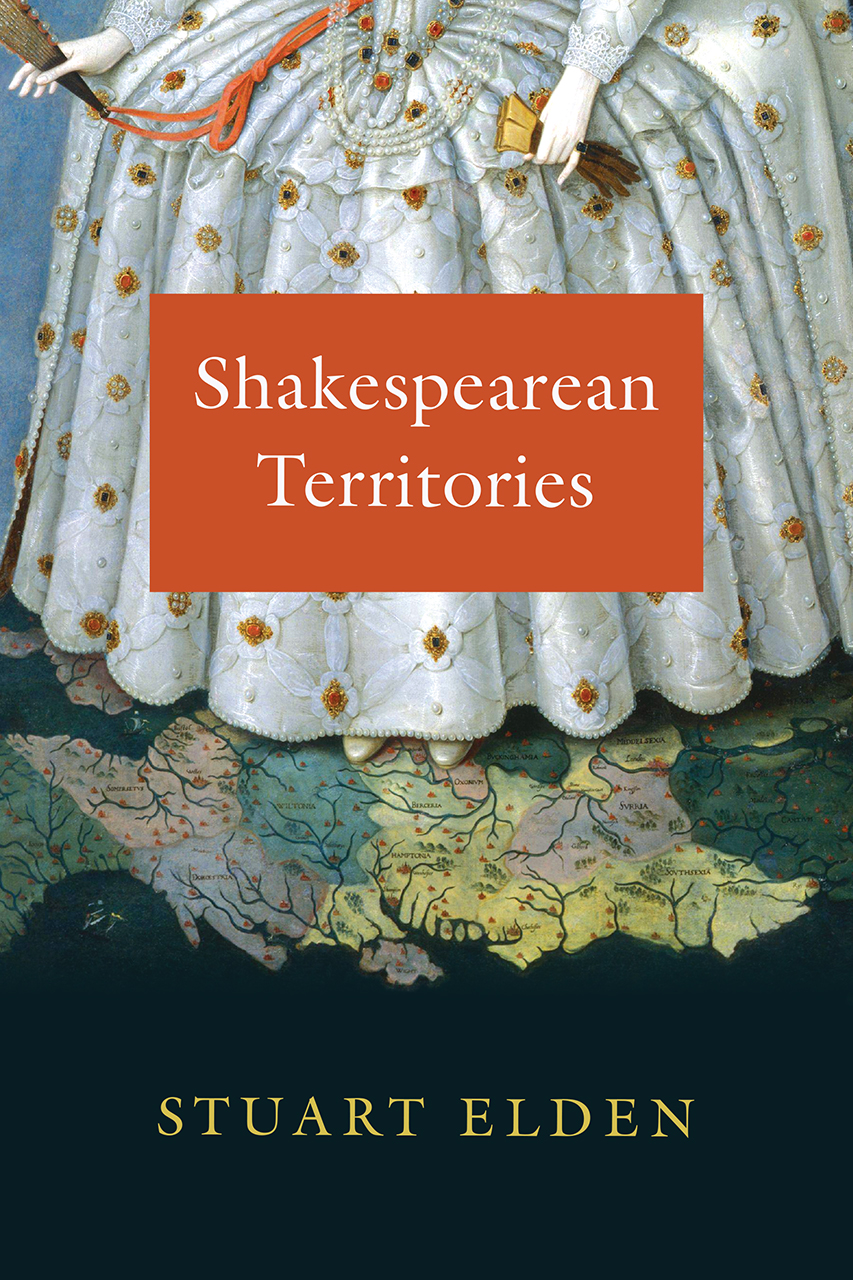
In Shakespearean Territories(University of Chicago Press, 2018),Stuart Elden, Professor of Political Theory and Geography at the University of Warwick and author of the Progressive Geographies blog, explores both of these questions, drawing on his earlier work theorising territory, as well as an extensive discussion of numerous works of Shakespeare. The book considers a range of subjects associated with the concept of territory, from the geo-politics of King Lear, the idea of sovereignty in King John, and power in Richard II, to questions of the body in Coriolanus, and ideas of calculation and measurement in The Merchant of Venice. Alongside Shakespeare’s relevance for understanding territory, territory offers a framework for alternative readings of Macbeth and Hamlet, and draws attention to often neglected or even completely ignored parts of Henry V. Fascinating and wide ranging, at the intersection of geography and English literature, the book is essential reading across the humanities and social sciences.
Dave O’Brien is Chancellor’s Fellow, Cultural and Creative Industries, at the University of Edinburgh’s College of Art.
Political scientists and political theorists have long been interested in social and political performance. Theatre and performance researchers have often focused on the political dimensions of the live arts. Yet the interdisciplinary nature of this labor has typically been assumed rather than rigorously explored. Further, it is crucial to bring the concepts of theatre and performance deployed by other disciplines such as psychology, law, political anthropology, sociology among others into a wider, as well as deeper, interdisciplinary engagement. Embodying and fostering that engagement is at the heart of this new handbook.
The Handbook brings together leading scholars in the fields of Politics and Performance to map out the evolving interdisciplinary engagement. The authors–drawn from a wide range of disciplines–investigate the relationship between politics and performance to show that certain features of political transactions shared by performances are fundamental to both disciplines, and that they also share, to a large extent, a common communicational base and language. The volume is organized into seven thematic sections: the interdisciplinary theory of politics and performance; performativity and theatricality (protest, regulation, resistance, change, authority); identities (race, gender, sexuality, class, citizenship, indigeneity); sites (states, borders, markets, law, religion); scripts (accountability, authority and legitimacy, security, ceremony, sustainability); body, voice, and gesture (representation, leadership, participation, rhetoric, disruption); and affect (media, care, love empathy, comedy, populism, memory).
I have a piece in it entitled “Ceremony, Genealogy, Political Theology”. As is the model with these handbooks unfortunately it is hardback and ebook only, at least for now.
Introduction by Milija Gluhovic, Silvija Jestrovic, Shirin Rai, and Michael Saward
Part I: Performativity/Theatricality
1. Lisa Skwirblies – Colonial Theatricality 2. Ameet Parameswaran – Theatricality, Sovereignty, and Resistance: Beyond Theatre of Roots 3. Adrian Kear – Authenticity/Theatricality: World Spectatorship and the Drama of the Image 4. Kate Leader – Law, Presence to Absence: The Case of the Disappearing Defendant 5. Sophie Nield – Towards a Theatrical History of the Picket Line 6. Jorge Cadena-Roa and Cristina Puga – Protest and Performativity 7. Jean-Pascal Daloz – Representation
Part II: Identities
8. Katie Beswick – Class, Race, and Marginality: Informal Street Performances in the City 9. Carole Spary – Gender, Politics, Performance: Embodiment and Representation in Political Institutions 10. Edgaras Klivis – National Identity 11. Ioana Szeman – Performance and Citizenship: The Roma in Europe 12. Yana Meerzon – From Exile to Migration – Staging (the) Face of the Human Waste
Part III: Sites
13. Emma Cox – Island Impasse: Refugee Detention and the Thickening Border 14. Kimberly Wedevan Segall – Media Sites: Political Revivals of American Muslim Women 15. Nirmal Puwar – The Force of the Somatic Norm: Women as Space Invaders in the UK Parliament 16. Matthew Watson – “The Market”: Eighteenth-Century Insights into the Performance of Market Practices 17. Charlotte Heath-Kelly – Staging Memorialisation: Performing the War on Terror and Resilient Nationalism 18. Matt Davies – Urban Sites of the Everyday and the International: The Other City and the Aesthetic Subject 19. Anna Leander – The Politics of Neo-Liberal Rituals: Performing the Institutionalization of Liminality at Trade Fairs 20. Catherine Chinara Charrett – Empire: A Performative Approach to Imperial Frontiers and Formations in Palestine
Part IV: Scripts
21. Desiree Lewis – Nativism: African Bodies and Photographic Performance 22. Willmar Sauter – Immersion 23. Stuart Elden – Ceremony, Genealogy, Political Theology 24. Erzsébet Strausz – Pedagogy: (Mis)performing the Contemporary University 25. Julia C. Strauss – Scripts, Authority, and Legitimacy: The View from China and Beyond 26. John Uhr – Political Leadership: “Saving the Show” 27. Vicky Angelaki – Adaptation and Environment: Landscape, Community and Politics in Henrik Ibsen’s Rosmersholm by Duncan Macmillan (2019)
Part V: Body/Voice/Gesture
28. Sruti Bala – Hurling and Hailing: Scenes of Interruption and Interpellation 29. Alan Finlayson – Performing Political Ideologies 30. M.I. Franklin – Music: Women Rewriting Punk Performance Politics 31. Lisa Fitzpatrick – Eroticism, and the Politics of Representing the Abused Body 32. Bishnupriya Dutt – Performing Gestures at Protests and Other Sites 33. Bree Hadley – What’s in a Name?: The Politics of Labelling in Disability Performance 34. Stephen Coleman – Taking a Position: Contemporary Dance and the Communication of Deep Political Feeling 35. Julia Peetz – The Body Politic and JFK’s Bad Back: Questions of Embodiment in the Performance of Politics
Part VI: Affect
36. Jordana Blejmar – Postmemory: Politics and Performance in Latin America 37. Roland Bleiker and Emma Hutchison – Performing Political Empathy 38. Narelle Warren – Care 39. Nobuko Anan – The Nation as Family: Motherhood and Love in Japan 40. Emma Crewe and Nicholas Sarra – Constituency Performances: The “Heart” of Democratic Politics 41. James Brassett – Comedy and the Performative Politics of Brexit 42. Illan rua Wall – Atmospheres of Protest 43. Goran Petrovic Lotina – Performance and Populism: Choreographing Popular Forms of Collectivity
Understanding how pasts resource presents is a fundamental first step towards building alternative futures in the Anthropocene. This collection brings together scholars from a range of disciplines to explore concepts of care, vulnerability, time, extinction, loss and inheritance across more-than-human worlds, connecting contemporary developments in the posthumanities with the field of critical heritage studies. Drawing on contributions from archaeology, anthropology, critical heritage studies, gender studies, geography, histories of science, media studies, philosophy, and science and technology studies, the book aims to place concepts of heritage at the centre of discussions of the Anthropocene and its associated climate and extinction crises – not as a nostalgic longing for how things were, but as a means of expanding collective imaginations and thinking critically and speculatively about the future and its alternatives. Contributors: Christina Fredengren, Cecilia Åsberg, Anna Bohlin, Adrian Van Allen, Esther Breithoff, Rodney Harrison, Colin Sterling, Joanna Zylinska, Denis Byrne, J. Kelechi Ugwuanyi, Caitlin DeSilvey, Anatolijs Venovcevs, Anna Storm and Claire Colebrook.
“Deterritorializing The Future is without doubt a major contribution to Critical Heritage Studies, and also has significant resonances beyond this emerging field. Anyone concerned with the art of living in ecologically precarious times, anyone who cares about the entanglement of the human and the nonhuman and their planetary legacies needs to read this book.”
Ben Dibley, Institute for Culture and Society, Western Sydney University
Theodor W. Adorno, Notes to Literature (combined edition) – Columbia University Press, 2019, edited by Rolf Tiedemann, translated by Shierry Weber Nicholson, with a new introduction by Paul Kottman.
I’d missed this when it was published late last year.
Notes to Literature is a collection of the great social theorist Theodor W. Adorno’s essays on such writers as Mann, Bloch, Hölderlin, Siegfried Kracauer, Goethe, Benjamin, and Stefan George. It also includes his reflections on a variety of subjects, such as literary titles, the physical qualities of books, political commitment in literature, the light-hearted and the serious in art, and the use of foreign words in writing. This edition presents this classic work in full in a single volume, with a new introduction by Paul Kottman.