Ten years ago, I posted an article on this blog with the exact same title as this one. It was enjoyable, at the time, to create a list of ten books I found both most personally influential and most significant in the intersectional study of ecology and culture. The list resonated fairly widely, attracting one of the highest number of visits on the blog to that point. (The blog looked different back then; you can see that in a screen shot here.)
Reviewing that list today, I can reaffirm the significance of each of its “top ten,” even if my ordering might be different in retrospect. Arturo Escobar’s Territories of Difference (second on that list) strikes me as the most forward-looking in terms of how it anticipated the most important stream of ecocultural thinking over the past ten years (the decolonial, though that term covers a great deal of complexity, which I will touch on below). Karen Barad’s Meeting the Universe Halfway (#4) is, of the ten, the book that has appeared on the greatest number of reading lists and graduate theses since then, in the areas that I read and advise in. And while the book I listed in first place, William Connolly’s Neuropolitics, has perhaps not aged as well as some of Connolly’s other books (so much has been written about “neuropolitics” since then), its intervention at the time of its writing was substantial and the author’s ongoing productivity merits great respect.
It’s not as easy to write a similar list today, in part because of the dynamics of the “present moment”: this year, in particular, with its global pandemic, its racial-justice convulsions, and its political insanity (here in the United States) has left me with a certain abyssal feeling of the loss of bearings. Can anyone today feel confident that they know what’s going on and what the future holds? (Other than that things will get much worse before they get any better.) [continues here]
This illuminating monograph examines analytical and practical aspects of the relationship between international law and international politics, providing a comprehensive analysis of the foundations on which both the international legal system and international politics rest.
With an interdisciplinary perspective, Alexander Orakhelashvili compares and contrasts the methods of international legal reasoning with international relations as a discipline, focusing on timeless and central issues that connect the past, present and future. The book examines, through the use of both disciplines’ methodology, some more specific areas such as public authority, global space, and peace, with the overall outcome that political contempt towards the international legal system could have unexpected and costly adverse political consequences.
Examining a broad range of theories and literature, International Law and International Politics will be an invigorating read for academics, students and practitioners of international law, international relations, politics, and diplomacy.
Hardback and e-book only at present, but Intro and Chapter 1 are available to read open access.
Thanks to Dave for the invitation to be part of this excellent podcast again.
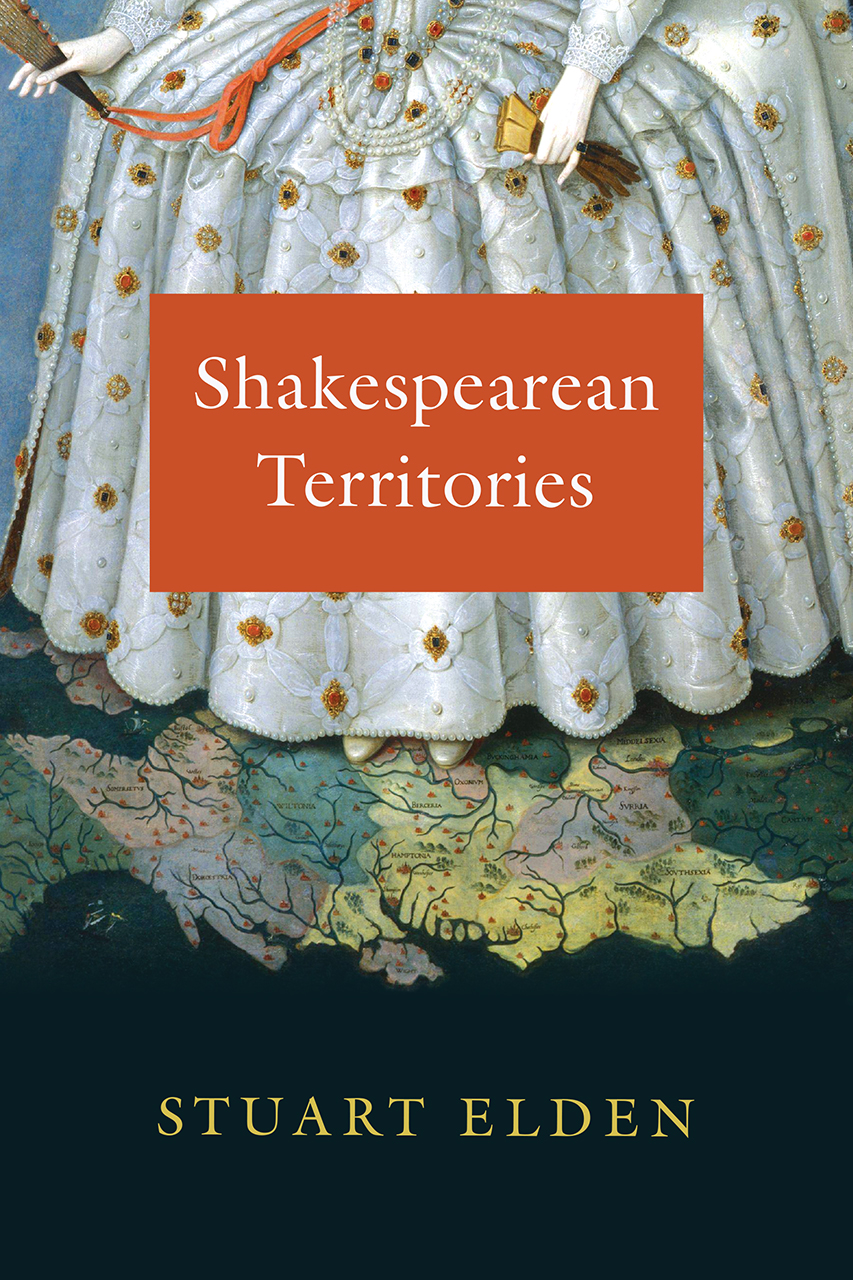
What can Shakespeare tell us about territory, and what can territory tell us about Shakespeare?
In Shakespearean Territories(University of Chicago Press, 2018),Stuart Elden, Professor of Political Theory and Geography at the University of Warwick and author of the Progressive Geographies blog, explores both of these questions, drawing on his earlier work theorising territory, as well as an extensive discussion of numerous works of Shakespeare. The book considers a range of subjects associated with the concept of territory, from the geo-politics of King Lear, the idea of sovereignty in King John, and power in Richard II, to questions of the body in Coriolanus, and ideas of calculation and measurement in The Merchant of Venice. Alongside Shakespeare’s relevance for understanding territory, territory offers a framework for alternative readings of Macbeth and Hamlet, and draws attention to often neglected or even completely ignored parts of Henry V. Fascinating and wide ranging, at the intersection of geography and English literature, the book is essential reading across the humanities and social sciences.
Dave O’Brien is Chancellor’s Fellow, Cultural and Creative Industries, at the University of Edinburgh’s College of Art.
Political scientists and political theorists have long been interested in social and political performance. Theatre and performance researchers have often focused on the political dimensions of the live arts. Yet the interdisciplinary nature of this labor has typically been assumed rather than rigorously explored. Further, it is crucial to bring the concepts of theatre and performance deployed by other disciplines such as psychology, law, political anthropology, sociology among others into a wider, as well as deeper, interdisciplinary engagement. Embodying and fostering that engagement is at the heart of this new handbook.
The Handbook brings together leading scholars in the fields of Politics and Performance to map out the evolving interdisciplinary engagement. The authors–drawn from a wide range of disciplines–investigate the relationship between politics and performance to show that certain features of political transactions shared by performances are fundamental to both disciplines, and that they also share, to a large extent, a common communicational base and language. The volume is organized into seven thematic sections: the interdisciplinary theory of politics and performance; performativity and theatricality (protest, regulation, resistance, change, authority); identities (race, gender, sexuality, class, citizenship, indigeneity); sites (states, borders, markets, law, religion); scripts (accountability, authority and legitimacy, security, ceremony, sustainability); body, voice, and gesture (representation, leadership, participation, rhetoric, disruption); and affect (media, care, love empathy, comedy, populism, memory).
I have a piece in it entitled “Ceremony, Genealogy, Political Theology”. As is the model with these handbooks unfortunately it is hardback and ebook only, at least for now.
Introduction by Milija Gluhovic, Silvija Jestrovic, Shirin Rai, and Michael Saward
Part I: Performativity/Theatricality
1. Lisa Skwirblies – Colonial Theatricality 2. Ameet Parameswaran – Theatricality, Sovereignty, and Resistance: Beyond Theatre of Roots 3. Adrian Kear – Authenticity/Theatricality: World Spectatorship and the Drama of the Image 4. Kate Leader – Law, Presence to Absence: The Case of the Disappearing Defendant 5. Sophie Nield – Towards a Theatrical History of the Picket Line 6. Jorge Cadena-Roa and Cristina Puga – Protest and Performativity 7. Jean-Pascal Daloz – Representation
Part II: Identities
8. Katie Beswick – Class, Race, and Marginality: Informal Street Performances in the City 9. Carole Spary – Gender, Politics, Performance: Embodiment and Representation in Political Institutions 10. Edgaras Klivis – National Identity 11. Ioana Szeman – Performance and Citizenship: The Roma in Europe 12. Yana Meerzon – From Exile to Migration – Staging (the) Face of the Human Waste
Part III: Sites
13. Emma Cox – Island Impasse: Refugee Detention and the Thickening Border 14. Kimberly Wedevan Segall – Media Sites: Political Revivals of American Muslim Women 15. Nirmal Puwar – The Force of the Somatic Norm: Women as Space Invaders in the UK Parliament 16. Matthew Watson – “The Market”: Eighteenth-Century Insights into the Performance of Market Practices 17. Charlotte Heath-Kelly – Staging Memorialisation: Performing the War on Terror and Resilient Nationalism 18. Matt Davies – Urban Sites of the Everyday and the International: The Other City and the Aesthetic Subject 19. Anna Leander – The Politics of Neo-Liberal Rituals: Performing the Institutionalization of Liminality at Trade Fairs 20. Catherine Chinara Charrett – Empire: A Performative Approach to Imperial Frontiers and Formations in Palestine
Part IV: Scripts
21. Desiree Lewis – Nativism: African Bodies and Photographic Performance 22. Willmar Sauter – Immersion 23. Stuart Elden – Ceremony, Genealogy, Political Theology 24. Erzsébet Strausz – Pedagogy: (Mis)performing the Contemporary University 25. Julia C. Strauss – Scripts, Authority, and Legitimacy: The View from China and Beyond 26. John Uhr – Political Leadership: “Saving the Show” 27. Vicky Angelaki – Adaptation and Environment: Landscape, Community and Politics in Henrik Ibsen’s Rosmersholm by Duncan Macmillan (2019)
Part V: Body/Voice/Gesture
28. Sruti Bala – Hurling and Hailing: Scenes of Interruption and Interpellation 29. Alan Finlayson – Performing Political Ideologies 30. M.I. Franklin – Music: Women Rewriting Punk Performance Politics 31. Lisa Fitzpatrick – Eroticism, and the Politics of Representing the Abused Body 32. Bishnupriya Dutt – Performing Gestures at Protests and Other Sites 33. Bree Hadley – What’s in a Name?: The Politics of Labelling in Disability Performance 34. Stephen Coleman – Taking a Position: Contemporary Dance and the Communication of Deep Political Feeling 35. Julia Peetz – The Body Politic and JFK’s Bad Back: Questions of Embodiment in the Performance of Politics
Part VI: Affect
36. Jordana Blejmar – Postmemory: Politics and Performance in Latin America 37. Roland Bleiker and Emma Hutchison – Performing Political Empathy 38. Narelle Warren – Care 39. Nobuko Anan – The Nation as Family: Motherhood and Love in Japan 40. Emma Crewe and Nicholas Sarra – Constituency Performances: The “Heart” of Democratic Politics 41. James Brassett – Comedy and the Performative Politics of Brexit 42. Illan rua Wall – Atmospheres of Protest 43. Goran Petrovic Lotina – Performance and Populism: Choreographing Popular Forms of Collectivity
Understanding how pasts resource presents is a fundamental first step towards building alternative futures in the Anthropocene. This collection brings together scholars from a range of disciplines to explore concepts of care, vulnerability, time, extinction, loss and inheritance across more-than-human worlds, connecting contemporary developments in the posthumanities with the field of critical heritage studies. Drawing on contributions from archaeology, anthropology, critical heritage studies, gender studies, geography, histories of science, media studies, philosophy, and science and technology studies, the book aims to place concepts of heritage at the centre of discussions of the Anthropocene and its associated climate and extinction crises – not as a nostalgic longing for how things were, but as a means of expanding collective imaginations and thinking critically and speculatively about the future and its alternatives. Contributors: Christina Fredengren, Cecilia Åsberg, Anna Bohlin, Adrian Van Allen, Esther Breithoff, Rodney Harrison, Colin Sterling, Joanna Zylinska, Denis Byrne, J. Kelechi Ugwuanyi, Caitlin DeSilvey, Anatolijs Venovcevs, Anna Storm and Claire Colebrook.
“Deterritorializing The Future is without doubt a major contribution to Critical Heritage Studies, and also has significant resonances beyond this emerging field. Anyone concerned with the art of living in ecologically precarious times, anyone who cares about the entanglement of the human and the nonhuman and their planetary legacies needs to read this book.”
Ben Dibley, Institute for Culture and Society, Western Sydney University
Theodor W. Adorno, Notes to Literature (combined edition) – Columbia University Press, 2019, edited by Rolf Tiedemann, translated by Shierry Weber Nicholson, with a new introduction by Paul Kottman.
I’d missed this when it was published late last year.
Notes to Literature is a collection of the great social theorist Theodor W. Adorno’s essays on such writers as Mann, Bloch, Hölderlin, Siegfried Kracauer, Goethe, Benjamin, and Stefan George. It also includes his reflections on a variety of subjects, such as literary titles, the physical qualities of books, political commitment in literature, the light-hearted and the serious in art, and the use of foreign words in writing. This edition presents this classic work in full in a single volume, with a new introduction by Paul Kottman.
This was an exceptionally difficult term – probably the hardest I can remember in twenty-five years of working in universities. It was very hard to make any progress on this manuscript – the fourth and final book in this sequence of studies of Foucault’s career and writings, this time looking at 1962-69.
As I mentioned in the last update some of the work in Wales in the last days of summer was making a long list of things to check when home, back online, with my books and limited access to libraries. This gave a number of small things which I could tick off the list in relatively short periods of time, which does give some sense of progress, however small, when more consolidated periods of writing are harder to get. Warwick’s library was reopened for term, after a long period of closure, although you could order books late in the summer. But getting access to older, non-digitised journals wasn’t possible until it reopened, so when I had a chance I worked through some issues of Critique, Esprit and Tel Quel.
Some of the other work concerned Foucault’s 1965 visit to Brazil and his time in Tunisia between 1966-68. The Brazil visit is discussed by Heliana de Barros Conde Rodrigues, in a book now translated into French as Michel Foucault au Brésil by Antony David Taïeb, and Marcelo Hoffman has been doing some further research on this theme, including editing an issue of the Carceral Notebooks on this topic. Foucault was in Brazil in 1965 to give a course which was based on his then forthcoming book Les mots et les choses (translated as The Order of Things). He returned to Brazil four times in the 1970s, each time giving some important lectures. The manuscript of the 1965 Brazil course is in Paris, and is due to be published in the new sequence of courses and works. I have read the manuscript, but would like some more time with it before finalising this section. But I think I’ve been able to set the text in a context now.
I’ve tried to do similarly for Foucault’s time in Tunisia. There are quite a lot of sources mentioned in the biographies by Didier Eribon and David Macey, and am tracking these down as I continue the work. One revealing interview from this time is in Dits et écrits. One course from Tunisia is also due to be published in the new series. Again, I’ve read this in manuscript but need more time with it. There are a few other lectures from this period which exist in manuscript, and some are published. Initially this was in unauthorised form on the basis of transcriptions, but they are now available in official editions. There are reports of other courses or lectures for which no manuscript trace seems to have survived. More recently, Marnia Lazreg in Foucault’s Orientand Kathryn Medien in an essay on “Foucault in Tunisia” have done some important work on Foucault’s time there, including uncovering some memoirs by some of his students. Both have given me some useful leads to follow up.
Foucault was often back in Paris while in Tunisia, and spent one summer back in his family home near Poitiers. In Paris he gave some lectures and appeared on some radio shows. There was a brief discussion with Raymond Aron on one of these, which was published as a little book a while ago. I’d bought and read it at the time, and didn’t think much of it then, but have returned again and it is an interesting little part of the story. It makes a bit more sense of a somewhat cryptic reference in Defert’s ‘Chronology’. Unfortunately, there seems to be no archival trace of Foucault’s attendance at Aron’s seminar at the Sorbonne around the same time – perhaps not surprising if it was discussion based, rather than a presentation – but there is another potential source, so that’s something else to try to track down whenever I can get back to Paris. The biography of Aron by Nicolas Baverez has a little detail.
The list of things to check in Paris and London libraries is growing. It’s not at all clear when I can get back to Paris. When I cancelled a trip in September I’d half-hoped I’d be able to get there in reading week this term, but that wasn’t possible. I then hoped that I might get there in the Christmas break and now I’m imagining it will be the spring, at best. All the time there is self-isolation for foreign travel it makes a trip impractical. These were intended shorter visits, which have been difficult enough to arrange. Add in the challenges of a post-Brexit relation with the EU, and teaching spread through the year rather than in blocks, and getting to Paris to do the next consolidated period of archival work is getting a whole lot more complicated.
I did have a couple of half-days in the British Library this week. You need to pre-book slots, and there are various other restrictions. But I had some time in the Newsroom with old French newspapers on microfilm, and in the Rare Books room where I was mainly checking a whole host of small things like journal mastheads, articles or chapters in obscure places, original language publications to compare to translations (or vice versa) and so on. There is loads more on my list, but at least while there are these restrictions I am concentrating on smaller things which can be done in shorter visits.
While getting back to Paris and other archives in France seems unlikely until the spring, getting to the USA to do the planned work at Yale and Princeton, and hopefully Irvine, feels even further into the future. Research leave I had in term 3 has been cancelled, and it’s not clear when it will be reinstated. All this means that my original plan for when I’d complete this manuscript is probably unrealistic, but I’m not yet sure enough of anything to come up with a revised plan. I’ve also been applying for research fellowships for the planned project after this, but so far nothing has worked out. I’ve had some particularly disappointing rejections this term.
I had hoped to get back to work on a couple of articles I’d agreed to write over this teaching break, but I started writing something which went in a quite different direction. I might be able to use elements from it in a talk I’ve agreed to give in the New Year, but it doesn’t work for the writing commitments. So I now have fragments of three possible pieces developing from this Foucault work, but can’t work out how to complete any of them.
A little more on this book is here, and updates for The Early Foucaulthere. A list of the resources on this site relating to Foucault – bibliographies, audio and video files, some textual comparisons, some short translations, etc. – can be found here. The earlier books Foucault: The Birth of Powerand Foucault’s Last Decade are both available from Polity. The Early Foucault is forthcoming in June 2021, and is now listed on the Polity site and some online bookstores.
Emanuel Clairizio, Robert Poma and Michel Spanò (eds.), Milieu, mi-lieu, milieux – Éditions Mimesis, 2020
Georges Canguilhem affirmait que la notion de milieu s’était constituée « comme catégorie de la pensée contemporaine ». En effet, depuis que la biologie de Lamarck a établi le postulat de l’influence des milieux de vie dans l’évolution des espèces zoologiques et que le positivisme a repris à son compte cette notion en guise de charnière entre le biologique et le social, elle a trouvé nombre d’applications dans les domaines les plus disparates, de la technologie à la biologie, de l’ethnologie aux sciences politiques, jusqu’à l’esthétique et au droit. Cet ouvrage se propose de repérer la convergence praxéologique de ces regards très divers, faisant du milieu l’enjeu d’une ethnographie des médiations. Il s’agit de penser l’espace de l’action comme un espace toujours relationnel, et l’action comme étant toujours une interaction. Ainsi le milieu apparaît-il à la fois comme le lieu de toute relation à autrui (lieu interstitiel : mi-lieu) et un espace doté de ses normativités propres, par principe multiples : les milieux.
Karl Marx circles us, and we him. This reflects the power of his legacy, but it also indicates the nature of the intellectual process. We move around objects of interest and insight, working by successive approximations. Peter Beilharz has been circling Marx for forty years. This volume of essays expands the metaphor by working through three circles in the history of Marxism. The first works with Marx; the second with the classical legacy, through to Bolshevism and western marxism; the third steps closer to the present , in thinkers such as Bauman, Heller and Castoriadis. Read together, these essays represent a lifetime’s engagement with Marx and his intellectual consequences.
This book is concerned with developing an in-depth understanding of contemporary political and spatial analyses of cities. In the three-part development of the book’s overall argument or premise, the reader is taken in Part I through a range of contemporary critical and political understandings of urban securitizing. This is followed by an historical urban landscape of emerging liberalism and neo-liberalism, in nineteenth-century Britain and twentieth-century United States, respectively. These case-study historical chapters enable the introduction of key political issues that are more critically assayed in Parts II and III. With Part II, the reader is introduced in depth to a series of spatial analyses undertaken by Michel Foucault that have been crucial for especially late-twentieth and twenty-first century urban theory and political geography. With Part III the full ramifications of a paradigmatic shift are explored at the level of rethinking territory, population and design.
This book is timely and useful for readers who want to develop a stronger understanding of what the book’s researchers term a new political paradigm in urban planning, one ultimately governed by global economic forces that define the end of probability.
Just an expensive hardback and slightly cheaper e-book at present, unfortunately.