Marcos Saquet, Approaches and conceptions of territory – Platão, 2020

Marcos Saquet, Approaches and conceptions of territory – Platão, 2020

An English translation of a book originally published in Portuguese – description is in Portuguese below.
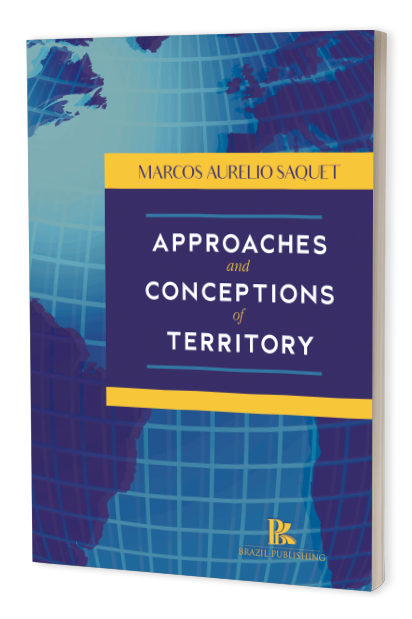
Este texto publicado originalmente em língua portuguesa (2007) está sendo preparado para a 5ª. Edição nesta língua. Ao mesmo tempo, foi publicado em língua italiana, em Milão (2012) e em língua espanhola, em bogotá (2019), tendo ampla circulação em virtude da amplitude de utilização do território.

O território tem sido objeto de estudos em diferentes áreas do conhecimento, como a geografia e a sociologia, a antropologia e a economia, no entanto, teve centralidade na geografia, assumindo histórica e geograficamente distintos significados, alguns conservadores do status quo e outros histórico-críticos. É um conceito polissêmico, de grande amplitude e utilizaçao no ensino, na pesquia e na extensão acadêmica e científica, assim, assume também um significado político e prático fundamental para compreender e transformar a realidade de vida cotidiana, considerando a necessidade de construir uma sociedade mais justa e ecológica. O território, desse modo, é um conceito fundamental, bem como objeto de estudos em diferentes áreas do conhecimento e, ao mesmo tempo, espaço de (in)formação, mobilização, resistência, luta e enfrentamento diante do estado burguês e dos agentes do capital: por de uma abordagem territorial histórico-crítica, conforme argumentamos, voltada para as pessoas mais simples e humildes, é tranquilamente viável a construção de projetos de desenvolvimento territorial de base local, ecológica e cultural, trabalhando-se para e com as pessoas, numa perspectiva dialógica, solidária, participativa e cooperada. Pesquisa e ação, diálogo e reflexão podem acontecer simultaneamente, no nível de cada território, em diferentes níveis escalares, em uma práxis popular e sustentável, entendendo-se o território como patrimônio da humanidade e lugar de vida saudável e emancipatória politicamente.

Posted in Territory | Leave a comment

The Deleuze Seminars – Data Rescue

I’ve mentioned the Deleuze Seminars project before – an online resource gathering recordings, transcriptions and translations of his teaching work. This kind of work is very valuable, but relies on source material. I know from my work on Foucault that sometimes people have recordings or other bits of evidence, and that they don’t always realise the value. So as well as sharing the link to the resource again, I also wanted to publicise the project’s appeal for help.

Data Rescue!

Did you attend Deleuze’s courses during the 1960s, 1970s, or 1980s? Do you have recordings or notes that you would be willing to have posted on The Deleuze Seminars website? 

If so, please email us at <thedeleuzeseminars@gmail.com>, or send us a message using “Contact Us” link in the website. If materials cannot be sent electronically, we will try to cover the cost of shipping them via the regular postal service. Items can be mailed to the director of the project, Daniel W. Smith, Department of Philosophy, Purdue University, 100 N. University Ave., West Lafayette, IN 47907 USA. 

Materials sent to us will be posted as soon as possible, and our hope is that they can ultimately be transcribed and translated.

Background

Deleuze began teaching at the University of Paris, Vincennes-St. Denis in 1969, where he taught until his retirement in 1987. Fortunately for posterity, a Japanese student named Hidenobu Suzuki recorded almost all Deleuze’s seminars between 1979 and 1987, and his cassettes became the basis for the archive established at the Bibliothèque nationale de France. 

However, before 1979 we have few recordings of Deleuze’s seminars, most of which were devoted to the research that resulted in the two volumes of Capitalism and Schizophrenia. The extant recordings from this period primarily were made by Richard Pinhas and are available at WebDeleuze

We are thus launching this data rescue effort to retrieve as many of these recordings as possible from the 1969-1979 decade (and even before). But the clock is ticking. Students who attended Deleuze’s course in 1970 when they were 25 years old are now 75 years old, and the cassette recordings form this period may soon be lost to posterity forever. So if you have recordings or notes—or know someone who does—please let us know. 

We are grateful for your assistance in helping us complete this archive of Deleuze’s seminar lectures.

Posted in Felix Guattari, Gilles Deleuze, Uncategorized | 4 Comments

David Storey (ed.), A Research Agenda for Territory and Territoriality – Elgar, 2020 [paperback 2022]

David Storey (ed.), A Research Agenda for Territory and Territoriality – Edward Elgar, 2020

Just an expensive hardback at present, but Introduction and front matter open access here.

Update: the paperback is now available.

Elgar Research Agendas outline the future of research in a given area. Leading scholars are given the space to explore their subject in provocative ways, and map out the potential directions of travel. They are relevant but also visionary.

This innovative Research Agenda draws together discussions on the conceptualization of territory and the ways in which territory and territorial practices are intimately bound with issues of power and control. Expert contributors provide a critical assessment of key areas of scholarship on territory and territoriality across a wide range of spatial scales and with examples drawn from the global landscape. 

After an introduction to shifting ideas of territory, territoriality and sovereignty, the book deals with territory in its more traditional macro-scale sense at the level of the nation-state before going on to explore questions of territory, identity and belonging at a more micro-scale focusing on issues of citizenship, inclusion and exclusion.

A Research Agenda for Territory and Territoriality will be a key resource for scholars and students in geopolitics and social and cultural geography, whilst also being a thought-provoking read for those interested in nations and nationalism, sovereignty, conflict, citizenship, and territory, place and locality.

Posted in Territory | 1 Comment

Henri Lefebvre, Hegel, Marx, Nietzsche Or the Realm of Shadows – Verso, February 2020 – reviewed at Marx & Philosophy by Kaiyue He

Henri Lefebvre, Hegel, Marx, Nietzsche Or the Realm of Shadows – translated by David Fernbach, introduced by Stuart Elden, Verso, February 2020 – reviewed at Marx & Philosophy by Kaiyue He.

The review is a useful survey of the book and its arguments and is open access. Here’s the Verso blurb of the book.

The great French Marxist philosopher weighs up the contributions of the three major critics of modernity

Henri Lefebvre saw Marx as an ‘unavoidable, necessary, but insufficient starting point’, and always insisted on the importance of Hegel to understanding Marx. Metaphilosophy also suggested the significance he ascribed to Nietzsche, in the ‘realm of shadows’ through which philosophy seeks to think the world. Hegel, Marx, Nietzsche: or the Realm of the Shadows proposes that the modern world is, at the same time, Hegelian in terms of the state, Marxist in terms of the social and society and Nietzschean in terms of civilisation and its values. As early as 1939, Lefebvre had pioneered a French reading of Nietzsche that rejected the philosopher’s appropriation by fascists, bringing out the tragic implications of Nietzsche’s proclamation that ‘God is dead’ long before this approach was followed by such later writers as Foucault, Derrida and Deleuze. Forty years later, in the last of his philosophical writings, Lefebvre juxtaposed the contributions of the three great thinkers, in a text that’s themes remain surprisingly relevant today.

Posted in Uncategorized | Leave a comment

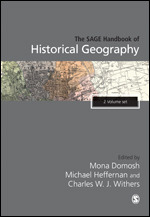
Mona Domosh, Michael Heffernan, Charlie W.J. Withers (eds.), The SAGE Handbook of Historical Geography – Sage, December 2020

Mona Domosh, Michael Heffernan, Charlie W.J. Withers (eds.), The SAGE Handbook of Historical Geography – Sage, December 2020

A major two-volume reference work, but really expensive…

Historical geography is an active, theoretically-informed and vibrant field of study within modern geography, with strong interdisciplinary connections with the humanities and the social sciences. The SAGE Handbook of Historical Geography provides an international and in-depth overview of the field with chapters that examine the history, present condition and future significance of historical geography in relation to recent developments and current research.

The Handbook is in two volumes, divided across nine parts. Volume One includes commentaries on the history and geography of historical geography, and reviews how historical geographers have considered the appropriation, management and representation of landscape, the changing geographies of property, land, money and financial capital, and the demographic, medical and political analysis of the world’s growing and mobile population. 

Volume Two shows how historical geographers have made significant contributions to geopolitical debates about the relationships between nation-states and empires, to environmental challenges posed by human interaction with the natural world, to studies of the cultural, intellectual and political implications of modern science and technology, and to investigations of communicative action, artefacts, performances and representations. The final part reviews the methodological and ethical challenges of historical geography as a publicly engaged research practice.

Posted in Uncategorized | Leave a comment

Stuart Elden, ‘Foucault as Translator of Binswanger and von Weizsäcker’, Theory, Culture & Society, 2020 (open access)

My article ‘Foucault as Translator of Binswanger and von Weizsäcker‘, is now available online first in Theory, Culture & Society, 2020

Foucault’s Introduction to a translation of Ludwig Binswanger’s essay ‘Dream and Existence’ was published in late 1954. The translation was credited to Jacqueline Verdeaux, with Foucault acknowledged for the notes. Yet Verdeaux herself indicates the intensely collaborative nature of their working process and the translation. In 1958, Victor von Weizsäcker’s Der Gestaltkreis was published in French as Le Cycle de la structure, translated by Foucault and Daniel Rocher. Foucault went on to translate and introduce Immanuel Kant’s Anthropology as his secondary doctoral thesis. His engagement with Kant and Binswanger’s ideas has been discussed in the literature, but his role as translator has generally been neglected. His engagement with von Weizsäcker is almost never mentioned. This article critically discusses Foucault’s role in the Binswanger and von Weizsäcker translations, comparing the German originals with the French texts, and showing how this is a useful additional element to the story of the early Foucault.

The article should be available open access, but please contact me if you can’t access it. The article will form part of a theme issue on ‘Foucault before the Collège de France’, which I’m guest editing with Orazio Irrera and Daniele Lorenzini. The article is an initial version of some of the material in The Early Foucault (Polity, June 2021).

Posted in Ludwig Binswanger, Michel Foucault, The Early Foucault | 2 Comments

Talking to Thinkers with Quentin Skinner, 2 November 2020 (video)

Talking to Thinkers with Quentin Skinner with Johnny Lyons, 2 November 2020 (video)

In the episode of Talking to Thinkers Johnny Lyons talks to the eminent historian Quentin Skinner, Barber Beaumont Professor of Humanities at Queen Mary, University of London and former Regius Professor of Modern History at the University of Cambridge

Posted in Quentin Skinnner | Leave a comment

Charlotte Epstein, Birth of the State: The Place of the Body in Crafting Modern Politics – Oxford University Press, December 2020

Charlotte Epstein, Birth of the State: The Place of the Body in Crafting Modern Politics – Oxford University Press, December 2020

This book uses the body to peel back the layers of time and taken-for-granted ideas about the two defining political forms of modernity, the state and the subject of rights. It traces, under the lens of the body, how the state and the subject mutually constituted each other all the way down, by going all the way back, to their original crafting in the seventeenth century. It considers two revolutions. The first, scientific, threw humanity out of the centre of the universe, and transformed the very meanings of matter, space, and the body; while the second, legal and political, re-established humans as the centre-point of the framework of modern rights. 

The book analyses the fundamental rights to security, liberty, and property respectively as the initial knots where the state-subject relation was first sealed. It develops three arguments, that the body served to naturalise security; to individualise liberty; and to privatise property. Covering a wide range of materials–from early modern Dutch painting, to the canon of English political thought, the Anglo-Scottish legal struggles of naturalization, and medical and religious practices–it shows both how the body has operated as history’s great naturaliser, and how it can be mobilised instead as a critical tool that lays bare the deeply racialised and gendered constructions that made the state and the subject of rights. The book returns to the origins of constructivist and constitutive theorising to reclaim their radical and critical potential.

Posted in Uncategorized | Leave a comment

Craig Robertson, The Filing Cabinet: A Vertical History of Information – University of Minnesota Press, May 2021

Craig Robertson, The Filing Cabinet: A Vertical History of Information – University of Minnesota Press, May 2021

The ubiquity of the filing cabinet in the twentieth-century office space, along with its noticeable absence of style, has obscured its transformative role in the histories of both information technology and work. In the first in-depth history of this neglected artifact, Craig Robertson explores how the filing cabinet profoundly shaped the way that information and data have been sorted, stored, retrieved, and used.

Invented in the 1890s, the filing cabinet was a result of the nineteenth-century faith in efficiency. Previously, paper records were arranged haphazardly: bound into books, stacked in piles, curled into slots, or impaled on spindles. The filing cabinet organized loose papers in tabbed folders that could be sorted alphanumerically, radically changing how people accessed, circulated, and structured information.

Robertson’s unconventional history of the origins of the information age posits the filing cabinet as an information storage container, an “automatic memory” machine that contributed to a new type of information labor privileging manual dexterity over mental deliberation. Gendered assumptions about women’s nimble fingers helped to naturalize the changes that brought women into the workforce as low-level clerical workers. The filing cabinet emerges from this unexpected account as a sophisticated piece of information technology and a site of gendered labor that with its folders, files, and tabs continues to shape how we interact with information and data in today’s digital world.

Posted in Uncategorized | Leave a comment

Émile Benveniste, Problems in General Linguistics, Expanded Edition – HAU Books, August 2021 [now listed as February 2023]

Émile Benveniste, Problems in General Linguistics, Expanded Edition – HAU Books, distributed by University of Chicago Press, August 2021 [now listed as February 2023]

First published fifty years ago, Émile Benveniste’s two-volume Problèmes de linguistique générale revolutionized the study of linguistics and remain among the most influential texts in the field. This expanded edition of the first volume presents the original English translation by Mary Elizabeth Meek, produced in close collaboration with Benveniste himself, along with his hitherto untranslated articles on play, translation, singular and plural forms, and Indigenous North American languages. These works are contextualized by an introduction by editor Jordan K. Skinner and a preface by Roland Barthes. 

This new edition will delight linguists and philosophers already familiar with Benveniste and introduce his work to a new generation of students. Benveniste studies are going through an enthusiastic revival in Europe; after reading this book, readers elsewhere will understand why.

HAU books previously published his Dictionary of Indo-European Concepts and Society, which is available open access here. I imagine Problems will also be available in this way as well as in print from University of Chicago Press.

Update June 2021: The Dictionary is no longer available open access, and Problems publication has been put back to November 2021. I understand that due to rights issues this will not be available open access.

Update November 2022: it is now listed as February 2023!

Update November 2024: now showing as December 2025…

Posted in Emile Benveniste, Roland Barthes | 1 Comment