Saiba Varma, The Occupied Clinic: Militarism and Care in Kashmir – Duke University Press, October 2020

Saiba Varma, The Occupied Clinic: Militarism and Care in Kashmir – Duke University Press, October 2020

The Introduction is open access here.
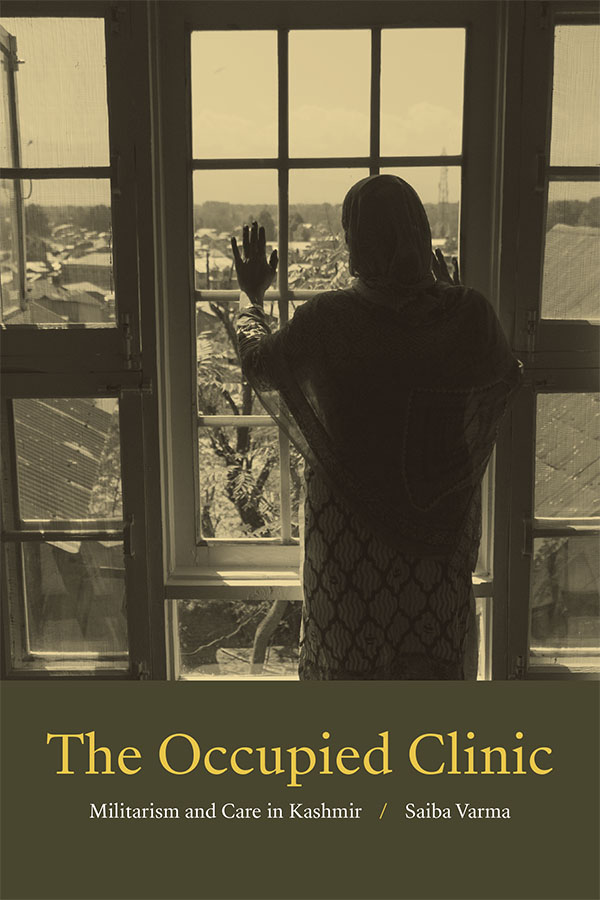
In The Occupied Clinic, Saiba Varma explores the psychological, ontological, and political entanglements between medicine and violence in Indian-controlled Kashmir—the world’s most densely militarized place. Into a long history of occupations, insurgencies, suppressions, natural disasters, and a crisis of public health infrastructure come interventions in human distress, especially those of doctors and humanitarians, who struggle against an epidemic: more than sixty percent of the civilian population suffers from depression, anxiety, PTSD, or acute stress. Drawing on encounters between medical providers and patients in an array of settings, Varma reveals how colonization is embodied and how overlapping state practices of care and violence create disorienting worlds for doctors and patients alike. Varma shows how occupation creates worlds of disrupted meaning in which clinical life is connected to political disorder, subverting biomedical neutrality, ethics, and processes of care in profound ways. By highlighting the imbrications between humanitarianism and militarism and between care and violence, Varma theorizes care not as a redemptive practice, but as a fraught sphere of action that is never quite what it seems.

Posted in Uncategorized | Leave a comment

Federico Italiano (ed.), The Dark Side of Translation – Routledge, 2020

Federico Italiano (ed.), The Dark Side of Translation – Routledge, 2020

We tend to consider translation as something good, virtuous and bright, but it can also function as an instrument of concealment, silencing and misdirection—as something that darkens and obscures. Propaganda, misinformation, narratives of trauma and imagery of the enemy—to mention just a few of the negative phenomena that shape our lives—show patterns of communication in which translation either functions as a weapon or constitutes a space of conflict. But what does this dark side of translation look like? How does it work? 

Ground-breaking in its theoretical conception and pioneering in its thematic approach, this book unites international scholars from a range of disciplines including philosophy, translation studies, literary theory, ecocriticism, game studies, history and political science. With examples that illustrate complex theoretical and philosophical issues, this book also has a major focus on the translational dimension of ecology and climate change.

Transdisciplinary and topical, this book is key reading for researchers, scholars and advanced students of translation studies, literature and related areas.

Posted in Uncategorized | 2 Comments

Conflict in Nagorno-Karabakh: What you need to know about the war between Armenia and Azerbaijan – video with Gerard Toal, John O’Laughlin and Maia Otarashvili

Join us for a special virtual panel discussion about the ongoing conflict between Armenia and Azerbaijan over Nagorno-Karabakh. The “frozen conflict” in Nagorno Karabakh is no longer “frozen”. Fighting between Armenian and Azerbaijani forces over the breakaway territory of Nagorno-Karabakh renewed on September 27th and still continues to rage. The current death toll stands at nearly 300 and counting, this includes civilians. Both sides are shelling major cities, and the conflict appears to be intensifying. The conflict has major ramifications not just for Armenia and Azerbaijan, but also for the region more broadly and could draw in major regional powers – Russia, Turkey, Iran. It threatens to destabilize the Black Sea/ Caucasus region, where peace is already fragile.

Video from 15 October 2020

Posted in Uncategorized | Leave a comment

Mira L. Siegelberg, Statelessness: A Modern History – Harvard University Press, 2020

Mira L. Siegelberg, Statelessness: A Modern History – Harvard University Press, 2020

The story of how a much-contested legal category—statelessness—transformed the international legal order and redefined the relationship between states and their citizens.

Two world wars left millions stranded in Europe. The collapse of empires and the rise of independent states in the twentieth century produced an unprecedented number of people without national belonging and with nowhere to go. Mira Siegelberg’s innovative history weaves together ideas about law and politics, rights and citizenship, with the intimate plight of stateless persons, to explore how and why the problem of statelessness compelled a new understanding of the international order in the twentieth century and beyond.

In the years following the First World War, the legal category of statelessness generated novel visions of cosmopolitan political and legal organization and challenged efforts to limit the boundaries of national membership and international authority. Yet, as Siegelberg shows, the emergence of mass statelessness ultimately gave rise to the rights regime created after World War II, which empowered the territorial state as the fundamental source of protection and rights, against alternative political configurations.

Today we live with the results: more than twelve million people are stateless and millions more belong to categories of recent invention, including refugees and asylum seekers. By uncovering the ideological origins of the international agreements that define categories of citizenship and non-citizenship, Statelessness better equips us to confront current dilemmas of political organization and authority at the global level.

Update: Isadora Dullaert reviews this at the LSE Review of Books

Posted in Uncategorized | 1 Comment

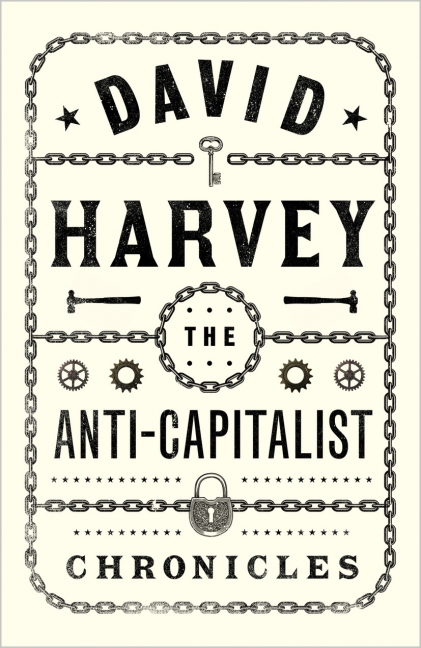
David Harvey, The Anti-Capitalist Chronicles – Pluto, October 2020

stuartelden's avatarProgressive Geographies

4930David Harvey, The Anti-Capitalist Chronicles – Pluto, October 2020

Amidst waves of economic crises, class struggle and neo-fascist reaction, few possess the clarity and foresight of world-renowned theorist, David Harvey. Since the publication of his bestselling A Brief History of Neoliberalism, Harvey has been tracking the evolution of the capitalist system as well as tides of radical opposition rising against it. In The Anti-Capitalist Chronicles, Harvey introduces new ways of understanding the crisis of global capitalism and the struggles for a better world.

While accounting for violence and disaster, Harvey also chronicles hope and possibility. By way of conversations about neoliberalism, capitalism, globalisation, the environment, technology and social movements, he outlines, with characteristic brilliance, how socialist alternatives are being imagined under very difficult circumstances.

In understanding the economic, political and social dimensions of the crisis, Harvey’s analysis in The Anti-Capitalist Chronicles will be of strategic importance to anyone…

View original post 8 more words

Posted in Uncategorized | Leave a comment

Capture: American Pursuits and the Making of a New Animal Condition (2020)

Antoine Traisnel, Capture: American Pursuits and the Making of a New Animal Condition – University of Minnesota Press, 2020

Clare O'Farrell's avatarFoucault News

Antoine Traisnel,Capture: American Pursuits and the Making of a New Animal Condition, Minnesota University Press, 2020

University of Minnesota Press | 368 pages | September 2020
ISBN 978-1-5179-0964-2 | paper | $27.00

ISBN 978-1-5179-0963-5 | cloth | $108.00

Reading canonical works of the nineteenth century through the modern transformation of human-animal relations

Antoine Traisnel reveals how the drive to contain and record disappearing animals was a central feature and organizing pursuit of the nineteenth-century U.S. cultural canon. Capture offers a critical genealogy of the dominant representation of animals as elusive, precarious, and endangered that came to circulate widely in the nineteenth century.

From Audubon’s still-life watercolors to Muybridge’s trip-wire locomotion studies, from Melville’s epic chases to Poe’s detective hunts, the nineteenth century witnessed a surge of artistic, literary, and scientific treatments that sought to “capture” the truth of animals at the historical moment when animals were receding from…

View original post 166 more words

Posted in Uncategorized | Leave a comment

Peter Brooks, Balzac’s Lives – NYRB, October 2020

Peter Brooks, Balzac’s Lives – NYRB, October 2020

Balzac, more than anyone, invented the nineteenth-century novel, and Oscar Wilde went so far as to say that Balzac had invented the nineteenth century. But it was above all through the wonderful, unforgettable, extravagant characters that Balzac dreamed up and made flesh—entrepreneurs, bankers, inventors, industrialists, poets, artists, bohemians of both sexes, journalists, aristocrats, politicians, prostitutes—that he brought to life the dynamic forces of an era that ushered in our own. Peter Brooks’s Balzac’s Lives is a vivid and searching portrait of a great novelist as revealed through the fictional lives he imagined.

Posted in Uncategorized | Leave a comment

Penser/Panser avec Bernard Stiegler – tribute organised by Peter Szendy and Emily Apter

Penser/Panser avec Bernard Stiegler – tribute organised by Peter Szendy and Emily Apter – with Achille Mbembe, Shaj Mohan, Michel Deguy, Divya Dwivedi, Martin Crowley, Katie Chenoweth, Daniel Hoffman-Schwartz, Alexander Galloway, Claire Colebrook, Jean-Luc Nancy. Thanks to dmf for the link.

Posted in Achille Mbembe, Bernard Stiegler | 1 Comment

Global book talk – Zygmunt Bauman: Life and Biography

Two chances to hear a discussion of Izabela Wagner’s new biography of Zygmunt Bauman.

Posted in Uncategorized | 1 Comment

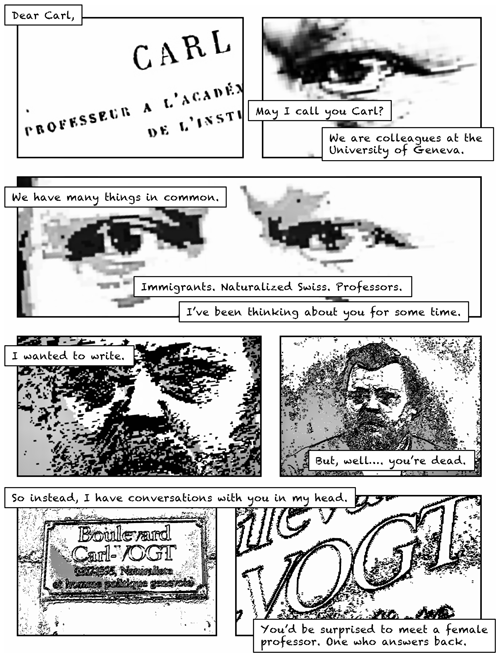
Juliet J. Fall, “Dear Carl”: thinking visually and geographically about public figures – Geographica Helvetica (open access)

I don’t often share journal articles, but this is an interesting and innovative piece which is also available open access, on the contested legacy of Carl Vogt.

Juliet J. Fall, “Dear Carl”: thinking visually and geographically about public figures – Geographica Helvetica (open access).

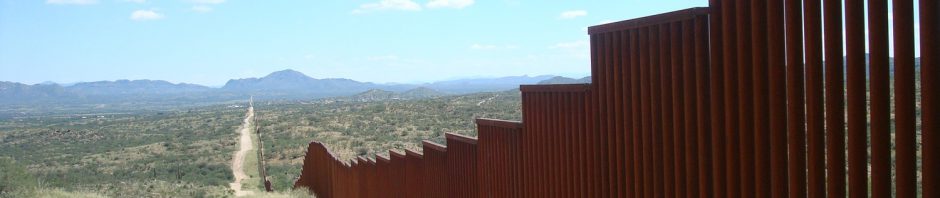
It uses a similar story-board/graphic novel approach to her earlier piece ‘Fenced In‘ (also open access).

Posted in Juliet Fall, Uncategorized | Leave a comment