Fresh perspectives on how medical texts, broadly construed, were recorded, perceived and utilised.
The past few decades have witnessed significant shifts in the scholarly investigation of early medieval medicine and its texts, moving far beyond outdated stereotypes of stagnation and superstition, not least via close study of the manuscript evidence, which has enabled a better appreciation of the processes involved in the recording and transfer of medical knowledge and healing practices. This book builds on these recent developments. With a particular focus on transmission, translation and transformation, the essays collected here offer detailed explorations of sources, contexts, producers and uses, examining material ranging from Bald’s Leechbook and continental Latin recipe collections to Old Norse sagas and a Byzantine Greek treatise on venomous animals (Book V of Paul of Aegina’s Pragmateia). Several contributors explore Old English’s multifarious connections with the Latin tradition, discussing charms, obstetric and gynaecological texts, as well as the Peri didaxeon. The volume concludes with an afterword by Peregrine Horden on future directions of study, inviting further research into this vibrant and growing field.
Chapter 3 is available as Open Access under the Creative Commons licence CC BY-NC-ND. The article received funding from the European Research Council (ERC) under the European Union’s Horizon 2020 research and innovation programme (grant agreement no. 101018645.
En 1954, Jean Hyppolite, professeur d’histoire de la philosophie à la Sorbonne, donne ces quatre conférences au Centre européen universitaire de Nancy. Il s’agit du seul travail qu’Hyppolite a consacré à l’auteur de Clio, et l’une des rares lectures philosophiques de Péguy.
In 1954, Jean Hyppolite, professor of the history of philosophy at the Sorbonne, gave these four lectures at the European University Center in Nancy. This is the only work Hyppolite devoted to the author of Clio, and all in all a rare philosophical reading of Péguy.
In May 1978, Foucault edited the memoir of a “hermaphrodite”, Herculine Barbin, for publication. In the dossier of documents appended to that text he says that “the question of strange destinies like these and which posed such problems for medicine and law since the sixteenth century will be treated in the volume of the History of Sexuality that will be devoted to hermaphrodites” (French p. 131, English p. 119).
That volume was never published. It was not listed in the original 1976 plan of future volumes, as outlined on the back cover of the first volume and elsewhere; nor was it in the final list of volumes announced in volumes two and three in 1984. In 1976 Foucault had promised a volume on Les Pervers – perverts or the perverse – which may have contained a discussion of these challenging bodies, but by 1978 he was talking of the book on hermaphrodites as a separate volume. This change must have happened around this time, because the listing in the 1977 preface to the German translation of the first volume, Sexualität und Wahrheit, which differs from the original French list, does not mention it.
In a posthumously published interview, from 29 May 1979 with Frank Mort and Roy Peters, Foucault is asked about the History of Sexuality series. He says he does not want to complete the five or six books originally envisioned, but has clearly not abandoned the project entirely. “Just now I am writing the second one about the Catholic Christian confessional, and also the third one on hermaphroditism” (“Foucault Recalled”, p. 12). Today, the term “hermaphrodite” is somewhat outdated as a reference to humans, and “intersex” is often used instead. But this is the term Foucault uses, referring to a range of historical cases, and I will follow his usage here. (For wider discussions, Alice Domurat Dreger, Hermaphrodites and the Medical Invention of Sex and Alex Sharpe, Foucault’s Monsters and the Challenge of Law are helpful.)
Foucault was asked to speak at a conference organised to commemorate 25 years of the homophile journal Arcadie in late May 1979, and chose to speak on the Barbin case. His paper did not appear in the proceedings, Le Regard des autres,published later that year. Instead, a short report previously published in the journal was included in its place. That report is cited by Didier Eribon in Michel Foucault et ses contemporains, and Foucault is reported as saying: “Pleasure is something which passes from one individual to another, it is not a secretion of identity. Pleasure has no passport, no identity card” (p. 271). This conference paper was developed into the introduction to the English translation of the Barbin memoir, dated to January 1980 (p. xvii), which was also published in French in Arcadie in November that year, and then reprinted in Dits et écrits in 1994. Eribon reports that André Baudry, founder of the journal, said Foucault did not want his original talk published in the proceedings, but wanted to continue working on it (Michel Foucault et ses contemporains, p. 272 n. 1).
It’s long been known that Foucault wrote another text on hermaphrodites, since the editors of Foucault’s 1974-75 course at the Collège de France, Les Anormaux, translated as Abnormal, had access to some unpublished material for their editorial work. In 1999 Valerio Marchetti and Antonella Salomoni say that a manuscript exists in Foucault’s papers. “To start with this manuscript seems to be the extension of the dossier on monsters. However, it soon becomes autonomous” (“Situation du cours”, p. 324; “Course Context”, p. 339). Foucault discusses hermaphrodites in that course, particularly in the lecture of 22 January 1975. The lecture discussed some cases, particularly Marie/Martin Lemarcis (or Le Marcis) and Anne/Jean-Baptiste Grandjean, which Foucault does not mention in the Introduction to the Barbin memoir.
The editors of the course say that in the lecture Foucault was drawing upon
a wide collection of data, bibliographies, and transcriptions preserved in a box file that we have been able consult thanks to the generosity of Daniel Defert, and which clearly indicate the plan of publication of an anthology of texts. The two cases inserted into the course Les Anormaux represent the most important emphases with regard to medico-legal discussion of bisexuality in the Modern Age (“Situation du cours”, p. 325; “Course Context”, p. 340).
As I discussed in Foucault’s Last Decadein 2016, though without access to unpublished material, there were several indications that Foucault wrote parts of different volumes of the original plan of the History of Sexuality, even if he published none of them. (I discussed this course’s analysis of hermaphrodites especially in Foucault’s Last Decade,pp. 12-14, and see pp. 50-51, 66; and much earlier with Sharon Cowan in “Words, Ideas, Desires”.) When I was researching and writing Foucault’s Last Decade, around 2013-15, there was very little unpublished material accessible in the archives. It was the work on the “Catholic Christian confessional”, originally on a much later period, which led Foucault further and further back to the early Church and then pagan antiquity. That research became the actually published volumes two, three in 1984 and – many years later – four. It’s not clear he would have returned to the earlier themes had he lived longer, though in 1983 he does suggest he might return to the material on the later church, saying to Hubert Dreyfus and Paul Rabinow he had “more than a draft of a book about sexual ethics in the sixteenth century” (Essential Works 1: Ethics, p. 255).
The Fonds Michel Foucault at the Collège de France is now fully available to researchers, and there are a lot of new documents to analyse. The other volumes of my series of books on Foucault made use of a lot of that material, including the texts from the 1950s and 1960s which have been published in recent years, but I’ve not systematically gone through the extensive manuscripts from the second half of the 1970s and the first half of the 1980s which are now available. Box 82 of the main fonds, NAF 28730, contains a manuscript on hermaphrodites, possibly initially planned to be a chapter within a volume on the perverse, but which seems to be at least the germ of the text Foucault mentions in 1978 and 1979. It seems the manuscript was put aside as the project shifted from a more thematic treatment of the subjects of sexuality to a more historical study that went back to early Christian texts and pagan antiquity.
This manuscript has now been published as a short book, Les Hermaphrodites. Though ultimately unfinished, it is a very interesting text by Foucault, even if his research took him in other directions and he seemingly never returned to it before his death. It is a short text of about 20,000 words, published with a similar amount of introductory and concluding material by the editors. Foucault’s text was written sometime between 1975 and 1978, as it connects to Les Anormaux and his publication of the case of Herculine Barbin. It postdates the lectures and predates the publication of the Barbin memoir, on the basis of textual evidence, as Arianna Sforzini indicates in her valuable introduction (p. 11).
This is the Foucault of Discipline and Punish or the first volume of the History of Sexuality, rather than the more austere and textual style of the later volumes. I know some people were disappointed that the fourth volume of the History of Sexuality was more like volumes two and three than volume one. This text is more like the mid-career work.It’s also quite a polished piece of writing – the editors say that as well as the manuscript, there is a typescript of quite a bit of the text (p. 41). Although the typescript has errors, its existence is a sign the writing was quite developed, since Foucault generally had texts typed only at a fairly late stage. Foucault provides quite a bit of detail on cases of hermaphrodites and the legal and medical discourse about them. It’s quite documentary, but it shows the shifts in understandings. Some of the cases are familiar from Les Anormaux, including Grandjean and Le Marcis; others are different. Foucault does not mention the Barbin case – presumably because it predates his discovery of that story.
A fuller discussion of all the implications of this text is beyond what I can do here, but I was particularly struck by the way Foucault relates these questions to notions of monstrosity and the fantastic, connecting his work, yet again, to that of Georges Canguilhem (pp. 53-54). Canguilhem’s discussion of monstrosity in Knowledge of Life Ch. 7 is one of Foucault’s references (on this, see Elden, Canguilhem, Ch. 6). There are also connections, not just to the History of Sexuality series, but to Foucault’s 1960s lectures on sexuality which were published and translated a few years ago, especially in relation to the discussions of biology. (For discussions of these lectures, see Moore and Elden, “Foucault’s 1960s Lectures on Sexuality” and The Archaeology of Foucault, Ch. 5.) It seems likely that in the discussions of biology he was reading his Collège de France colleague Étienne Wolff’s work too, especially Les Changements de sexeand La science des monstres.
The framing texts by Arianna Sforzini and Éric Fassin are really helpful. Sforzini situates the text within Foucault’s work, showing how it relates to other writings, and Fassin shows how it connects to debates in the more contemporary moment about sex, gender and sexuality. Fassin rightly notes that ‘gender’ is not a term used by Foucault, indicating that its use largely postdates his work (“Postface: Le sexe qui parle”, p. 134). Sforzini discusses both the archival traces and how they fit with published work. I know this period of Foucault’s career well, but I can imagine it would be even more useful for those who perhaps know just parts of the whole sexuality project. She also transcribes parts of another short text by Foucault, found in the same archival box (“Préface: Le chantier « hermaphrodite »”, pp. 32-33). Part of this text is very close to the report of the Arcadie conference:
Pleasure must be freed from the law of sexual identification. Why should the pleasure we experience be masculine or feminine… Pleasure happens, it passes between two, it flares and fades. It is event and invention. It is not the centre of an identity. Masculine/feminine pleasure: that makes no sense. Pleasure without an identity card; pleasure without a passport (NAF 28730, box 82, folder 7 quoted by Sforzini, “Préface”, p. 33).
It seems likely that this text was used by Foucault for the Arcadie conference, the recollection of which by an audience member is quoted by Eribon in Michel Foucault et ses contemporains (p. 271, translated above). Sforzini’s partial transcription helps to join up these different bits of evidence. It’s not clear, though, why this brief text wasn’t included in this short volume as a supplement to the longer manuscript, rather than just parts of it being quoted by Sforzini. [For more on the Arcadie conference, see here.]
It’s also worth noting that the French version of the preface to the Barbin memoir, as it appeared in Arcadie, was a little longer than the English version. Those short additions have never been translated. Dits et écrits text 287 provides the longer French version, marking the differences between it and the English. One of the two main additions is on the direction of conscience, providing a link between the interest in hermaphrodites and confession (Dits et écrits, Vol IV, p. 120). The other is about the complications of the Barbin case, suggesting that she “enjoyed being ‘other’”, but did not have the desire to become the “other sex” (Dits et écrits, Vol IV, p. 121). There is also a short piece containing some brief excerpts from an interview with Foucault in an Italian journal in 1978, at the time the Barbin memoir appeared in French. This is included as Dits et écrits text 237 as “Le mystérieux hermaphrodite”, translated back into French. This text has not been previously translated into English. In this interview, Foucault makes the point that:
In modern civilization, there is a requirement for a strict correspondence between anatomical sex, legal sex and social sex: these sexes must coincide and place us in one of two columns of society. Before the 17th century though, there was a fairly large margin of movement (Dits et écrits, Vol III, p. 624).
In this interview, Foucault makes some links between Christianity and the question of hermaphrodites, and says that “one of the main aspects that a history of hermaphroditism should elucidate” is the question “how did we arrive at this condemnation of two entirely distinct phenomena: hermaphroditism and homosexuality?” (p. 625). It’s a short but important text. A translation of these two texts – this short Italian interview and the longer version of the Barbin introduction – would be a useful addition to any future English translation of Les Hermaphrodites.
[Update 17 December 2025: The first edition of Herculine Barbin was published on 26 May 1978. Roland Barthes mentions it and the forthcoming volume on hermaphrodites in his Collège de France lecture of 3 June 1978: Le Neutre: Notes de cours au Collège de France 1977-1978, ed. Thomas Clerc, Paris: Seuil/IMEC, 2002,239; The Neutral: Lecture Course at the Collège de France (1977-1978), trans. Rosalind E. Krauss and Denis Hollier, New York: Columbia University Press, 2005, 191.]
References
Herculine Barbin dite Alexina B, ed. Michel Foucault, Paris: Gallimard, 1978; Herculine Barbin, Being the Recently Discovered Memoirs of a Nineteenth-century French Hermaphrodite, trans. Richard McDougall, New York: Pantheon, 1980.
Le Regard des autres: Actes du congrès international tenu de 24 au 27 mai 1979, Paris: Arcadie, 1979.
Georges Canguilhem, La connaissance de la vie, Paris: Vrin, 2nd revised editionn, 1965 [1952]; trans. Stefanos Geroulanos and Daniela Ginsburg, Knowledge of Life, New York: Fordham University Press, 2009.
Sharon Cowan and Stuart Elden, “Words, Ideas and Desires: Freud, Foucault and the Hermaphroditic Roots of Bisexuality”, Pli: Warwick Journal of Philosophy, Vol 13, 2002, 79-99.
Alice Domurat Dreger, Hermaphrodites and the Medical Invention of Sex,Cambridge, MA: Harvard University Press, 1998.
Stuart Elden, Foucault’s Last Decade, Cambridge: Polity, 2016.
Stuart Elden, Canguilhem, Cambridge: Polity, 2019.
Stuart Elden, The Archaeology of Foucault, Cambridge: Polity, 2023.
Didier Eribon, Michel Foucault et ses contemporains, Paris: Fayard, 1994.
Éric Fassin, “Postface: Le sexe qui parle”, in Michel Foucault, Les Hermaphrodites, eds. Henri-Paul Fruchaud and Arianna Sforzini, Paris: Gallimard, 2025, 121-53.
Michel Foucault, “Le mystérieux hermaphrodite”, trans. Christian Lazzeri, in Dits et écrits, eds. Daniel Defert and François Ewald, Paris: Gallimard, four volumes, 1994, Vol III, pp. 624-25.
Michel Foucault, “Introduction”, in Herculine Barbin, Being the Recently Discovered Memoirs of a Nineteenth-century French Hermaphrodite, trans. Richard McDougall, Brighton: Harvester, 1980.
Michel Foucault, “Le vrai sexe”, Arcadie 27 (323), 1980, 617-25; reprinted in Dits et écrits, eds. Daniel Defert and François Ewald, Paris: Gallimard, four volumes, 1994, Vol IV, 115-23.
Michel Foucault, “On the Genealogy of Ethics”, in Essential Works, eds. Paul Rabinow and James Faubion, trans. Robert Hurley and others, London: Allen Lane, 3 vols., 1997-2000, Vol 1, 253-80.
Michel Foucault, Les Anormaux: Cours au Collège de France, 1974-1975, eds. Valerio Marchetti and Antonella Salomoni, EHESS/Gallimard/Seuil, 1999, revised edition by Élisabetta Basso, Paris: Points, 2024; trans. Graham Burchell as Abnormal: Lectures at the Collège de France 1974–1975, London: Verso, 2003.
Michel Foucault, La Sexualité: Cours donné à l’université de Clermont- Ferrand (1964), suivi de Le Discours de la sexualité: Cours donné à l’université de Vincennes (1969), ed. Claude- Olivier Doron, Paris: EHESS/Gallimard/Seuil, 2018; Sexuality: The 1964 Clermont-Ferrand and 1969 Vincennes Lectures, trans. Graham Burchell, New York: Columbia University Press, 2021.
Michel Foucault, Les Hermaphrodites, eds. Henri-Paul Fruchaud and Arianna Sforzini, Paris: Gallimard, 2025.
Valerio Marchetti and Antonella Salomoni, “Situation du cours”, in Michel Foucault, Les Anormaux, eds. Valerio Marchetti and Antonella Salomoni, EHESS/Gallimard/Seuil, 1999, 315-37; “Course Context”, trans. Graham Burchell as Abnormal: Lectures at the Collège de France 1974–5, London: Verso, 2003, 331-56.
Alison Downham Moore and Stuart Elden, “Foucault’s 1960s Lectures on Sexuality”, Theory, Culture and Society 40 (1-2), 2023, 279-93.
Frank Mort and Roy Peters, ‘Foucault Recalled: Interview with Michel Foucault’, New Formations 55, 2005, 9-22.
Alex Sharpe, Foucault’s Monsters and the Challenge of Law, London: Routledge, 2010.
Arianna Sforzini, “Préface: Le chantier « hermaphrodite »”, in Michel Foucault, Les Hermaphrodites, eds. Henri-Paul Fruchaud and Arianna Sforzini, Paris: Gallimard, 2025, 7-39.
Étienne Wolff, Les Changements de sexe, Paris: Gallimard, 1946.
Étienne Wolff, La science des monstres, Paris: Gallimard, 1948.
Archives
Fonds Michel Foucault, NAF 28730, Bibliothèque nationale de France
This is the 44th post of a weekly series, where I post short essays with some indications of further reading and sources, but which are not as formal as something I’d try to publish more conventionally. They are usually tangential to my main writing focus, a home for spare ideas, asides, dead-ends and possible futures. I hope there is some interest in them. They are provisional and suggestions are welcome. A few, usually shorter, pieces in a similar style have been posted mid-week. This week I posted David Harvey in Paris: A Tribute for his 90th Birthday on 31 October 2025, to coincide with the anniversary itself.
The full chronological list of ‘Sunday histories’ is here, with a thematic ordering here.
Given all his other achievements, Edward Said’s role in bringing Foucault’s work to an anglophone audience is perhaps understated today. His 1971 essay “Abecedarium culturae”, in Northwestern’s literary journal TriQuarterly was a significant piece on so-called “structuralism”, and the following year’s “Michel Foucault as an Intellectual Imagination” was one of the first articles devoted to Foucault in the United States. It was possibly the first, apart from reviews. “Michel Foucault as an Intellectual Imagination” appeared as the first article in the launch issue of boundary 2, invited by William Spanos. “Abecedarium culturae” was reprinted in Modern French Criticism: From Proust and Valery to Structuralism, a collection edited by Foucault’s host for his visits to Buffalo, John K. Simon. Said’s 1975 book Beginnings has a chapter entitled “Abecedarium culturae” which takes material from both the earlier essays. [continues here]
This Element offers the first comprehensive study of Hegel’s views on European colonialism. In surprisingly detailed discussions scattered throughout much of his mature oeuvre, Hegel offers assessments that legitimise colonialism in the Americas, the enslavement of Africans, and British rule in India. The Element reconstructs these discussions as being held together by a systematic account of colonialism as racial domination, underpinned by central elements of his philosophy and situated within long-overlooked contexts, including Hegel’s engagement with British abolitionism and Scottish four-stages theories of social development. Challenging prevailing approaches in scholarship, James and Knappik show that Hegel’s accounts of issues like freedom, personhood and the dialectic of lordship and bondage are deeply entangled with his disturbing views on colonialism, slavery, and race. Lastly, they address Hegel’s ambivalent legacy, examining how British Idealists and others adopted his pro-colonial ideas, while thinkers like C. L. R. James and Angela Davis transformed them for anti-colonial purposes. This title is also available as open access on Cambridge Core.
Choice touches virtually every aspect of our lives, from what to buy and where to live to whom to love, what profession to practice, and even what to believe. But the option to choose in such matters was not something we always possessed or even aspired to. At the same time, we have been warned by everybody from marketing gurus to psychologists about the negative consequences stemming from our current obsession with choice. It turns out that not only are we not very good at realizing our personal desires, we are also overwhelmed with too many possibilities and anxious about what best to select. There are social costs too. How did all this happen? The Age of Choice tells the long history of the invention of choice as the defining feature of modern freedom.
Taking readers from the seventeenth century to today, Sophia Rosenfeld describes how the early modern world witnessed the simultaneous rise of shopping as an activity and religious freedom as a matter of being able to pick one’s convictions. Similarly, she traces the history of choice in romantic life, politics, and the ideals of human rights. Throughout, she pays particular attention to the lives of women, those often with the fewest choices, who have frequently been the drivers of this change. She concludes with an exploration of how reproductive rights have become a symbolic flashpoint in our contemporary struggles over the association of liberty with choice.
Drawing on a wealth of sources ranging from novels and restaurant menus to the latest scientific findings about choice in psychology and economics, The Age of Choice urges us to rethink the meaning of choice and its promise and limitations in modern life.
In a retrospective of his long career, first published in 2021, David Harvey made the following claim:
I have written quite a few books over the course of my academic career, beginning with Explanation in Geography (Harvey, 1969) and most recently Marx, Capital and the Madness of Economic Reason (Harvey, 2017). I am often asked which of these many books I consider to be the most important. My invariable answer is Limits to Capital (Harvey, 1982) and Paris, Capital of Modernity (Harvey, 2003), the first draft of which appeared in Consciousness and the Urban Experience (Harvey, 1985) (“Reflections on an Academic Life”, p. 2).
I wonder whether others were as surprised by this as me. Not by the inclusion of The Limits to Capital, which is arguably the most important book written by a geographer in my lifetime, but by its pairing with Paris, Capital of Modernity.
Today, 31 October 2025, David Harvey turns 90. To mark this anniversary, through October Verso have been running a series of pieces on his books, and I want this piece to be a minor additional tribute to his life and work, especially his writings on Paris. By Harvey and Paris, I mean his writings on this city, and particularly this book, rather than his links to French theorists or, as he describes it, his “frustrating sabbatical year in Paris in 1975-1976” (“Reflections on an Academic Life”, p. 3; though see Spaces of Capital, p. 12 which says it was 1976-77).
He explains the relation between Limits and Paris in an interesting and compelling way:
Having read Marx’s Eighteenth Brumaire of Louis Bonaparte and the Civil War in France, I thought it would be fascinating to read more about what happened to Paris between the revolution of 1848 and the Commune of 1871. I became particularly fascinated by the building and symbolism of the Basilica of Sacré Coeur and began a study of it more or less as an enjoyable side-line. There was something creepy about being inside that building and I was determined to find out what it was. And so the parallel historical-geographical study of urbanization that I planned shifted to Second Empire Paris, even as I ploughed ahead step by step with my Marx studies. The Paris project turned into a labor of love, a respite from the world particularly when everything else seemed to be going very badly. I relished spending summers in Paris reading all sorts of accounts and documents in the stunningly beautiful Biblioteque [sic] Historique de la Ville de Paris in the Marais.
Thus I arrived at the core of my interests: to redirect and advance Marx’s theoretical exploration of the laws of motion of capital in relation to a historical-geographical materialist enquiry into the transformation of Paris between 1848 and 1871. The Paris study was always in the back of my mind as I was writing Limits just as Limits was in my mind while exploring what happened in Second Empire Paris. Bouncing back and forth between the two perspectives was a thrilling intellectual experience. The “bouncing” was in part between theory and practices but it went far deeper than that: it was anchored by the sense of a contradictory unity between social relations in constant transformation on the ground and alien processes of capital accumulation and overaccumulation that rule the economic system as real abstractions. What I learned from doing these two studies in dialogue made the subsequent writing of The Condition of Postmodernity incredibly easy. What I learned from that whole experience has underpinned my work ever since (“Reflections on an Academic Life”, p. 4).
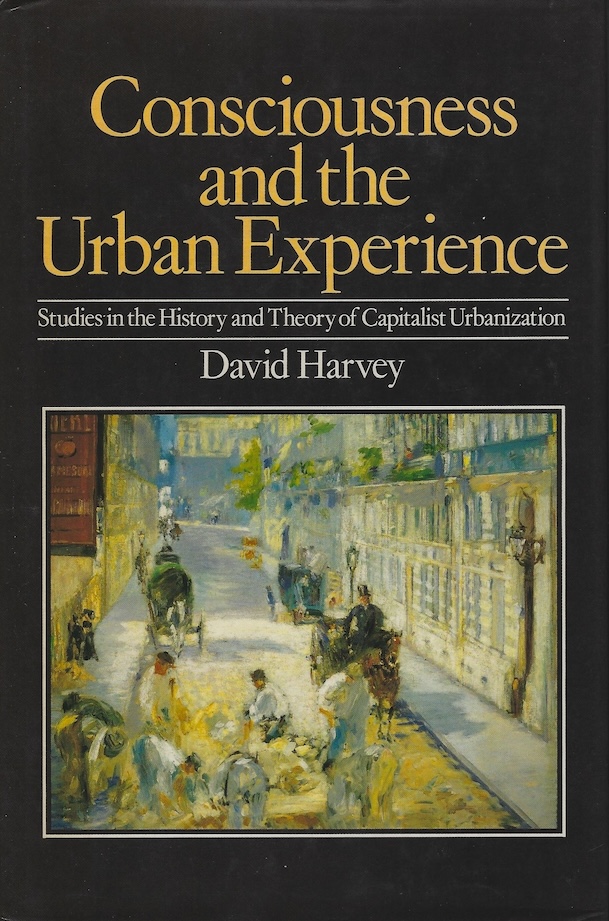
However, the pairing of Limits and Paris are of books almost two decades apart, when this discussion indicates their parallel production. I knew Harvey had written on Paris earlier in his career, as he indicates in this piece, but the original version of the essay is long out of print. It was originally published in one of two hardback volumes with The Johns Hopkins University Press and Basil Blackwell in 1985, a few years after The Limits to Capital (1982). Consciousness and the Urban Experience and The Urbanization of Capital wereboth subtitled Studies in the History and Theory of Capitalist Urbanization and clearly form a pair of connected studies. Neither was reprinted in paperback in the same form, but instead The Urban Experience, published in 1989, compiled several of the previously published essays. As he says in that book:
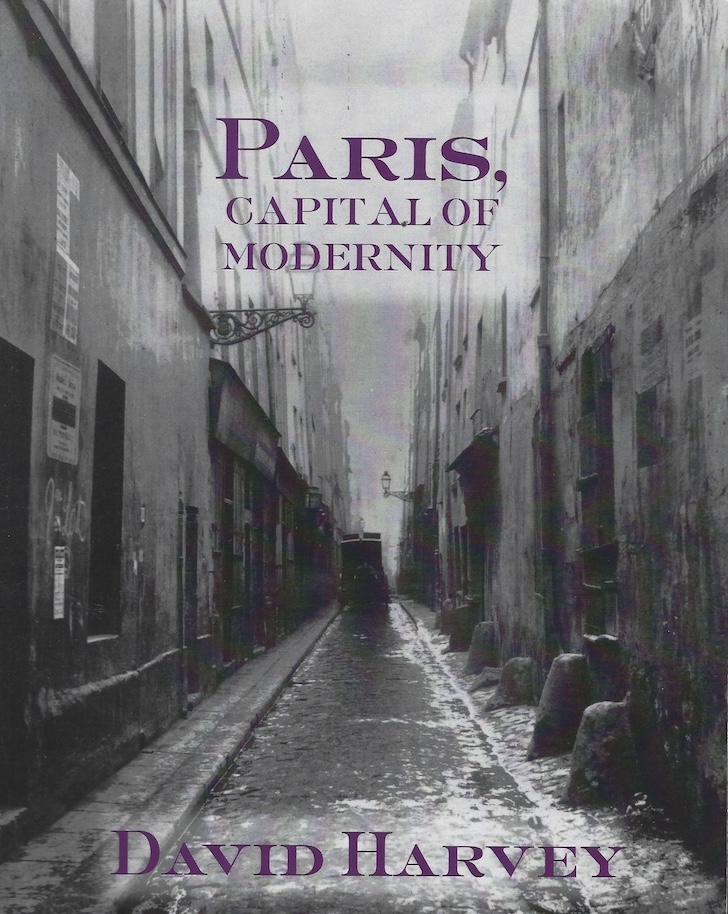
Consciousness and the Urban ExperienceParis, Capital of Modernity
I have chosen the essays for this paperback version with an eye to their theoretical coherence and utility in providing an interpretation of why the urban experience under capitalism takes the form it does. I have added one essay not included in the original volumes because I think it helps illustrate some of the ways in which the theory might be put to work to interpret recent trends. I also felt it useful to transform the original ‘Preface’ into a lengthier ‘Introduction’ and to engage in an extensive re-write of the essay on ‘The Urbanization of Consciousness’ which here appears as chapter 8. Otherwise, the original texts remain unchanged, except of minor alterations to ensure consistency and to eliminate duplication (The Urban Experience,Preface, p. ix).
Some of the essays from Consciousness and the Urban Experience and The Urbanization of Capital which not included in The Urban Experience have been reprinted elsewhere. “The Geography of Capitalist Accumulation: Towards a Reconstruction of the Marxian Theory” is included in Spaces of Capital in 2001, and by far the longest essay in Consciousness and the Urban Experience, “Paris, 1850-1870” (pp. 62-220), is the text reworked as the second part of the 2003 book Paris: Capital of Modernity.
The original long essay, which could have easily been a short book on its own, is a historico-geographical analysis of a tumultuous period in the city, an example of historical-geographical materialism. Paris: Capital of Modernity also includes a reprint of “Monument and Myth: The Building of the Basilica of the Sacred Heart”, also taken from Consciousness and the Urban Experience, as Part III, though this essay had been included in The Urban Experience. Paris: Capital of Modernity starts with a new Introduction, and its Part I comprises “The Myths of Modernity: Balzac’s Paris”, previously published as two book chapters, and a new chapter “Dreaming the Body Politic: Revolutionary Politics and Utopian Schemes, 1830-1848” (see Paris: Capital of Modernity, p. 20).
When asked about the use of literature in his work on Paris, Harvey said that he had always been reading this material, but had never considered using it until this work: “Once I started to do so, I discovered how many historical ideas poetry or fiction can set alight. And once I made that turn, everything came flooding out”. He says this shift was partly because of the security of his academic position, but also partly the “pleasure of the texts themselves, after the hard grind of Limits” (Spaces of Capital, p. 12).
The themes are important, politically and geographically – the 1848 revolution and the reactionary birth of the Second Empire; Baron Haussmann’s transformation of the spaces of Paris; the Paris commune and its violent suppression; and the building of Sacré Coeur on its ruins. Harvey’s purpose is to show how the pivotal year of 1848 was anticipated by longer historical transformations, whether this is in literature, revolutionary politics or urban transformation. Modernity, as seen in these artistic, political and spatial forms, is not the break it is sometimes supposed to be, but a process, a modernization. This is viewed through the clash between a bourgeois, capitalist vision of property, the market and consumption, and a socialist vision of support, improvement and justice.
I don’t remember many reviews at the time of publication, and a quick search now does not produce many pieces. I’ve added references to a few below. And by Harvey’s standards, the citations of the Paris are more limited, though they are the sort of numbers most of us would be delighted by, of course.
As Patricia Tilburg said of the book, describing it as a work of synthesis, “Harvey’s ability to weave place and ideas is one of this eminently readable study’s greatest strengths” (p. 821). Harvey himself describes the book as synthetic, recognising how his book “depends heavily on archival work by others”, but (not entirely convincingly) that because the archives have been “so richly mined” it was possible to use these secondary sources alone (p. 19). Richard A. Walker, in the Verso series for Harvey’s 90th birthday calls the Paris book “his finest piece of writing”. In that Verso series, Andy Merrifield has a much fuller discussion of the historical account of Paris. From a review at the time:
Paris: Capital of Modernity works in multiple registers. It is part urban history, part social history, part political history, and it is the book’s particular virtue to attempt a synthesis of them all. Something of the open-ended, multivalent character of the idea of modernity, however, is lost in the process. The modern has multiple political meanings. It takes a variety of cultural forms, depending on time and place. It has a productivist face as well as a spectacular one. It can be provincial as well as metropolitan. The meaning of the term “modernity” has been the subject of endless debate. Harvey weighs in with a particular take of his own, but it is worth remembering that his take is just one among many (Nord, p. 731).
The same year the Paris book appeared Harvey also published The New Imperialism, bringing his analyses into the present moment – it was one of the first books by a geographer engaging with the ‘war on terror’. Since then, his books have appeared at a regular rhythm of one every year or two – the companions to Marx’s Capital and the Grundrisse and a series on contemporary political economic issues. It’s been an astonishing run of publications in his 70s, 80s and now 90s, with The Story of Capital:What Everyone Should Know About How Capital Worksdue for publication in early 2026. But Harvey has never quite returned to the kind of historical-geographical materialism on display in his work on Paris.
References
Euan Hague, “Paris, Capital of Modernity. David Harvey”, Urban Geography 27 (3), 2006, 293-96.
David Harvey, The Limits to Capital, Oxford: Basil Blackwell, 1982.
David Harvey, Consciousness and the Urban Experience: Studies in the History and Theory of Capitalist Urbanization, Oxford: Basil Blackwell, 1985.
David Harvey, The Urbanization of Capital: Studies in the History and Theory of Capitalist Urbanization, Oxford: Basil Blackwell, 1985.
David Harvey, The Urban Experience, Baltimore: The Johns Hopkins University Press, 1989.
David Harvey, Spaces of Capital: Towards a Critical Geography, New York: Routledge, 2001.
David Harvey, Paris: Capital of Modernity, New York: Routledge, 2003.
David Harvey, The New Imperialism, London: Verso, 2003.
Philip Nord, “Paris: Capital of Modernity by David Harvey”, The Journal of Modern History 78 (3), 2006, 730-31.
Patricia Tilburg. “David Harvey, Paris, Capital of Modernity. New York: Routledge, 2003”, Comparative Studies in Society and History 50 (3), 2008, 820-21.
This piece is in the same style as the ‘Sunday histories‘ posts that I’ve been posting every week through 2025, though this is out of sequence because I wanted to post on Harvey’s birthday. The ‘Sunday Histories’ are short essays with some indications of further reading and sources, but which are not as formal as something I’d try to publish more conventionally. They are usually tangential to my main writing focus, a home for spare ideas, asides, dead-ends and possible futures. I hope there is some interest in them. They are provisional and suggestions are welcome. A few shorter pieces in a similar style have been posted mid-week. This Sunday’s post will be on Foucault’s recently published manuscript,Les Hermaphrodites [update: now available here].
The full chronological list of ‘Sunday histories’ is here, with a thematic ordering here.
Offers the first comprehensive study of Martin Heidegger’s five conversational texts.
Reading Martin Heidegger’s five conversational texts together for the first time, Heidegger’s Conversations elaborates not only what Heidegger thought but howhe did so by attending to the philosophical possibilities of the genre of these under-studied texts written between 1944 and 1954. Though he wrote little on the topic of teaching and learning explicitly, Katherine Davies shows Heidegger performed an implicit poetic pedagogy in his conversations that remains to be recognized. Heidegger launched an experimental attempt to enact a learning of non-representational, non-metaphysical thinking by cultivating a distinctly collaborative sensitivity to the call of the poetic. Davies illustrates how each conversation emphasizes a particular pedagogical element-non-oppositionality, making mistakes, thinking in community, poetic interpretation, and the dangers of such pedagogy-which together constitute the developmental arc of these texts. Whether Heidegger is revising or reinforcing his own earlier pedagogical practices, Davies argues that attending to the dramatic staging of the conversations offers a distinct vantage point from which to contend with Heidegger’s philosophy and politics in the post-war period.
Michel Foucault est un auteur polymorphe, qui a su toucher, par ses écrits et ses interventions, des publics très divers. On s’intéresse dans ce livre aux cours donnés au Collège de France, où Foucault enseigne de 1970 à 1984, et où s’élaborent des concepts qui ont fait sa renommée, comme ceux de biopouvoir, de gouvernementalité et de dire-vrai. Les dix études qui composent cet essai ne visent pas à reconstituer un système ni à proposer un glossaire exhaustif : on y suit une pensée au travail, sans chercher à gommer les difficultés qu’elle affronte, ni les déplacements qu’elle opère. Au gré de ses transformations, on circule au sein de champs multiples – de la pratique punitive aux conduites d’aveu, de la psychiatrie aux stratégies libérales et néolibérales –, et d’époques différentes – de l’Antiquité gréco-romaine à l’avènement de l’État moderne, en passant par le christianisme des débuts et l’Aufklärung. On interroge un cheminement construit, aigu et inquiet, dont l’horizon est éthique et l’enjeu politique : donner forme à l’art de gouverner, c’est garder vive l’actualité de la résistance aux pouvoirs.
Correcting the misunderstood role of maxims at the intersection of early science and literature
Eighteenth-century novels are full of maxims—pithy statements of received wisdom such as “necessity is the mother of invention” or “neither a borrower nor a lender be.” Maxims are ancient rhetorical forms, celebrated by no less an influential figure than Aristotle as powerful tools of persuasion. Critics have generally explained away their ubiquitous presence in eighteenth-century novels as a vestige of a premodern form. As Kelly Swartz explains, however, their presence illustrates an important yet often overlooked aspect of the novel’s relationship with the early empirical sciences.
Applying insights from Francis Bacon’s account of aphorizing as a method of scientific writing to works by Aphra Behn, Jonathan Swift, Samuel Richardson, and Jane Austen, Swartz shows how maxims functioned in a critical role that she calls “unknowing.” Such expressions, she argues, represented the not yet known as a way to inspire in readers a desire for ongoing, collective inquiry. Maxims also allowed these authors to invent unknowing fictional minds, at once attractive and vexing, ranging from the incoherent and banal to the unintelligibly rich. Maxims and the Mind thus offers new insight into the nature of the relationship between science and the early novel, emphasizing their shared interest in the representation of knowledge still awaiting discovery.