Verso Book Club launched – subscription service to receive print and e-books

Book_Club_July-Verso Book Club launched – three levels of subscription, from e-book access to e-book and some physical copies a month, to e-book and more physical copies a month. A good way to support this press at this difficult time for publishing. All levels give a 50% discount for all Verso books.

In our 50th year, we are excited to announce the Verso Book Club! Join now and get every new ebook that we publish, as well as one or more new books in the mail if you choose a print subscription. All Book Club members will also get 50% off everything on our website, for as long as you are a subscriber. To celebrate our 50th year of radical publishing and the launch of our book club, each member tier is 50% off for the first three months.

You can choose between three options: the Verso Reader digital subscription, Verso Subscriber for print and digital, and Verso Comrade to receive even more books in the mail (including one new work of politics or theory every month, as well as the occasional classic from Verso’s backlist). Learn more about the different member options here.

Every month we’ll offer a carefully curated selection of our best new titles, across a wide range of topics and subject areas, to bring you books that everyone at Verso regards as essential reading. In mid-July, we’ll email all members with more details about the August book club selection—including a letter from the editor—so that you can choose which one you want to receive, any time before the end of the month.

Posted in Uncategorized | Leave a comment

The rush to claim an undersea mountain range (BBC News)

The rush to claim an undersea mountain range (BBC News)

Interesting piece on the Lomonosov Ridge between Siberia, Greenland and Canada. Klaus Dodds, Phil Steinberg and Ingrid Medby all interviewed.

Screenshot 2020-07-27 at 09.14.29

Posted in Boundaries, terrain, Territory, Uncategorized | Leave a comment

Laleh Khalili and Rowland Atkinson – global flows of capital, commodities and people (video)

Laleh Khalili and Rowland Atkinson – global flows of capital, commodities and people (video, via The Gamming)

As part of Verso Live events, Rowland Atkinson (author of Alpha City) and Laleh Khalili (author of Sinews of War and Trade) in conversation about global flows of capital, commodities and people.

Posted in Uncategorized | Leave a comment

Historians Call for a Review of Home Office Citizenship and Settlement Test

Historians call for a review of UK Home Office Citizenship and Settlement test

Historical Association's avatarHistory blog archive

21 July 2020

Historians Call for a Review of Home Office Citizenship and Settlement Test

We are historians of Britain and the British Empire and writing in protest at the on-going misrepresentation of slavery and Empire in the “Life in the UK Test”, which is a requirement for applicants for citizenship or settlement (“indefinite leave to remain”) in the United Kingdom. The official handbook published by the Home Office is fundamentally misleading and in places demonstrably false. For example, it states that ‘While slavery was illegal within Britain itself, by the 18th century it was a fully established overseas industry’ (p.42). In fact, whether slavery was legal or illegal within Britain was a matter of debate in the eighteenth century, and many people were held as slaves. The handbook is full of dates and numbers but does not give the number of people transported as slaves on British ships (over…

View original post 2,734 more words

Posted in Uncategorized | Leave a comment

Bradley Garrett, Bunker: Building for the End Times – Allen Lane, August 2020 (and Guardian article)


imageBradley Garrett, Bunker: Building for the End Times – Allen Lane, August 2020

Update: see also this piece in The Guardian

Bunker is an extraordinary achievement; a big-thinking, deep-diving, page-turning study of fear, privilege and apocalypse told through the space of the bunker. Garrett has written a gripping, grim, witty work of geography and ethnography, which he completed – with eerie timeliness – in the first weeks of the COVID pandemic. A book about prepping and prognostication, then, which had already foretold its own future’ Robert MacFarlane

Today, the bunker has become the extreme expression of our greatest fears: from pandemics to climate change and nuclear war. And once you look, it doesn’t take long to start seeing bunkers everywhere.

In Bunker, acclaimed urban explorer and cultural geographer Bradley Garrett explores the global and rapidly growing movement of ‘prepping’ for social and environmental collapse, or ‘Doomsday’. From the ‘dread merchants’ hustling safe spaces in the American mid-West to eco-fortresses in Thailand, from geoscrapers to armoured mobile bunkers, Bunker is a brilliant, original and never less than deeply disturbing story from the frontlines of the way we live now: an illuminating reflection on our age of disquiet and dread that brings it into new, sharp focus.

The bunker, Garrett shows, is all around us: in malls, airports, gated communities, the vehicles we drive. Most of all, he shows, it’s in our minds.

Posted in Uncategorized | 1 Comment

The History of Verso Books with Tariq Ali and Sebastian Budgen (video)

The History of Verso Books – very interesting discussion between Tariq Ali and Sebastian Budgen, which also covers the history of New Left Review, the publishing house New Left Books which became Verso, and the history of the British left more generally. Right at the end there is a discussion of the books they should have published, including one modern classic that they turned down…

Posted in Uncategorized | Leave a comment

Topical map of COVID-19 social research literature

This looks a very useful resource on the academic literature. My own list continues to be updated – https://progressivegeographies.com/resources/geographers-sociologists-philosophers-etc-on-covid-19/

Deborah Lupton's avatarThis Sociological Life

I have been busy checking out the explosion of peer-reviewed articles published recently in social science journals on the COVID crisis. I located over 120 such articles, and have conducted a rapid topic mapping process to support my own COVID-related research.

In case anyone else might find this document useful, it can be accessed here: Lupton – Map of Social Research on COVID 19 July 2020 (updated version 20 July 2020).

View original post

Posted in Uncategorized | Leave a comment

Gilles Deleuze, Letters and Other Texts (Semiotext(e)) June 23, 2020

Deleuze’s Letters and Other Texts translated into English.

Thomas Nail's avatarThe Philosophy of Movement

81yr--rqvLL.jpg

A posthumous collection of writings by Deleuze, including letters, youthful essays, and an interview, many previously unpublished.

Letters and Other Texts is the third and final volume of the posthumous texts of Gilles Deleuze, collected for publication in French on the twentieth anniversary of his death. It contains several letters addressed to his contemporaries (Michel Foucault, Pierre Klossowski, François Châtelet, and Clément Rosset, among others). Of particular importance are the letters addressed to Félix Guattari, which offer an irreplaceable account of their work as a duo from Anti-Oedipus to What is Philosophy? Later letters provide a new perspective on Deleuze’s work as he responds to students’ questions.

his volume also offers a set of unpublished or hard-to-find texts, including some essays from Deleuze’s youth, a few unusual drawings, and a long interview from 1973 on Anti-Oedipus with Guattari.

___________________________________________

Congratulations to David L. This looks like a great…

View original post 28 more words

Posted in Uncategorized | 1 Comment

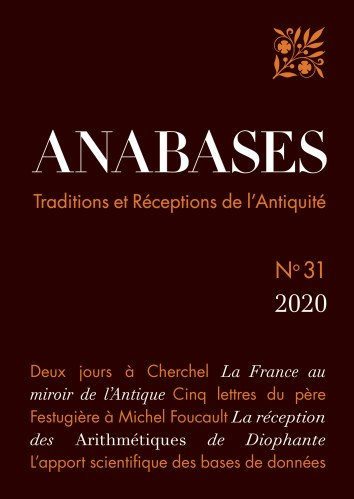
Five letters from père Festugière to Michel Foucault (1956-1957), edited by Pierre Vesperini, Anabases (requires subscription)

Vesperini 2020 - Festugiere FoucaultPierre Vesperini,“« Un gentil mécréant, avec qui l’on entre aussitôt dans le seul monde qui compte »: Cinq lettres du père Festugière à Michel Foucault (1956-1957)”, Anabases 31, 2020, 125-130.

André-Jean Festugière was known to me as the translator of Artemidorus, Onirocritica, which Foucault discusses in the The Care of the Self and the Subjectivity and Truth lectures. I discuss that reading at length in Foucault’s Last Decade. I also knew that in 1956, Foucault invited Festugière to Uppsala to speak at the Maison de France.

Now Pierre Vesperini has published the letters which Festugière sent to Foucault – Foucault’s letters have unfortunately not been found – and they are an interesting insight into an intellectual friendship. Another footnote to The Early Foucault, and an unexpected indication of a line to follow for a future project.

Posted in Michel Foucault, The Early Foucault, Uncategorized | 1 Comment

Lynne Huffer, Foucault’s Strange Eros – Columbia University Press, June 2020

9780231197151Lynne Huffer, Foucault’s Strange Eros – Columbia University Press, June 2020

What is the strange eros that haunts Foucault’s writing? In this deeply original consideration of Foucault’s erotic ethics, Lynne Huffer provocatively rewrites Foucault as a Sapphic poet. She uncovers eros as a mode of thought that erodes the interiority of the thinking subject. Focusing on the ethical implications of this mode of thought, Huffer shows how Foucault’s poetic archival method offers a way to counter the disciplining of speech.

At the heart of this method is a conception of the archive as Sapphic: the past’s remains are, like Sappho’s verses, hole-ridden, scattered, and dissolved by time. Listening for eros across fragmented texts, Huffer stages a series of encounters within an archive of literary and theoretical readings: the eroticization of violence in works by Freud and Eve Kosofsky Sedgwick, the historicity of madness in the Foucault-Derrida debate, the afterlives of Foucault’s antiprison activism, and Monique Wittig’s Sapphic materialism. Through these encounters, Foucault’s Strange Eros conceives of ethics as experiments in living that work poetically to make the present strange. Crafting fragments that dissolve into Sapphic brackets, Huffer performs the ethics she describes in her own practice of experimental writing. Foucault’s Strange Eros hints at the self-hollowing speech of an eros that opens a space for the strange.

In a provocative take on eros as a verb—as erosion of the thinking subject bound by grids of intelligibility that define her identity—Huffer offers the splendid final installment of her Foucault trilogy. Forcefully written with a capacious imagination, this book exemplifies the enviable rewards of a sustained in-depth engagement with Foucault as an ethopoietic thinker.
Rey Chow, author of Not Like a Native Speaker: On Languaging as a Postcolonial Experience

In this innovative and intimate work, Huffer recuperates from the work of Michel Foucault a philosophy of eros with the potential to replace the unduly dominant orders of sexuality. Eros would always be murmuring and calling for various forms of release, including the release of ‘self from self.’ The consequences of eros’ broad scope and elusiveness, are shown to encompasses the full range of Foucault’s work, and to challenging our understanding of freedom, intimacy, passion, ethics, and selfhood.
Penelope Deutscher, author of Foucault’s Futures: A Critique of Reproductive Reason

Foucault’s Strange Eros challenges its readers to describe aptly, to touch delicately their seeking, mortal, embodied selves. The book elicits and sustains their interest. It rejoices on some pages to weep on others, but it is animated throughout by generous reading and creative responding.
Mark Jordan, author of Convulsing Bodies: Religion and Resistance in Foucault

Bowing, bending down, and keeping watch over Foucault’s work, Lynne Huffer listens for Foucault’s Strange Eros and its ethical call. Huffer reads Foucault as a poet, allowing us to hear the discontinuous Sapphic murmur beneath philosophy’s Platonic ground. This is an inspired work of love and a tour de force.
Sverre Raffnsøe, editor in chief of Foucault Studies and author of Michel Foucault: A Research Companion

Foucault’s Strange Eros is a haunting and beautiful book. In this final book in her Foucault trilogy, Lynne Huffer once again returns to the theme of Foucault’s erotic ethics. Drawing on Anne Carson’s new translations and writings on Sappho, she identifies a queer feminist erotic, a non-phallic creative capacity for new relational forms. In this light, Foucault’s genealogies are revealed as rooted in a poignant ethical sensibility—that of a loving and vigilant guardian of the lost ‘little ones’ in the archives, one who uncovers traces of unnecessary and intolerable suffering, and events that did not take place. This is what is meant by thought of the outside—impossible thought, or thoughts and experiences erased and rendered impossible within present conditions of possibility. Thus, Huffer deepens our appreciation of genealogy as an ethical practice of freedom, of eros—a practice that might loosen our attachments to present understandings of self and world—to ways of living that create unnecessary suffering and violence.
Jana Sawicki, Williams College

Thanks to Peter Gratton for the alert.
Posted in Michel Foucault, Uncategorized | Leave a comment