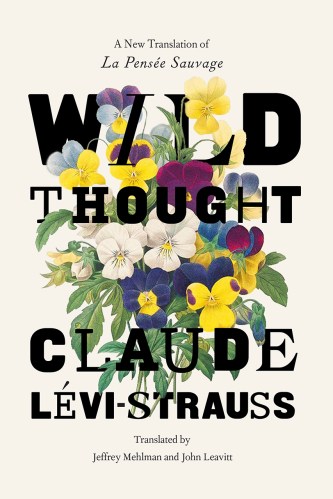
Claude Lévi-Strauss, Wild Thought – a new translation of La pensée sauvage – University of Chicago Press, February 2021 (now published)

9780226413082Claude Lévi-Strauss, Wild Thought – a new translation of La pensée sauvage – translated by Jeffrey Mehlman and John Leavitt, University of Chicago Press, December 2020 [update: now listed as February 2021]

Perhaps the most influential anthropologist of his generation, Claude Lévi-Strauss left a profound mark on the development of twentieth-century thought, equal to that of phenomenology and existentialism. Through a fertile mixture of insights gleaned from linguistics and from sociology and ethnology, Lévi-Strauss elaborated his theory of structural unity in culture and became the preeminent representative of structural anthropology. La Pensée sauvage, published in French in 1962, was his crowning achievement. Ranging over philosophies, historical periods, and human societies, it challenged the prevailing assumption of the superiority of modern Western culture and sought to explain the unity of human intellection.

Unfortunately titled The Savage Mind when it first published in English in 1966, the original translation nevertheless sparked a fascination with Lévi-Strauss’s work among generations of Anglophone readers. Wild Thought: A New Translation of “La Pensée sauvage” rekindles that spark with a fresh and accessible new translation. Including critical annotations for the contemporary reader, it restores the accuracy and integrity of the book that changed the course of twentieth-century thought, making it an indispensable addition to any philosophical and anthropological library.
Posted in Claude Lévi-Strauss, Uncategorized | 1 Comment

Books received – University of Minnesota Press, Sartre, Dumézil, Koyré

IMG_3373 copy

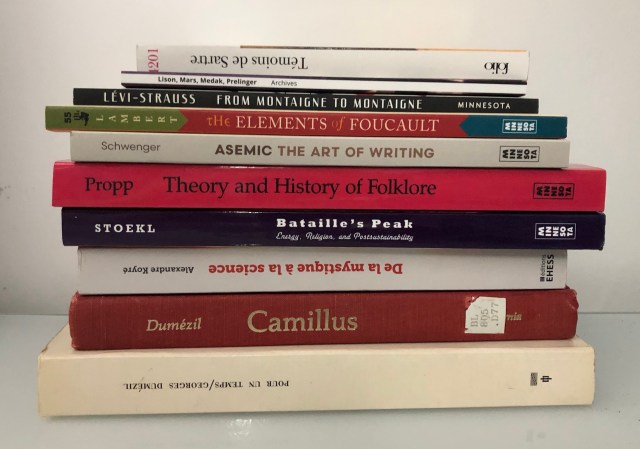
A mixed pile of books, mostly from University of Minnesota Press in recompense for some review work, along with some second-hand French books.

Posted in Georges Bataille, Georges Dumézil, Jean-Paul Sartre, Michel Foucault, Uncategorized | 1 Comment

Franck Billé, Voluminous States: Sovereignty, Materiality, and the Territorial Imagination – Duke UP, August 2020

The Introduction is open access here

stuartelden's avatarProgressive Geographies

Franck Billé, Voluminous States: Sovereignty, Materiality, and the Territorial Imagination – Duke UP, August 2020

From the Arctic to the South China Sea, states are vying to secure sovereign rights over vast maritime stretches, undersea continental plates, shifting ice flows, airspace, and the subsoil. Conceiving of sovereign space as volume rather than area, the contributors to Voluminous States explore how such a conception reveals and underscores the three-dimensional nature of modern territorial governance. In case studies ranging from the United States, Europe, and the Himalayas to Hong Kong, Korea, and Bangladesh, the contributors outline how states are using airspace surveillance, maritime patrols, and subterranean monitoring to gain and exercise sovereignty over three-dimensional space. Whether examining how militaries are digging tunnels to create new theaters of operations, the impacts of climate change on borders, or the relation between borders and nonhuman ecologies, they demonstrate that a three-dimensional approach to studying borders…

View original post 179 more words

Posted in Uncategorized | 1 Comment

Marnia Lazreg, Foucault’s Orient: The Conundrum of Cultural Difference, From Tunisia to Japan (2020 pb)

Good to see this is now out in paperback.

Clare O'Farrell's avatarFoucault News

Marnia Lazreg, Foucault’s Orient: The Conundrum of Cultural Difference, From Tunisia to Japan, Berghahn, 2017, 2020

Now out in paperback

DESCRIPTION
Foucault lived in Tunisia for two years and travelled to Japan and Iran more than once. Yet throughout his critical scholarship, he insisted that the cultures of the “Orient” constitute the “limit” of Western rationality. Using archival research supplemented by interviews with key scholars in Tunisia, Japan and France, this book examines the philosophical sources, evolution as well as contradictions of Foucault’s experience with non-Western cultures. Beyond tracing Foucault’s journey into the world of otherness, the book reveals the personal, political as well as methodological effects of a radical conception of cultural difference that extolled the local over the cosmopolitan.

Marnia Lazreg is professor of sociology at Hunter College and the Graduate Center, City University of New York. Her latest publications include Torture and the Twilight of Empire:…

View original post 17 more words

Posted in Uncategorized | Leave a comment

What Intellectual History Teaches Us: A Conversation with Quentin Skinner (2019)

What Intellectual History Teaches Us: A Conversation with Quentin Skinner – Jeremy Jennings at the Centre for the Study of Governance and Society, Kings College London

A couple of years old, but still interesting in relation to his career, recent books and some more general issues. Transcript and audio here; also on YouTube.

Tune in to a special conversation on the governance podcast between Professor Jeremy Jennings of King’s College London and Professor Quentin Skinner of Queen Mary University. Professor Skinner discusses the meaning of intellectual history, key insights about republicanism and political representation, and the perennial lessons we stand to learn from the humanities about our political present.

Posted in Quentin Skinnner, Uncategorized | Leave a comment

Samuel Talcott, Georges Canguilhem and the Problem of Error reviewed at NDPR by Paul M. Livingstone

9783030007782Samuel Talcott, Georges Canguilhem and the Problem of Error – reviewed at NDPR by Paul M. Livingstone.

Posted in Georges Canguilhem, Uncategorized | Leave a comment

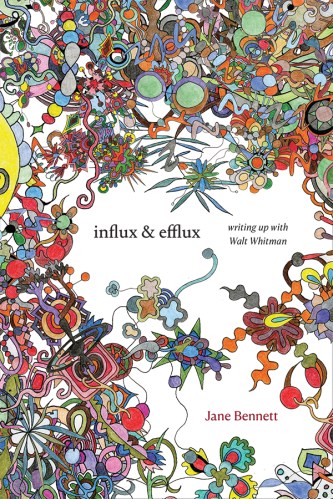
Jane Bennett, Influx and Efflux: Writing Up with Walt Whitman – Duke University Press, 2020 (open access Introduction and discussion)

978-1-4780-0830-9_prJane Bennett, Influx and Efflux: Writing Up with Walt Whitman – Duke University Press, 2020

In influx & efflux Jane Bennett pursues a question that was bracketed in her book Vibrant Matter: how to think about human agency in a world teeming with powerful nonhuman influences? “Influx & efflux”—a phrase borrowed  from Whitman’s “Song of Myself”—refers to everyday movements whereby outside influences enter bodies, infuse and confuse their organization, and then exit, themselves having been transformed into something new. How to describe the human efforts involved in that process? What kinds of “I” and “we” can live well and act effectively in a world of so many other lively materialities? Drawing upon Whitman, Thoreau, Caillois, Whitehead, and other poetic writers, Bennett links a nonanthropocentric model of self to a radically egalitarian pluralism and also to a syntax and style of writing appropriate to the entangled world in which we live. The book tries to enact the uncanny process by which we “write up” influences that pervade, enable, and disrupt us.

“Jane Bennett has always been interested in reading the ecological from a political point of view and articulating an ecological politics. But this book will be a new moment in how we think about ecology and democracy. For it explains to us not only the possibility of ‘ecological democracy’ but also why a truly democratic personality must be ecological: open and attentive, susceptible to otherness, and welcoming influences. Influx & efflux is a wonderful achievement.” — Branka Arsic, author of Bird Relics: Grief and Vitalism in Thoreau

“In this remarkable book Jane Bennett shows us just why a capacious sense of influence matters so much to our efforts to shape the circumstances we find ourselves in. Generous, surprising, and beautifully illustrated, influx & efflux resounds as a compelling affirmation of the value of drawing diverse elements and agencies into new lines of thinking and feeling. This book does nothing less than shift the tone and terms of political theory, offering us a vital poetic vocabulary for making more of the world’s participation in the political and ecological stances we take.” — Derek P. McCormack, author of Atmospheric Things: On the Allure of Elemental Envelopment

The Introduction is open access; there is a discussion here.

Posted in Jane Bennett, Uncategorized | Leave a comment

Books received – Benveniste, Dumézil, Merleau-Ponty, Piel (and a note on the political controversy around Dumézil)

IMG_3360

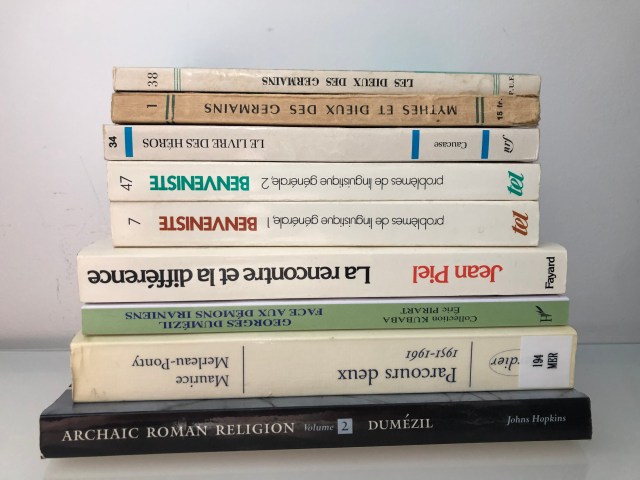
A pile of second-hand books, all for the Foucault work and related projects.

In particular I’m writing a piece on Foucault and Dumézil, which is mainly about their understandings of sovereignty. In that piece, which I think will largely focus on Dumézil’s Mitra-Varuna, I touch on the political controversy about his work – particularly around his writings on Scandinavian mythology and its contemporary resonances. The two books at the top of the pile are at the centre of this controversy – Mythes et dieux des Germains was published in 1939, and Les Dieux des Germains in 1959. The latter was translated as Gods of the Ancient Northmen in 1973, along with some additional essays (I’m still looking for a good quality copy of that translation, long out of print, though it’s available at archive.org). One argument made – by people like Carlo Ginzburg and Arnaldo Momigliano – is that the 1959 book is a sanitised version, avoiding some of the contemporary allusions of the 1939 book. This critique began in the early-mid 1980s, and Dumézil replied to both Ginzburg and Momigliano, though he says he will add more at a later date – a promise that was never fulfilled, since he died in 1986.

For this piece I will say relatively little about the controversy, but I want to at least mention it, since the 1939 book is important for Dumézil’s development of an understanding of sovereignty. I might return to the political question at a later point, though this has been quite extensively discussed – Didier Eribon and Bruce Lincoln have both written about this topic. But it’s good to have copies of the books at the heart of this issue – Mythes et dieux des Germains was quite hard to find, as are many of Dumézil’s early works.

Posted in Georges Dumézil, Maurice Merleau-Ponty, Michel Foucault, The Archaeology of Foucault, The Early Foucault, Uncategorized | 1 Comment

Michel Foucault and Richard Sennett, Sexuality and Solitude – London Review of Books, 1981 (open access)

LRB-0309-01As part of their ‘Diverted Traffic’ series, the London Review of Books has made Michel Foucault and Richard Sennett, ‘Sexuality and Solitude‘ from 1981 open access. Reprints of this piece – Dits et écrits or Essential Works, for example, tend to omit Sennett’s contribution. The pieces come from a 1980 seminar at New York University.

Posted in Michel Foucault, Uncategorized | 1 Comment

Some open access books and journal article] on Protests, Policing and Race – updated

Now with some Taylor & Francis books and articles

stuartelden's avatarProgressive Geographies

Some open access books and journal articles on Protests, Policing and Race

Cambridge University Press (until July 12, 2020)

Verso Books (not sure of end date; 40% of other books at present)

Bristol University Press/Policy Press

Update: Taylor & Francis has made some books and articles available here.

will add others if I see them – please add in comments

View original post

Posted in Uncategorized | Leave a comment