Laleh Khalili, Sinews of War and Trade Shipping and Capitalism in the Arabian Peninsula – Verso, May 2020 (and podcast discussion)

This book is now published with Verso. There is a discussion about the book here – Sinews of War and Trade: Laleh Khalili speaks to Rafeef Ziadah

stuartelden's avatarProgressive Geographies

9781786634818.jpgLaleh Khalili, Sinews of War and Trade Shipping and Capitalism in the Arabian Peninsula – Verso, May 2020

On the map of global trade, China is now the factory of the world. A parade of ships full of raw commodities -iron ore, coal, oil- arrive in its ports, and fleets of container ships leave with manufactured goods in all directions. The oil that fuels China’s manufacturing comes primarily from the Arabian Peninsula. Much of the material shipped from China are transported through the ports of Arabian Peninsula, Dubai’s Jabal Ali port foremost among them. China’s ‘maritime silk road’ flanks the Peninsula on all sides.

Sinews of War and Trade is the story of what the making of new ports and shipping infrastructures has meant not only for the Arabian Peninsula itself, but for the region and the world beyond. The book is the account of how maritime transportation is not…

View original post 52 more words

Posted in Uncategorized | Leave a comment

Hashim Sarkis, Roi Salgueiro Barrio and Gabriel Kozlowski, The World as an Architectural Project – MIT Press, March 2020

?collid=books_covers_0&isbn=9780262043960&type=Hashim Sarkis, Roi Salgueiro Barrio and Gabriel Kozlowski, The World as an Architectural Project – MIT Press, March 2020

[updated to correct the attribution – the three names are the book’s authors, not editors. My apologies.]

Architects imagine the planet: fifty speculative world-scale projects from Patrick Geddes, Alison and Peter Smithson, Kiyonori Kikutake, Juan Navarro Baldeweg, Luc Deleu, and others.

The world’s growing vulnerability to planet-sized risks invites action on a global scale. The World as an Architectural Project shows how for more than a century architects have imagined the future of the planet through world-scale projects. With fifty speculative projects by Patrick Geddes, Alison and Peter Smithson, Kiyonori Kikutake, Saverio Muratori, Takis Zenetos, Sergio Bernardes, Juan Navarro Baldeweg, Luc Deleu, and many others, documented in text and images, this ambitious and wide-ranging book is the first compilation of its kind.

Interestingly, architects begin to address the world as a project long before the advent of contemporary globalism and its assorted anxieties. The Spanish urban theorist and entrepreneur Arturo Soria y Mata, for example, in 1882 envisions a system that connects the entire planet in a linear urban network. In 1927, Buckminster Fuller’s “World Town Plan—4D Tower” proposes to solve global housing problems with mobile structures delivered and installed by a Zeppelin. And Joyce Hsiang and Bimal Mendis visualize the conditions of a worldwide “City of Seven Billion” in a 2015–2019 project. Rather than indulging the cliché of the megalomaniac architect, this volume presents a discipline reflecting on its own responsibilities.

Thanks to George Mantzios for the link.

Posted in Uncategorized | 1 Comment

Alain Badiou – the film, directed by Gorav and Rohan Kalyan

Badiou – the film, directed by Gorav and Rohan Kalyan (more details here)

Posted in Alain Badiou, Uncategorized | Leave a comment

Truth and Knowledge for Michel Foucault, with Ann Stoler (2020)

Podcast discussion with Ann Stoler on Foucault

Clare O'Farrell's avatarFoucault News

Truth and Knowledge for Michel Foucault, with Ann Stoler
Great Books 31, Think About It | Podcast
Conversations on big ideas and great books hosted by Uli Baer.

Why is everyone talking about Michel Foucault these days? How can Foucault’s work have so many resonances in our contemporary world? What were his insights and discoveries that have influenced disciplines as diverse as cultural studies, gender and queer studies, or post-colonial studies? There is no doubt that Michel Foucault was one of the greatest thinkers of all time. His work —always critical— between philosophy and history, resists easy labels. Some regard him as a historian of knowledge, while others think he is a philosopher. He thought of his own method as genealogy, and I wanted to understand what this means. His celebrated four-volume work History of Sexuality, published between 1978 and 2018 —the final volume posthumously— and his conferences in…

View original post 140 more words

Posted in Uncategorized | Leave a comment

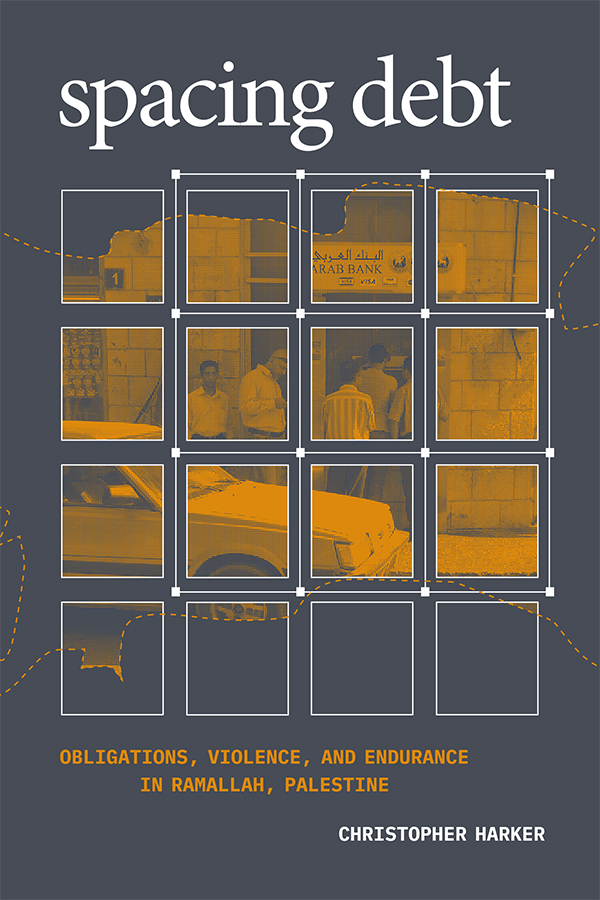
Christopher Harker, Spacing Debt: Obligations, Violence, and Endurance in Ramallah, Palestine – Duke University Press, December 2020

Christopher Harker, Spacing Debt: Obligations, Violence, and Endurance in Ramallah, Palestine – Duke University Press, December 2020

In Spacing Debt Christopher Harker demonstrates that financial debt is as much a spatial phenomenon as it is a temporal and social one. Harker traces the emergence of debt in Ramallah after 2008 as part of the financialization of the Palestinian economy under Israeli settler colonialism. Debt contributes to processes through which Palestinians are kept economically unstable and subordinate. He draws extensively on residents’ accounts of living with the explosion of personal debt to highlight the entanglement of consumer credit with other obligatory relations among family, friends, and institutions. Harker offers a new geographical theorization of debt, showing how debt affects urban space, including the movement of bodies through the city, localized economies, and the political violence associated with occupation. Bringing cultural and urban imaginaries into conversation with monetized debt, Harker shows how debt itself becomes a slow violence embedded into the everyday lives of citizens. However, debt is also a means through which Palestinians practice endurance, creatively adapting to life under occupation.

“The first in-depth ethnographic research on debt formation in the contemporary Palestinian context, this groundbreaking work proposes a host of new ways for social geographers to rethink debt at multiple scales. Spacing Debt ambitiously engages theoretical debates across a wide array of disciplinary approaches and effectively links it with fascinating and carefully treated ethnographic cases and interview materials.” — Deborah James, author of Money from Nothing: Indebtedness and Aspiration in South Africa

The Introduction is open access here

Posted in Uncategorized | 1 Comment

History of the Human Sciences, Volume 33, Number 1, 2020 – Cybernetics and the Human Sciences, edited by Stefanos Geroulanos and Leif Weatherby (requires subscription)

History of the Human Sciences, Volume 33, Number 1, 2020 – Cybernetics and the Human Sciences, edited by Stefanos Geroulanos and Leif Weatherby (requires subscription)

Cybernetics saturates the humanities. Norbert Wiener’s movement gave vocabulary and hardware to developments all across the early digital era, and still does so today to those who seek to interpret it. Even while the Macy Conferences were still taking place in the early 1950s, talk of feedback and information and pattern had spread to popular culture – and to Europe. The new science created a shared language and culture for surpassing political and intellectual ideas that could be relegated to a pre-computing tradition, and it refracted or channelled currents developing in fields from manufacturing to human physiology. It produced conceptions of the political world, as well as new forms of historical consciousness. It offered frameworks for structuralist thought, but also for policies regarding manufacturing and technology, international relations, and governmental decision-making. But the rising sense of the breadth, importance, and even shock of cybernetics long remained understudied, even as its intellectual assemblages continued to, well, relay. In devices and the so-called ‘digital humanities’, a refracted legacy of cybernetics is also visible. From mainframes to category-frameworks, cybernetics is everywhere in our material and intellectual worlds, even as the name and its meaning have faded. To the extent that cybernetics permeates the human sciences and our culture at large, it remains opaque – an only partially visible legacy often deemed too complex to form a simple object of historical narrative. This special issue on cybernetics in the human sciences outlines the history and stakes of cybernetics, as well as the possibilities of returning to it today.

Posted in Uncategorized | 1 Comment

Building a personal research and teaching library…

Building a personal research and teaching library – a few thoughts inspired by Dave Beer, The case of bookcases. Thank you to Dave both for this post and encouraging me to say something about my books.

At home, I’m fortunate to have a large room as a study. This is the main writing collection, with all the books by Foucault, Heidegger, Lefebvre and other thinkers whose work I want to have easily accessible. I have most in original language and translation. I also have a lot of secondary literature on each of them, and, especially with Foucault, a lot of related texts – documents, bibliographies, pamphlets, etc. I also have nearly all my history of political thought and philosophy books, pre-20th century, at home – loads of books by Plato, Aristotle, Descartes, Leibniz, Kant, Hegel, Marx, Nietzsche and many others. I also have books by Kostas Axelos, the complete run of the Arden Shakespeare, along with most of the Cambridge and Penguin editions, secondary literature and related books. Novels are all at home too, though now in a different room.
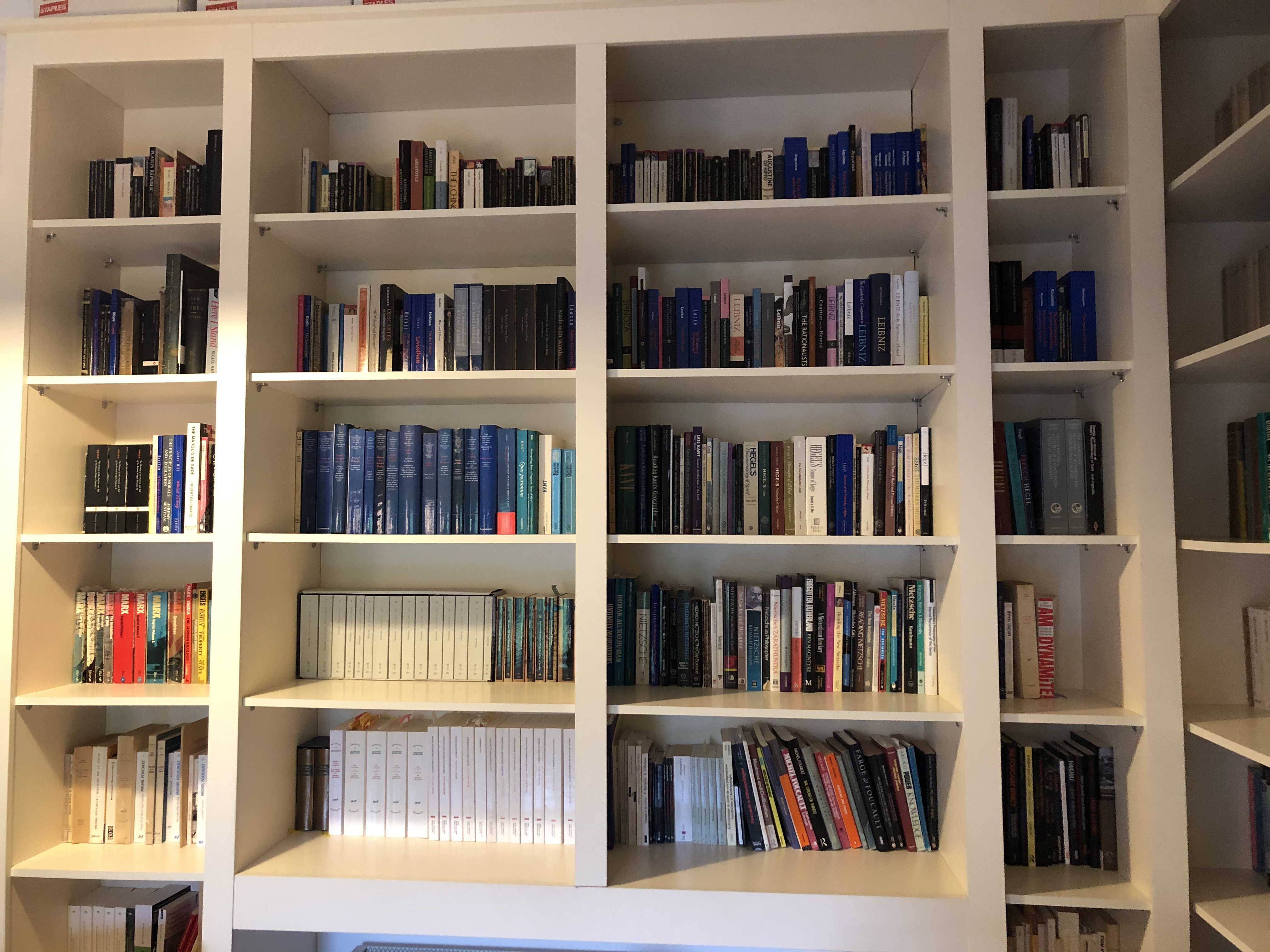
IMG_3294.jpg
History of philosophy and political theory, pre-20th century, and the beginning of the Foucault books. The wall to the right has Heidegger and the rest of the Foucault.

Increasingly I’ve also been building up collections of thinkers who I turned to at least initially because of a connection with Foucault – Gaston Bachelard, Georges Canguilhem, Ludwig Binswanger, Georges Bataille, Georges Dumézil, Sigmund Freud, Roland Kuhn, Jacques Lacan, Maurice Merleau-Ponty, Jean Wahl… But some of these have or may become a focus of projects in their own right.
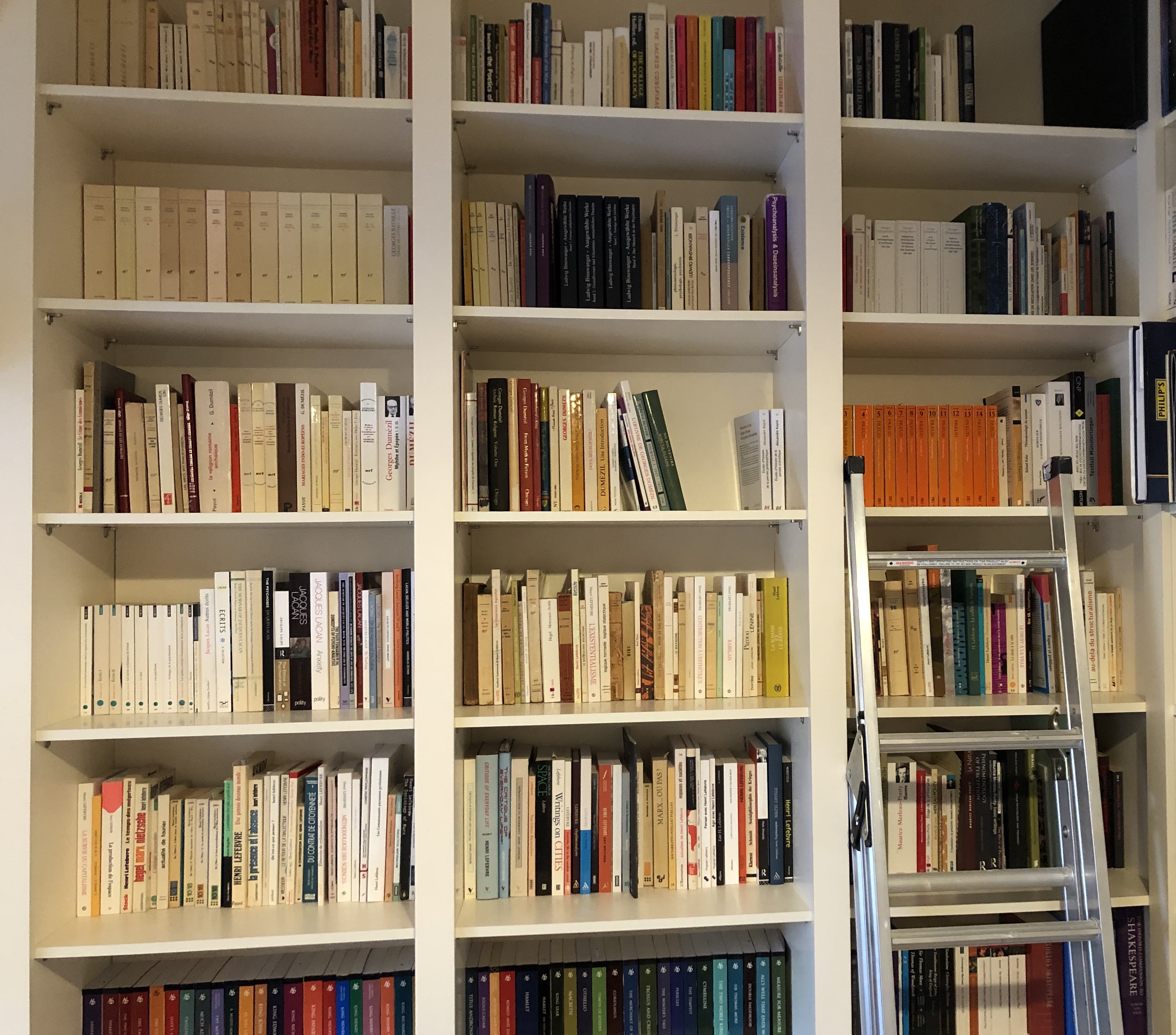
bookshelf 2.jpg
Axelos, Bachelard, Bataille, Binswanger, Canguilhem, Dumézil, Freud, Kuhn, Lacan, Lefebvre, Merleau-Ponty and others, and then the beginning of the Shakespeare shelves

In my Warwick office, I have books I mainly use for teaching, which means nearly all the history, geography and politics research books and textbooks. I also have quite a lot of 20th and 21st century theory at work. These are often thinkers I teach, but don’t usually write about – including Giorgio Agamben, Louis Althusser, Hannah Arendt, Judith Butler, Simone de Beauvoir, Jacques Derrida, Gilles Deleuze and Félix Guattari, Frantz Fanon, Achille Mbembe, Jean-Paul Sartre… All the books by geographers like Louise Amoore, Klaus Dodds, David Harvey, David Livingstone, Doreen Massey, Neil Smith, Edward Soja and so on are there too. My collections of theorists I’ve worked on in the past, but probably won’t again, like Eugen Fink, Carl Schmitt, and Peter Sloterdijk, are at work too. And there are loads of books by theorists I may never write on, but read or have read a lot – Alain Badiou, Roland Barthes, Walter Benjamin, Jane Bennett, Wendy Brown, William Connolly, Jenny Edkins, Umberto Eco, Roberto Esposito, Luce Irigaray, Ernst Kantorowicz, Bruno Latour, Quentin Skinner, Ann Laura Stoler, Slavoj Žižek and others. A lot of the people I read, write about or teach have written a lot, and I do tend to get most of those books. There was an ‘authors where you have more than 10 of their books’ list thing going round a while ago, and I guess I would be at something like forty authors.
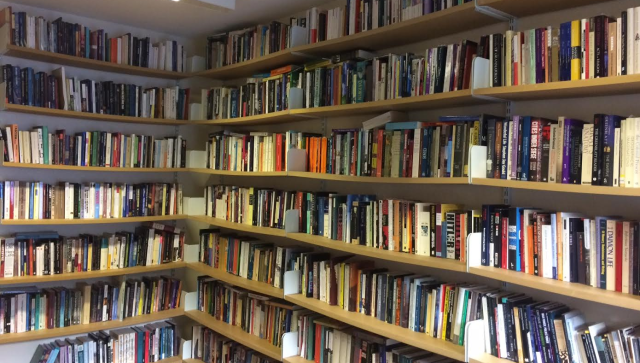
untitled.png
Warwick office back in 2016 – taken after a reorganisation and the best image I have without being able to take a more recent picture

At home I also have one small bookshelf and lots of piles which are of books ‘to read’ – most of the recently bought books, along with ones I’ve been sent by authors, or by publishers as review copies or in recompense for review work. There are some of those books at work too, but most are at home, which has been useful in this period when I can’t access the work office. I have no idea what post is awaiting me at work – although everything I’ve bought in the past several weeks has been sent to home, there is usually quite a bit that goes to the work address. In normal times there is a constant ferrying of books between home and work, and the pile to take to work when the University reopens is quite large now.

Despite how many I have, I wouldn’t really describe myself as a book collector, as the point of getting these is because of their use, rather than their worth or just to have. I like to be able to resolve reference queries quickly when writing, and having such an extensive library at home makes that a lot easier. But some of the books I wanted for work purposes were harder to find than others. Things like the original edition of Foucault’s Folie et déraison, or the first edition of Naissance de la clinique, superseded by newer editions, but with significant differences. Some of the early books by Lefebvre which are long out-of-print were hard to find – and I got hold of most of these in the 1990s, before sites like bookfinder.com made it much easier to find second-hand copies. His little book on Hitler, for example, took many years before I located a copy. I don’t tend to search out first editions for the sake of it, or signed copies, though I have signed books by Lefebvre and Dumézil, which were not that expensive. A signed copy of Foucault would probably be out of my price range…

I’ve written before about the appearance of books in a series, and how presses shift the style in seemingly arbitrary ways. Looking for that post led me to a couple of others I’d written about my own collection – some 2010 thoughts on how books were organised; and moving house and unpacking my library back in 2012.

I do have an awful lot of books, and even with all the space I have, the shelves are getting full and in some cases overflowing. To free up some room I’ve been trying to scan old box files of photocopied journal articles and chapters, but this is slow work. There are also some old runs of journals at work, which I almost never look at – if I want something I tend to get the pdf via the library, so those are probably the next thing to go to save space. I have a quite well-organised library of pdfs of articles and some books, which I keep in iCloud and so can access anywhere. It’s really helpful to have that access, and quite a lot of books I own I also have as pirate pdfs. I wish more publishers would follow Verso‘s model of bundling e-books with physical sales.

Although I can’t finish The Early Foucault manuscript until libraries reopen, I can continue or begin quite a few projects with what I have at home. In the weekend before the University closed, I picked up a few books from the office I thought I might need. That’s been useful, and I do have a lot of books at home, but I’m still missing being able to access the ones at work, or in libraries in the UK and further afield. This is especially the case at the moment as I’m trying to check and correct references in an edited translation.

Posted in Books, Uncategorized | 1 Comment

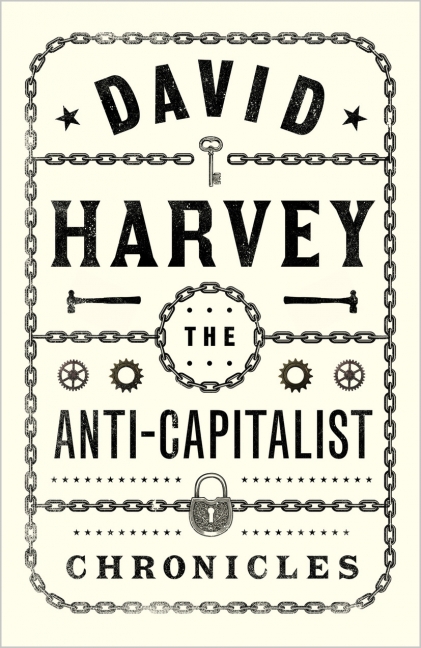
David Harvey, The Anti-Capitalist Chronicles – Pluto, October 2020

4930David Harvey, The Anti-Capitalist Chronicles – Pluto, October 2020

Amidst waves of economic crises, class struggle and neo-fascist reaction, few possess the clarity and foresight of world-renowned theorist, David Harvey. Since the publication of his bestselling A Brief History of Neoliberalism, Harvey has been tracking the evolution of the capitalist system as well as tides of radical opposition rising against it. In The Anti-Capitalist Chronicles, Harvey introduces new ways of understanding the crisis of global capitalism and the struggles for a better world.

While accounting for violence and disaster, Harvey also chronicles hope and possibility. By way of conversations about neoliberalism, capitalism, globalisation, the environment, technology and social movements, he outlines, with characteristic brilliance, how socialist alternatives are being imagined under very difficult circumstances.

In understanding the economic, political and social dimensions of the crisis, Harvey’s analysis in The Anti-Capitalist Chronicles will be of strategic importance to anyone wanting to both understand and change the world.

Posted in David Harvey, Uncategorized | 1 Comment

Historical Materialism tribute to Neil Davidson (1957-2020)

At Historical Materialism, we are very devastated by the loss to our movement of Neil Davidson, who was a source of unflinching support to the journal, book series and conferences. We will be publishing two books by him in the book series, and we strongly encourage you to purchase his works that are available from Haymarket Books https://www.haymarketbooks.org/authors/86-neil-davidson and from Pluto Press https://www.plutobooks.com/author/neil-davidson/

In honour of Neil, a special page on the Brill website with a number of his articles free to download:

https://www2.brill.com/Neil_Davidson

Other articles available for download can be found here:

Crisis Neoliberalism and Regimes of Permanent Exception

https://journals.sagepub.com/doi/10.1177/0896920516655386

Neoliberalism and the Far-Right: A Contradictory Embrace

https://journals.sagepub.com/doi/10.1177/0896920516671180

and here:

https://salvage.zone/articles/neoliberalism-as-the-agent-of-capitalist-self-destruction-2/?utm_source=ALL&utm_campaign=7d382713b6-EMAIL_CAMPAIGN_2019_11_14_10_06_COPY_01&utm_medium=email&utm_term=0_50dc301c58-7d382713b6-169123497&mc_cid=7d382713b6&mc_eid=bbf1ed2414

https://salvage.zone/articles/the-national-question-class-and-the-european-union-an-interview-with-neil-davidson/?utm_source=ALL&utm_campaign=7d382713b6-EMAIL_CAMPAIGN_2019_11_14_10_06_COPY_01&utm_medium=email&utm_term=0_50dc301c58-7d382713b6-169123497&mc_cid=7d382713b6&mc_eid=bbf1ed2414

and here:

IS Journal Writers: Neil Davidson (1957–2020)

10 May 2020: Added to the Neil Davidson Archive in the Encyclopaedia of Trotskyism On-Line (ETOL):

STUC conference (letter) (2001)

Scottish Revolution – They Took the High Road (2003)

What did capitalism do for us? (2004)

The ghosts of struggle haunt festival city (2004)

Good Tradition (book review) (2004)

How was this kingdom united? (interview) (2004)

‘Beyond expectations’ (strike report extract) (2004)

Bourgeois Revolutions – On the Road to Salvation for all Mankind (2004)

A History of Mutiny (2005)

The myth of Britishness (2005)

SSP get set for Livingston by-election (2005)

Islam and the Enlightenment (2006)

The 1926 general strike – nine days of hope (2006)

No defence for the British empire (2006)

Third World Revolution (2006)

Should Scotland become independent? (2009)

[Thanks to Einde O’Callaghan]

https://www.marxists.org/history/etol/writers/davidson/index.htm

You can also look at his Academia.edu page: https://glasgow.academia.edu/NeilDavidson

And since nothing replaces listening to Neil in his, er, “inimitable” accent, please check these talks out:

https://wearemany.org/media?type%5B%5D=audio&type%5B%5D=video&keys=neil+davidson

Please also read  wonderful obituary of Neil Davidson by Jamie Allinson

https://www.versobooks.com/blogs/4697-in-memoriam-neil-davidson-9-october-1957-3-may-2020

as well as the following:

https://www.rs21.org.uk/2020/05/07/obituary-neil-davidson-1957-2020/

https://bellacaledonia.org.uk/2020/05/07/an-appreciation-of-neil-davidson-1957-2020/?fbclid=IwAR3vaFw7FkGwb4YYM5jGYodtTFUcWxlWRzEHYmiK4e4K3prhffQiWhFV1zg

Posted in Uncategorized | Leave a comment

Talking Politics – History of Ideas talks by David Runciman

TP_History_Podcast_Talking Politics – History of Ideas talks by David Runciman

History Of Ideas is a new series of talks by David Runciman in which he explores some of the most important thinkers and prominent ideas lying behind modern politics – from Hobbes to Gandhi, from democracy to patriarchy, from revolution to lock down.

David also talks about the crises – revolutions, wars, depressions, pandemics – that generated these new ways of political thinking.

Created by the team that brought you Talking Politics: this podcast is a history of ideas to help make sense of what’s happening today.

Thanks to Dirk (dmf) for this link.

Posted in Uncategorized | Leave a comment