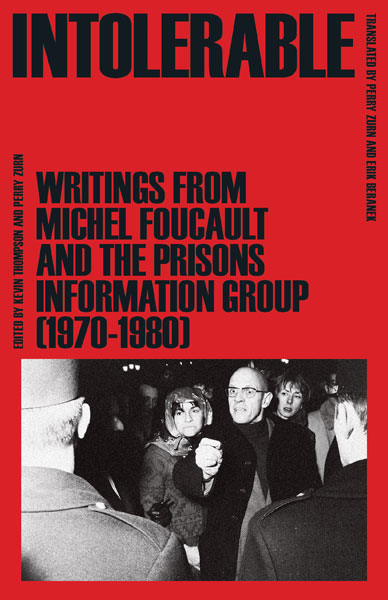
Intolerable: Writings from Michel Foucault and the Prisons Information Group (1970–1980), edited by Kevin Thompson and Perry Zurn, University of Minnesota Press, April 2021

image

Intolerable: Writings from Michel Foucault and the Prisons Information Group (1970–1980), edited by Kevin Thompson and Perry Zurn, University of Minnesota Press, December 2020 [updated: April 2021]

Founded by Michel Foucault and others in 1970–71, the Prisons Information Group (GIP) circulated information about the inhumane conditions within the French prison system. Intolerable makes available for the first time in English a fully annotated compilation of materials produced by the GIP during its brief but influential existence, including an exclusive new interview with GIP member Hélène Cixous and writings by Gilles Deleuze and Jean Genet.

These archival documents—public announcements, manifestos, reports, pamphlets, interventions, press conference statements, interviews, and round table discussions—trace the GIP’s establishment in post-1968 political turmoil, the new models of social activism it pioneered, the prison revolts it supported across France, and the retrospective assessments that followed its denouement. At the same time, Intolerable offers a rich, concrete exploration of Foucault’s concept of resistance, providing a new understanding of the arc of his intellectual development and the genesis of his most influential book, Discipline and Punish. Presenting the account of France’s most vibrant prison resistance movement in its own words and on its own terms, this significant and relevant collection also connects the approach and activities of the GIP to radical prison resistance movements today.

he Prisons Information Group was a crucial part of Foucault’s political trajectory, but it was an intensely collaborative project between intellectuals, prisoners, and their families. Expertly translated and introduced, this is the definitive collection of the group’s writings. Although the focus is France, the texts also illuminate other European countries, while the Algerian war opens up questions of colonialism, and the group’s links to the Black Panthers make it important for an understanding of the politics of race. A significant book that is both long overdue and a timely intervention in contemporary debates about police and prison abolition and reform.

Stuart Elden, author of The Early Foucault

Intolerable contributes to incarceration studies by highlighting the contributions (and pointing to the contradictions) of the Prisons Information Group (GIP). By emphasizing the activism of the GIP, it demonstrates how the author and theorist as an academic activist was influenced by the militancy of political actors and revolutionaries who took great risks, especially as incarcerated intellectuals and rebels, to challenge repression structured by racial/colonial capitalism and captivity.

Joy James, author of Seeking the Beloved Community: A Feminist Race Reader

Posted in Michel Foucault, Politics, Uncategorized | 3 Comments

Georges Bataille’s Oeuvres complètes and English translations – list updated to include all volumes

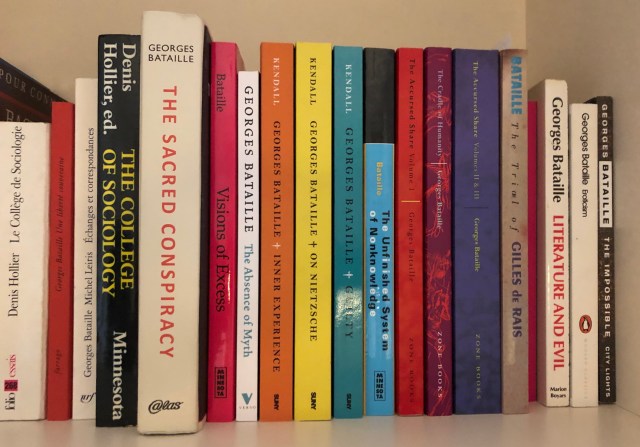
BatailleI’ve done some further updating to the list of works in Georges Bataille’s Oeuvres complètes and other French collections and the English translations.

The main addition is that I’ve now listed the articles in Volumes XI and XII of the Oeuvres complètes, along with their translations.

There was some other work over the last week, including filling in details of pieces in The Cradle of Humanitydetails of the dossiers at the end of Vol X, and listing the short pieces included in “The Place of Violence: Selected Writings”, translated by Bruce Belay, Parallax 6 (2), 2010, 81-91.

I think this listing is now complete, and that it includes all the short pieces in English books by Bataille, as well as the longer works. But I am sure there are pieces translated in edited collections or in journals which I’ve missed, so as before I’d certainly welcome additions, corrections or comments.

This page is part of the Resources part of this site, which also includes lots of resources on Foucault (links, some images, translations, a bibliography of his collaborative projects, audio and video links, etc.), reading guides to Lefebvre and Sloterdijk, a German-French-English bibliography of Ludwig Binswanger, literature on Boko Haram, Ebola and Covid-19, links and comments on writing and publishing, and lists of my favourite academic books of each year.

IMG_3266.jpg

Posted in Georges Bataille, Uncategorized | 4 Comments

Where to start with reading Peter Sloterdijk? – reading guide updated with recent translations

Where to start with reading Peter Sloterdijk? – my reading guide has been updated with recent translations from Polity.

I’d still suggest beginning with either You Must Change Your Life or In the World Interior of Capital, depending on whether you are most interested in philosophy of the self or philosophy of the world. I’ve not kept up on his more recent works, but I’ve tried to add in links to all the translations – let me know if I’ve missed any.


Posted in Peter Sloterdijk, Uncategorized | Leave a comment

10 years of Progressive Geographies – thanks for reading

I launched this site 10 years ago – both as a blog, but also as a place to share publications, some research resources and other things. I never imagined I’d still be running it a decade later. My focus has changed quite a lot in this time – when I started it I was in the Geography department at Durham, about half-way through a research fellowship working on territory, and for the past seven years I’ve been in Warwick’s Politics and International Studies department. I’ve moved through interests in Foucault, Canguilhem, Shakespeare. terrain and other things in this time. Many thanks for reading.

Posted in Uncategorized | 7 Comments

PAIS to Launch Global Insights Panel Series reflecting on COVID-19 in collaboration with international partners in Canada, the US, Germany and Ethiopia

Politics and International Studies at Warwick, along with partner institutions, is launching a Global Insights Panel Series reflecting on COVID-19 in collaboration with international partners in Canada, the US, Germany and Ethiopia. Registration required, but free and open to all, with the recording to follow on YouTube.

In collaboration with four of our international partners, PAIS is pleased to present “Global Insights” – a weekly live-streamed moderated panel series which will provide different national and regional perspectives on big questions currently facing researchers, policymakers and planners worldwide in light of the Coronavirus pandemic.

The first of the weekly Global Insights series will be held on Thursday, 30 April at 4pm-5pm:

COVID-19: Stress-test for the Global Economy

Hosted by Ann Fitz-Gerald, Director, Balsillie School of International Affairs,

University of Waterloo

featuring

John Ravenhill (Balsillie School, University of Waterloo)

Stephen Silvia (School of International Service, American University)

Lena Rethel (PAIS, University of Warwick – Director of CSGR)

Gerald Schneider (University of Konstanz)

Tewodros Mekonnen (Instutute for Strategic Affairs, Addis Ababa)

Please sign up for free at Eventbrite: https://www.eventbrite.ca/e/global-insights-covid-19-stress-test-for-the-global-economy-tickets-103250916270

The edited recording will be posted to the Balsillie School You Tube channel by May 6th https://www.youtube.com/user/BalsillieSchool

Future sessions will include themes such as The Changing Global Balance of Power; A New Concept of Security; The Future of Democracy; Federalism; Climate Change; Public Health; Technology Innovation; Data, Digitalisation & Governance; Migration and Mobility; Multilateralism and International Cooperation…and more.

Look for more details of the second panel discussion – May 7, 2020: COVID-19 and the Global South.

My updated list of links to pieces by geographers, sociologists, philosophers and others is here.

Posted in Uncategorized | Leave a comment

“Foucault Was Always Much More Circumspect”: Stuart Elden on Foucault’s Politics and the Rediscovery of His Early Years – 2nd part of Journal of the History of Ideas interview

Elden-10The second part of my interview with Jonas Knatz and Anne Schult for the Journal of History of Ideas blog is now available – “Foucault Was Always Much More Circumspect”: Stuart Elden on Foucault’s Politics and the Rediscovery of His Early Years
In this part I discuss Foucault’s political activism, the relation of lecture courses and notes to his publications, his collaborative research projects, working with archives and how I use this blog. The final chapter discusses the research for The Early Foucault. Part 1 of the interview is here.

Posted in Foucault's Last Decade, Foucault: The Birth of Power, Michel Foucault, The Archaeology of Foucault, The Early Foucault, Uncategorized | 1 Comment

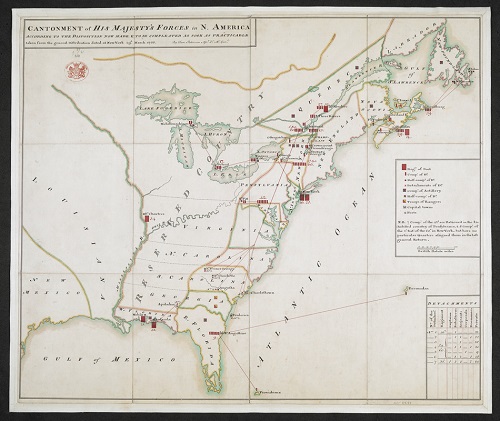
Where to find British Library maps online

Tom Harper has a list of where to find British Library maps online at the British Library Maps and Views blog.

6a00d8341c464853ef025d9b4aac5a200c-800wi.jpg

Posted in Uncategorized | Leave a comment

Marlon Salomon, Obituary, François Delaporte (1941 – 2019)

An obituary for François Delaporte from last year.

Clare O'Farrell's avatarFoucault News

Marlon Salomon, Obituary, François Delaporte (1941 – 2019)
Transversal: International Journal for the Historiography of Science (6) 2019: 115-123

DOI: 10.24117/2526-2270.2019.i6.11

On the 28th of May, the French philosopher and historian of sciences, François Delaporte died in Amiens at the age of 78. He was an emeritus professor at the Université de Picardie Jules Verne (UPJV). His death is an irreparable loss to the philosophy and historiography of the sciences.
[…]

From 1966, Delaporte began to regularly attend Canguilhem’s courses, and soon after in May of 1968, he began his master’s studies under his professor’s guidance. Two years later, he presented his master’s dissertation, on issues surrounding the notion of vegetality in the eighteenth century.

Delaporte then started to work on a doctoral thesis (troisième cycle). Georges Canguilhem, however, could no longer advise him, since he would retire in 1971, so Canguilhem asked Michel Foucault, who used to attend the…

View original post 394 more words

Posted in Uncategorized | Leave a comment

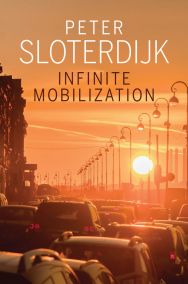
Two new Sloterdijk translations from Polity – After God and Infinite Mobilisation

Two new Sloterdijk translations from Polity – After God, translated by Ian Alexander Moore, and Infinite Mobilisation, translated by Sandra Berjan.

agHere’s the press description for After God.

In his Critique of Cynical Reason, Peter Sloterdijk pursued an enlightenment of the Enlightenment in both its beginnings and the present. After God is dedicated to the theological enlightenment of theology. It ranges from the period when gods reigned, through the rule of the world-creator god to reveries about the godlike power of artificial intelligence. The path of this self-enlightening theology, which is carried out here by a non-theologian, must begin well before Nietzsche’s declaration of the death of God, and it must move beyond this dictum to explore the present and the future.

Since the early 20th century we have seen how the metaphysical twilight of the gods, which has preoccupied philosophers and theologians, has been accompanied by an earthly twilight of the souls.  The emergence of psychoanalysis, and more recently the development of the neuro-cognitive sciences, have secularized the old Indo-European concept of the soul and transferred many accomplishments of the human mind to computerized machines.  What remains of the eternal light of the soul after the artificial lights have been turned on?  Have the inventors of AI thrust themselves into the position vacated by the death of god?  Perhaps the distinction between God and idols will soon re-emerge here for the citizens of modernity, only this time in a technological and political register. For them, theological enlightenment – which is completely different from an instinctive rejection of religion – will be a fateful task.

This new work by one of the most original thinkers today will appeal to students and scholars across the humanities and social sciences, as well as anyone interested in religion, philosophy and critical theory today.

imand for Infinite Mobilization:

The core of what we refer to as ‘the project of modernity’ is the idea that human beings have the power to bring the world under their control, and hence it is based on a ‘kinetic utopia’: the movement of the world as a whole reflects the implementation of our plans for it.  

But as soon as the kinetic utopia of modernity is exposed, its seemingly stable foundation cracks open and new problems appear: things don’t happen according to plan because as we actualize our plans, we set in motion other things that we didn’t want as unintended side-effects. We watch with mounting unease as the self-perpetuating side-effects of modern progress overshadow our plans, as a foreign movement breaks off from the very core of the modern project supposedly guided by reason and slips away from us, spinning out of control. What looked like a steady march towards freedom turns out to be a slide into an uncontrollable and catastrophic syndrome of perpetual mobilization. And precisely because so much comes about through our actions, these developments turn out to have explosive consequences for our self-understanding, as we begin to realize that, so far from bringing the world under our control, we are instead the agents of our own destruction.

In this brilliant and insightful book Sloterdijk lays out the elements of a new critical theory of modernity understood as a critique of political kinetics, shifting the focus of critical theory from production to mobilization and shedding new light on a world facing the growing risk of humanly induced catastrophe.

My reading guide is here – Where to start with reading Peter Sloterdijk? It’s out-of-date in terms of recent English translations, and could use some updating. I’ll try to do that soon. Update: I’ve added in the last few English translations here. Let me know if I’ve missed any.

Update 2: Thanks to Kai Frederick Lorentzen for the alert that After God is not a new book in German, but a compilation of texts, with one new chapter. See the German discussion here. And to clear up any confusion, Infinite Mobilization is a translation of the German text Eurotaoismus.

Posted in Peter Sloterdijk, Uncategorized | 1 Comment

Historicizing Foucault: Stuart Elden on Tracing Foucault’s Ideas from Discipline and Punish to the History of Sexuality

Elden-9Historicizing Foucault: Stuart Elden on Tracing Foucault’s Ideas from Discipline and Punish to the History of Sexuality – part 1 of a longer interview at the Journal of History of Ideas blog, conducted earlier this month. My thanks to Anne Schult and Jonas Knatz for the invitation to do this and some interesting questions. Part 2 is here.


Stuart Elden is Professor of Political Theory and Geography at University of Warwick. His publication series on Foucault includesFoucault’s Last Decade (Polity, 2016),Foucault: The Birth of Power (Polity, 2017), The Early Foucault (Polity, forthcoming), and The Archaeology of Foucault (Polity, forthcoming). Beyond Foucault, he most recently authoredShakespearean Territories (University of Chicago Press, 2018) andCanguilhem (Polity, 2019). He runs a blog at www.progressivegeographies.com.

Jonas Knatz is a PhD Student in New York University’s History Department. He works on 20th century European intellectual history.

Anne Schult a PhD Candidate in New York University’s History Department. Her current research focuses on the intersection of migration, law, and demography in 20th-century Europe.

Part 1 continues here; part 2 is here.

Posted in Books, Foucault's Last Decade, Foucault: The Birth of Power, Michel Foucault, Shakespearean Territories, The Archaeology of Foucault, The Early Foucault, Theory, Uncategorized | 1 Comment