I gave my last UBC lecture on 2 December (below), but I shall – of course! – continue my research and writing. So this isn’t retirement yet – and my tenure as Peter Wall Distinguished Professorship isn’t up yet either – but it does bring me to the end of a long teaching career.
It’s well worth a read. At the end of the post, he talks of the current writing plans:
As I write this, it’s neither a Monday nor the 1st of the month. I may be turning a page on my teaching career, but – as I said at the outset – the research and the writing will continue apace. I have two books in prospect. Reach from the Sky will bring together my work on genealogies and geographies of aerial violence, and Purple Testament – a title I’ve taken (if you’ve read this far, you will know how doubly appropriate this is) from Shakespeare’s Richard II: ‘the purple testament of bleeding war’ – which extends my work on trauma geographies and woundscapes from the First World War to Afghanistan and Syria.
Michel Foucault, Interview with Madeleine Chapsal, The Journal of Continental Philosophy Translated by Mark G. E. Kelly, Volume 1, Issue 1, 2020, Pages 29-35
Abstract
In this 1966 interview, published here in English translation for the first time, Michel Foucault positions himself as a representative of a ‘generation’ of French thinkers who turned towards the analysis of ‘structures’ and away from the phenomenological approaches that had previously dominated French philosophy. In this, Foucault claims inspiration not only from older French scholars—namely Georges Dumézil, Jacques Lacan, and Claude Lévi-Strauss—but also from the science of genetics.
Writing for academic publication is highly stylised and formalised. In this post Rob Kitchin describes how writing fiction has shaped his own academic praxis and can provide scholars with an expanded range of conceptual tools for communicating their research.
The video abstract for this open access article is now available:
Foucault’s Introduction to a translation of Ludwig Binswanger’s essay ‘Dream and Existence’ was published in late 1954. The translation was credited to Jacqueline Verdeaux, with Foucault acknowledged for the notes. Yet Verdeaux herself indicates the intensely collaborative nature of their working process and the translation. In 1958, Victor von Weizsäcker’s Der Gestaltkreis was published in French as Le Cycle de la structure, translated by Foucault and Daniel Rocher. Foucault went on to translate and introduce Immanuel Kant’s Anthropology as his secondary doctoral thesis. His engagement with Kant and Binswanger’s ideas has been discussed in the literature, but his role as translator has generally been neglected. His engagement with von Weizsäcker is almost never mentioned. This article critically discusses Foucault’s role in the Binswanger and von Weizsäcker translations, comparing the German originals with the French texts, and showing how this is a useful additional element to the story of the early Foucault.
The article comes from the research for The Early Foucault, which is forthcoming with Polity in June 2021.
Sara Fregonese (SF): This book is the result of my doctoral research (2004-2008), to which I then added a layer of historical detail about the administrative changes in 1840s Mount Lebanon and their impact on today’s sectarian politics. I also integrated a chapter on more recent sustained urban clashes in 2008 that partly encompasses my postdoctoral research around sovereignty and non-state armed groups (2009-2012) and their relation with the idea and practice of the State.
What made me write the book was, firstly, a disciplinary frustration with the lack of attention (in western scholarship at least) given to the representations and narrations of non-state actors and sub-national spaces of the civil war in Lebanon. We see a lot of grand scale geopolitical analysis around the 1975-1990 events, but less enquiry linking the kind of geopolitical reasoning from international relations and political science, with spatial accounts of what was actually happening at the urban level during the conflict.
Update: there is a discussion on the New Books podcast here.
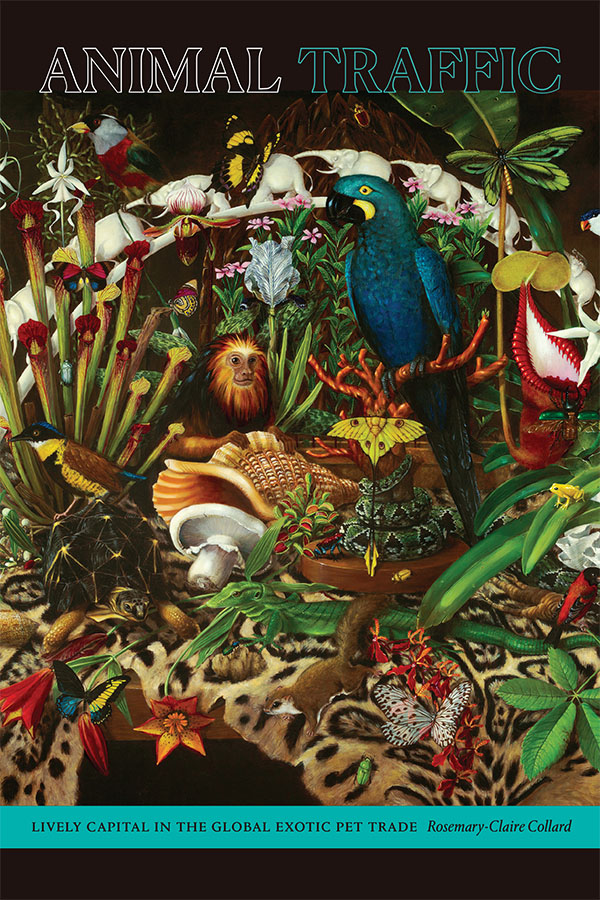
Parrots and snakes, wild cats and monkeys—exotic pets can now be found everywhere from skyscraper apartments and fenced suburban backyards to roadside petting zoos. In Animal Traffic Rosemary-Claire Collard investigates the multibillion-dollar global exotic pet trade and the largely hidden processes through which exotic pets are produced and traded as lively capital. Tracking the capture of animals in biosphere reserves in Mexico, Guatemala, and Belize; their exchange at exotic animal auctions in the United States; and the attempted rehabilitation of former exotic pets at a wildlife center in Guatemala, Collard shows how exotic pets are fetishized both as commodities and as objects. Their capture and sale sever their ties to complex socio-ecological…
In Caesarism and Bonapartism in Gramsci, Francesca Antonini offers a fresh insight into Antonio Gramsci’s thought. Building on the achievements of recent Gramscian scholarship, she investigates his usage of the concepts of Bonapartism and Caesarism, both in his pre-prison writings and in the Prison Notebooks. The Caesarist-Bonapartist paradigm relates crucially to Gramsci’s reflections on hegemony and on its transformations across the nineteenth and twentieth centuries. While this model is essential to Gramsci’s understanding of the interwar period and of the Fascist regime in Italy, it also sheds a meaningful light on other past and present scenarios, from the French Second Empire to the USSR of his time. Finally, yet importantly, Antonini’s analysis illuminates Gramsci’s approach towards the Marxian legacy.
Just in hardback and ebook at present, but books in this series do appear in paperback with Haymarket a bit later. The Revisiting Gramsci’s Notebooks collection Francesca co-edited, and which I previously mentioned on this blog, is now available in paper.
Revisiting Gramsci’s Notebooks offers a rich collection of historical, philosophical, and political studies addressing the thought of Antonio Gramsci, one of the most significant intellectuals of the twentieth century. Based on thorough analyses of Gramsci’s texts, these interdisciplinary investigations engage with ongoing debates in different fields of study. They are exciting evidence of the enduring capacity of Gramsci’s thought to generate and nurture innovative inquiries across diverse themes.
Gathering scholars from different continents, the volume represents a global network of Gramscian thinkers from early-career researchers to experienced scholars. Combining rigorous explication of the past with a strategic analysis of the present, these studies mobilise underexplored resources from the Gramscian toolbox to confront the actuality of our ‘great and terrible’ world.
Contributors include: F. Antonini, A. Bernstein, D. Boothman, W. Buddharaksa, T. Chino, R. Ciavolella, C. Conelli, A. Crézégut, V. Cuppi, Y. Douet, A. Freeland, F. Frosini, L. Fusaro, R. Jackson, A. Loftus, S. Meret, S. Neubauer, A. Panichi, I. Pohn-Lauggas, R. Roccu, B. Settis, A. Showstack Sassoon, A. Suceska, P.D. Thomas, N. Vandeviver, M.N. Wróblewska.
In today’s episode of the Telos Press Podcast, Camelia Raghinaru talks with Mark G. E. Kelly about his article “Foucault and the Politics of Language Today,” from Telos 191 (Summer 2020). An excerpt of the article appears below. If your university has an online subscription to Telos, you can read the full article at the Telos Online website.
From Telos 191 (Summer 2020):
Foucault and the Politics of Language Today
Mark G. E. Kelly
We find ourselves today in a conjuncture where the use of language has become an object of political concern to a perhaps unprecedented extent, or at least in unprecedented ways. In particular, the words used to refer to individuals and to groups, down to the use of pronouns, have come into intense…
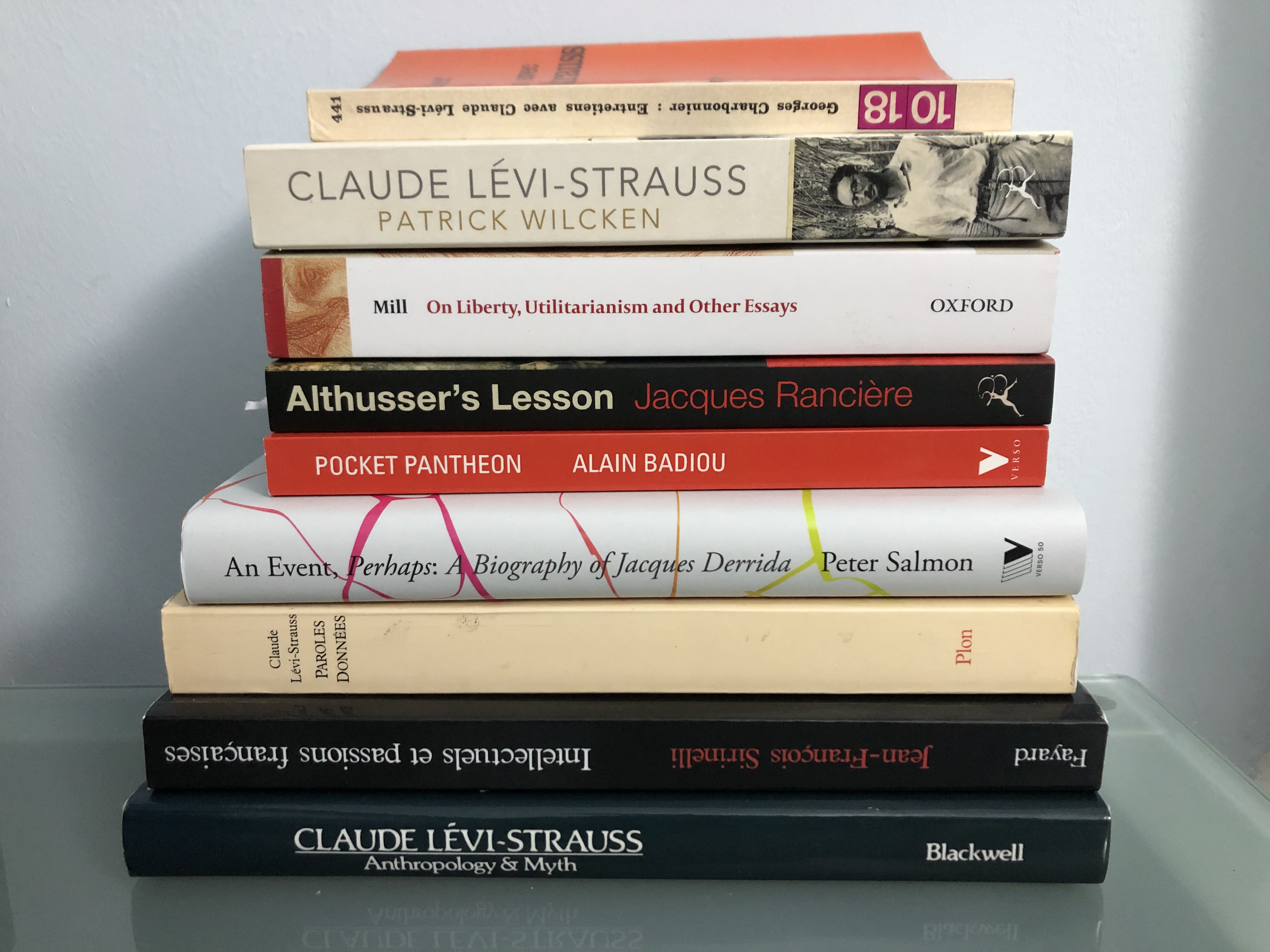
Some books bought recently for the Foucault work, related projects and J.S. Mill for teaching. I’m teaching the history of political thought again this year, and while I have most of the texts we’re using, didn’t have Mill’s Considerations on Representative Government which is in this collection, edited by Mark Philp of Warwick’s History department and Frederick Rosen of UCL.





 Rosemary-Claire Collard,