
Stuart Hall’s documentary on Marx and Marxism
This has been circulating on social media – I got it from Jussi Parikka.
Update: looks like it’s been removed from vimeo. Here’s a youtube link:
Stuart Hall’s documentary on Marx and Marxism
This has been circulating on social media – I got it from Jussi Parikka.
Update: looks like it’s been removed from vimeo. Here’s a youtube link:
 Power and Time: Temporalities in Conflict and the Making of History, edited by Dan Edelstein, Stefanos Geroulanos and Natasha Wheatley – University of Chicago Press, December 2020
Time is the backdrop of historical inquiry, yet it is much more than a featureless setting for events. Different temporalities interact dynamically; sometimes they coexist tensely, sometimes they clash violently. In this innovative volume, editors Dan Edelstein, Stefanos Geroulanos, and Natasha Wheatley bring together essays that challenge how we interpret history by focusing on the nexus of two concepts— “power” and “time”—as they manifest in a wide variety of case studies. Analyzing history, culture, politics, technology, law, art, and science, this engaging book shows how “temporal regimes” are constituted through the shaping of power in historically specific ways. Power and Time includes seventeen essays on a wide variety of subjects: human rights; sovereignty; Islamic, European, and Indian history; slavery; capitalism; revolution; the Supreme Court; and even the Manson Family. Power and Time will be an agenda-setting volume, highlighting the work of some of the world’s most respected and innovative contemporary historians and posing fundamental questions for the craft of history.
Ann Stoler, The New School“What a gift this magnificent edited volume will be for those of us who have long sought to identify the implicit and violent ways in which power is garnered in battles over timing and time. With conceptual and empirical acuity, this is a volume that ‘harasses’ disciplinary strictures as it explodes the most revered canons. Moving from ‘multiple temporalities’ to conflictual ones is at the heart of this collective agenda, each author showing why such a conceptual and methodological move disrupts the seamlessness of linear histories and are critical moves we need to make. Here is a volume of depth, creativity, and inspiration for those long obsessed with thinking time and temporalities and for those who have not broached how profoundly such thinking recalibrates our collective futures—both their dark diagnostics and enabling horizons.”Udi Greenberg, Dartmouth College“This exciting and wide-ranging collection explores a crucial nexus of modern life: how social-political visions and conceptions of time shape each other. Its dazzling collection of case studies brings to life political leaders, scientists, economists, activists, and jurists as the authors chart how the interaction between temporality and authority transformed life across the globe. With original research and fresh methodological insights, Power and Time is a vital contribution to our understanding of contemporary history.”Ethan Kleinberg, Wesleyan University“In Power and Time, Edelstein, Geroulanos, and Wheatley have curated a constellation of essays that take up the fascinating and vexed relation between the history of time and the times of history. The essays provide incredible range but maintain a tight thematic focus through the analytical pairing of power and time. In doing so, they offer an original and comprehensive survey of temporal regimes and the reciprocal feedback loop between the nodes of power that create them and the means by which that power is maintained. Power and Timeis impressive in scope and depth and an important contribution to the new metaphysics of time.”
 Architecture in Global Socialism by Łukasz Stanek (Princeton University Press) reviewed in The Guardian by Owen Hatherley – “a book that rewrites the cold war”
This is one of those books that turns a discipline upside down – the cold war, state socialism, eastern Europe and 20th-century architecture all look different in the light of its findings. Based on multilingual research, it concentrates on how the development of several postcolonial cities – mainly, but not exclusively, Accra, Lagos, Baghdad, Abu Dhabi and Kuwait City – were in large part the product of architects and planners from the USSR, Yugoslavia, Poland, East Germany, Hungary, Bulgaria and Romania. It sketches in a strange geography, where an architect couldn’t legally go from one end of Berlin to the other, but could travel across the world and reconstruct it. Each state’s foreign trade organisation kept a close eye on travelling architects – and took as much as a third of salaries in hard cash – but the notion of state socialist insularity and autarchy is blown to pieces. So too is the idea of total Soviet control, both over its satellites and its postcolonial “proxies”. Each of the countries discussed here was in the Non-Aligned Movement set up in the 50s by India, Indonesia and Yugoslavia; they ranged from the statist developmentalism of Kwame Nkrumah’s Ghana and Ahmed Hassan al-Bakr’s Iraq to the rentier capitalism of 70s Nigeria, ending in the oil monarchies of the Gulf. Most of these governments harshly repressed their local communists, but welcomed foreign ones to plan and build their towns and industries – in the age of Sputnik, they gambled that the Soviet path to modernity would be faster and fairer.
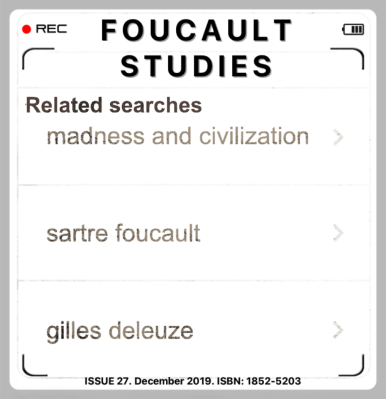 Foucault Studies, Number 27, December 2019 – now out, open access (via Foucault News)
The editors of Foucault Studies are pleased to publish this issue of Foucault Studies containing seven original articles and three book reviews. Among the themes highlighted in the seven original articles are: norms, normalization, normativity, law and rule; genealogy and the diagnosis of the present; regimes of truth and truth-telling; ethics, ethical invention and transformation; the Panopticon and surveillance; as well as the relationship between Foucault and Deleuze, and Sartre and Foucault.
Editorial
Sverre Raffnsøe et al.Articles
What’s In a Norm? Foucault’s Conceptualisation and Genealogy of the Norm
Mark KellyFoucault, Normativity, and Freedom: A Reappraisal
Giovanni MascarettiRe-thinking Thought: Foucault, Deleuze, and the Possibility of Thinking
Wendyl LunaFoucault as an Ethical Philosopher: The Genealogical Discussion of Antiquity and the Present
Dimitrios LaisEthical Invention in Sartre and Foucault: Courage, Freedom, Transformation
Kimberly EngelsSirens in the Panopticon: Intersections Between Ainslean Picoeconomics and Foucault`s Discipline Theory
Yevhenii Osiievskyi, Maksym YakovlyevThe Paradoxes in the Use of the Panopticon as a Theoretical Reference in Urban Video-surveillance Studies: A Case Study of a CCTV System of a Brazilian city
Iafet Leonardi BricalliBook Reviews
Colin Koopman: “How We Became Our Data: A Genealogy of the Informational Person”
Leonard D’CruzTom Boland: “The Spectacle of Critique: from Philosophy to Cacophony”
Stephanie MartensRosi Braidotti and Maria Hlavajova: “Posthuman Glossary”
Asker Bryld Staunæs, Mads Rosendahl Thomsen
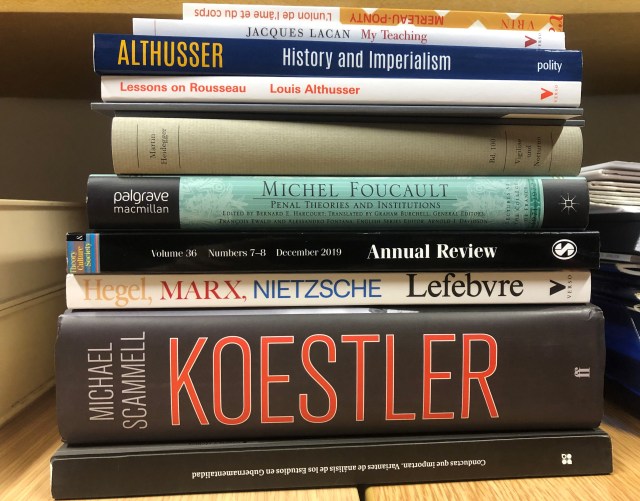
A mixed pile of books to come back to in the office. They include –
Some good news – this book is now available in paperback
https://www.sunypress.edu/p-6670-militant-acts.aspx
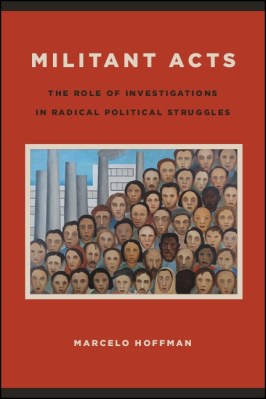 Marcelo Hoffman, Militant Acts: The Role of Investigations in Radical Political Struggles – SUNY Press, January 2019
Offers a history of the role of investigations in radical political struggles from the nineteenth century forward.
Militant Acts presents a broad history of the concept and practice of investigations in radical political struggles from the nineteenth century to the present. Radicals launched investigations into the conditions and struggles of the oppressed and exploited to stimulate their political mobilization and organization. These investigations assumed a variety of methodological forms in a wide range of geographical and institutional contexts, and they also drew support from the participation of intellectuals such as Marx, Lenin, Mao, Dunayevskaya, Foucault, and Badiou. Marcelo Hoffman analyzes newspapers, pamphlets, reports, and other source materials, which reveal the diverse histories, underappreciated difficulties, and theoretical import of investigations in radical political struggles. In so doing, he challenges readers to rethink the supposed…
View original post 167 more words
Foucault at Warwick, 17 January 2020, 5pm, with Alison Downham Moore, Lisa Downing, Stuart Elden, Daniele Lorenzini and Federico Testa – free and open to all. I’ll be speaking about the archival work I’ve done on the early Foucault.

 The making of migration: A roundtable on Martina Tazzioli’s book The Making of Migration: The Biopolitics of Mobility at Europe’s Borders (Sage, 2019)
With Stuart Elden (PAIS, Warwick), Daniele Lorenzini (Philosophy, Warwick), Vicki Squire (PAIS, Warwick), Maurice Stierl (PAIS, Warwick) and Martina Tazzioli (Goldsmiths, University of London)
Wednesday, January 15 2020, 4:30pm to 5:45pm (room S0.17)
Warwick PAIS and Philosophy organise a roundtable to discuss Martina Tazzioli’s new book, The making of migration: The biopolitics of mobility at Europe’s borders (London: SAGE, 2019) on 15 January 2020, at 4:30pm in S0.17.
The book addresses the rapid phenomenon that has become one of the most contentious issues in contemporary life: How are migrants governed as individual subjects and as part of groups? What are the modes of control, identification and partitions that migrants are subjected to?
Bringing together an ethnographically grounded analysis of migration, and a critical theoretical engagement with the security and humanitarian modes of governing migrants, The making of migration pushes us to rethink notions that are central in current political theory such as multiplicity and subjectivity. This is an innovative and sophisticated study, deploying migration as an analytical angle for complicating and reconceptualising the emergence of collective subjects, mechanisms of individualisation, and political invisibility/visibility.
Further details on the book can be found here – https://uk.sagepub.com/en-gb/eur/the-making-of-migration/book263211
All welcome!
As ever, a list of the books I read as a break from normal academic reading, though the line gets blurred with some of the biographies. I enjoyed the biographies more than the novels, and even abandoned a novel – which I do very rarely. Some of the more recent bios appear on the list of academic books I liked this year.
For lists from previous years see here, and for some responses to questions asked about my novel reading see here.
New Perspectives – 03/2019 – Full Issue open access
Benjamin Tallis announces that the journal will be moving to Sage in 2020

Editorial
1. The Velvet Revolution Happened Yesterday
Alena Drieschová
Research Articles
2. Brexit and EU Legitimation: Unwitting Martyr for the Cause?
Paul Beaumont
3. How Quantum Ontology and Q Methodology Can Revitalise Agency in IR
Pinja Lehtonen
4. Forgotten Velvet: Understanding Eastern Slovakia’s 1989
Marty Manor Mullins
Fora
5. Russia and the World: 2019 IMEMO Forecast
Mark Galeotti, Cai Wilkinson, Alexander Graef, Paul Robinson, Glenn Diesen
6. Multiplicity and/as International Relations
Justin Rosenberg, Cameron Thies, Catarina Kinnvall, Alena Drieschová, Anatoly Reshetnikov, Benjamin Tallis


