‘Writing Nomos Otherwise? Appropriation in the Anthropocene’, 3 Feb 2020, University of Westminster. Tickets and details here.

‘Writing Nomos Otherwise? Appropriation in the Anthropocene’, 3 Feb 2020, University of Westminster. Tickets and details here.
Marxist Summer School, Kasos, Greece, June 28-July 11 2020 – further details here
The Institute for the Radical Imagination is pleased to announce the creation of the Marxist Summer School, to be held yearly. For 2020, the Summer School will take place from June 28th through July 11th on the Greek island of Kasos. The Marxist Summer School is designed to enable those who are new to historical materialism as well as more advanced participants to address fundamental questions, concepts, and texts in an intensive way and in an inclusive, non-sectarian, and congenial setting. There will be two daily seminar sessions (held in the Kasos municipal library) where participants will collaborate on close readings of texts and address some of the core political problems of our times: from ecological devastation, the transformation of desire and subjectivity, and the politics of economic austerity to the new forms of technocratic capitalism and the ever-increasing tendency toward authoritarian rule.
The Marxist Summer School is open to everyone with intellectual drive and revolutionary zeal and does not require any previous preparation. Students can register on the Institute website.
 Clancy Wilmott, Mobile Mapping: Space, Cartography and the Digital – Amsterdam UP, March 2020
This book argues for a theory of mobile mapping, a situated and spatial approach towards researching how everyday digital mobile media practices are bound up in global systems of knowledge and power. Drawing from literature in media studies and geography – and the work of Michel Foucault and Doreen Massey – it examines how geographical and historical material, social, and cultural conditions are embedded in the way in which contemporary (digital) cartographies are read, deployed, and engaged. This is explored through seventeen walking interviews in Hong Kong and Sydney, as potent discourses like cartographic reason continue to transform and weave through the world in ways that haunt mobile mapping and bring old conflicts into new media. In doing so, Mobile Mapping offers an interdisciplinary rethinking about how multiple translations of spatial knowledges between rational digital epistemologies and tacit ways of understanding space and experience might be conceptualized and researched.
Only a very expensive hardback at the moment…
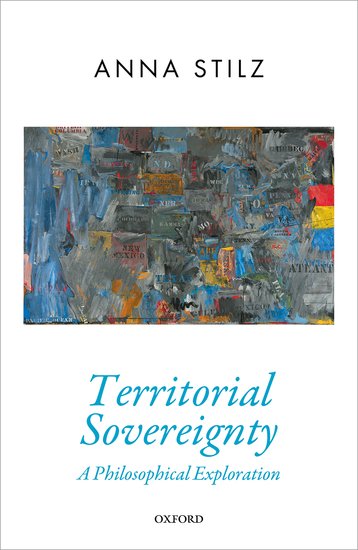 Anna Stilz, Territorial Sovereignty: A Philosophical Exploration – OUP, October 2019
Territorial Sovereignty: A Philosophical Exploration offers a qualified defense of a territorial states-system. It argues that three core values-occupancy, basic justice, and collective self-determination-are served by an international system made up of self-governing, spatially defined political units. The defense is qualified because the book does not actually justify all the sovereignty rights states currently claim, and that are recognized in international law. Instead, the book proposes important changes to states’ sovereign prerogatives, particularly with respect to internal autonomy for political minorities, immigration, and natural resources. Part I of the book argues for a right of occupancy, holding that a legitimate function of the international system is to specify and protect people’s preinstitutional claims to specific geographical places. Part II turns to the question of how a state might acquire legitimate jurisdiction over a population of occupants. It argues that the state will have a right to rule a population and its territory if it satisfies conditions of basic justice and also facilitates its people’s collective self-determination. Finally, Parts III and IV of this book argue that the exclusionary sovereignty rights to control over borders and natural resources that can plausibly be justified on the basis of the three core values are more limited than has traditionally been thought.
The book is discussed on The Political Theory Review (audio). Thanks to dmf for the link.
 Correspondance entre Gaston Bachelard et Ludwig Binswanger – open access online
It’s part of a special issue of Revue Germanique Internationale on ‘Histoire et philosophie de la psychiatrie au XXe siècle : regards croisés franco-allemands’, edited by Elisabetta Basso et Emmanuel Delille.
The issue also includes a piece by Elisabetta Basso on the Bachelard-Binswanger-Roland Kuhn dialogue. She previously published the correspondence between Kuhn and Bachelard in Revue de Sythèse (requires subscription), and between Binswanger and Foucault in Foucault à Münsterlingen.
 Martín Arboleda, Planetary Mine: Territories of Extraction under Late Capitalism – Verso, January 2020
“Martín Arboleda’s Planetary Mine offers a masterful re-theorization of the political economy of territoriality, logistics, state sovereignty, and primary commodity production. This is a powerful exploration of what we might call “actually existing global capitalism.” Theoretically fresh and politically compelling, Planetary Mine is destined to be a classic.”– Christian Parenti, John Jay College CUNY and author of The Means Proper
 Christopher Watkin, Michel Serres: Figures of Thought – Edinburgh University Press, March 2020
Great to see details of this major study, several years in the making.
The first full introduction to Serres, from The System of Leibniz (1968) to his final publications in 2019
- The first assessment of Serres’ thought as a whole
- Works from the original French to engage with the broadest range of Serres texts: both his translated works and his major untranslated works
- Provides a resource for scholars in philosophy, ecology, new materialisms, literature, the history and philosophy of science and the history of ideas
- Brings Serres into conversation with other major thinkers such as Jacques Derrida, Gilles Deleuze, Michel Foucault and Jean-Luc Nancy
- Focuses on the repeated moves that characterise Serres’ thinking, opening up his writing for scholars across disciplines and showing how his ideas can be brought to bear on new areas
Christopher Watkin provides a true overview of Serres’ thinking. Using diagrams to explain Serres’ thought, the first half of the book carefully explores Serres’ ‘global intuition’ – how he understands and engages with the world – and his ‘figures of thought’, the repeated intellectual moves that characterise his unique approach. The second half explores in detail Serres’ revolutionary contributions to the areas of language, objects and ecology.
All told, Watkin shows that Michel Serres has produced a cross-disciplinary body of work that provides a crucial and as yet under-exploited reference for current debates in post-humanism, object oriented ontology, ecological thought and the environmental humanities.This is an exceptionally lucid, detailed introduction to the disruptive thought of Michel Serres. Gone are the classic themes of subjects and objects, agency and responsibility, and in their place Serres charts the arrival of information technologies, climate catastrophe and the morphing of the human, as radically shifting structures of what Serres calls ‘hominescence’. Christopher Watkin opens his admirable account by outlining Serres’ disagreements with Descartes and Plato, and with Serres’ adaptation of Leibnizian monadology. Rethinking space and time, language, quasi-objects and a new broad scope notion of ecology fill out an intense engagement with Serres’ powerfully enabling legacy. Both general readers and specialists are in Watkin’s debt for thus providing access to the strange new world of Serresian philosophy.
Joanna Hodge, Manchester Metropolitan University
Chris Watkin has written a marvellously lucid and accessible guide to the prodigious work of Michel Serres. Watkin takes account expertly of the whole spread of Serres’s long career and breathtakingly various oeuvre, navigating through it not by text or theme, but by ‘figures of thought’. This is a brilliant device that allows him to pay attention not just to the matter of Serres’s thought but also to its particoloured styles and textures.
Steven Connor, University of Cambridge
Update: Entitled Opinions discussion podcast on the book – thanks to dmf for this link.
 Silvia Bigliazzi (ed), Oedipus at Colonus and King Lear: Classical and Early Modern Intersections – open access book
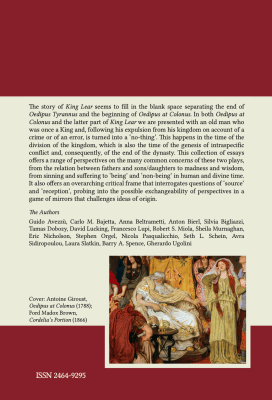
The story of King Lear seems to fill in the blank space separating the end of Oedipus Tyrannus and the beginning of Oedipus at Colonus. In both Oedipus at Colonus and the latter part of King Lear we are presented with an old man who was once a King and, following his expulsion from his kingdom on account of a crime or of an error, is turned into a ‘no-thing’. This happens in the time of the division of the kingdom, which is also the time of the genesis of intraspecific conflict and, consequently, of the end of the dynasty. This collection of essays offers a range of perspectives on the many common concerns of these two plays, from the relation between fathers and sons/daughters to madness and wisdom, from sinning and suffering to ‘being’ and ‘non-being’ in human and divine time. It also offers an overarching critical frame that interrogates questions of ‘source’ and ‘reception’, probing into the possible exchangeability of perspectives in a game of mirrors that challenges ideas of origin.
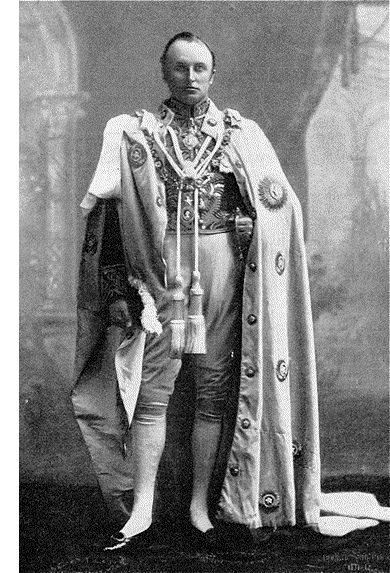 Call for papers: Curzonic geographies/Reading ‘Frontiers’
RGS-IBG conference, 1-4 September 2020
organised by Richard Schofield (KCL) and Matthew Tillotson (Leicester) – contact Matthew with any queries
As an embodiment of a classic, privileged travel writer George Curzon (1859-1925) documented his Central Asian, Persian and Far Eastern sojourns. Later, as the last Victorian viceroy of India (1899-1905), Curzon was the architect of both a ‘brilliantly organized famine’ (Davis 2017: 174) and Britain’s ‘Oriental’ borderlands. And with his 1907 Romanes lecture on ‘Frontiers’ in Oxford, Curzon articulated a ‘science’ on boundaries as an academic and intellectual project vital to British imperial interests.
Curzon the viceroy was heir to, and the advocate of utilitarian, Benthamite experiments in biopower. British liberals had long channelled Malthusian, social Darwinist and evangelical thought to justify the deaths of millions in the colonised world. Imperial wars and the retrenchments of free market ideology obscured genocidal imperial policy and framed famine relief as an obscene, inefficient response to overpopulation in India. But it was not only free market economics (in the tradition of Haileybury and the East India Company) that Curzon prized and he regarded geography as ‘one of the first and foremost of the sciences’ (Curzon 1915), vital for a period in which the imperial scramble for supposedly ‘vacant’ spaces would conclude.
Frontier policy would therefore provide ‘incessant employment for the keenest intellects and the most virile energies of the Anglo-Saxon race’ (Curzon 1907: 5). In ‘Frontiers’ and on foreign policy and territorial questions, Curzon’s thought was characterised by an environmental determinism that is qualified and never absolute: although preferring facts over generalisations still he sought to explain ‘the action of great natural forces’ (Curzon 1915: 156) over imperial policy, commerce and the distribution of settler colonial populations. Further, Curzon espoused a ‘pedagogical view of empire’ (Said 2003: 213). With the Orient recognised as Britain’sobligation, imperial space was interpreted as a political, historical and social fact. Not only was a perpetual British presence required overseas – the empire had continually to be studied.
At this session we invite panellists to discuss the troubling legacies of ‘Curzonic’ geographies: the biopolitics of hunger and famine, the interface between geographical knowledge and the projection of imperial power, and critical interpretations of ‘Frontiers’. We interpret ‘Curzonic’ broadly and welcome contributions that touch on these (and other) themes over and above Curzon’s life and times.
Society and Space has a new digital magazine style website at https://www.societyandspace.org
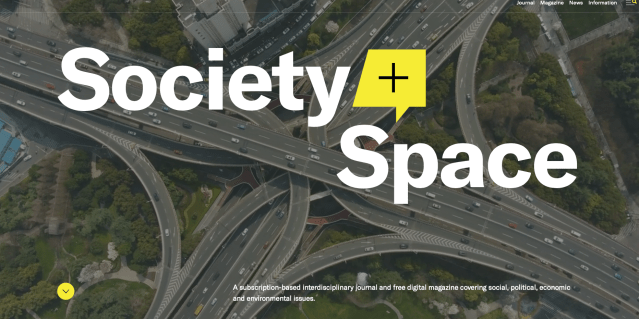
A free digital magazine and subscription based journal that helps people stay informed on interdisciplinary debates related to pressing social, political, and environmental issues.