Response to the Danny Dorling article by Alison Blunt, Martin Evans and others

In November, Danny Dorling published a piece in Emotion, Space and Society entitled ‘Kindness: A new kind of rigour for British Geographers‘ (open access), which was picked up by The Times Higher Education – “Geography seen as ‘soft option’ by ‘posh’ students, warns Dorling. Now Alison Blunt, Martin Evans and many heads of Geography departments reply – “Geography degrees are preparing disadvantaged students for relevant careers.


Posted in Uncategorized | 2 Comments

Marcelo Hoffmann on Perry Anderson, Brazil Apart: 1964-2019

Marcelo Hoffmann reviews Perry Anderson, Brazil Apart: 1964-2019, at Berfrois: The Workers’ Party and the Rise of Bolsonaro

Posted in Uncategorized | Leave a comment

Books received – a pile from the Verso sale

The Verso sale runs until the end of December 2019

Posted in Books, Georges Bataille, Jacques Derrida, Jacques Lacan, Karl Marx, Louis Althusser, Politics | Leave a comment

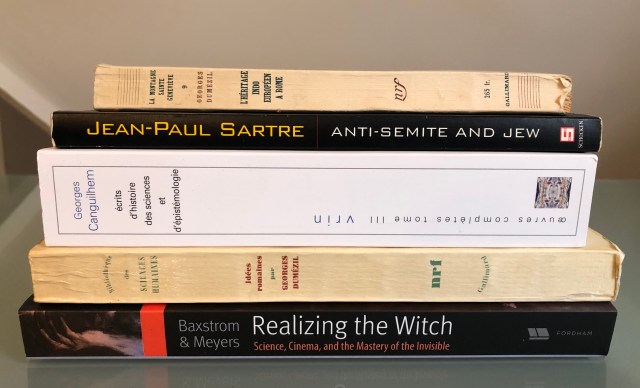
Books received – Dumézil, Sartre, Canguilhem, Baxstrom and Meyers

Two books by Dumézil, one by Sartre, the latest volume of the Canguilhem Oeuvres, and Richard Baxstrom and Todd Meyers, Realizing the Witch: Science, Cinema, and the Mastery of the Invisible.

Posted in Georges Canguilhem, Georges Dumézil, Jean-Paul Sartre | Leave a comment

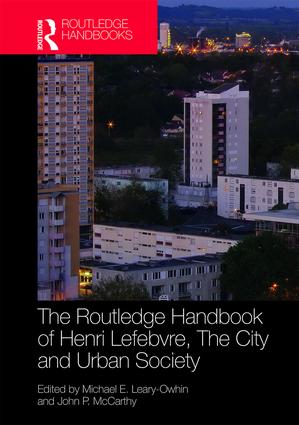
The Routledge Handbook of Henri Lefebvre, The City and Urban Society

The Routledge Handbook of Henri Lefebvre, The City and Urban Society – edited by Michael E. Leary-Owhin and John P. McCarthy

The Routledge Handbook of Henri Lefebvre,The City and Urban Society is the first edited book to focus on Lefebvre’s urban theories and ideas from a global perspective, making use of recent theoretical and empirical developments, with contributions from eminent as well as emergent global scholars.

The book provides international comparison of Lefebvrian research and theoretical conjecture and aims; to engage with and critique Lefebvre’s ideas in the context of contemporary urban, social and environmental upheavals; to use Lefebvre’s spatial triad as a research tool as well as a point of departure for the adoption of ideas such as differential space; to reassess Lefebvre’s ideas in relation to nature and global environmental sustainability; and to highlight how a Lefebvrian approach might assist in mobilising resistance to the excesses of globalised neoliberal urbanism. The volume draws inspiration from Lefebvre’s key texts (The Production of Space; Critique of Everyday Life; and The Urban Revolution) and includes a comprehensive introduction and concluding chapter by the editors. The conclusions highlight implications in relation to increasing spatial inequalities; increasing diversity of needs including those of migrants; more authoritarian approaches; and asymmetries of access to urban space. Above all, the book illustrates the continuing relevance of Levebvre’s ideas for contemporary urban issues and shows – via global case studies – how resistance to spatial domination by powerful interests might be achieved.

The Handbook helps the reader navigate the complex terrain of spatial research inspired by Lefebvre. In particular the Handbook focuses on: the series of struggles globally for the ‘right to the city’ and the collision of debates around the urban age, ‘cityism’ and planetary urbanisation. It will be a guide for graduate and advanced undergraduate teaching, and a key reference for academics in the fields of Human Geography, Sociology, Political Science, Applied Philosophy, Planning, Urban Theory and Urban Studies. Practitioners and activists in the field will also find the book of relevance.

Posted in Henri Lefebvre | 3 Comments

A bibliographical curiosity – ‘Michel Foucault’ and a thesis on penicillin

Michael Clark’s Michel Foucault, an Annotated Bibliography: Tool Kit for a New Age includes a curious entry on p. 3:
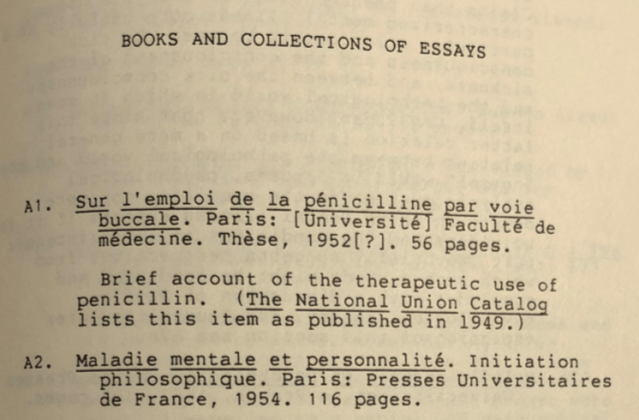
Clark p 3.png

“Sur l’emploi de la pénicilline par voie buccale”, Paris: Université Faculté de médecine, 1952 [?], 56 pages. The title would translate as ‘On the use of penicillin by mouth’.

Clark indicates that this is “Brief account of the therapeutic use of penicillin. (The National Union Catalog lists this as published in 1949.) It’s not clear why Clark thinks 1952 is a possible date.

Clearly this text is not by the well-known Michel Foucault, given we know that his training was in philosophy and psychology, not medicine. Later people working on Foucault, and building their own bibliographies, do not mention it. But while I’ve yet to find anyone who follows Clark, I’ve also not found anyone who explains why it is there.

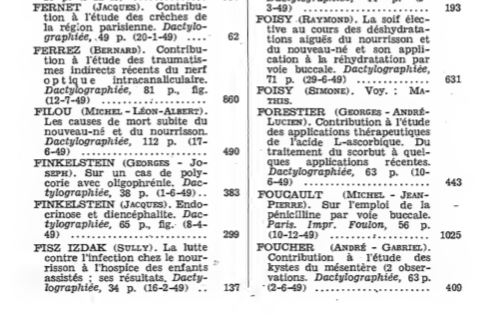
I’ve not found the National Union catalogue reference, but I did find it listed in Tables des thèses soutenant devant la Faculté de Médecine en 1949, Paris: Libraire Arnette, 1950, p. 24:
Tables des theses p 24.png

FOUCAULT (Michel – Jean-Pierre) Sur l’emploi de pénicilline par voie buccale, Paris, Impr. Foulon, 56 (10-12-49).

It is also listed on p. 100. A copy of this thesis is at the Bibliothèque nationale.
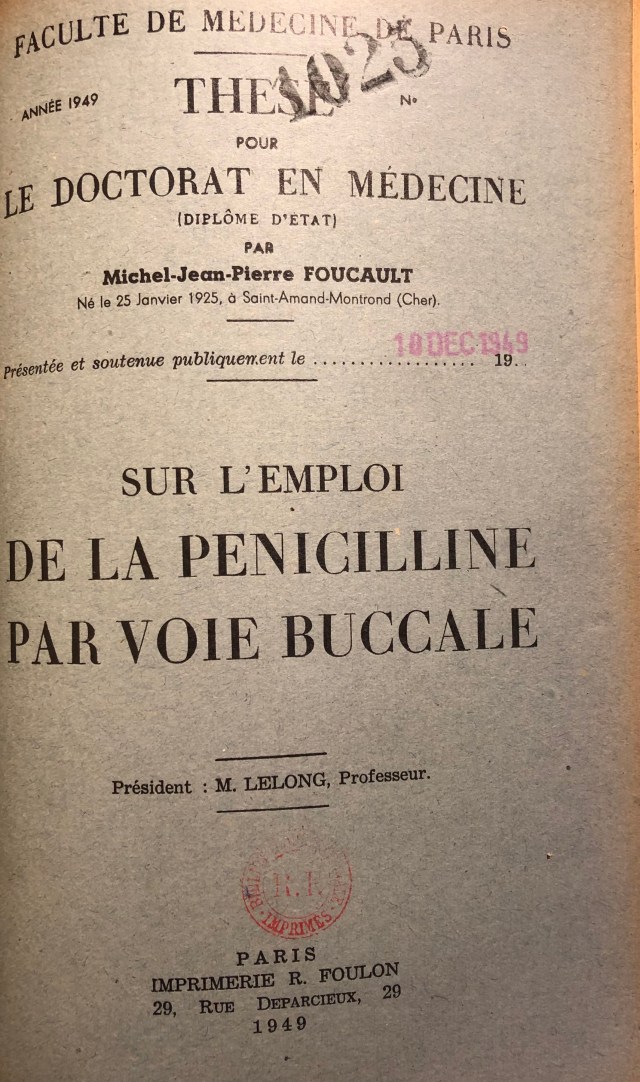
Foucault 1949 - Sur l'emploi de la penicilline 1.jpg

The famous Michel Foucault was named at birth ‘Paul Michel Foucault’, though he dropped the ‘Paul’ which was his father’s name (and also, apparently, because it gave him the same initials as Pierre Mendès France). This Foucault was born in 1925, one year before his famous namesake. Whatever became of Michel Jean-Pierre Foucault? Worldcat only lists this single thesis under his name.


Posted in Michel Foucault, Uncategorized | Leave a comment

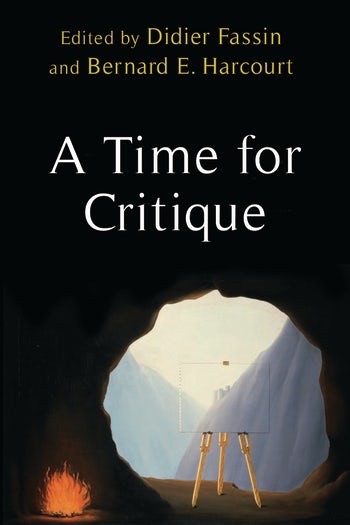
A Time for Critique (2019)

A Time for Critique, Edited by Didier Fassin and Bernard E. Harcourt
Columbia University Press, 2019

Clare O'Farrell's avatarFoucault News

A Time for Critique, Edited by Didier Fassin and Bernard E. Harcourt
Columbia University Press, 2019

In a world of political upheaval, rising inequality, catastrophic climate change, and widespread doubt of even the most authoritative sources of information, is there a place for critique? This book calls for a systematic reappraisal of critical thinking—its assumptions, its practices, its genealogy, its predicament—following the principle that critique can only start with self-critique.

In A Time for Critique, Didier Fassin, Bernard E. Harcourt, and a group of eminent political theorists, anthropologists, sociologists, philosophers, and literary and legal scholars reflect on the multiplying contexts and forms of critical discourse and on the social actors and social movements engaged in them. How can one maintain sufficient distance from the eventful present without doing it an injustice? How can one address contemporary issues without repudiating the intellectual legacies of the past? How can one…

View original post 392 more words

Posted in Uncategorized | Leave a comment

Alice Jardine, At the Risk of Thinking: An Intellectual Biography of Julia Kristeva – Bloomsbury, January 2020

9781501341342Alice Jardine, At the Risk of Thinking: An Intellectual Biography of Julia Kristeva – Bloomsbury, January 2020

At the Risk of Thinking is the first biography of Julia Kristeva–one of the most celebrated intellectuals in the world. Her some fifty books, translated across the globe, address topics such as the history of love, questions surrounding female genius, new forms of revolt, and the importance of understanding the history and influence of religion. She is the author of six novels and her prize-winning contributions have informed the fields of philosophy, literary criticism, critical theory, psychoanalysis, and feminism, among others.

Alice Jardine’s biography brings Kristeva’s work to a broader readership by connecting Kristeva’s personal journey–from her childhood in Communist Bulgaria to her adult life as an international public intellectual based in Paris–with the history of her ideas. This itinerary has recently taken on new meaning as Kristeva has been accused of spying for the Bulgarian Secret Services in the early 1970s–a totally unanticipated slap in the face by history. Informed in part by extensive interviews with Kristeva herself, this telling of a remarkable woman’s life story also clearly analyzes the complexities of Kristeva’s writing, emphasizing her call for an urgent revival of bold interdisciplinary thinking in order to understand–and to act–in today’s world.

Posted in Julia Kristeva, Uncategorized | Leave a comment

Le dossier sauvage/ The Wild File (2019

Philippe Artières, Le dossier sauvage

Clare O'Farrell's avatarFoucault News

Philippe Artières, Le dossier sauvage, Verticales, Octobre 2019

« Enquêter sur des archives qui auraient été rassemblées par Michel Foucault. Déplier chacune de ses pièces pour suivre la trace d’individus qui se sont retirés du monde au XIXe et au XXe siècle. Redécouvrir, en marge du dossier, que dans une forêt des Vosges, il est un autre ermite qui a marqué mon enfance.
Lors du dépouillement de cette généalogie sauvage, il arrivera que je me perde, mais n’est-ce pas le propre du chercheur que de s’aventurer en un territoire où plus il avance plus ce qu’il croyait savoir se dérobe sous ses pas. » [Ph.A.]

*******

From the outset Philippe Artières stages himself receiving a file entitled «Wild Lives» which seems to have been gathered by Michel Foucault. This unpublished collection contains bundles of documents on individuals who withdrew from the world in the 19th and 20th centuries. Among…

View original post 229 more words

Posted in Uncategorized | Leave a comment

Jane Hutton | Reciprocal Landscapes: Stories of Material Movements

Jane Hutton’s Reciprocal Landscapes: Stories of Material Movements

asevillab's avatarmultipliciudades

Jane Hutton’s Reciprocal Landscapes: Stories of Material Movements, is out with Routledge. I have been following Hutton’s work for a long time and I was eager to read this elaboration of her previous research on the relational political ecology of uneven material flows. Here is the summary:

https://images.tandf.co.uk/common/jackets/amazon/978113883/9781138830684.jpgHow are the far-away, invisible landscapes where materials come from related to the highly visible, urban landscapes where those same materials are installed? Reciprocal Landscapes: Stories of Material Movements traces five everyday landscape construction materials – fertilizer, stone, steel, trees, and wood – from seminal public landscapes in New York City, back to where they came from.

Drawing from archival documents, photographs, and field trips, the author brings these two separate landscapes – the material’s source and the urban site where the material ended up – together, exploring themes of unequal ecological exchange, labor, and material flows. Each chapter follows a single…

View original post 146 more words

Posted in Uncategorized | Leave a comment