Conductas que importan. Variantes de análisis de los Estudios en Gubernamentalidad (2019)

Spanish collection on Foucault and governmentality, in which I have an essay.

Clare O'Farrell's avatarFoucault News

Aldo Avellaneda y Guillermo Vega, (eds.) Conductas que importan. Variantes de análisis de los Estudios en Gubernamentalidad. EUDENE 2018.

Presentation: Wednesday, 27, 18:30. Salón de Actos, Facultad de Humanidades, Universidad Nacional del Nordeste, Argentina.

Resumen
Los así llamados Governmentality Studies (Estudios en Gubernamentalidad) vieron la luz en el año 1991, si convenimos en otorgar crédito suficiente a la designación que Colin Gordon, Graham Burchel y Peter Miller emplearon para denominar una compilación de artículos que se hacían eco, de una u otra manera, del concepto foucaulteano de gobierno. En efecto, en la clase del primero de febrero de 1978 dictada en el Collège de France, Foucault se había enfocado en las artes de gobierno como modo específico de articulación de las relaciones de poder y en la gubernamentalidad como grilla de inteligibilidad de las mismas, dando de esta manera un giro vertiginoso sobre las estrategias de análisis de los…

View original post 210 more words

Posted in Uncategorized | Leave a comment

Jacques Derrida: La vie la mort: Séminaire (1975-1976) – Phenomenological Reviews

Posted in Uncategorized | Leave a comment

Henri Lefebvre, Hegel, Marx, Nietzsche Or the Realm of Shadows – translated by David Fernbach, Verso, February 2020

Hegel__Marx__Nietzsche_and_The_End_of_Hisory-99e410129bcc1f7c22f8f3557f4adba9.jpgHenri Lefebvre, Hegel, Marx, Nietzsche Or the Realm of Shadows – translated by David Fernbach, Verso, February 2020

I’ve mentioned this before, but it’s now up on the Verso site and online bookstores. I wrote an Introduction to this. A reminder that buying from Verso will come with a bundled e-book (I really wish more publishers would do this).

The great French Marxist philosopher weighs up the contributions of the three major critics of modernity

Henri Lefebvre saw Marx as an ‘unavoidable, necessary, but insufficient starting point’, and always insisted on the importance of Hegel to understanding Marx. Metaphilosophy also suggested the significance he ascribed to Nietzsche, in the ‘realm of shadows’ through which philosophy seeks to think the world. Hegel, Marx, Nietzsche: or the Realm of the Shadows proposes that the modern world is, at the same time, Hegelian in terms of the state, Marxist in terms of the social and society and Nietzschean in terms of civilisation and its values. As early as 1939, Lefebvre had pioneered a French reading of Nietzsche that rejected the philosopher’s appropriation by fascists, bringing out the tragic implications of Nietzsche’s proclamation that ‘God is dead’ long before this approach was followed by such later writers as Foucault, Derrida and Deleuze. Forty years later, in the last of his philosophical writings, Lefebvre juxtaposed the contributions of the three great thinkers, in a text that’s themes remain surprisingly relevant today.

Posted in Friedrich Nietzsche, Georg Wilhelm Friedrich Hegel, Henri Lefebvre, Karl Marx, Uncategorized | Leave a comment

Franck Billé, Voluminous States: Sovereignty, Materiality, and the Territorial Imagination – Duke UP, August 2020

Franck Billé, Voluminous States: Sovereignty, Materiality, and the Territorial Imagination – Duke UP, August 2020

From the Arctic to the South China Sea, states are vying to secure sovereign rights over vast maritime stretches, undersea continental plates, shifting ice flows, airspace, and the subsoil. Conceiving of sovereign space as volume rather than area, the contributors to Voluminous States explore how such a conception reveals and underscores the three-dimensional nature of modern territorial governance. In case studies ranging from the United States, Europe, and the Himalayas to Hong Kong, Korea, and Bangladesh, the contributors outline how states are using airspace surveillance, maritime patrols, and subterranean monitoring to gain and exercise sovereignty over three-dimensional space. Whether examining how militaries are digging tunnels to create new theaters of operations, the impacts of climate change on borders, or the relation between borders and nonhuman ecologies, they demonstrate that a three-dimensional approach to studying borders is imperative for gaining a fuller understanding of sovereignty.

Contributors. Debbora Battaglia, Franck Billé, Wayne Chambliss, Jason Cons, Hilary Cunningham (Scharper), Klaus Dodds, Elizabeth Cullen Dunn, Gastón Gordillo, Sarah Green, Tina Harris, Caroline Humphrey, Marcel LaFlamme, Lisa Sang Mi Min, Aihwa Ong, Clancy Wilmott, Jerry Zee

“Responding to the changing ways in which states are colonizing previously inconceivable dimensions of life and livelihood in the ever-reinvented interests of territorial sovereignty, Voluminous States tackles real-life issues of state control. With its specific focus on three-dimensional space as itself a materiality as well as a force in political conceptions and social analysis, it will be welcomed by scholars interested in climate change, sustainability, sovereignty, territoriality, and beyond. This volume sparks the imagination.” — Marilyn Strathern, author of Relations: An Anthropological Account

“Taking materiality and dimensionality seriously in thinking about geopolitics, Voluminous States is likely to become a standard reference in developing debates in human geography, political theory, international relations, and anthropology. Global in reach, this is a great project that is executed extremely well.” — Stuart Elden, author of Shakespearean Territories

Posted in Uncategorized | 2 Comments

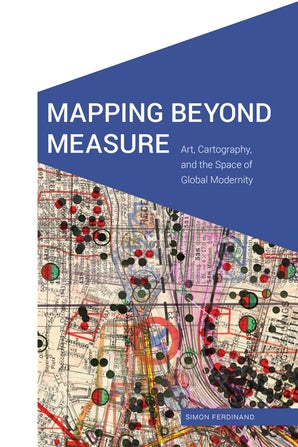
Simon Ferdinand, Mapping Beyond Measure: Art, Cartography, and the Space of Global Modernity – University of Nebraska Press, 2019

9781496212115Simon Ferdinand, Mapping Beyond Measure: Art, Cartography, and the Space of Global Modernity – University of Nebraska Press, 2019

Over the last century a growing number of visual artists have been captivated by the entwinements of beauty and power, truth and artifice, and the fantasy and functionality they perceive in geographical mapmaking. This field of “map art” has moved into increasing prominence in recent years yet critical writing on the topic has been largely confined to general overviews of the field.

In Mapping Beyond Measure Simon Ferdinand analyzes diverse map-based works of painting, collage, film, walking performance, and digital drawing made in Britain, Japan, the Netherlands, Ukraine, the United States, and the former Soviet Union, arguing that together they challenge the dominant modern view of the world as a measurable and malleable geometrical space. This challenge has strong political ramifications, for it is on the basis of modernity’s geometrical worldview that states have legislated over social space; that capital has coordinated global markets and exploited distant environments; and that powerful cartographic institutions have claimed exclusive authority in mapmaking.

Mapping Beyond Measure breaks fresh ground in undertaking a series of close readings of significant map artworks in sustained dialogue with spatial theorists, including Peter Sloterdijk, Zygmunt Bauman, and Michel de Certeau. In so doing Ferdinand reveals how map art calls into question some of the central myths and narratives of rupture through which modern space has traditionally been imagined and establishes map art’s distinct value amid broader contemporary shifts toward digital mapping.

“In this thoughtful analysis of ‘map art’ Simon Ferdinand offers an innovative interpretation of contemporary artworks that tests and reconfigures the challenges and opportunities posed by the transformation in global modernity of our lived world into lines and grids. ‘I map, therefore I am modern’ is the resounding implication that emerges from Ferdinand’s perceptive exploration of how visual artists in our times have used the map form to relate to the world, to the globe, indeed to earth itself.”—Sumathi Ramaswamy, author of Terrestrial Lessons: The Conquest of the World as Globe

“This is an important book on a theoretical level. By looking at recent technologies as a continuation of existing ontologies, Ferdinand goes beyond the hype around digital mapping. The chapters touch deftly on many themes that will also be of interest to academic readers who don’t deal explicitly with maps in their work, including utopia, modernity, quantification, and futurism, among many others.”—Jess Bier, author of Mapping Israel, Mapping Palestine: How Occupied Landscapes Shape Scientific Knowledge

Posted in Uncategorized | Leave a comment

Irus Braverman and Elizabeth R. Johnson (eds.),Blue Legalities: The Life and Laws of the Sea – Duke University Press, 2019

The Introduction is available open access here – https://www.dukeupress.edu/Assets/PubMaterials/978-1-4780-0654-1_601.pdf

stuartelden's avatarProgressive Geographies

Irus Braverman and Elizabeth R. Johnson (eds.), Blue Legalities: The Life and Laws of the Sea – Duke University Press, 2019

The ocean and its inhabitants sketch and stretch our understandings of law in unexpected ways. Inspired by the blue turn in the social sciences and humanities, Blue Legalities explores how regulatory frameworks and governmental infrastructures are made, reworked, and contested in the oceans. Its interdisciplinary contributors analyze topics that range from militarization and Maori cosmologies to island building in the South China Sea and underwater robotics. Throughout, Blue Legalities illuminates the vast and unusual challenges associated with regulating the turbulent materialities and lives of the sea. Offering much more than an analysis of legal frameworks, the chapters in this volume show how the more-than-human ocean is central to the construction of terrestrial institutions and modes of governance. By thinking with the more-than-human ocean, Blue Legalities questions what we think…

View original post 227 more words

Posted in Uncategorized | Leave a comment

The Early Foucault Update 28 – second half of the manuscript, Swiss archives and asylums

Term 1 is when I do most of my teaching, but I’ve been doing a little bit of work on my The Early Foucault manuscript most days. I’ve mainly been reworking the organisation of the second half of the text. Chapter 6 discusses the writing of History of Madness, mainly in Uppsala; Chapter 7 the time in Warsaw and Hamburg, with the work on the Kant translation and introduction; Chapter 8 the defence of the theses, publishing the History of Madness and its initial reception. The concluding chapter discusses the revision of Maladie mentale et personnalité into Maladie mentale et psychologie in 1962, and the abridgment of History of Madness in 1964 for the 10/18 series. It also points towards themes that Foucault would work on in the 1960s, which will be the topic of my planned fourth book in this series.

Foucault’s thesis defence is interesting. The notes he used for his short presentations of the two theses are in the Paris archive, and Didier Eribon reproduces the formal report and some of Henri Gouhier’s notes from the defence itself in his biography, with most detail in the revised third edition. This discussion works better now that I have a clearer account of the Kant thesis. I’ve seen the introduction part of that thesis in a couple of archives (rather than just the published version), but not the thesis version of the translation (as opposed to the 1964 publication). The two partts of the thesis are at the Sorbonne, and I’ve recently discovered another copy is elsewhere in Paris. Hopefully I’ll get to look at them later this year.

Chapter 6 needs the most work, and I plan to do more with this in Uppsala next year. I have begun working through the published History of Madness again, and working out what I want to say about it here. Initially I’ve been working on the 1961 and 1972 prefaces (and the abbreviated 1964 version). I’d long liked the 1961 text, but there is a nice phrase in the 1972 one which I’d sort of glossed over before about the book as produced is “a miniscule event, an object that fits into the hand”, and how Foucault hopes that his book might be just the sentences that make it up. I’m trying to do something about how what I’m doing in this book works backwards from that point. Chapter 5, on Foucault’s reading of Nietzsche and Heidegger also needs some reworking and addition – much of that needs to be done in Paris.

I’ve also been tracking some of the harder to find sources for this period. As well as some visits to the British Library, this has included a trip to the Bodleian library in Oxford to consult the University of Hamburg’s teaching records for the time Foucault was there. While I might go to Hamburg at some point, the Bodleian is the only UK library that seems to have a copy. There are almost no traces of lecture material from Uppsala, Warsaw or Hamburg in his own archive, so working out what Foucault did needs to be on the basis of reports elsewhere. These include newspapers announcing lectures, the course catalogues for universities at which he taught, and memoirs from people who attended. Eribon and Macey do a lot of this work, but I think a little more can be established.

I’ve also updated the chronology of audio and video recordings of Foucault online
Kreuzlingen asylum 10 with couch.jpg

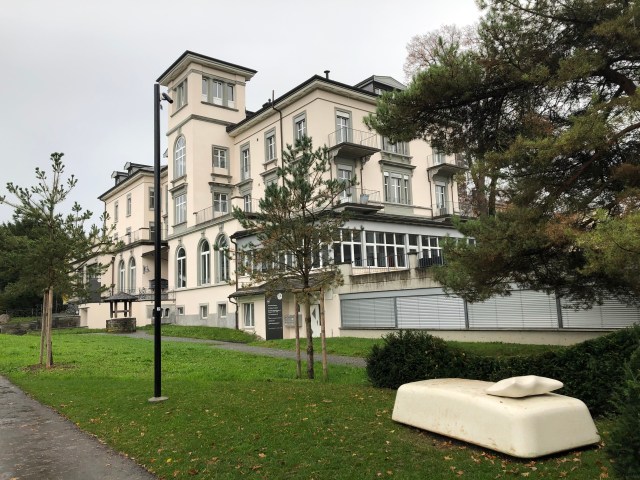
Part of Ludwig Binswanger’s old asylum in Kreuzlingen, metres from the Swiss-German border

In reading week I went to Switzerland for a few days on the trail of papers by some of the people Foucault knew in the mid-1950s. Because I wanted to go to both Berne and the north of the country, I stayed in Zürich. While I made the trip for the archives, I had a bit of time there when they were closed so I went to Kreuzlingen and Münsterlingen, where Ludwig Binswanger and Roland Kuhn ran psychiatric hospitals. Foucault visited them in 1954 – the Foucault à Münsterlingen collection has a lot of detail about this. But it was good to see what was left – not so much of Binswanger’s workplace in Kreuzlingen, although a couple of key buildings remain; but there is a lot of the Münsterlingen hospital still there. It’s still used as a hospital, in an impressive setting on the shores of the Bodensee/Lake Constance. Kuhn’s papers are in Frauenfeld, not far from Kreuzlingen, and Binswanger’s are in Tübingen. I got to see Kuhn’s papers on this trip, and I will look at Binswanger’s soon.

Some of these visits involve checking things referenced by others, where I would prefer to see the original rather than just follow someone else’s reference. But others are through a bit of pro-active work – contacting various archives and finding out what they have, and then sometimes negotiating access. Some things are restricted, but I’ve usually been able to get to see things I need.

Such visits are always worthwhile – either to find the text someone else has referenced, or to see what remains of something I’m actively looking for, or to be surprised. One text I was hoping to find only exists in a German translation, even though the catalogue entry was in French, but that’s certainly better than nothing; another non-descript file that I was checking for completeness sake turned out to have a typescript of something I’d thought no longer existed. Other things triggered thoughts of other places to look – even discovering Warwick had a copy of something I might never have otherwise checked, but which has an interesting nugget of information.

I’m continually struck by how some claims become engrained in the secondary literature, but on checking all ultimately derive from a single source which may or may not be accurate. But repetition means that it appears common knowledge, and challenging it becomes ever more difficult with the passing of time. This, and much else, is not helped by people not citing sources, or claiming that they’ve consulted a primary text or document when really they have only seen it cited elsewhere. Little repeated errors in references are often a giveaway for this.

At the end of reading week I headed off to Wales to a remote place with no Wi-Fi, barely a phone signal and lots of hills. I had a couple of days of cycling and writing – I was much more focused without any form of contact with the outside world. The initial irritation of not being immediately able to check a reference online or find a library that had something soon fell away, and instead I made lists of things to check later and got down to writing, cutting and reorganising. I’m now much happier with the second half of the text.

I’ll be speaking about some of this work in Warwick and Oxford in 2020. I’m also planning some future archive visits – Paris in December, Germany in January, and then hopefully Uppsala, the United States and France again.

The previous updates on this project are here; and the previous books Foucault’s Last Decade and Foucault: The Birth of Power available from Polity. The related book Canguilhem came out earlier this year, and is discussed a bit more here. Several Foucault research resources such as bibliographies, short translations, textual comparisons and so on, produced while doing the work for these books, are available here.

Posted in Ludwig Binswanger, Michel Foucault, The Early Foucault, Uncategorized | 4 Comments

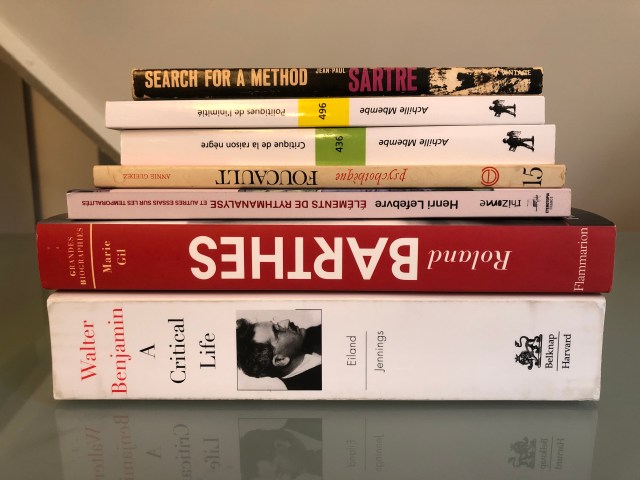
Books received – Sartre, Mbembe, Guedez, Lefebvre, Gil, Eiland and Jennings

2019-11-12 08.47.51.jpg

Sartre’s Search for a Method and two books by Achille Mbembe for teaching; Annie Guédez’s early study of Foucault, which relates him to psychology; the new edition of Lefebvre’s Rhythmanlaysis; and two biographies – Marie Gil on Roland Barthes and Howard Eiland and Michael Jennings on Walter Benjamin.

Posted in Achille Mbembe, Henri Lefebvre, Jean-Paul Sartre, Michel Foucault, Roland Barthes, Uncategorized, Walter Benjamin | Leave a comment

Christiansen and Gebauer (eds.), Rhythms Now: Henri Lefebvre’s Rhythmanalysis Revisited – Aaborg University Press, 2019 (open access)

Steen Ledet Christiansen and Mirjam Gebauer (eds.), Henri Lefebvre’s Rhythmanalysis Revisited – Aaborg University Press, 2019 (open accessUntitled)

Rhythms abound today, in a time where all manner of rhythms intersect and amplify each other. Rhythmanalysis enables us to discuss lived experience, both in terms of the constraints of contemporary society, but also the affordances (social, techno- logical, cultural) that we all have access to, in different ways. By focusing on rhythms, we recognize how multiple, different forms inform both our experience but also culture and society as a whole. Rhythmanalysis allows for close attention to the parti- cularities of each rhythm, while also recognizing the combined effect. In this way, rhythmanalysis can be seen as an productive supplement of constructivist thought, thus illuminating critical theory, poststructuralism, and most other branches of cultural theory.

Revisiting, discussing and revising Henry Lefebvre’s rhythm- analysis, this volume thus contributes to rhythmanalysis by out- lining a methodology for others to adapt, while at the same time providing specific instances of how rhythmanalysis can work as an analytic tool, but also shows how rhythms manifest in a multitude of ways.

Posted in Henri Lefebvre, Uncategorized | 1 Comment

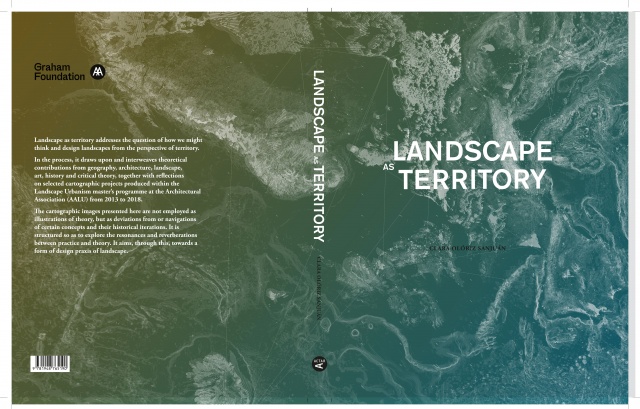
Clara Oloriz, Landscape as Territory – Book Launch, 20 November 2019, Architectural Association bookshop, London

Clara Oloriz, Landscape as Territory – Book Launch

6.30pm, 20 November 2019, Architectural Association bookshop, London

1572517910.jpg

The Landscape as Territory Book was awarded an AA fellowship and a Graham Foundation Grant for its edition, writing & publication. Published by Actar.

Landscape as territory addresses the question of how we might think and design landscapes from the perspective of territory. In the process, it draws upon and interweaves theoretical contributions from geography, architecture, landscape, art, history and critical theory, together with reflections on selected cartographic projects produced within the Landscape Urbanism master’s programme at the Architectural Association (AALU) from 2013 to 2018. The cartographic images presented here are not employed as illustrations of theory, but as deviations from or navigations of certain concepts and their historical iterations. It is structured so as to explore the resonances and reverberations between practice and theory. It aims, through this, towards a form of design praxis of landscape.

Join us for a drinks reception with Clara Oloriz introduced by the Director of Landscape Urbanism at the AA Jose Alfredo Ramirez to celebrate the launch of this great new publication.

Launch Price £30 RRP £35

All lectures are open to members of the public, staff and students unless otherwise stated.


Posted in Uncategorized | Leave a comment