Łukasz Stanek, Architecture in Global Socialism: Eastern Europe, West Africa, and the Middle East in the Cold War – Princeton U Press, January 2020

9780691168708.jpgŁukasz Stanek, Architecture in Global Socialism: Eastern Europe, West Africa, and the Middle East in the Cold War – Princeton U Press, January 2020

In the course of the Cold War, architects, planners, and construction companies from socialist Eastern Europe engaged in a vibrant collaboration with those in West Africa and the Middle East in order to bring modernization to the developing world. Architecture in Global Socialism shows how their collaboration reshaped five cities in the Global South: Accra, Lagos, Baghdad, Abu Dhabi, and Kuwait City.

Łukasz Stanek describes how local authorities and professionals in these cities drew on Soviet prefabrication systems, Hungarian and Polish planning methods, Yugoslav and Bulgarian construction materials, Romanian and East German standard designs, and manual laborers from across Eastern Europe. He explores how the socialist development path was adapted to tropical conditions in Ghana in the 1960s, and how Eastern European architectural traditions were given new life in 1970s Nigeria. He looks at how the differences between socialist foreign trade and the emerging global construction market were exploited in the Middle East in the closing decades of the Cold War. Stanek demonstrates how these and other practices of global cooperation by socialist countries—what he calls socialist worldmaking—left their enduring mark on urban landscapes in the postcolonial world.

Featuring an extensive collection of previously unpublished images, Architecture in Global Socialism draws on original archival research on four continents and a wealth of in-depth interviews. This incisive book presents a new understanding of global urbanization and its architecture through the lens of socialist internationalism, challenging long-held notions about modernization and development in the Global South.

I interviewed Lukasz about his earlier work on Lefebvre for Society and Space some years ago, and he discussed this project towards the end of his comments. It’s great to see it published.


Posted in Uncategorized | Leave a comment

‘There is always in history this possibility of the unexpected’: Interview with Carlo Ginzburg

Screen_Shot_2019-10-22_at_15.10.00-.pngAlso at the Verso blog – ‘There is always in history this possibility of the unexpected’: Interview with Carlo Ginzburg

Carlo Ginzburg, author of The Cheese and the Worms, is one of Europe’s most influential historians. In this interview with Claire Zalc, Ginzburg discusses the influence of his parents – the novelist Natalia Ginzburg and scholar of Russian literature Leone Ginzburg – his childhood in Fascist Italy, historical method, Aby Warburg, and the continuing importance of historical scholarship.

Posted in Uncategorized | Leave a comment

Christopher Law on Judith Butler, Anti-Semitism and the force of discourse

Force_of_Nonviolence.jpgChristopher Law on Judith Butler, Anti-Semitism and the force of discourse at the Verso blog. Butler’s book The Force of Nonviolence: The Ethical in the Political is forthcoming from Verso in 2020:

Here’s the book’s description:

Judith Butler’s new book shows how an ethic of nonviolence must be connected to a broader political struggle for social equality. Further, it argues that nonviolence is often misunderstood as a passive practice that emanates from a calm region of the soul, or as an individualist ethical relation to existing forms of power. But, in fact, nonviolence is an ethical position found in the midst of the political field. An aggressive form of nonviolence accepts that hostility is part of our psychic constitution, but values ambivalence as a way of checking the conversion of aggression into violence. One contemporary challenge to a politics of nonviolence points out that there is a difference of opinion on what counts as violence and nonviolence. The distinction between them can be mobilised in the service of ratifying the state’s monopoly on violence.

Considering nonviolence as an ethical problem within a political philosophy requires a critique of individualism as well as an understanding of the psychosocial dimensions of violence. Butler draws upon Foucault, Fanon, Freud, and Benjamin to consider how the interdiction against violence fails to include lives regarded as ungrievable. By considering how ‘racial phantasms’ inform justifications of state and administrative violence, Butler tracks how violence is often attributed to those who are most severely exposed to its lethal effects. The struggle for nonviolence is found in movements for social transformation that reframe the grievability of lives in light of social equality and whose ethical claims follow from an insight into the interdependency of life as the basis of social and political equality.

Posted in Judith Butler, Uncategorized | Leave a comment

Tarik Kochi, Global Justice and Social Conflict: The Foundations of Liberal Order and International Law – Routledge, 2019

9780367406813Tarik Kochi, Global Justice and Social Conflict: The Foundations of Liberal Order and International Law – Routledge, 2019

Global Justice and Social Conflict offers a ground-breaking historical and theoretical reappraisal of the ideas that underpin and sustain the global liberal order, international law and neoliberal rationality.

Across the 20th and 21st centuries, liberalism, and increasingly neoliberalism, have dominated the construction and shape of the global political order, the global economy and international law. For some, this development has been directed by a vision of ‘global justice’. Yet, for many, the world has been marked by a history and continued experience of injustice, inequality, indignity, insecurity, poverty and war – a reality in which attempts to realise an idea of justice cannot be detached from acts of violence and widespread social conflict. In this book Tarik Kochi argues that to think seriously about global justice we need to understand how both liberalism and neoliberalism have pushed aside rival ideas of social and economic justice in the name of private property, individualistic rights, state security and capitalist ‘free’ markets. Ranging from ancient concepts of natural law and republican constitutionalism, to early modern ideas of natural rights and political economy, and to contemporary discourses of human rights, humanitarian war and global constitutionalism, Kochi shows how the key foundational elements of a now globalised political, economic and juridical tradition are constituted and continually beset by struggles over what counts as justice and over how to realise it. Engaging with a wide range of thinkers and reaching provocatively across a breadth of subject areas, Kochi investigates the roots of many globalised struggles over justice, human rights, democracy and equality, and offers an alternative constitutional understanding of the future of emancipatory politics and international law.

Global Justice and Social Conflict will be essential reading for scholars and students with an interest in international law, international relations, international political economy, intellectual history, and critical and political theory.

The good news is that, unlike many Routledge books, this is available in paperback as well as hardback and ebook. There is also a promotional 20% discount code of FLR40.

Posted in Uncategorized | 1 Comment

Books received – Kirkpatrick, Carlisle, Stratford, Carrigan

books-1.jpgKate Kirkpatrick, Becoming Beauvoir; Clare Carlisle, Philosopher of the Heart: The Restless Life of Søren Kierkegaard; Elaine Stratford, Home, Nature and the Feminine Ideal: Geographies of the Interior and of Empire; and Mark Carrigan, Social Media for Academics, second edition. Elaine and Mark’s books were sent by the publishers – I was interviewed for the first edition of Mark’s book.

Posted in Simone de Beauvoir, Uncategorized | Leave a comment

Cat Moir, Ernst Bloch’s Speculative Materialism: Ontology, Epistemology, Politics – Brill 2019; paperback forthcoming with Haymarket, December 2020

2019-10-25-Ernst-Block-Cat-Moir.jpgCat Moir, Ernst Bloch’s Speculative Materialism: Ontology, Epistemology, Politics – Brill 2019; paperback forthcoming with Haymarket, December 2020

In Ernst Bloch’s Speculative Materialism: Ontology, Epistemology, Politics, Cat Moir offers a new interpretation of the philosophy of Ernst Bloch. The reception of Bloch’s work has seen him variously painted as a naïve realist, a romantic nature philosopher, a totalitarian thinker, and an irrationalist whose obscure literary style stands in for a lack of systematic rigour. Moir challenges these conceptions of Bloch by reconstructing the ontological, epistemological, and political dimensions of his speculative materialism. Through a close, historically contextualised reading of Bloch’s major work of ontology, Das Materialismusproblem, seine Geschichte und Substanz (The Materialism Problem, its History and Substance), Moir presents Bloch as one of the twentieth century’s most significant critical thinkers.

Currently only an expensive hardback, but since it’s part of the Historical Materialism series, this should mean a paperback will follow. There’s also a discussion of the book at the University of Sydney on 25 October 2019.

Posted in Uncategorized | 1 Comment

Stuart Schrader, Badges without Borders: How Global Counterinsurgency Transformed American Policing – U California Press, November 2019

Now published – Stuart Schrader, Badges without Borders

stuartelden's avatarProgressive Geographies

9780520295629.jpgStuart Schrader, Badges without Borders: How Global Counterinsurgency Transformed American Policing– University of California Press, November 2019

From the Cold War through today, the U.S. has quietly assisted dozens of regimes around the world in suppressing civil unrest and securing the conditions for the smooth operation of capitalism. Casting a new light on American empire, Badges Without Borders shows, for the first time,  that the very same people charged with global counterinsurgency also militarized American policing at home.

In this groundbreaking exposé, Stuart Schrader shows how the United States projected imperial power overseas through police training and technical assistance—and how this effort reverberated to shape the policing of city streets at home. Examining diverse records, from recently declassified national security and intelligence materials to police textbooks and professional magazines, Schrader reveals how U.S. police leaders envisioned the beat to be as wide as the globe and worked to put…

View original post 44 more words

Posted in Uncategorized | Leave a comment

‘Le Temps musical’ video – Elliott Carter, Pierre Boulez, Roland Barthes, Jean-Claude Risset, Gerald Bennett, Michel Decoust, Michel Foucault, Gilles Deleuze

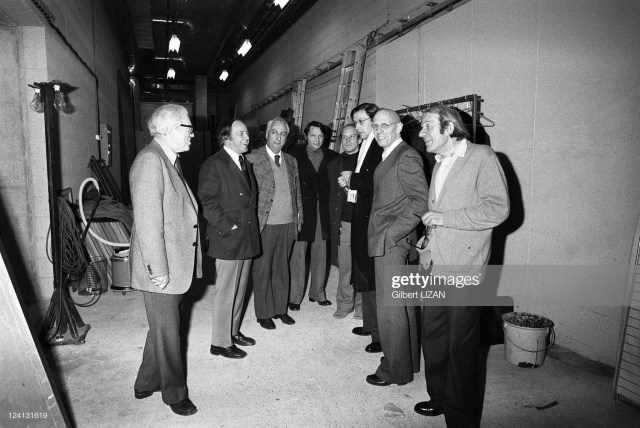
Many thanks to all who commented on Twitter and Facebook on yesterday’s photo – especially Alistair Leadbetter and Rangel Luis Manuel.

gettyimages-124131619-2048x2048

FRANCE – FEBRUARY 23: Michel Foucault, Roland Barthes and Pierre Boulez in Paris, France on February 23, 1978. (Photo by Gilbert UZAN/Gamma-Rapho via Getty Images)

From left to right, the people are Elliott Carter, Pierre Boulez, Roland Barthes, Jean-Claude Risset, Gerald Bennett, Michel Decoust, Michel Foucault, Gilles Deleuze.

[Update: on Facebook, Caleb Salgado suggests it isn’t Elliott Carter, but might be Milton Babbitt. Babbitt seems less likely, but it might not be Carter. There are some other images of this person with Foucault here. There is also an image of Carter in 1978 here (picture 4)]

Carter.JPG

There are some details on the event here.

Rangel also sent a link to a video of the event, organised by IRCAM at the Centre Pompidou. It includes Foucault’s contribution, which I’d not seen before.

It can be seen here [Update February 2023: this link seems to be broken; but it is also here].

Posted in Gilles Deleuze, Michel Foucault, Roland Barthes, Uncategorized | 2 Comments

Books received – Gabrys, Arendt, de Beauvoir, Prideaux, Brown, Milgram

Jennifer Gabrys, How to do Things with Sensors; Hannah Arendt, Between Past and Future; Simone de Beauvoir, The Second Sex; Sue Prideaux, I am Dynamite! A Life of Friedrich Nietzsche; Wendy Brown, In the Ruins of Neoliberalism; and Stanley Milgram, Obedience to Authority.

Jennifer Gabrys’s book was sent by the publisher; the rest were bought new or second-hand. Most are related to this year’s teaching.

Posted in Friedrich Nietzsche, Hannah Arendt, Simone de Beauvoir, Wendy Brown | Leave a comment

Boulez, Barthes… Foucault and Deleuze – who else is in the photo?

Yesterday I posted this picture on Twitter, asking who the three middle figures were – left to right, Boulez, Barthes, ?, ?, ?, Foucault and Deleuze. The photo was taken from Monoskop, which says it was taken at IRCAM, Paris, in February 1978.

[Update: see below for details, but it is Boulez, Barthes, Jean-Claude Risset, Gerald Bennett, Michel Decoust, Foucault, Deleuze]

Boulez_Barthes_Foucault_Deleuze_1978.jpg

I said that I thought the person next to Barthes was the composer Jean-Claude Risset, and @BarthesStudies suggested that the composer and conductor Michel Decoust was next to Foucault. But they also indicated that this was a cropped version of a larger picture, found in Marie Gil’s biography of Barthes, or at Getty Images:

gettyimages-124131619-2048x2048

This includes another figure I don’t recognise.

So, that would mean – unknown, Boulez, Barthes, Risset, unknown, Decoust, Foucault, Deleuze.

Anyone help with the other two people?

[Update: see below for details, but it is Elliott Carter, Pierre Boulez, Roland Barthes, Jean-Claude Risset, Gerald Bennett, Michel Decoust, Michel Foucault, Gilles Deleuze]

Alistair Leadbetter has suggested that Elliott Carter and Gerald Bennett may be the two others. The conference programme is here – medias.ircam.fr/xcd4f03 which lists Bennett, Risset and Decoust. Carter’s work was featured in a concert immediately before the conference.

Posted in Gilles Deleuze, Michel Foucault, Roland Barthes, Uncategorized | 4 Comments