Wendy Brown, In the Ruins of Neoliberalism: The Rise of Antidemocratic Politics in the West, Columbia UP, 2019 – and New Books Network discussion

9780231550536.jpgWendy Brown, In the Ruins of Neoliberalism: The Rise of Antidemocratic Politics in the West, Columbia University Press, 2019

Across the West, hard-right leaders are surging to power on platforms of ethno-economic nationalism, Christianity, and traditional family values. Is this phenomenon the end of neoliberalism or its monstrous offspring?

In the Ruins of Neoliberalism casts the hard-right turn as animated by socioeconomically aggrieved white working- and middle-class populations but contoured by neoliberalism’s multipronged assault on democratic values. From its inception, neoliberalism flirted with authoritarian liberalism as it warred against robust democracy. It repelled social-justice claims through appeals to market freedom and morality. It sought to de-democratize the state, economy, and society and re-secure the patriarchal family. In key works of the founding neoliberal intellectuals, Wendy Brown traces the ambition to replace democratic orders with ones disciplined by markets and traditional morality and democratic states with technocratic ones.

Yet plutocracy, white supremacy, politicized mass affect, indifference to truth, and extreme social disinhibition were no part of the neoliberal vision. Brown theorizes their unintentional spurring by neoliberal reason, from its attack on the value of society and its fetish of individual freedom to its legitimation of inequality. Above all, she argues, neoliberalism’s intensification of nihilism coupled with its accidental wounding of white male supremacy generates an apocalyptic populism willing to destroy the world rather than endure a future in which this supremacy disappears.

There is a discussion of the book at the New Books Network. Thanks to dmf for the link.

 

Posted in Uncategorized, Wendy Brown | 1 Comment

Setha Low and Mark Maguire (eds.), Spaces of Security: Ethnographies of Securityscapes, Surveillance, and Control – NYU Press, 2019
9781479870066.jpgSetha Low and Mark Maguire (eds.), Spaces of Security: Ethnographies of Securityscapes, Surveillance, and Control – NYU Press, 2019
An ethnographic investigation into the dynamics between space and security in countries around the world

It is difficult to imagine two contexts as different as a soccer stadium and a panic room. Yet, they both demonstrate dynamics of the interplay between security and space. This book focuses on the infrastructures of security, considering locations as varied as public entertainment venues to border walls to blast-proof bedrooms.

Around the world, experts, organizations, and governments are managing societies in the name of security, while scholars and commentators are writing about surveillance, state violence, and new technologies. Yet in spite of the growing emphasis on security, few truly consider the spatial dimensions of security, and particularly how the relationship between space and security varies across cultures.

This volume explores spaces of security not only by attending to how security is produced by and in spaces, but also by emphasizing the ways in which it is constructed in the contemporary landscape. The book explores diverse contexts ranging from biometrics in India to counterterrorism in East Africa to border security in Argentina. The ethnographic studies demonstrate the power of a spatial lens to highlight aspects of security that otherwise remain hidden, while also adding clarity to an elusive and dangerous way of managing the world.

Posted in Setha Low, Uncategorized | Leave a comment

Conference at Harvard University on Foucault’s Confessions of the Flesh (2019)

Conference at Harvard University on Foucault’s Confessions of the Flesh

Clare O'Farrell's avatarFoucault News

Conference at Harvard University on Foucault’s Confessions of the Flesh

5 December 2019

In February 2018, the fourth and final volume of Michel Foucault’s History of Sexuality project—Confessions of the Flesh—was published for the first time in French by Éditions Gallimard. This is an extraordinary publishing event since the book was not supposed to have been printed at all. This one-day conference will assess the reception and impact of this missing volume of Foucault’s History of Sexuality. It will highlight the text of Confessions of the Flesh, its place in Foucault’s oeuvre, the context in which he wrote, and the contemporary relevance of this new work. It is far enough away from the Foucault-overload of past decades that it is now possible to freshly examine the enduring value of this influential thinker—a re-examination inspired by the belated publication of his final book.

Organizers
Julian Bourg (Boston College)
Annabel Kim (Harvard…

View original post 160 more words

Posted in Uncategorized | Leave a comment

Books received – Foucault, Althusser, Dumézil, Kant

Some older books by Althusser, Dumézil, and Kant, and the most recent collection of Foucault’s lectures and writings, Folie, language, littérature, sent by the publisher. Books 13 Oct

Posted in Georges Dumézil, Immanuel Kant, Louis Althusser, Michel Foucault, Uncategorized | Leave a comment

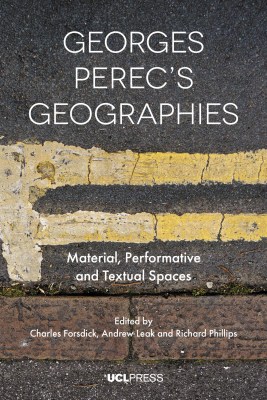
Georges Perec’s Geographies: Material, Performative and Textual Spaces – UCL Press 2019 (open access e-book)

_jpg_rgb_1500h.jpgGeorges Perec’s Geographies: Material, Performative and Textual Spaces, edited by Charles Forsdick, Andrew Leak, and Richard Phillips – UCL Press 2019. Available in physical copy and as an open access e-book.

Georges Perec, novelist, filmmaker and essayist, was one of the most inventive and original writers of the twentieth century. A fascinating aspect of his work is its intrinsically geographical nature. With major projects on space and place, Perec’s writing speaks to a variety of geographical, urban and architectural concerns, both in a substantive way, including a focus on cities, streets, homes and apartments, and in a methodological way, experimenting with methods of urban exploration and observation, classification, enumeration and taxonomy.

Georges Perec’s Geographies is the first book to offer a rounded picture of Perec’s geographical interests. Divided into two parts, Part I, Perec’s Geographies, explores the geographies within Perec’s work in film, literature and radio, from descriptions of streets to the spaces of his texts, while Part II, Perecquian Geographies, explores geographies in a range of material and metaphorical forms, including photographic essays, soundscapes, theatre, dance and writing, created by those directly inspired by Perec.

Georges Perec’s Geographies extends the body of Perec criticism beyond Literary and French Studies to disciplines including Geography, Urban Studies, Planning and Architecture to offer a complete and systematic examination of Georges Perec’s geographies. The diversity of readings and approaches will be of interest not only to Perec readers and fans but to students and researchers across these subjects.

Posted in Uncategorized | 2 Comments

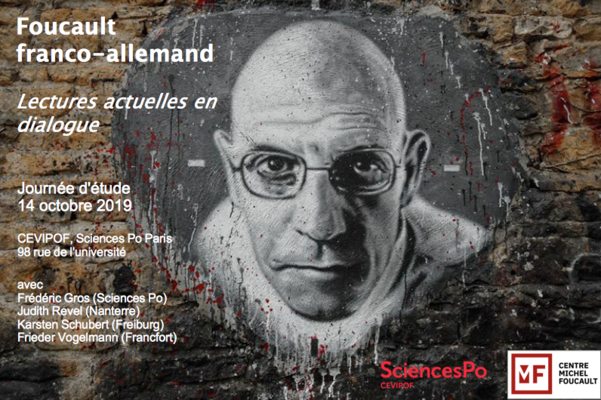
Foucault franco-allemand : lectures actuelles en dialogue (2019)

Tomorrow in Paris…

Clare O'Farrell's avatarFoucault News

Foucault franco-allemand : lectures actuelles en dialogue

Programme,(PDF, 1,09Mo)

14 octobre 2019 11h-19h
Journée organisée par le CEVIPOF, l’Ecole docorale de Sciences po et le Centre Michel Foucault.

11h-13h : Panel 1 : Current work by doctoral students

« Foucault’s moral monsters: gender and the reversal of penal norms »
Amélie Bescont, Sciences Po, CEVIPOF
« Autonomy, Recognition and the Politics of Knowledge in Foucault and Honneth »
Antoine Athanassiadis, UC Dublin
« Diverging assonances: Foucault as a critic of Schmitt »
Valentina Antoniol, EHESS/University of Bologna
13h-14h30: Lunch

14h30-16h30 : Panel 2 : Foucault as a normative theorist?
Chair : Niklas Plaetzer, Sciences Po, CEVIPOF
« Dimensions of Freedom in Foucault’s Work »
Karsten Schubert, université de Freiburg Frédéric Gros (Sciences Po, CEVIPOF) : Qu’est-ce qu’une révolution ?
16h30-17h: Cofee break

17h-19h: Panel 3 : Critical theory and practice after Foucault
Chair : Lucile Richard, Sciences Po, CEVIPOF

View original post 24 more words

Posted in Uncategorized | Leave a comment

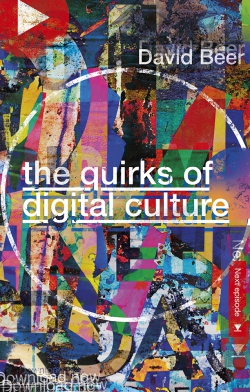
David Beer, The Quirks of Digital Culture – Emerald, 2019

9781787699168.jpgDavid Beer, The Quirks of Digital Culture – Emerald, 2019

The culture we consume is increasingly delivered to us via various digital on-demand platforms. The last decade has seen platforms like Facebook, Amazon, Netflix, Spotify, Google and the like become massive players in shaping cultural consumption. But how can we understand culture once it moves on to big tech platforms? How can we make sense of the changes this brings to our lives? These platforms have the power to shape our cultural landscape and to use data, algorithms and other technological means to shape our experiences, from what we remember through to what we know and even the speed and accessibility of culture.
This book asks how can we understand the chaos and messiness of on-demand culture? Beer suggests that we focus on the quirks and use these as openings to see inside patterns and dynamics of these new cultural formations. By exploring the strange quirks that typify our new on-demand culture, this book seeks to answer these questions. The Quirks of Digital Culture is a guide to understanding the complex and unsettling cultural present, whilst also casting an eye on how our consumption and cultural experiences may unfold in what seems like an unpredictable future.

Sample chapter here

David’s newsletter here and davidbeer.net

From the newsletter:

If you want to read more about it, there is a piece describing the approach taken in the book here.
I’ve also created a Spotfiy music playlist to accompany the book. You can listen to that here.


Posted in Uncategorized | Leave a comment

Antipod: A Radical Geography Podcast and Sound Collective from Antipode

Antipod: A Radical Geography Podcast and Sound Collective from Antipode

Many will know (and love) it already, but for those that don’t we’re pleased to share here Antipod: A Radical Geography Podcast and Sound Collective.

Launched earlier this year by the Antipod Sound Collective – KT Bender (UCLA), Allison Guess (CUNY Graduate Center), Alex Moulton (Clark University/Middle Tennessee State University), Darren Patrick/dp (York University), Akira Drake Rodriguez (University of Pennsylvania) and Brian Williams (Dartmouth/Mississippi State University), who first met at our sixth Institute for the Geographies of Justice in 2017 – the podcast currently consists of a pilot and Episode 1, “Clyde Woods, Dispossession, and Resistance in New Orleans”. With the support of the Antipode Foundation, five more episodes are planned for the first season.

You can read more about Antipod here and below, access Episodes 0 and 1 at https://thisisantipod.org/category/episodes/, and subscribe to future releases at https://thisisantipod.org/subscribe/ Follow on Twitter @ThisIsAntipod

Posted in Uncategorized | 1 Comment