Alex Jeffrey, The Edge of Law: Legal Geographies of a War Crimes Court – Cambridge University Press, December 2019

9781107199842Alex Jeffrey, The Edge of Law: Legal Geographies of a War Crimes Court – Cambridge University Press, December 2019

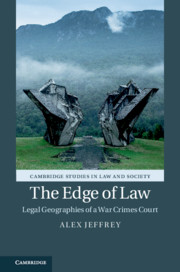
The Edge of Law explores the spatial implications of establishing a new legal institution in the wake of violent conflict. Using the example of the establishment of the War Crimes Chamber of the Court of Bosnia and Herzegovina, Alex Jeffrey argues that legal processes constantly demarcate a line of inclusion and exclusion: materially, territorially and corporally. In contrast to accounts that have focused on the judicial outcomes of these transitional justice efforts, The Edge of Law draws on long-term fieldwork in Bosnia and Herzegovina to focus on the social and political consequences of the trials, tracing the fraught mechanisms that have been used by international and local political elites to convey their legitimacy. This book will be of interest to socio-legal and geographical scholars working in the fields of transitional justice, legal systems, critical geopolitics and criminology.

Posted in Uncategorized | Leave a comment

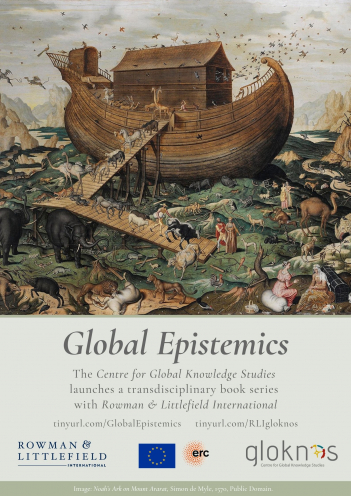
The Global Epistemics Book Series

The Global Epistemics Book Series – now launched, edited by Inanna Hamati-Ataya (Centre for Global Knowledges, University of Cambridge).

Global-Epistemics-Launch-Poster-copy.jpg

Global Epistemics is a transdisciplinary series established in partnership with Rowman & Littlefield International, that aims to foster, promote, and disseminate empirically grounded and theoretically ambitious research on knowledge as a cultural and natural phenomenon.

The series invites individual and collaborative works that efficiently transgress contemporary disciplinary boundaries across the historical, social, and natural sciences, to fruitfully advance our understanding of the nature, history, politics, pragmatics, and normative dimensions of human knowledges – their constitution, co-evolution, diffusion, cultural and material impacts, forms, and uses – as well as their relation to non-human knowledges and to evolving socio-ecological environments. We also invite approaches to animal (human and non-human) cognition that can redefine classical philosophical questions on knowledge and knowing, or delineate new areas and horizons for philosophical and ethical inquiry, on the basis of advanced empirical research and new research methodologies.

Grounded in an anthropologically holistic understanding of knowledge that encompasses its ideational, artistic, institutional, and material manifestations across history, as well as the full spectrum of historical modes of practical and intellectual validation (from ‘prehistorical’ to ‘modern’ paradigms, practices, and technologies and from ‘ancient’ to ‘modern’ science), the series also approaches globality simultaneously as totality, extension, and connectivity. It thus aims to advance naturalist, artisanal, and historical epistemologies beyond classical ontological and temporal divides; to explore the patterns of epistemic emergence, diffusion, and exchange across historical times, geocultural spaces, ecological contexts, and sociopolitical configurations; and to investigate modes of knowing and doing that illuminate human commonalities while making sense of our differences as manifestations of our cultural and behavioural plasticity.

The series welcomes empirically grounded and intellectually robust contributions that serve its mission, regardless of their methodologies, conceptual frameworks, levels of analysis, temporal scope, or specific objects of investigation. This includes investigations of contemporaneous natural and cultural structures, processes, actors, and media of epistemic activity, as well as studies inscribed in the longue durée or deep-historical time, or addressing past or present knowledge from a comparative perspective. We are looking for projects that can speak to audiences across academic specialties, whether they aim to initiate new transdisciplinary work, disseminate the results of such research, or develop ambitious syntheses.

In addition to its transdisciplinary ambitions, the series hopes to showcase, and facilitate access to, cross-sectorial contributions to the understanding of human and non-human knowledge, especially in domains wherein epistemic activity is strongly grounded in artisanal, social, and technical praxis. We therefore encourage the submission of projects that engage with, and include, epistemic actors beyond the community of academics, scientists, and scholars, without deviating from the series’ commitment to robust research standards and clarity of scholarly communication. Such projects will be subjected to the same process and expectations of academic peer-reviewing.

Full details here.

Posted in Uncategorized | Leave a comment

Andrea Ballestero, A Future History of Water – Duke University Press, June 2019

978-1-4780-0389-2_pr.jpgAndrea Ballestero, A Future History of Water – Duke University Press, June 2019

Based on fieldwork among state officials, NGOs, politicians, and activists in Costa Rica and Brazil, A Future History of Water traces the unspectacular work necessary to make water access a human right and a human right something different from a commodity. Andrea Ballestero shows how these ephemeral distinctions are made through four technolegal devices—formula, index, list and pact. She argues that what is at stake in these devices is not the making of a distinct future but what counts as the future in the first place. A Future History of Water is an ethnographically rich and conceptually charged journey into ant-filled water meters, fantastical water taxonomies, promises captured on slips of paper, and statistical maneuvers that dissolve the human of human rights. Ultimately, Ballestero demonstrates what happens when instead of trying to fix its meaning, we make water’s changing form the precondition of our analyses.

Posted in Uncategorized | Leave a comment

L’aventure Althusser – 1 hour documentary with interviews with Macherey, Balibar, Rancière, etc, available until 7 July 2019

L’aventure Althusser – 1 hour documentary with interviews with Macherey, Balibar, Rancière, etc, available until 7 July 2019. Thanks to Nadim Khoury for sending the link.

Le portrait passionnant du philosophe marxiste Louis Althusser qui, avant de sombrer dans la folie, a forgé une pensée aujourd’hui réinvestie par ceux qui contestent le capitalisme.

Le 16 novembre 1980, le philosophe Louis Althusser étrangle sa femme Hélène Rytmann dans leur appartement de l’École normale supérieure de la rue d’Ulm, à Paris, où il enseigne depuis plus de trente ans. Ce crime commis dans une crise de démence, son long internement en institution psychiatrique, puis sa mort, dix ans plus tard, auraient pu l’engloutir dans l’oubli. Il en allait de même pour l’idéologie communiste qu’il a toujours revendiquée, et que la chute du mur de Berlin semblait avoir condamnée. Mais après le triomphe de l’individualisme post-1968 et du néolibéralisme des années 1980, le marxisme d’Althusser et de ses disciples, d’Alain Badiou à Étienne Balibar, connaît un regain de faveur, notamment auprès de la jeunesse, à l’heure du capitalisme mondialisé. En s’appuyant sur de riches archives, mais aussi sur les passionnants témoignages de ses élèves et compagnons – les philosophes Étienne Balibar, Yves Duroux, Jacques Rancière, Lucien Sève, Pierre Macherey… –, Bruno Oliviero et Adila Bennedjaï-Zou dressent le portrait intellectuel et intime du philosophe français qui a voulu réinventer le marxisme sans tourner le dos au communisme, ni quitter le PCF, parce qu’il était, disait-il, “le parti des masses“.

Catastrophe annoncée
Ces intervenants montrent combien les livres (sur Marx, Montesquieu ou Machiavel), les articles et l’enseignement de Louis Althusser, fondés sur un travail collectif avec ses disciples, ont modelé une génération, faisant de lui un maître à penser des années 1960, à l’égal de Lacan, Foucault et Barthes. Ils expliquent aussi comment l’ensevelissement progressif du marxisme dans le débat contemporain, notamment après 1968, a marqué l’œuvre du philosophe, et jusqu’à sa vie intime. Pris peu à peu dans un compte à rebours inexorable, Althusser se débattra pour tenter de dégager le marxisme de la catastrophe annoncée, désespérant d’achever la tâche titanesque qu’il s’est fixée : concevoir la philosophie que le Marx du Capital n’a pas eu le temps d’écrire. Sans prétendre expliquer le meurtre qui, deux décennies durant, fera l’essentiel de sa triste célébrité, ce documentaire évoque aussi, en filigrane, les contradictions amoureuses et les assauts de la maladie psychique qui l’entraîneront dans le gouffre.

Posted in Etienne Balibar, Jacques Rancière, Louis Althusser, Pierre Macherey, Uncategorized | 1 Comment

John Agnew awarded the 2019 Prix Vautrin-Lud

John Agnew has been awarded the 2019 Prix Vautrin-Lud – the highest award in Geography and sometimes called the equivalent of the discipline’s Nobel prize. There is a news report in French here. Thanks to Sally Hardy for the alert.

Posted in John Agnew, Uncategorized | Leave a comment

“Discourse and Truth” and “Parresia” (2019)

It’s good to see this edition out in English. The 1983 Berkeley lectures were originally given in English, but the ‘Fearless Speech’ version of them was inaccurate, missing material and certainly not a critical edition. This version makes use of the French critical edition published a few years ago, with its apparatus and definitive text. It also includes a 1982 lecture given in Grenoble, translated in Critical Inquiry.

Clare O'Farrell's avatarFoucault News

Michel Foucault, “Discourse and Truth” and “Parresia”, Chicago University Press, 2019

Edited by Henri-Paul Fruchaud and Daniele Lorenzini
With an Introduction by Frédéric Gros
English edition established by Nancy Luxon
The Chicago Foucault Project

This volume collects a series of lectures given by the renowned French thinker Michel Foucault late in his career. The book is composed of two parts: a talk, Parrēsia, delivered at the University of Grenoble in 1982, and a series of lectures entitled “Discourse and Truth,” given at the University of California, Berkeley in 1983, which appears here for the first time in its full and correct form. Together, they provide an unprecedented account of Foucault’s reading of the Greek concept of parrēsia, often translated as “truth-telling” or “frank speech.” The lectures trace the transformation of this concept across Greek, Roman, and early Christian thought, from its origins in pre-Socratic Greece to its role as…

View original post 495 more words

Posted in Uncategorized | Leave a comment

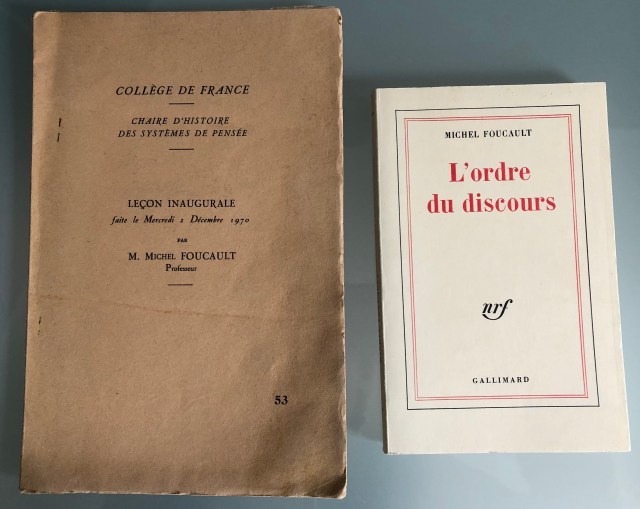
Foucault’s Inaugural lecture at the Collège de France, L’ordre du discours – comparison of the two different versions

L'ordre du discours.jpgFoucault’s Inaugural lecture at the Collège de France was delivered on 2 December 1970, one week before the beginning of his first course, published as Leçons sur la volonté de savoir and translated as Lectures on the Will to Know.

The inaugural lecture was published in French by Gallimard as a short book in 1971, L’ordre du discourse: Leçon inaugurale au Collège de France prononcée le 2 décembre 1970. It has been translated into English twice, as a journal article which was reprinted as an appendix to some editions of The Archaeology of Knowledge, and in Robert Young (ed.), Untying the Text: A Poststructuralist Reader (open access here). A third translation is forthcoming.

In the Gallimard book, Foucault notes, “due to limitations of time, certain passages were shortened or changed in the lecture. They are restored here” (p. 6).

In Foucault: The Birth of Power I commented on this: “Unfortunately these passages are not marked, and in the absence of a recording of the lecture – none of the archives have a copy – it is not possible to distinguish between what was said, what was written, and what may have been changed after the event in the editing process” (p. 15).

This was a mistake on my part, because I had not realised until recently that an earlier version of the text, essentially what Foucault said on the evening of 2 December 1970, had been published by the Collège de France itself. It did not have the title L’ordre du discours, but simply Leçon inaugurale faite le Mercredi 2 Décembre 1970. I was alerted to this version of the text by ‘Ambulo Ergosum’ – someone who attended this lecture and others by Foucault, but who wishes to remain anonymous.

Ambulo sent me a comparison of the two different versions, and this led me to look for a copy of the original. It’s not the easiest thing to find, in part because the titles are so similar, and very few libraries have copies. Eventually I was able to buy it second-hand. The lecture is included in the recent Pléiade edition of Foucault’s Œuvres, but the two different versions are only indicated briefly. Daniel Defert, who edited this text for the Œeuvres, says that “On trouve d’infimes variants entre les deux éditions; nous suivons la seconde” (Vol II, p. 1459). Defert gives a couple of examples of these “tiny variations” in a note to that page, but does not list the variants in detail. The text as printed is indeed that of the Gallimard edition.

However, the Gallimard text has hundreds of differences from the earlier Collège de France version. These range from very minor punctuation changes, through substitution of words and phrases, through to the much more significant – paragraphs or sections being replaced or added. Some of the additions are of several pages. The most significant additions are L’ordre du discours pp. 33-36, 38-47, a paragraph on p. 54, pp. 56-61, 62-64, 65-66, and 67-70. There are also substantial changes on pp. 19-20, 25-26, 63-64, and 71.

At this page I provide a comprehensive list of the differences between the two texts, building on Ambulo’s analysis but supplemented with the differences I found on my own line-by-line comparison. The comparison is between the two French editions – I have not cross-referenced to English translations, but that should be straight-forward for anyone with the Gallimard text.

(This post is part of the Foucault Resources part of this site, which also includes bibliographies, links to audio and video recordings, some other textual comparisons, a few brief translations, and some other pieces.)

 

Posted in Foucault: The Birth of Power, Michel Foucault, Uncategorized | 2 Comments

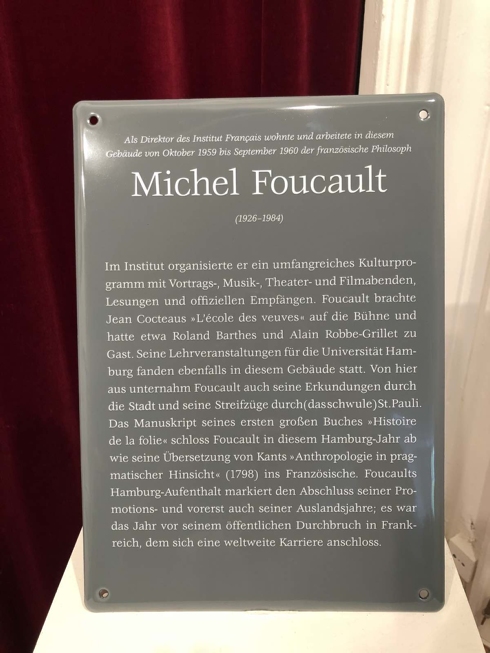
Foucault in Hamburg – commemorative plaque and translation of text

Foucault’s time in Hamburg has been commemorated with a plaque on the building he worked in.

Foucault in Hamburg plaque

It’s reproduced and discussed in this newsletter, sent to me by Melissa Pawelski. Melissa has also provided this translation of the plaque and the comment, which I share here with her permission.

As Director of the Institut Français lived and worked in this building from October 1959 until September 1960 the French philosopher
Michel Foucault
(1926-1984)
He organised for the Institute a wide-ranging cultural programme with lectures, film, theatre and music nights, readings and official receptions. Foucault brought “L’école des veuves” by Jean Cocteau to the stage, received amongst others Roland Barthes and Alain Robbe-Grillet as his guests. His courses for the University of Hamburg took place in this building too. Foucault also started his explorations of the city and his wanderings through the (gay) district of St. Pauli. He finished the manuscript of his first great book “Histoire de la folie” during this year in Hamburg as well as his French translation of Kant’s “Anthropologie in pragmatischer Hinsicht” (1798). Foucault’s stay in Hamburg marks the end of his years of doctoral research and time spent abroad in the first instance; it was the year of his public breakthrough in France, which was followed by a world-wide career.

Comment by Marc Widmann:

Hardly anyone knows it: in Heimhuder Straße 55 in Rotherbaum district lived one of the greatest French thinkers. Michel Foucault lived there from October 1959 until September 1960, when he served as director of the Institute Francais in the same building. “He was markedly active”, said Rainer Nicolaysen from the University of Hamburg yesterday at the inauguration of the commemorative plaque. Foucault brought well-known writers to Hamburg, stage-managed the play “L’école des veuves” by Jean-Cocteau, translated Kant, gave courses for students – and at night wandered through the gay subculture of St.Pauli. He also took prominent guests with him to this neighbourhood (Kiez). These guests were astonished that Foucault was known everywhere and was addressed as “Herr Doktor”, although his doctoral work “Histoire de la folie” was not yet finished. Shortly afterwards it became his first great success. An article worth-reading on the history of Foucault [in Hamburg] can be found here.

Posted in Michel Foucault, Uncategorized | 1 Comment

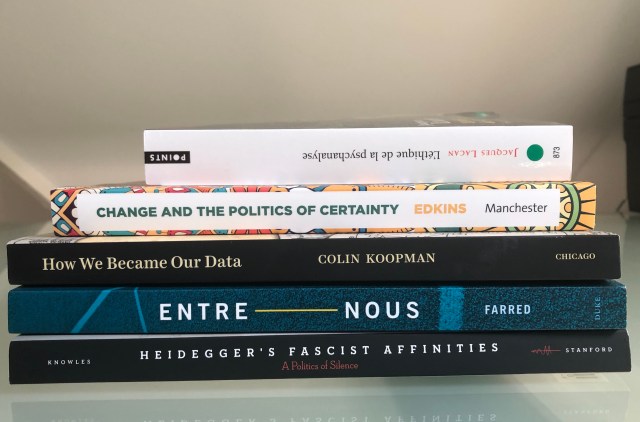
Books received – Lacan, Edkins, Koopman, Farred, Knowles


IMG_0247.jpgJacques Lacan, L’éthique de la psychanalyse (newly in the Points series); Jenny Edkins, Change and the Politics of Certainty; Colin Koopman, How We Became Our Data: A Genealogy of the Informational Person; Grant Farred, Entre Nous: Between the World Cup and Me and Adam Knowles, Heidegger’s Fascist Affinities: A Politics of Silence.

I bought the Lacan, Adam kindly sent me a copy of his book, and the rest were sent by the publishers.

Posted in Jacques Lacan, Jenny Edkins, Martin Heidegger, Uncategorized | 1 Comment

Georges Canguilhem and the Problem of Error (2019)

Samuel Talcott’s study of Canguilhem now published – looking forward to seeing this.

Clare O'Farrell's avatarFoucault News

Samuel R. Talcott, Georges Canguilhem and the Problem of Error (Palgrave Macmillan, 2019)

About this book
Examining Georges Canguilhem’s enduring attention to the problem of error, from his early writings to Michel Foucault’s first major responses to his work, this pathbreaking book shows that the historian of science was also a centrally important philosopher in postwar France. Samuel Talcott elucidates Canguilhem’s contributions by drawing on previously neglected publications and archival sources to trace the continuity of commitment that led him to alter his early anti-vitalist, pacifist positions in the face of political catastrophe and concrete human problems. Talcott shows how Canguilhem critically appropriated the philosophical work of Alain, Bergson, Bachelard, and many others while developing his own distinct writings on medicine, experimentation, and scientific concepts in an ethical and political endeavor to resist alienation and injustice. And, while suggesting Canguilhem’s sometimes surprising philosophical importance for a range of younger thinkers…

View original post 542 more words

Posted in Uncategorized | Leave a comment