New Perspectives, 01/2019 – full Issue to download

NP_2019_01_Cover_HiRes2.jpgNew Perspectives, 01/2019 – full Issue to download

Editorial

1. Über Berlin

Benjamin Tallis

Research Articles

2. Great Expectations: The EU’s Social Role as a Great Power Manager

David M. McCourt & Andrew Glencross

3. The (Small) State of the Union: Assessing the EU’s Ability to Implement Its Global Strategy

Rebecca Pedi

4. The Wrong Critiques: Why Internal Border Controls Don’t Mean the End of Schengen

Markéta Votoupalová

Fora

5. Russia and the World: IMEMO Forecast 2018

Mark Galeotti, Minda Holm, Tuomas Forsberg, Ruth Deyermond & Irina Kobrinskaya

6. Twilight of the Proletariat: Reading Critical Balkanology as Liberal Ideology

Catherine Baker, Nataša Kovačević, Dragan Kujundžić & Rade Zinaić

Cultural Cut

7. Bauhaus Imaginista: Framing Renshichirō Kawakita’s Transcultural Legacy and Pedagogy

Helena Čapková

NP_2019_01_Cover_HiRes2.jpg

Posted in Uncategorized | Leave a comment

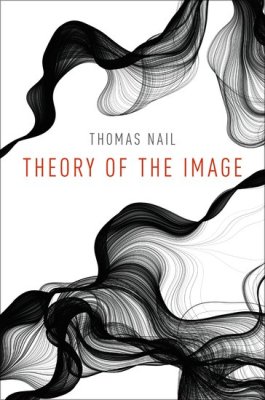
Thomas Nail, Theory of the Image – OUP, May 2019

9780190050085Thomas Nail, Theory of the Image – OUP, May 2019

We live in an age of the mobile image. The world today is absolutely saturated with images of all kinds circulating around the world at an incredible rate. The movement of the image has never been more extraordinary than it is today. This recent kinetic revolution of the image has enormous consequences not only for the way we think about contemporary art and aesthetics but also for art history as well.

Responding to this historical moment, Theory of the Image offers a fresh new theory and history of art from the perspective of this epoch-defining mobility. The image has been understood in many ways, but it is rarely understood to be fundamentally in motion. The original and materialist approach is what defines Theory of the Image and what allows it to offer the first kinetic history of the Western art tradition. In this book, Thomas Nail further develops his larger philosophy of movement into a comprehensive

“This is an engaging book with a fascinating argument. Thomas Nail stakes out new territory, building a theory from the group up of the image as kinetic” — David Morgan , Duke University

“Thomas Nail’s Theory of the Image is an ambitious and original attempt to re-theorize the material and cognitive dynamics of the image. In this respect, his model is kinetic as opposed to representational, mimetic, or hermeneutical. The book is eminently suitable for use on a range of undergraduate and postgraduate courses, in particular, philosophy, cultural theory, and art history.” — John Roberts , University of Wolverhampton

Posted in Uncategorized | Leave a comment

“Shakespearean Landscapes”, Fourth Denis Cosgrove Lecture in the GeoHumanities, British Academy, 23 May 2019

Also next week, I’ll be giving the Fourth Denis Cosgrove Lecture in the GeoHumanities, at the British Academy, 23 May 2019, 6.15pm

The title of the talk is “Shakespearean Landscapes”, and while I will say something about the Shakespearean Territories book, I will be mainly discussing this related but distinct theme.

This lecture explores how Shakespeare’s plays evoke a sense of landscape. Shakespeare’s grasp of specific geographies could be shaky, but his plays are rich with a range of geographical themes, language and detail. Shakespeare lived and wrote at a time of colonial exploration and saw the development of many cartographic, navigational and land-measuring techniques. The lecture builds on the argument of my recent book, Shakespearean Territories, but explores a different yet related geographical theme – that of landscape. This is of course a theme which Denis Cosgrove examined so perceptively. The plays discussed will include some of Shakespeare’s most famous, such as Macbeth and King Lear, and lesser known ones including Timon of Athens.

The lecture is free to attend, but the organisers have asked that people do register beforehand. Full details here.

Posted in Uncategorized | 2 Comments

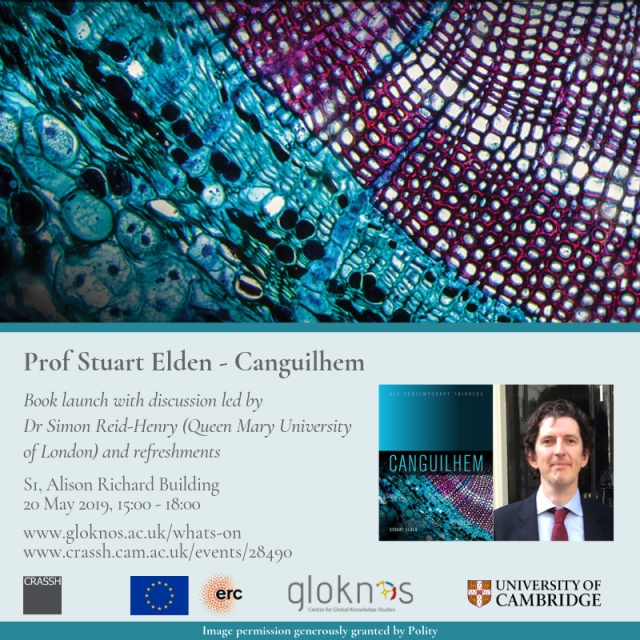
book launch for Canguilhem, gloknos/CRASSH, Cambridge, 20 May 3pm

Coming up next week – 20 May, 3pm book launch for Canguilhem, gloknos/CRASSH, S1, Alison Richard Building, University of Cambridge (with Inanna Hamati-Ataya and Simon Reid-Henry)

Posted in Uncategorized | Leave a comment

The Hollow Crown: Shakespeare and Political Theology, Hampton Court/Garrick’s Temple, June 21-22 2019

Draft programme for the two days of The Hollow Crown: Shakespeare and Political Theology event in June. I’ll be speaking about Shakespeare and Kantorowicz on the second day.

kingstonshakespeareseminar's avatarKingston Shakespeare Seminar

Poster

The Hollow Crown: Shakespeare and Political Theology event consists of two related events, both of which highlight current thought on political theology in Shakespeare.

The first day, held in the Jane Seymour Room at Hampton Court Palace, dovetails into two themes: Crown and Crowd. The Crown section begins at 10 am and features talks on coronation rituals and absent kings by Charles Farris, Anthony Musson and Michael Hattaway. The crowd section begins at 2 pm with talks by Sam Gilchrist Hall, Edel Lamb, Sally Barnden and Yan Brailowsky. The day also features musical interludes by ARCHIcantiores performing ‘royal’ and ‘crowd’ music as well as ballads. Ticket price includes tea, coffee and a packed lunch.

The second day at Garrick’s Temple (a short walk from Hampton Court and Hampton Station) continues the symposia on Shakespeare in philosophy with a day on the seminal political theologian Ernst Kantorowicz (1895-1963). Speakers include…

View original post 320 more words

Posted in Uncategorized | Leave a comment

Simon Reid-Henry, Empire of Democracy: The Remaking of the West Since the Cold War, 1971–2017 – Simon & Schuster, 2019

empire-of-democracy-9781451684964_lgSimon Reid-Henry, Empire of Democracy: The Remaking of the West Since the Cold War, 1971–2017 – Simon & Schuster, 2019

Book launch – London Review Bookshop, 24 June 2019, 7pm

The first panoramic history of the Western world from the 1970s to the present day, Empire of Democracy is the story for those asking how we got to where we are.

Half a century ago, at the height of the Cold War and amidst a world economic crisis, the Western democracies were forced to undergo a profound transformation. Against what some saw as a full-scale “crisis of democracy”— with race riots, anti-Vietnam marches and a wave of worker discontent sowing crisis from one nation to the next— a new political-economic order was devised and the postwar social contract was torn up and written anew.

In this epic narrative of the events that have shaped our own times, Simon Reid-Henry shows how liberal democracy, and western history with it, was profoundly reimagined when the postwar Golden Age ended. As the institutions of liberal rule were reinvented, a new generation of politicians emerged: Thatcher, Reagan, Mitterrand, Kohl. The late twentieth century heyday they oversaw carried the Western democracies triumphantly to victory in the Cold War and into the economic boom of the 1990s. But equally it led them into the fiasco of Iraq, to the high drama of the financial crisis in 2007/8, and ultimately to the anti-liberal surge of our own times.

The present crisis of liberalism enjoins us to revisit these as yet unscripted decades. The era we have all been living through is closing out, democracy is turning on its axis once again. As this panoramic history poignantly reminds us, the choices we make going forward require us first to come to terms with where we have been.


Posted in Uncategorized | Leave a comment

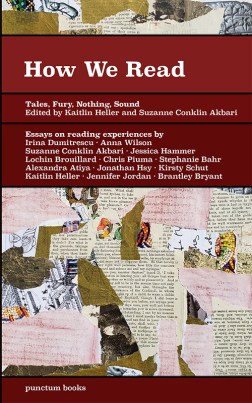
How We Read: Tales, Fury, Nothing, Sound, edited by Suzanne Conklin Akbari and Kaitlin Heller- Punctum, summer 2019

how-we-read-cover-20190412How We Read: Tales, Fury, Nothing, Sound, edited by Suzanne Conklin Akbari and Kaitlin Heller- Punctum, summer 2019 – the follow-up to How We Write: Thirteen Ways of Looking at a Blank Page

What do we do when we read?

Reading can be an act of consumption or an act of creation. Our “work reading” overlaps with our “pleasure reading,” and yet these two modes of reading engage with different parts of the self. It is sometimes passive, sometimes active, and can even be an embodied form.

The contributors to this volume share their own histories of reading in order to reveal the shared pleasure that lies in this most solitary of acts – which is also, paradoxically, the act of most complete plenitude. Many of the contributors engage in academic writing, and several publish in other genres, including poetry and fiction; some contributors maintain an active online presence. All are engaged with reading’s capacity to stimulate and excite as well as to frustrate and confuse. The synergies and tensions of online reading and print reading animate these thirteen contributions, generating a sense of shared community. Together, the authors open their libraries to us. This is how we read.

Posted in Uncategorized, Writing | 1 Comment

After Grenfell: Violence, Resistance and Response, edited by Dan Bulley, Jenny Edkins, Nadine El-Enany – Pluto 2019
9780745339580After Grenfell: Violence, Resistance and Response, edited by Dan Bulley, Jenny Edkins, Nadine El-Enany – Pluto 2019

Currently 50% off – royalties to charity

On the 14th June 2017, a fire engulfed a tower block in West London, seventy-two people lost their lives and hundreds of others were left displaced and traumatised. The Grenfell Tower fire is the epicentre of a long history of violence enacted by government and corporations. On its second anniversary activists, artists and academics come together to respond, remember and recover the disaster.

The Grenfell Tower fire illustrates Britain’s symbolic order; the continued logic of colonialism, the disposability of working class lives, the marketisation of social provision and global austerity politics, and the negligence and malfeasance of multinational contractors. Exploring these topics and more, the contributors construct critical analysis from legal, cultural, media, community and government responses to the fire, asking whether, without remedy for multifaceted power and violence, we will ever really be ‘after’ Grenfell?

With poetry by Ben Okri and Tony Walsh, and photographs by Parveen Ali, Sam Boal and Yolanthe Fawehinmi.

With contributions from Phil Scraton, Daniel Renwick, Nadine El-Enany, Sarah Keenan, Gracie Mae Bradley and The Radical Housing Network.

‘No other account names those to blame so clearly, or so convincingly uncovers the slow violence, the racist attitudes, and the legacy of empire that led to this disaster’ – Danny Dorling, author of ‘Inequality and the 1%’

Posted in Uncategorized | Leave a comment

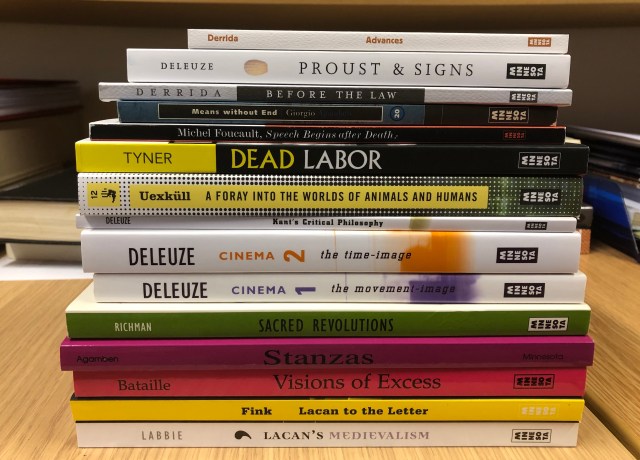
Books received – review work for University of Minnesota Press

IMG_0140.jpg

Mainly older works by Agamben, Deleuze, Derrida, and Foucault, but also some other books, including James Tyner, Dead Labor: Towards a Political Economy of Premature Death, Michèle H. Richman, Sacred Revolutions: Durkheim and the Collège de Sociologie and Erin Felicia Labbie, Lacan’s Medievalism.

Posted in Georges Bataille, Gilles Deleuze, Giorgio Agamben, Jacques Derrida, Jacques Lacan, Jakob von Uexküll, Michel Foucault, Uncategorized | Leave a comment

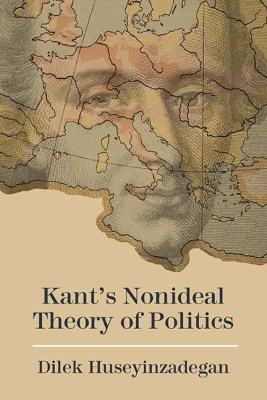
Dilek Huseyinzadegan, Kant’s Non-Ideal Theory of Politics – Northwestern U Press, 2019

kant-s-nonideal-theory-of-politicsDilek Huseyinzadegan, Kant’s Non-Ideal Theory of Politics – Northwestern University Press, 2019

Kant’s Nonideal Theory of Politics argues that Kant’s political thought must be understood by reference to his philosophy of history, cultural anthropology, and geography. The central thesis of the book is that Kant’s assessment of the politically salient features of history, culture, and geography generates a nonideal theory of politics, which supplements his well-known ideal theory of cosmopolitanism.

This novel analysis thus challenges the common assumption that an ideal theory of cosmopolitanism constitutes Kant’s sole political legacy. Dilek Huseyinzadegan demonstrates that Kant employs a teleological worldview throughout his political writings as a means of grappling with the pressing issues of multiplicity, diversity, and plurality—issues that confront us to this day.

Kant’s Nonideal Theory of Politics is the first book-length treatment of Kant’s political thought that gives full attention to the role that history, anthropology, and geography play in his mainstream political writings. Interweaving close textual analyses of Kant’s writings with more contemporary political frameworks, this book also makes Kant accessible and responsive to fields other than philosophy. As such, it will be of interest to students and scholars working at the intersections of political theory, feminism, critical race theory, and post- and decolonial thought.


Posted in Immanuel Kant, Uncategorized | 1 Comment