John Agnew & Mat Coleman (eds.), Handbook on the Geographies of Power – review in Geographical Research

9781785365638I have a review of John Agnew & Mat Coleman (eds.), Handbook on the Geographies of Power in Geographical Research. A read-only version can be accessed here; a downloadable preprint here.

I’m very positive about the content of the book, but critical of the business model and price.

The publisher’s description of the book follows:

The so-called spatial turn in the social sciences means that many researchers have become much more interested in what can be called the spatialities of power, or the ways in which power as a medium for achieving goals is related to where it takes place. Most famous authors on the subject, such as Machiavelli and Hobbes, saw power as entirely equivalent to domination exercised by some over others. Though this meaning is hardly redundant, understandings of power have become more multidimensional and nuanced as a result of the spatial turn. Much recent writing in human geography, for example, has rigorously extended use of the term power beyond its typical understanding as a resource that pools up in some hands and some places to a medium of agency that has different effects depending on how it is deployed across space and how actors cooperate, or not, to give it effect. To address this objective, the book is organized thematically into four sections that cover the main areas in which much of the contemporary work on geographies of power is concentrated: bodies, economy, environment and energy, and war.

 

Posted in John Agnew, Uncategorized | Leave a comment

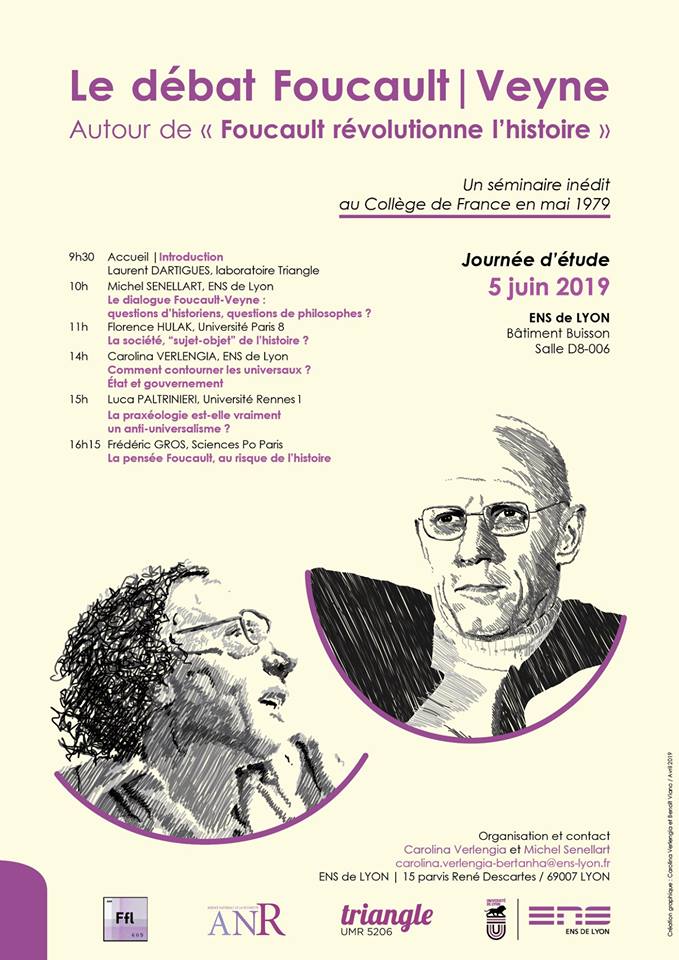
Le débat Foucault | Veyne (2019)

Event in Lyon on the Michel Foucault-Paul Veyne relation

Clare O'Farrell's avatarFoucault News

View original post

Posted in Uncategorized | Leave a comment

Canguilhem – short post on the Polity blog

Canguilhem coverI’ve written a short piece about George Canguilhem and my book on him at the Polity blog. More details on the book itself can be found here.
On Valentine’s day 1966, Louis Althusser wrote to his translator and lover Franca Madonia, mentioning that he had met up with Georges Canguilhem, his former teacher. Canguilhem was described by Althusser as “one of our old masters, a fierce man, angry, shy and violent, who convinced himself, after years of mistrust, that we really loved him”. [continues here]


Posted in Canguilhem (book), Georges Canguilhem, Louis Althusser, Uncategorized | Leave a comment

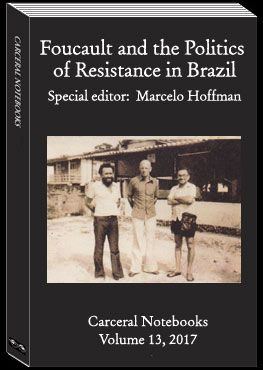
Carceral Notebooks 13: Foucault and the Politics of Resistance in Brazil – now published open access
book-vol13.jpgCarceral Notebooks 13: Foucault and the Politics of Resistance in Brazil – now published and essays available open access

http://www.thecarceral.org/journal-vol13.html

Bernard E. Harcourt, Preface

Bernard E. Harcourt, Dedication

Marcelo Hoffman, Special Editor, Introduction

Salma Tannus Muchail and Márcio Alves da Fonseca, Power and Resistance: Foucault’s Laboratory in Brazil

Marcelo Hoffman, From Public Silence to Public Protest: Foucault at the University of São Paulo in 1975

José Castilho Marques Neto, In the Taxi with Michel Foucault: Memories of a Twenty-Two-Year-Old Philosophy Student

Ernani Chaves, “The SNI Was Asking for the Roster…”: Foucault in Belém in November 1976

Heliana de Barros Conde Rodrigues and Rosimeri de Oliveira Dias, The Tiny Brazilian Press as Resistance: Foucault, the Enemy of the King

Mauricio Pelegrini, Foucault in Iran, Foucault in Brazil: Political Spirituality and Counter-Conducts

Margareth Rago, Foucault, Subjectivity, and Self-Writing in Brazilian Feminism

Oswaldo Giacoia Junior, Beyond a Critic of Human Rights: Foucault in Brazil

Priscila Piazentini Vieira, Freeing Ourselves: The Experience of the Prisons Information Group (In Light of Foucault’s 1973 Rio Lectures)

Edson Passetti, Penal Abolitionism: An Anarchist Perspective From Brazil

Contributors


Posted in Michel Foucault, Politics, Uncategorized | Leave a comment

Books received – Newman, Lacan, Chartier, Calvet, Esposito, Boquet and Nacy

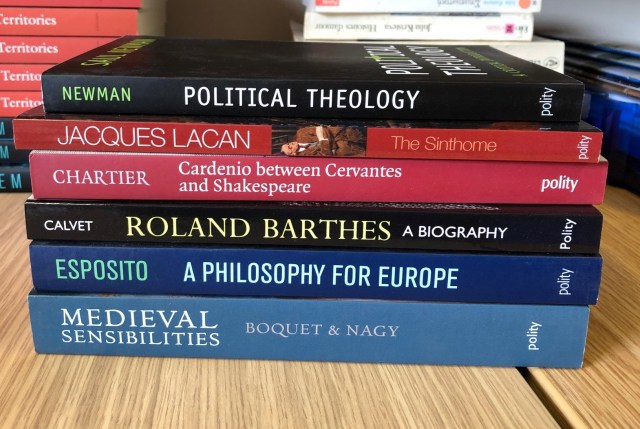
books 2.jpgSome books received in recompense for review work for Polity – Saul Newman, Political Theology; Jacques Lacan, The Sinthome; Roger Chartier, Cardenio between Cervantes and Shakespeare; Louis-Jean Calvet’s biography of Roland Barthes; Roberto Esposito, A Philosophy for Europe; and Damien Boquet and Piroska Nagy, Medieval Sensibilities.

Posted in Jacques Lacan, Roberto Esposito, Uncategorized, William Shakespeare | Leave a comment

Robert Macfarlane, Underland – Penguin 2019, and short piece in The Guardian

imageRobert Macfarlane, Underland – Penguin 2019, and short piece in The Guardian

The highly anticipated new book from the internationally bestselling, prize-winning author of Landmarks, The Lost Words and The Old Ways
Discover the hidden worlds beneath our feet…
In Underland, Robert Macfarlane takes us on a journey into the worlds beneath our feet. From the ice-blue depths of Greenland’s glaciers, to the underground networks by which trees communicate, from Bronze Age burial chambers to the rock art of remote Arctic sea-caves, this is a deep-time voyage into the planet’s past and future. Global in its geography, gripping in its voice and haunting in its implications, Underland is a work of huge range and power, and a remarkable new chapter in Macfarlane’s long-term exploration of landscape and the human heart.


Posted in Uncategorized | Leave a comment

Nicolas de Warren and Thomas Vongehr (eds.), Philosophers at the Front: Phenomenology and the First World War, Leuven University Press, 2017 – reviewed at NDPR
_jpg_rgb_1500hNicolas de Warren and Thomas Vongehr (eds.), Philosophers at the Front: Phenomenology and the First World War, Leuven University Press, 2017 – reviewed at NDPR

An exceptional collection of letters, postcards, original writings, and photographs

The First World War witnessed an unprecedented mobilization of philosophers and their families: as soldiers at the front; as public figures on the home front; as nurses in field hospitals; as mothers and wives; as sons and fathers. In Germany, the war irrupted in the midst of the rapid growth of Edmund Husserl’s phenomenological movement – widely considered one of the most significant philosophical movements in twentieth century thought. Philosophers at the Front offers a documentary history of phenomenology in the First World War. Through an exceptional collection of primary source materials (letters, postcards, original writings, photographs) from the Husserl Archives in Leuven, the Bayerische Staatsbibliothek, and the Archives of the University of Göttingen, the complex narratives of how the war affected the lives and thought of central figures in the phenomenological movement are charted. Key figures such as Edmund Husserl, his sons Wolfgang and Gerhart, Max Scheler, Edith Stein, Adolf Reinach, Martin Heidegger, and others are included in this collection of materials.

The volume includes reproductions of original material, as well as German transcription of all texts and their English translation.


Posted in Uncategorized | Leave a comment

Emmanuelle Loyer, Lévi-Strauss: A Biography – Polity, 2018 (and review)

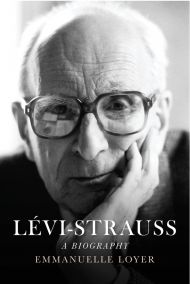
9781509511983.jpgEmmanuelle Loyer, Lévi-Strauss: A Biography – Polity, 2018, translated by Ninon Vinsonneau and Jonathan Magidoff

Academic, writer, figure of melancholy, aesthete – Claude Lévi-Strauss (1908–2009) not only transformed his academic discipline, he also profoundly changed the way that we view ourselves and the world around us. 

In this award-winning biography, historian Emmanuelle Loyer recounts Lévi-Strauss’s childhood in an assimilated Jewish household, his promising student years as well as his first forays into political and intellectual movements. As a young professor, Lévi-Strauss left Paris in 1935 for São Paulo to teach sociology. His rugged expeditions into the Brazilian hinterland, where he discovered the Amerindian Other, made him into an anthropologist. The racial laws of the Vichy regime would force him to leave France yet again, this time for the USA in 1941, where he became Professor Claude L. Strauss – to avoid confusion with the jeans manufacturer.

Lévi-Strauss’s return to France, after the war, ushered in the period during which he produced his greatest works: several decades of intense labour in which he reinvented anthropology, establishing it as a discipline that offered a  offered new view on the world. In 1955,  Tristes Tropiques indisputable proof of this the world over. During those years, Lévi-Strauss became something of a French national monument, as well as a celebrity intellectual of global renown. But he always claimed his perspective was a ‘view from afar’, enabling him to deliver incisive and subversive diagnoses of our waning modernity.

Loyer’s outstanding biography tells the story of a true intellectual adventurer whose unforgettable voice invites us to rethink questions of the human and the meaning of progress. She portrays Lévi-Strauss less as a modern than as our own great and disquieted contemporary.

The book is reviewed in Boston Review (thanks to Peter Gratton for the link)

Posted in Uncategorized | Leave a comment

Stuart Elden, Canguilhem – Polity Key Contemporary Thinkers series, now published

This book should now be available in the US and worldwide.

stuartelden's avatarProgressive Geographies

Canguilhem coverMy study of George Canguilhem for Polity’s Key Contemporary Thinkers series is now released in the UK in both hardback and paperback. It should be available in North America and worldwide over the next couple of months. [Update April 23 – now available worldwide]

Although it is coming out very shortly after Shakespearean Territories, the manuscripts were actually submitted about a year apart – Polity are much faster at getting books through production.

Georges Canguilhem (1904-95) was an influential historian and philosopher of science, as renowned for his teaching as for his writings. He is best known for his book The Normal and the Pathological, originally his doctoral thesis inmedicine, but he also wrote a thesis in philosophy on the concept of the reflex, supervised by Gaston Bachelard. He was the sponsor of Michel Foucault’s doctoral thesis on madness. However, his work extends far beyond what is suggested…

View original post 196 more words

Posted in Uncategorized | 1 Comment

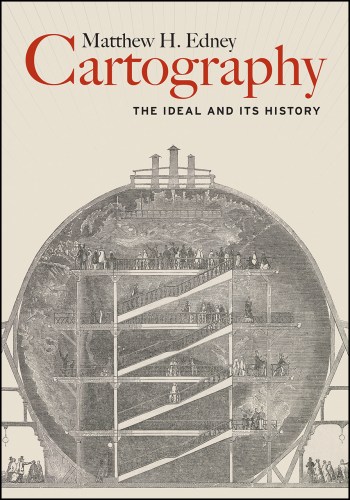
Matthew H. Edney, Cartography: The Ideal and its History – U Chicago Press, April 2019

9780226605685.jpgMatthew H. Edney, Cartography: The Ideal and its History – University of Chicago Press, April 2019

Over the past four decades, the volumes published in the landmark History of Cartography series have both chronicled and encouraged scholarship about maps and mapping practices across time and space. As the current director of the project that has produced these volumes, Matthew H. Edney has a unique vantage point for understanding what “cartography” has come to mean and include.

In this book Edney disavows the term cartography, rejecting the notion that maps represent an undifferentiated category of objects for study. Rather than treating maps as a single, unified group, he argues, scholars need to take a processual approach that examines specific types of maps—sea charts versus thematic maps, for example—in the context of the unique circumstances of their production, circulation, and consumption. To illuminate this bold argument, Edney chronicles precisely how the ideal of cartography that has developed in the West since 1800 has gone astray. By exposing the flaws in this ideal, his book challenges everyone who studies maps and mapping practices to reexamine their approach to the topic. The study of cartography will never be the same.


Posted in Uncategorized | 1 Comment