David Farrell Krell, The Cudgel and the Caress: Reflections on Cruelty and Tenderness – SUNY Press, March 2019

63943_cov.jpgDavid Farrell Krell, The Cudgel and the Caress: Reflections on Cruelty and Tenderness – SUNY Press, 2019

I shared news of Krell’s recent The Sea: A Philosophical Encounter a couple of days ago. Thanks to Ron Sexton for commenting that he has another new book out. Currently only in expensive hardback and e-book, but SUNY usually do paperback fairly soon. The first chapter is available here.

Offers philosophical and psychological reflections on cruelty and tenderness.

The Cudgel and the Caress explores the enduring significance of tenderness and cruelty in a range of works across philosophy, psychoanalysis, and literature. Divided into two parts, the book initially focuses on tenderness, with David Farrell Krell delivering original readings of Homer’s Iliad, Sophocles’s Antigone, and writings by Hölderlin, Hegel, Freud, and Derrida that deal with the importance of tenderness and the tragic consequences of its absence. Part One concludes with an extended reading of Robert Musil’s Man Without Qualities, in which Krell analyzes the tender relationship between Ulrich and Agathe. In Part Two, Krell begins by examining Otto Rank’s Birth Trauma, which reflects on the tenderness of gestation in the womb and the cruel necessity of birth. He then turns to an examination of cruelty in general, focusing on Derrida’s challenge to contemporary psychoanalysis, his opposition between Kant and Nietzsche, and his analysis (and indictment) of the death penalty. Groundbreaking and insightful, the book provides a rare philosophical treatment of subjects vital to the world we live in.

“This book offers nuanced readings from a range of texts important to the continental philosophical tradition. David Farrell Krell is an established and brilliant voice in the field, and the individual chapters reflect a lifetime of reflection, a history of successive interpretations, and a philosophical depth and humanity that are difficult to find today.” — Julia Ireland, cotranslator of Martin Heidegger’s Hölderlin’s Hymn “Remembrance”

Posted in Uncategorized | Leave a comment

Jenny Edkins, Change and the Politics of Certainty – Manchester University Press, May 2019

9781526119032.jpgJenny Edkins, Change and the Politics of Certainty – Manchester University Press, 2019

Renowned politics scholar Jenny Edkins explores the imperative for change in a world filled with inequality, violence, persecution, and injustice–and the difficulties of bringing it about. How do we transform the world when we are ourselves inescapably part of it? If we cannot know what makes the world the way it is, or what impact our actions will have, where do we begin? Over the course of ten chapters this book examines our varied responses to questions such as aid in times of famine; opposition to the Iraq War; humanitarian intervention; the memorialisation of 9/11; enforced disappearance; and calls for justice after the Grenfell Tower fire. Drawing on insights from the author’s life and on the work of playwrights and filmmakers, this book interrogates the ideas of thinkers including Lauren Berlant, Judith Butler, Jacques Derrida, Michel Foucault, Stuart Hall, Eric Santner, Elaine Scarry, Carolyn Steedman and Slavoj Zizek. Tackling themes such as the fantasy of security, contemporary notions of time and space, and ideas of humanity and sentience, this accessible book is essential reading for all who strive for a better world.

Posted in Jacques Derrida, Jenny Edkins, Judith Butler, Michel Foucault, Slavoj Zizek, Stuart Hall, Uncategorized | Leave a comment

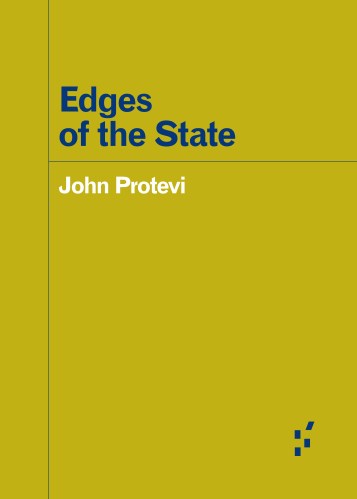
John Protevi, Edges of the State – University of Minnesota Press, Forerunner, April 2019

image.jpgJohn Protevi, Edges of the State – University of Minnesota Press, Forerunner, 2019

This book takes a look at the formation, and edges, of states: their breakdowns and attempts to repair them, and their encounters with non-state peoples. It draws upon anthropology, political philosophy, neuroscience, evolutionary biology, child developmental psychology, and other fields to look at states as projects of constructing “bodies politic,” where the civic and the somatic intersect. John Protevi asserts that humans are predisposed to “prosociality,” or being emotionally invested in social partners and patterns. With readings from Jean-Jacques Rousseau and James C. Scott; a critique of the assumption of widespread pre-state warfare as a selection pressure for the evolution of human prosociality and altruism; and an examination of the different “economies of violence” of state and non-state societies, Edges of the State


Posted in John Protevi, Uncategorized | Leave a comment

Christian Abrahamsson, Topoi/Graphein: Mapping the Middle in Spatial Thought _ U Nebraska Press, 2018, with preface by Gunnar Olsson

9781496204196Christian Abrahamsson, Topoi/Graphein: Mapping the Middle in Spatial Thought – University of Nebraska Press, 2018, with preface by Gunnar Olsson

In Topoi/Graphein Christian Abrahamsson maps the paradoxical limit of the in-between to reveal that to be human is to know how to live with the difference between the known and the unknown. Using filmic case studies, including Code Inconnu, Lord of the Flies, and Apocalypse Now, and focusing on key concerns developed in the works of the philosophers Deleuze, Olsson, and Wittgenstein, Abrahamsson starts within the notion of fixed spatiality, in which human thought and action are anchored in the given of identity. He then moves through a social world in which spatiotemporal transformations are neither fixed nor taken for granted. Finally he edges into the pure temporality that lies beyond the maps of fixed points and social relations.

Each chapter is organized into two subjects: topoi, or excerpts from the films, and graphein, the author’s interpretation of presented theories to mirror the displacements, transpositions, juxtapositions, fluctuations, and transformations between delimited categories. A landmark work in the study of human geography, Abrahamsson’s book proposes that academic and intellectual attention should focus on the spatialization between meaning and its materialization in everyday life.

“Readers with an interest in spatial theory or cinematic geography should obviously appreciate this work, but so should anyone who wants to understand how a world falls apart and continues to fall apart.”—Marcus A. Doel, Social and Cultural Geography
Topoi/Graphein poses the most profound philosophical and conceptual questions concerning the human condition from a compelling geographical perspective. A sustained meditation on our engagement with the world, it journeys over remarkably wide-ranging territory, delivering valuable insights with an uncommon intensity of thought. This is a heavyweight work that wears its profundity lightly.”—David B. Clarke, professor of human geography and head of the Department of Geography at Swansea University
“Generations of scholars have identified their respective positions with reference to landmark propositions emanating from singular publications. Topoi/Graphein holds the promise of becoming such a book for a coming generation. It tackles its subject matter with considerable verve and elegant style.”—Ulf Strohmayer, professor of geography at the National University of Ireland, Galway
Posted in Gilles Deleuze, Gunnar Olsson, Uncategorized | Leave a comment

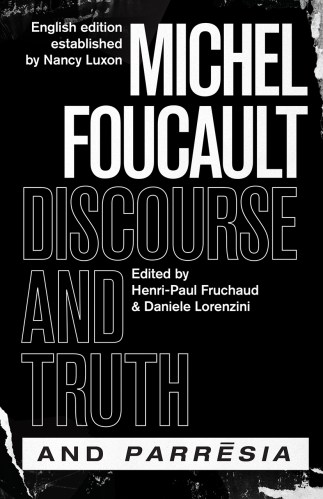
Michel Foucault, Discourse and Truth and Parresia, University of Chicago Press, 2019

9780226509464.jpgMichel Foucault, Discourse and Truth and Parresia, University of Chicago Press, 2019

edited by Henri-Paul Fruchaud and Daniele Lorenzini, English edition established by Nancy Luxon

This volume collects a series of lectures given by the renowned French thinker Michel Foucault late in his career. The book is composed of two parts: a talk, Parrēsia, delivered at the University of Grenoble in 1982, and a series of lectures entitled “Discourse and Truth,” given at the University of California, Berkeley in 1983, which appears here for the first time in its full and correct form. Together, they provide an unprecedented account of Foucault’s reading of the Greek concept of parrēsia, often translated as “truth-telling” or “frank speech.” The lectures trace the transformation of this concept across Greek, Roman, and early Christian thought, from its origins in pre-Socratic Greece to its role as a central element of the relationship between teacher and student. In mapping the concept’s history, Foucault’s concern is not to advocate for free speech; rather, his aim is to explore the moral and political position one must occupy in order to take the risk to speak truthfully.

These lectures—carefully edited and including notes and introductory material to fully illuminate Foucault’s insights—are a major addition to Foucault’s English language corpus.

This is a critical edition of the text previously published as Fearless Speech, and the Grenoble lecture previously appeared in Critical Inquiry. It’s the English equivalent of Discours et vérité, which appeared in 2016 with Vrin. The Fearless Speech book was unauthorised, and the seminars were transcribed from recordings. They were incomplete and sometimes wrong – this volume is complete, corrected and supplemented by Foucault’s manuscripts. There is also a good amount of critical apparatus.

Posted in Michel Foucault, Uncategorized | 1 Comment

Erik Daryl Meyer, Inner Animalities: Theology and the End of the Human – Fordham UP, 2018 and book forum


9780823280155Erik Daryl Meyer, Inner Animalities: Theology and the End of the Human – Fordham UP and book forum at An Und Für Sich

Most theology proceeds under the assumption that divine grace works on human beings at the points of our supposed uniqueness among earth’s creatures—our freedom, our self-awareness, our language, or our rationality. Inner Animalities turns this assumption on its head. Arguing that much theological anthropology contains a deeply anti-ecological impulse, the book draws creatively on historical and scriptural texts to imagine an account of human life centered in our creaturely commonality.

The tendency to deny our own human animality leaves our self-understanding riven with contradictions, disavowals, and repressions. How are human relationships transformed when God draws us into communion through our instincts, our desires, and our bodily needs? Meyer argues that humanity’s exceptional status is not the result of divine endorsement, but a delusion of human sin. Where the work of God knits human beings back into creaturely connections, ecological degradation is no longer just a matter of bodily life and death, but a matter of ultimate significance.

Bringing a theological perspective to the growing field of Critical Animal Studies, Inner Animalities puts Gregory of Nyssa and Karl Rahner in conversation with Jacques Derrida, Giorgio Agamben, Kelly Oliver, and Cary Wolfe. What results is not only a counterintuitive account of human life in relation with nonhuman neighbors, but also a new angle into ecological theology.

Posted in Uncategorized | Leave a comment

David Farrell Krell, The Sea: A Philosophical Encounter – Bloomsbury, 2019

9781350076723.jpgDavid Farrell Krell, The Sea: A Philosophical Encounter – Bloomsbury, 2019

Humankind has a profound and complex relationship with the sea, a relationship that is extensively reflected in biology, psychology, religion, literature and poetry. The sea cradles and soothes us, we visit it often for solace and inspiration, it is familiar, being the place where life ultimately began. Yet the sea is also dark and mysterious and often spells catastrophe and death. The sea is a set of contradictions: kind, cruel, indifferent. She is a blind will that will ‘have her way’. In exploring this most capricious of phenomena, David Farrell Krell engages the work of an array of thinkers and writers including, but not limited to, Homer, Thales, Anaximander, Heraclitus, Plato, Aristotle, Hölderlin, Melville, Woolf, Whitman, Nietzsche, Heidegger, Schelling, Ferenczi, Rank and Freud.

The Sea explores the significance in Western civilization of the catastrophic and generative power of the sea and what humankind’s complex relationship with it reveals about the human condition, human consciousness, temporality, striving, anxiety, happiness and mortality.

Posted in David Farrell Krell, Uncategorized | 2 Comments

Richard Horton, ‘Frantz Fanon and the origins of global health’, The Lancet (open access)

Richard Horton, ‘Frantz Fanon and the origins of global health’, The Lancet (open access)

Posted in Frantz Fanon, Uncategorized | Leave a comment

Open access monographs: perspectives from university presses

Open access monographs: perspectives from university presses – at WONKHE

As Research England formulates a requirement for open access monographs in future Research Excellence Frameworks (REFs), let us consider how university presses publish single-subject, often single-author, scholarly works and participate in the construction of a complex and, we hope, robust OA monograph equation.

Monographs have their own unique and valued publishing processes and scholarly purposes, requiring support and infrastructure. It is likely, therefore, that existing models for OA journals, which are typically composed of shorter scholarly pieces by multiple authors, may be of limited utility when devising protocols for OA monographs. The fundamentally different peer and editorial review processes, in particular, are esteemed by scholars for assuring the quality of published long-form works; similarly, marketing entails not just selling, but vital discovery and dissemination work essential to authors and readers alike. [continues here]

Posted in Publishing, Uncategorized | Leave a comment

Forthcoming translations of Althusser – History and Imperialism (Polity) and Lessons on Rousseau (Verso)

Forthcoming translations of Althusser from Polity and Verso

History and Imperialism: Writings 1964-1988, translated by G.M. Goshgarian, Polity, October 2019

Writings on History brings together a selection of texts by Louis Althusser dating from 1963 to 1986, including essays, a lecture, notes to his collaborators, and the transcript of an informal 1963 discussion of literary history. The centrepiece of this collection is Althusser’s previously unpublished Book on Imperialism, a theorization of globalized capitalism that remained unfinished. All these writings are concerned with the place of history in Marxist theory and, in particular, on what Althusser considered to be the mortal danger of historicism haunting the revolutionary reading of the present. They testify to his continuing dialogue with the historiography of his day, several of whose representatives were engaged in discussion and debate with him. Deeply interested in history but intent on avoiding the kind of interpretation that would transform it into a deterministic force, Althusser never ceased to reflect on the equilibrium between the historical and the concept in Marxist historiography, an equilibrium that he sought to reinvent for his time. The traces of that undertaking, which continues to generate debate throughout the world today, are brought together in this volume.

Lessons on Rousseau, translated by G.M. Goshgarian, Verso, November 2019

Althusser delivered these lectures on Rousseau’s Discourse on the Origins of Inequality at the École normale supérieure in Paris in 1972. They are fascinating for two reasons. First, they gave rise to a new generation of Rousseau scholars, attentive not just to Rousseau’s ideas, but also to those of his concepts that were buried beneath metaphors or fictional situations and characters. Second, we are now discovering that the “late Althusser’s” theses about aleatory materialism and the need to break with the strict determinism of theories of history in order to devise a new philosophy “for Marx” were being worked out well before 1985 in this reading of Rousseau dating from twelve years earlier, which introduces into Rousseau’s text the ideas of the void, the accident, the take, and the necessity of contingency.

Posted in Jean Jacques Rousseau, Louis Althusser, Uncategorized | Leave a comment