Erik Daryl Meyer, Inner Animalities: Theology and the End of the Human – Fordham UP, 2018 and book forum


9780823280155Erik Daryl Meyer, Inner Animalities: Theology and the End of the Human – Fordham UP and book forum at An Und Für Sich

Most theology proceeds under the assumption that divine grace works on human beings at the points of our supposed uniqueness among earth’s creatures—our freedom, our self-awareness, our language, or our rationality. Inner Animalities turns this assumption on its head. Arguing that much theological anthropology contains a deeply anti-ecological impulse, the book draws creatively on historical and scriptural texts to imagine an account of human life centered in our creaturely commonality.

The tendency to deny our own human animality leaves our self-understanding riven with contradictions, disavowals, and repressions. How are human relationships transformed when God draws us into communion through our instincts, our desires, and our bodily needs? Meyer argues that humanity’s exceptional status is not the result of divine endorsement, but a delusion of human sin. Where the work of God knits human beings back into creaturely connections, ecological degradation is no longer just a matter of bodily life and death, but a matter of ultimate significance.

Bringing a theological perspective to the growing field of Critical Animal Studies, Inner Animalities puts Gregory of Nyssa and Karl Rahner in conversation with Jacques Derrida, Giorgio Agamben, Kelly Oliver, and Cary Wolfe. What results is not only a counterintuitive account of human life in relation with nonhuman neighbors, but also a new angle into ecological theology.

Posted in Uncategorized | Leave a comment

David Farrell Krell, The Sea: A Philosophical Encounter – Bloomsbury, 2019

9781350076723.jpgDavid Farrell Krell, The Sea: A Philosophical Encounter – Bloomsbury, 2019

Humankind has a profound and complex relationship with the sea, a relationship that is extensively reflected in biology, psychology, religion, literature and poetry. The sea cradles and soothes us, we visit it often for solace and inspiration, it is familiar, being the place where life ultimately began. Yet the sea is also dark and mysterious and often spells catastrophe and death. The sea is a set of contradictions: kind, cruel, indifferent. She is a blind will that will ‘have her way’. In exploring this most capricious of phenomena, David Farrell Krell engages the work of an array of thinkers and writers including, but not limited to, Homer, Thales, Anaximander, Heraclitus, Plato, Aristotle, Hölderlin, Melville, Woolf, Whitman, Nietzsche, Heidegger, Schelling, Ferenczi, Rank and Freud.

The Sea explores the significance in Western civilization of the catastrophic and generative power of the sea and what humankind’s complex relationship with it reveals about the human condition, human consciousness, temporality, striving, anxiety, happiness and mortality.

Posted in David Farrell Krell, Uncategorized | 2 Comments

Richard Horton, ‘Frantz Fanon and the origins of global health’, The Lancet (open access)

Richard Horton, ‘Frantz Fanon and the origins of global health’, The Lancet (open access)

Posted in Frantz Fanon, Uncategorized | Leave a comment

Open access monographs: perspectives from university presses

Open access monographs: perspectives from university presses – at WONKHE

As Research England formulates a requirement for open access monographs in future Research Excellence Frameworks (REFs), let us consider how university presses publish single-subject, often single-author, scholarly works and participate in the construction of a complex and, we hope, robust OA monograph equation.

Monographs have their own unique and valued publishing processes and scholarly purposes, requiring support and infrastructure. It is likely, therefore, that existing models for OA journals, which are typically composed of shorter scholarly pieces by multiple authors, may be of limited utility when devising protocols for OA monographs. The fundamentally different peer and editorial review processes, in particular, are esteemed by scholars for assuring the quality of published long-form works; similarly, marketing entails not just selling, but vital discovery and dissemination work essential to authors and readers alike. [continues here]

Posted in Publishing, Uncategorized | Leave a comment

Forthcoming translations of Althusser – History and Imperialism (Polity) and Lessons on Rousseau (Verso)

Forthcoming translations of Althusser from Polity and Verso

History and Imperialism: Writings 1964-1988, translated by G.M. Goshgarian, Polity, October 2019

Writings on History brings together a selection of texts by Louis Althusser dating from 1963 to 1986, including essays, a lecture, notes to his collaborators, and the transcript of an informal 1963 discussion of literary history. The centrepiece of this collection is Althusser’s previously unpublished Book on Imperialism, a theorization of globalized capitalism that remained unfinished. All these writings are concerned with the place of history in Marxist theory and, in particular, on what Althusser considered to be the mortal danger of historicism haunting the revolutionary reading of the present. They testify to his continuing dialogue with the historiography of his day, several of whose representatives were engaged in discussion and debate with him. Deeply interested in history but intent on avoiding the kind of interpretation that would transform it into a deterministic force, Althusser never ceased to reflect on the equilibrium between the historical and the concept in Marxist historiography, an equilibrium that he sought to reinvent for his time. The traces of that undertaking, which continues to generate debate throughout the world today, are brought together in this volume.

Lessons on Rousseau, translated by G.M. Goshgarian, Verso, November 2019

Althusser delivered these lectures on Rousseau’s Discourse on the Origins of Inequality at the École normale supérieure in Paris in 1972. They are fascinating for two reasons. First, they gave rise to a new generation of Rousseau scholars, attentive not just to Rousseau’s ideas, but also to those of his concepts that were buried beneath metaphors or fictional situations and characters. Second, we are now discovering that the “late Althusser’s” theses about aleatory materialism and the need to break with the strict determinism of theories of history in order to devise a new philosophy “for Marx” were being worked out well before 1985 in this reading of Rousseau dating from twelve years earlier, which introduces into Rousseau’s text the ideas of the void, the accident, the take, and the necessity of contingency.

Posted in Jean Jacques Rousseau, Louis Althusser, Uncategorized | Leave a comment

David Farrell Krell, “Derrida, Heidegger, and the Magnetism of the Trakl House” (on Derrida’s Geschlecht III – video)

And while we’re on that theme –

David Farrell Krell, “Derrida, Heidegger, and the Magnetism of the Trakl House” (on Derrida’s Geschlecht III – video)

Posted in David Farrell Krell, Jacques Derrida, Martin Heidegger, Uncategorized | 1 Comment

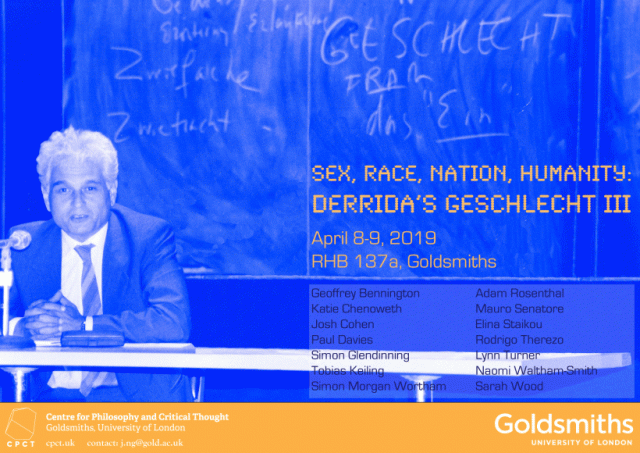
Sex, Race, Nation, Humanity: Derrida’s Geschlecht III (Goldsmiths, April 8-9, 2019)

Sex, Race, Nation, Humanity: Derrida’s Geschlecht III (Goldsmiths, April 8-9, 2019)

Sex, Race, Nation, Humanity: Derrida’s Geschlecht III

A Conference on a Newly Re-discovered Text

April 8-9, 2019

Richard Hoggart Building 137a, Goldsmiths, University of London

This two-day conference focuses on a recently discovered text by the late Franco-Algerian philosopher Jacques Derrida.  Geschlecht III, rediscovered in the Derrida archive and newly published in French (forthcoming in English), is the “missing” installment in Derrida’s four-part series on Martin Heidegger and the German word Geschlecht (meaning, among other things, “sex,” “race,” and “species”).  Geschlecht III presents us with one of Derrida’s most sustained engagements with Heidegger, a meticulous reading of what he will call Heidegger’s “national-humanism”: the nationalistic undercurrent in Heidegger’s thought that posits German and Germany as the privileged media through which to think the essence of the human and its relationship to the fate of the West. 

derrida-geschlecht-3-2019-4-d.gif

Posted in Jacques Derrida, Martin Heidegger, Uncategorized | 1 Comment

Andrea Bagnato, Marco Ferrari and Elisa Pasqual, A Moving Border – Alpine Cartographies of Climate Change, Columbia University Press – and o/a link to my piece

stuartelden's avatarProgressive Geographies

a-moving-border_cover_300dpi
Andrea Bagnato, Marco Ferrari and Elisa Pasqual, A Moving Border – Alpine Cartographies of Climate Change, Columbia University Press, forthcoming 2019.

[now updated with the final cover]

This is the book developing from the Italian Limes project. I was pleased to welcome Andrea and Marco to Warwick for one of the ICE-LAW project workshops, and to be asked to write an essay for this book. With their permission, you can access my piece, ‘The Instability of Terrain’, here.

There will be a book launch at the Royal Academy on the evening of 15 April 2019 with some of the contributors. More details when advertised.

Italy’s northern border follows the watershed that separates the drainage basins of Northern and Southern Europe. Running mostly at high altitudes, it crosses snowfields and perennial glaciers—all of which are now melting as a result of anthropogenic climate change. As the watershed…

View original post 225 more words

Posted in Uncategorized | Leave a comment

Being in the World (film)

Being in the World – 2010 documentary film directed by Tao Ruspoli

https://www.youtube.com/watch?time_continue=312&v=k5QJ8s3qUyA

|||'s avatarsynthetic zerØ

Being in the World is a 2010 documentary film directed by Tao Ruspoli. The film is based on Martin Heidegger’s philosophy and is inspired by Hubert Dreyfus. It features a number of prominent philosophers. Philosophers such as Mark Wrathall, Sean Kelly, Taylor Carman, John Haugeland, Iain Thomson, Charles Taylor and Albert Borgmann are also featured in the film.

Synopsis: ‘Being in the World is a celebration of human beings and our ability, through the mastery of physical, intellectual and creative skills, to find meaning in the world around us. Some of our most renowned philosophers, from Harvard to Berkeley, take us on a gripping journey to meet modern day masters-people who not only have learned to respond in a sensitive way to the requirements of their craft, but have also gathered their communities in ways that our technological age threatens to make obsolete.’

Initial release: 2010
Director: Tao…

View original post 4 more words

Posted in Uncategorized | 1 Comment

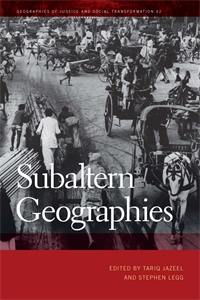
Tariq Jazeel and Stephen Legg (eds.), Subaltern Geographies – University of Georgia Press, 2019

9780820354590.jpgTariq Jazeel and Stephen Legg (eds.), Subaltern Geographies – University of Georgia Press, 2019

Subaltern Geographies is the first book-length discussion addressing the relationship between the historical innovations of subaltern studies and the critical intellectual practices and methodologies of cultural, urban, historical, and political geography. This edited volume explores this relationship by attempting to think critically about space and spatial categorizations.

Editors Tariq Jazeel and Stephen Legg ask, What methodologicalphilosophical potential does a rigorously geographical engagement with the concept of subalternity pose for geographical thought, whether in historical or contemporary contexts? And what types of craft are necessary for us to seek out subaltern perspectives both from the past and in the present? In so doing, Subaltern Geographies engages with the implications for and impact on disciplinary geographical thought of subaltern studies scholarship, as well as the potential for such thought. In the process, it probes new spatial ideas and forms of learning in an attempt to bypass the spatial categorizations of methodological nationalism and Eurocentrism.

CONTRIBUTORS: David Arnold, Sharad Chari, David Featherstone, Vinay Gidwani, Mukul Kumar, Sunil Kumar, Anna F. Laing, Colin McFarlane, Sarah A. Radcliffe, Ananya Roy, and Jo Sharp

Posted in Uncategorized | 1 Comment