Books received – Macherey, Mezzadra & Neilson, Zevnik, Gotman, Owens and Almqvist, Sartre

books.jpg

Pierre Macherey, A Theory of Literary Production; Tim Smith-Lang, Michel Foucault’s What is an Author?; Sandro Mezzadra and Brett Neilson, The Politics of Operation: Excavating Contemporary Capitalism; Andreja Zevnik, Lacan, Deleuze and World Politics; Kelina Gotman, Essays on Theatre and Change; Owens and Ahmqvist (eds.), Studying Lacan’s Seminars IV and V; and the new translation of Sartre’s Being and Nothingness. These were mainly in recompense for review work for Routledge, but The Politics of Operations was kindly sent by the publisher. Here’s the description:

In The Politics of Operations Sandro Mezzadra and Brett Neilson investigate how capital reshapes its relation with politics through operations that enable the extraction and exploitation of mineral resources, labor, data, and cultures. They show how capital—which they theorize as a direct political actor—operates through the logistical organization of relations between people, property, and objects as well as through the penetration of financialization into all realms of economic life. Mezzadra and Neilson present a capacious analysis of a wide range of issues, from racial capitalism, the convergence of neoliberalism and nationalism, and Marx’s concept of aggregate capital to the financial crisis of 2008 and how colonialism, empire, and globalization have shaped the modern state since World War II. In so doing, they illustrate the distinctive rationality and logics of contemporary capitalism while calling for a politics based on collective institutions that exist outside the state.
Posted in Gilles Deleuze, Jacques Lacan, Jean-Paul Sartre, Michel Foucault, Pierre Macherey, Uncategorized | Leave a comment

Alexandre Kojève, Atheism, translated by Jeff Love – Columbia UP 2018

9780231180009.jpgAlexandre Kojève, Atheism, translated by Jeff Love, Columbia UP 2018

One of the twentieth century’s most brilliant and unconventional thinkers, Alexandre Kojève was a Russian émigré to France whose lectures on Hegel in the 1930s galvanized a generation of French intellectuals. Although Kojève wrote a great deal, he published very little in his lifetime, and so the ongoing rediscovery of his work continues to present new challenges to philosophy and political theory. Written in 1931 but left unfinished, Atheism is an erudite and open-ended exploration of profound questions of estrangement, death, suicide, and the infinite that demonstrates the range and the provocative power of Kojève’s thought.

Ranging across Heidegger, Buddhism, Christianity, German idealism, Russian literature, and mathematics, Kojève advances a novel argument about freedom and authority. He investigates the possibility that there is not any vantage point or source of authority—including philosophy, science, or God—that is outside or beyond politics and the world as we experience it. The question becomes whether atheism—or theism—is even a meaningful position since both affirmation and denial of God’s existence imply a knowledge that seems clearly outside our capacities. Masterfully translated by Jeff Love, this book offers a striking new perspective on Kojève’s work and its implications for theism, atheism, politics, and freedom.

The book is discussed by Jeff Love and Carrie Lynn Evans at the New Books Network. Thanks to dmf for the link.

Posted in Uncategorized | Leave a comment

Corine Pelluchon, Nourishment: A Philosophy of the Political Body – Bloomsbury 2019

Now published – Contents and Introduction available to read here

stuartelden's avatarProgressive Geographies

9781350073876Corine Pelluchon, Nourishment: A Philosophy of the Political Body, translated by Justin E. H. Smith,  Bloomsbury 2019

In this original and important book, Corine Pelluchon argues for nothing less than a new social contract that does justice to the biosphere, to all life, especially other animals, as well as human life, and to future generations. On the basis of a phenomenology of food and nourishment, she shows how freedom depends on the “love of life” and on sharing what nourishes with others. Pelluchon also takes up the practical challenge of reimagining democratic institutions to sustain this ethics of life. Anyone interested in questions of justice and environmental or food ethics should read this book.

View original post

Posted in Uncategorized | Leave a comment

Books received – Sartre, Althusser, Macey, Derrida, Edkins and Zehfuss

books.jpg

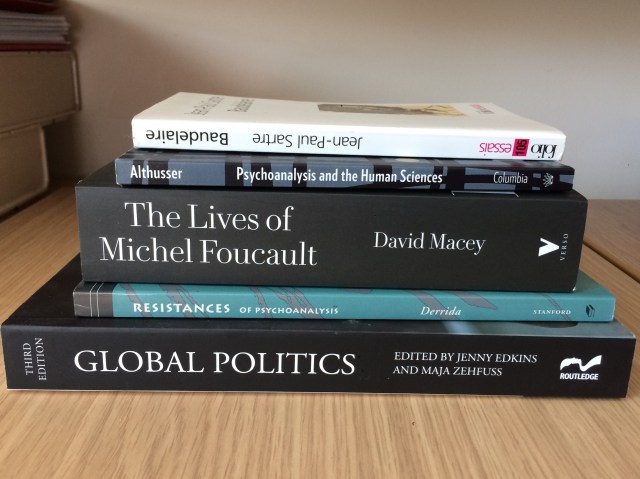
Three books for the Foucault work; the new edition of David Macey’s The Lives of Michel Foucault, with an afterword by me, and the third edition of Jenny Edkins and Maja Zehfuss, Global Politics. The last has a chapter from me on territory, and the whole book is fully updated.

Posted in Jacques Derrida, Jean-Paul Sartre, Jenny Edkins, Louis Althusser, Maja Zehfuss, Michel Foucault, My Publications, Territory, The Early Foucault, Uncategorized | Leave a comment

Society and Space book series – Adams, Circulation and Urbanization and Beer, The Data Gaze

ss.jpg

Finally got series editor copies of the two new books in the Society and Space book seriesDavid Beer, The Data Gaze: Capitalism, Power and Perception and Ross Exo Adams, Circulation and Urbanization. Both highly recommended, of course!

More details on the series can be found here. Previously published titles are

Dan Bulley, Migration, Ethics and Power: Spaces Of Hospitality In International Politics

Marcus Doel, Geographies of Violence: Killing Space, Killing Time

Francisco Klauser, Surveillance and Space

Forthcoming titles include:

Shiloh Krupar and Greig Crysler, The Waste Complex: Capital \ Ecology \ Citizenship

Martina Tazzioli, The Making of Migration

Kirsten Simonsen and Lasse Koefoed, Geographies of Embodiment

If you’d like to discuss an idea for the series, please get in contact. While the books are not textbooks, they do need to be suitable for teaching, with a good possibility of adoption. Here’s the series description:

The Society and Space series explores the fascinating relationship between the spatial and the social. Each title draws on a range of modern and historical theories to offer important insights into the key cultural and political topics of our times, including migration, globalisation, race, gender, sexuality and technology. These stimulating and provocative books combine high intellectual standards with contemporary appeal for students of politics, international relations, sociology, philosophy, and human geography.


Posted in Society and Space, Uncategorized | Leave a comment

Books received – Althusser, Koyré and Lemke

Books received.jpg

Copies of some older Althusser and Koyré books, along with the more recently published Que Faire? and the English translation of Thomas Lemke, Foucault’s Analysis of Modern Governmentality: A Critique of Political Reason.

Posted in Louis Althusser, Michel Foucault, Uncategorized | Leave a comment

Stuart Elden, Canguilhem – Polity Key Contemporary Thinkers series, now published

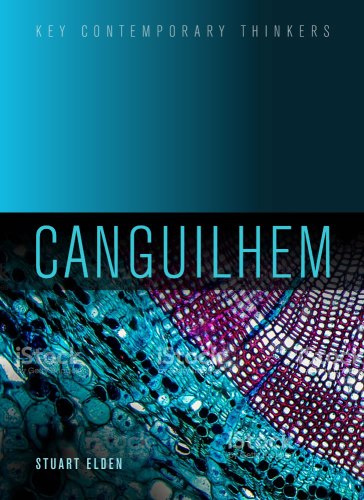
Canguilhem coverMy study of George Canguilhem for Polity’s Key Contemporary Thinkers series is now released in the UK in both hardback and paperback. It should be available in North America and worldwide over the next couple of months. [Update April 23 – now available worldwide]

Although it is coming out very shortly after Shakespearean Territories, the manuscripts were actually submitted about a year apart – Polity are much faster at getting books through production.

Georges Canguilhem (1904-95) was an influential historian and philosopher of science, as renowned for his teaching as for his writings. He is best known for his book The Normal and the Pathological, originally his doctoral thesis inmedicine, but he also wrote a thesis in philosophy on the concept of the reflex, supervised by Gaston Bachelard. He was the sponsor of Michel Foucault’s doctoral thesis on madness. However, his work extends far beyond what is suggested by his association with these thinkers. Canguilhem also produced a series of important works on the natural sciences, including studies of evolution, psychology, vitalism and mechanism, experimentation, monstrosity and disease.
Stuart Elden discusses the whole of this important thinker’s complex work, including recently rediscovered texts and archival materials. Canguilhem always approached questions historically, examining how it was that we came to a significant moment in time, outlining tensions, detours and paths not taken. The first comprehensive study in English, this book is a crucial guide for those coming to terms with Canguilhem’s important contributions, and will appeal to researchers and students from a range of fields.

‘The patience, clarity and erudition we expect of Stuart Elden’s books are on full display in this exceptional work. More than a simple introduction, Canguilhem enables readers to see the outlines, stakes and details of the works of an important thinker.’
John Protevi, Louisiana State University

‘This impressive and meticulously researched volume which includes a wealth of references to archival material provides the first comprehensive introduction in English to a figure recognized as a seminal influence by postwar French thinkers, including Foucault and Althusser.’
Clare O’Farrell, Queensland University of Technology

Posted in Canguilhem (book), Gaston Bachelard, Georges Canguilhem, Michel Foucault, Uncategorized | 3 Comments

Monstrous Ontologies. Politics, Ethics, Materiality – Roehampton, 1 July 2019

One-day Symposium at the Department of Social Sciences, University of Roehampton, London the 1st of July 2019

We invite you to a one-day symposium on Monstrous Ontologies. Politics, Ethics, Materiality at the Department of Social Sciences, University of Roehampton, London, the 1st of July 2019.
The intention is to provoke participants to think and engage with monstrosity as not a mere cultural construct of the ‘other’ (to be deconstructed), but an ontological reality that require to be faced (speculatively, politically, and ethically) in its complex and really-existent materiality.

The scope of the symposium is widely trans-disciplinar, welcoming contributions, from sociological, legal, geographical, psychological, philosophical, political and cultural studies, as well as from the arts. The symposium will compile the research papers presented into a book to be published in 2020.

We expect to receive a 250-word abstract by 1 March 2019 (send to Caterina.Nirta@roehampton.ac.uk or andrea.pavoni@iscte-iul.pt).

Monstrous Ontologies. Politics, Ethics, Materiality

Fantastic animals, evil criminals, notorious neighbourhoods, mysterious objects, invisible ideologies, unspoken laws: monstrosity can take different shapes, crossing the boundaries between the visible and the thinkable, reality and imagination, human and nonhuman, as an uncanny atmosphere always on the verge of being materialised and individualised in the monsters that populate collective imagination, biological taxonomies, legal discourses, and moral panics. Contemporary critical thought has done much to frame monstrosity as reflecting the cultural anxieties of the contexts from which it is drawn. Accordingly, much of its wider significance has been located in the affective impact and emotional salience of monsters: the ability to become fearsome, to provoke feelings of disgust, but also to agglomerate desire around a not fully-explored alterity, and create curiosity towards their embodied transgression. Insofar as a purely cultural construction depending on the transgression of given (social, cultural, moral, biological) norms, monstrosity has been critically demystified, by challenging its insidious categorisations of the other (species, body, race, gender) as monstrous. While, as the current climate forcefully shows, it is necessary to challenge these monstrous otherings and their perverse socio-political effects, we do contest the consequent reduction of monstrosity to a mere cultural construction of the other. Against this dialectical definition, we do claim that monstrosity is not a merely epistemological construct, but that it has an ontological reality.

There is a more that the monster embodies and communicates, a monstrous excess that materially resists being ingested within an order (it is this very resistance that is unbearably shown and viscerally exposed by the disgust the monster elicits), and yet cannot be placed in a negative, dialectical opposition to that order either. Reason, Language, Law, Science and other conceptual mechanisms do not simply produce monsters (as their dialectical counter-part), they rather capture, domesticate and naturalise them within their own system, denying their monstrous excess. As George Canguilhem suggests, the sleep of reason does not generate monsters: it liberates them. While monsters may be said to be the end product of discursive rhetorics, normative pressure, and bio-political apparatuses, we suggest monstrosity to be inherently excessive to them. As such, understanding monstrosity means to radically challenge not only the (legal, social, political) categories we use, but also the very mechanisms of categorisation through which reality is framed and acted upon. Here lies the profound ethical and political dimension that monstrosity forces us to acknowledge, one that cannot be unfolded by merely deconstructing monstrosity, and requires facing its uncomfortable, appalling, and revealing materiality. This is the challenge this symposium addresses, encouraging participants to do so by engaging with questions such as (but not limited to):

• What makes a monster a monster?
• What is the material reality of monstrosity?
• What is the advantage of approaching monstrosity ontologically?
• What would a monstrous ethics look like?
• What is the political potential of a monstrous ethics?
• Human, nonhuman, inhuman monsters.
• Monsters, fear and the politics of affect.
• Invisible monsters: atmospheres, ideologies, structures.
• Is gender monstrous?
• Monstrosity, violence, resistance

Organisers
Caterina Nirta, University of Roehampton
Andrea Pavoni, DINAMIA’CET, ISCTE-IUL, University Institute of Lisbon

Posted in Uncategorized | 1 Comment

Books received – Yusoff, Foucault, Koyré, Althusser, Kantorowicz

Books received

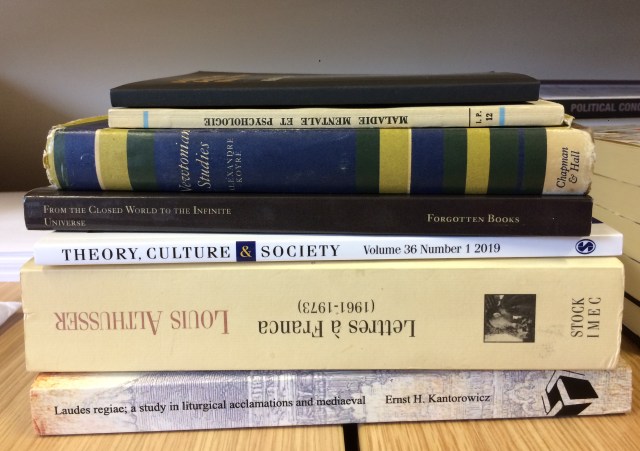
Some books that arrived while I was away – Kathryn Yusoff, A Billion Black Anthropocenes or None; a copy of Foucault’s Maladie mental et psychologie; Alexandre Koyré’s Newtonian Studies and From the Closed World to the Infinite Universe; the latest issue of Theory, Culture and Society; Louis Althusser’s Lettres à Franca; and Ernst KantorowiczLaudes Regiae.

Kathryn’s book was sent by University of Minnesota Press. Here’s the description:

Kathryn Yusoff examines how the grammar of geology is foundational to establishing the extractive economies of subjective life and the earth under colonialism and slavery. She initiates a transdisciplinary conversation between black feminist theory, geography, and the earth sciences, addressing the politics of the Anthropocene within the context of race, materiality, deep time, and the afterlives of geology.

Posted in Ernst Kantorowicz, Louis Althusser, Michel Foucault, Uncategorized | Leave a comment

“Shakespearean Landscapes”, Fourth Denis Cosgrove Lecture in the GeoHumanities, British Academy, 23 May 2019

I am delighted to have been invited to give the fourth Denis Cosgrove Lecture in the GeoHumanities. The lecture is organised by the Royal Holloway Centre for the GeoHumanities, and will take place at the British Academy in London, on 23 May 2019 at 6pm.

I didn’t know Denis well, but I was a visiting professor at UCLA in 2006, while he was teaching there. The 2018 lecture was given by the art historian Joan Schwartz (Queens, Canada), the 2017 lecture by performance scholar and practitioner Dee Heddon (Glasgow), and the 2016 lecture by Jerry Brotton (QMUL). It’s a real honour to be asked.

As was requested, the topic will related to my work on Shakespeare, but while I will draw on my previous work in Shakespearean Territories I do plan to develop some further ideas. The title I’ve given the organisers is “Shakespearean Landscapes”, which naturally connects to some of Denis’s best-known work.

This lecture explores how Shakespeare’s plays evoke a sense of landscape. Shakespeare’s grasp of specific geographies could be shaky, but his plays are rich with a range of geographical themes, language and detail. Shakespeare lived and wrote at a time of colonial exploration and saw the development of many cartographic, navigational and land-measuring techniques. The lecture builds on the argument of my recent book, Shakespearean Territories, but explores a different yet related geographical theme – that of landscape. This is of course a theme which Denis Cosgrove examined so perceptively. The plays discussed will include some of Shakespeare’s most famous, such as Macbeth and King Lear, and lesser known ones including Timon of Athens.


Posted in Shakespearean Territories, Uncategorized, William Shakespeare | Leave a comment