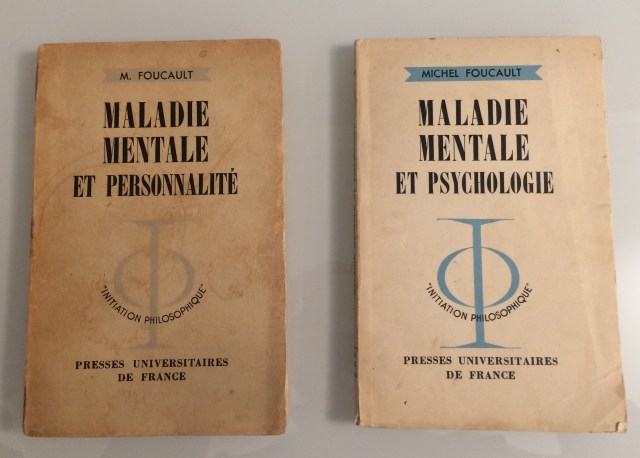
The changes between Foucault’s Maladie mentale et personnalité (1954) and Maladie mentale et psychologie (1962)


MMpe-MMPs.JPG

Maladie mentale et personnalité (1954) and Maladie mentale et psychologie (1962)

As mentioned in the last update on my research for The Early Foucault, I have done a comparison of the 1954 text Maladie mentale et personnalité and the 1962 Maladie mentale et psychologie.

The full analysis can be found here.

Foucault tried to prevent the reissue of the book, following the success of Folie et déraison: Histoire de la folie à l’âge classique (1961), but was unable to do so. Instead, he revised the text and changed its title.

The usual way of describing the changes is that Foucault lightly revises the Introduction and first half (chapters 1-4) and provides a new second half (chapters 5-6) and Conclusion. But the second part does make use of the original: Foucault revises the introduction to the second part, writes a new fifth chapter, uses about half of the original fifth chapter in his new sixth one, with some new material, and drops the original chapter six. He then writes a new conclusion in place of the original. The English translation is of the 1962 edition, which is the only one still in print in France.

The changes are important in tracking how Foucault’s thought developed between 1954 and 1962. A discussion of each book and what the changes mean will be in The Early Foucault. But the raw material for a comparative analysis is here. I’d welcome any corrections or additions to what I’ve done, and I do hope someone finds it useful.

There are lots of other resources on this site relating to Foucault – bibliographies, audio files, some short translations, some more textual comparisons, etc.

Posted in Michel Foucault, The Early Foucault, Uncategorized | Leave a comment

Anthony King, Command: The Twenty-First Century General – CUP, 2019

9781108700276Just published by my Warwick colleague Anthony King, Command: The Twenty-First Century General – Cambridge University Press, 2019

In the wake of the troubled campaigns in Afghanistan and Iraq, military decision-making appears to be in crisis and generals have been subjected to intense and sustained public criticism. Taking these interventions as a starting point, Anthony King examines the transformation of military command in the twenty-first century. Focusing on the army division, King argues that a phenomenon of collective command is developing. In the twentieth century, generals typically directed and led operations personally, monopolising decision-making. They commanded individualistically, even heroically. As operations have expanded in range and scope, decision-making has multiplied and diversified. As a result command is becoming increasingly professionalised and collaborative. Through interviews with many leading generals and vivid ethnographic analysis of divisional headquarters, this book provides a unique insight into the transformation of command in western armies.

  • Includes interviews with some of the most prominent generals of the current era (such as James Mattis, David Petraeus and Nick Carter)
  • Contains a highly original and detailed ethnography of the divisional headquarters, based on extensive fieldwork
  • Includes historical research back to the First World War of both counter-insurgency and conventional operations
  • Presents international comparisons of the major western powers (France, Germany, UK and US)

‘A timely study of the transformation of military command from the realm of individual genius to a more collective and participatory style better suited to today’s multifaceted organizations, global distances, and complex environments. King argues that twenty-first century generalship requires not just heroic leadership and tactical brilliance, but the ability to establish networks and empower subordinates in a more collaborative model tuned to the realities of the information age. A controversial argument that is highly recommended reading for military officers and defense policy makers.’ Peter R. Mansoor, author of Surge: My Journey With General David Petraeus and the Remaking of the Iraq War

‘This book is bound to become a core text on contemporary military command. By focusing on the divisional structure Anthony King is able to chart the move from traditional individualistic and hierarchical approaches to a more professional and collectivist approach. This is done using examples of military success and failure, from Monash to Mattis, and from conventional battles to counterinsurgency.’ Lawrence Freedman, Emeritus Professor of War Studies, King’s College London

‘A fascinating study of the evolution of military command over the past century, explaining how and why many of the challenges of command today are different. Highly recommended – not least for twenty-first-century generals and those who aspire to be.’ John Kiszely, Retired Lieutenant General and author of Anatomy of a Campaign. The British Fiasco in Norway, 1940

‘No one gives a better inside view of what goes on in a combat headquarters than Anthony King. His fieldwork in the Afghanistan War is set against the background of heroic generals in the World Wars, the growth of administrative bureaucracy in WWII, and the shift to counterinsurgency midway through the Iraq War. Throughout, King discerns a growing trend to program combat decisons in a collective of headquarters officers. Apart from the usual studies of generals’ strategies and heroism, King shows how generals have actually commanded their divisions in daily action. On a new level of sociological sophistication, King shows the lifeworld of command – the mesh of individual leaders with the organization that enables and constrains them.’ Randall Collins, author of Civil War Two

Posted in Uncategorized | Leave a comment

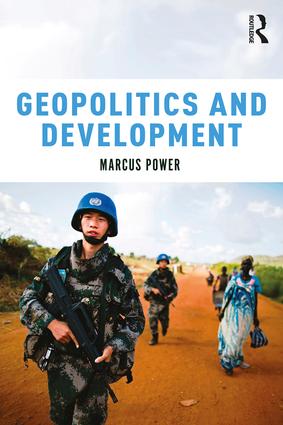
Marcus Power, Geopolitics and Development – Routledge, 2019

Now published – Marcus Power, Geopolitics and Development

stuartelden's avatarProgressive Geographies

9780415519571Marcus Power, Geopolitics and Development – Routledge, 2019

Unlike many Routledge titles, pleased to see this will be in paperback immediately.

Geopolitics and Development examines the historical emergence of development as a form of governmentality, from the end of empire to the Cold War and the War on Terror. It illustrates the various ways in which the meanings and relations of development as a discourse, an apparatus and an aspiration, have been geopolitically imagined and enframed.

The book traces some of the multiple historical associations between development and diplomacy and seeks to underline the centrality of questions of territory, security, statehood and sovereignty to the pursuit of development, along with its enrolment in various (b)ordering practices. In making a case for greater attention to the evolving nexus between geopolitics and development and with particular reference to Africa, the book explores the historical and contemporary geopolitics of foreign aid, the interconnections…

View original post 115 more words

Posted in Uncategorized | Leave a comment

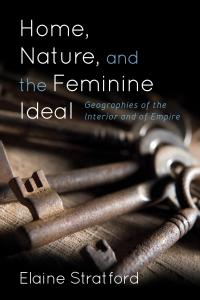
Elaine Stratford, Home, Nature, and the Feminine Ideal: Geographies of the Interior and of Empire – Rowman, January 2019

Elaine Stratford, Home, Nature, and the Feminine Ideal: Geographies of the Interior and of Empire, Rowman, January 2019 – now published

stuartelden's avatarProgressive Geographies

5b46ee7ef5ba74183c269bfd.jpgElaine Stratford, Home, Nature, and the Feminine Ideal: Geographies of the Interior and of Empire – Rowman International, January 2019.

Take three things: the home, nature, and the feminine ideal—a notional and perfected femininity. Constitute them as inexorably and universally connected. Enrol them in diverse strategies and tactics that create varied anatomo-politics of the body and biopolitics of the population. Enlist those three things as the “handmaidens” of the government of individuals and groups, places and spaces, and comings and goings. Focus some effort on the periodical press, and on producing and disseminating narratives, discourses, and practices that relate specifically to health and well-being. Deploy those texts and shape those contexts in ways that affect flesh and bone, psychology and social conduct, and the spatial organization and relational dynamics of dwellings and streets, settlements and regions, and states and empires. Stretch these activities over the Anglophone world—from the epicentres of…

View original post 84 more words

Posted in Uncategorized | Leave a comment

Stuart Hall, Essential Essays (Two-volume set): Foundations of Cultural Studies & Identity and Diaspora, edited by David Morley, Duke UP 2019

Hall.jpgStuart Hall, Essential Essays (Two-volume set): Foundations of Cultural Studies & Identity and Diaspora, edited by David Morley, Duke University Press, 2019

Volumes 1 and 2 of Stuart Hall’s Essential Essays are available as a set

From his arrival in Britain in the 1950s and involvement in the New Left, to founding the field of cultural studies and examining race and identity in the 1990s and early 2000s, Stuart Hall has been central to shaping many of the cultural and political debates of our time. Essential Essays—a landmark two volume set—brings together Stuart Hall’s most influential and foundational works. Spanning the whole of his career, these volumes reflect the breadth and depth of his intellectual and political projects while demonstrating their continued vitality and importance.

Volume 1: Foundations of Cultural Studies focuses on the first half of Hall’s career, when he wrestled with questions of culture, class, representation, and politics. This volume’s stand-out essays include his field-defining “Cultural Studies and Its Theoretical Legacies;” the prescient “The Great Moving Right Show,” which first identified the emergent mode of authoritarian populism in British politics; and “Encoding and Decoding in the Television Discourse,” one of his most influential pieces of media criticism. As a whole, Volume 1 provides a panoramic view of Hall’s fundamental contributions to cultural studies.

Volume 2: Identity and Diaspora draws from Hall’s later essays, in which he investigated questions of colonialism, empire, and race. It opens with “Gramsci’s Relevance for the Study of Race and Ethnicity,” which frames the volume and finds Hall rethinking received notions of racial essentialism. In addition to essays on multiculturalism and globalization, black popular culture, and Western modernity’s racial underpinnings, Volume 2 contains three interviews with Hall, in which he reflects on his life to theorize his identity as a colonial and diasporic subject.

Posted in Stuart Hall, Uncategorized | 1 Comment

New Perspectives Vol 26 No 3 out – focus on ‘Post-Truth’ and Politics

New Perspectives Vol 3, 2018 – open access here

Post-Truth-Telling in IR
We break new ground in this issue of New Perspectives with an extensive co-edited special section on ‘Post-Truth’ and its relevance for politics and international relations. As Editor-in-Chief, I have been delighted to share the editing duties – and the authorship of the editorial – with Nick Michelsen of Kings College. It’s been a rich and rewarding collaboration that began in a chance conversation back at ISA 2017 in Baltimore, continued with a high-profile roundtable at ISA 2018 in San Francisco, some low-profile drinks at at the wonderful Gordons Wine Bar in London, and now comes to fruition in this issue of the journal. I’m delighted with how this has turned out and to have such a wonderful array of scholarship – and scholars – in the journal. We present post-truth (and its implications) as seen from the various perspectives of Arendtian ethical politics, critical realism, post-universal international justice, trust and the return of agency as well as the history, and future, of IR as a discipline engaged in or disengaged from the (post-truth) world.

This is one of the first extended, multi-perspectival academic engagements with post-truth and as well as showcasing cutting edge thinking on this hot topic, it will make a wonderful teaching resource in and beyond IR.

It is, therefore, my proud duty as editor of the journal to thank Colin Wight, Kjersti Lohne, Ari-Elmeri Hyvönen, Hannah Marshall and Alena Drieschova, Dagmar Rychnovská and Martin Kohut for their stellar contributions to the special section – and to welcome Nick Michelsen to our Associate Editor team on a permanent basis.

Posted in Uncategorized | Leave a comment

Bruno Latour interviewed in Artnet

Bruno Latour interviewed in Artnet (via Graham Harman)

Posted in Bruno Latour, Graham Harman, Uncategorized | 3 Comments

David Beer, The Data Gaze, reviewed at LSE Review of Books

92857_9781526436924David Beer, The Data Gaze (Sage 2018, Society and Space series) is reviewed at LSE Review of Books by Ignas Kalpokas.

It can by now be taken as a given that ‘data’ or, more precisely, ‘big data’ (often even capitalised to reflect its importance), has come to define today’s society. In fact, as David Beer suggests in this book, we are permanently put under ‘the data gaze’ that extracts, analyses and predicts key variables that are taken to define our world in increasingly granular detail, down to the level of the individual. In this timely and important book, Beer aims to shed light not only on how datafied visibility takes place, but also on how it is seen to act because this imaginary is key to the self-legitimation of the data analytics industry. [continues here]

Posted in Uncategorized | Leave a comment

Sun-Young Park, Ideals of the Body: Architecture, Urbanism, and Hygiene in Postrevolutionary Paris – U Pittsburgh Press, 2018

9780822945284-380x542.jpgSun-Young Park, Ideals of the Body: Architecture, Urbanism, and Hygiene in Postrevolutionary Paris – University of Pittsburgh Press, 2018

Modern hygienic urbanism originated in the airy boulevards, public parks, and sewer system that transformed the Parisian cityscape in the mid-nineteenth century. Yet these well-known developments in public health built on a previous moment of anxiety about the hygiene of modern city dwellers. Amid fears of national decline that accompanied the collapse of the Napoleonic Empire, efforts to modernize Paris between 1800 and 1850 focused not on grand and comprehensive structural reforms, but rather on improving the bodily and mental fitness of the individual citizen. These forgotten efforts to renew and reform the physical and moral health of the urban subject found expression in the built environment of the city—in the gymnasiums, swimming pools, and green spaces of private and public institutions, from the pedagogical to the recreational. Sun-Young Park reveals how these anxieties about health and social order, which manifested in emerging ideals of the body, created a uniquely spatial and urban experience of modernity in the postrevolutionary capital, one profoundly impacted by hygiene, mobility, productivity, leisure, spectacle, and technology.

We know quite a bit about the physical signatures of urban “modernity” foisted upon Paris by Baron Haussmann in the late nineteenth century — the broad boulevards, networked infrastructures, connected apartment houses, and assorted monuments — but little scholarship has seized on its precursors in the half-century prior. In Ideals of the Body: Architecture, Urbanism, and Hygiene in Postrevolutionary Paris(University of Pittsburgh Press, 2018), Sun-Young Park turns to another modernity, recovering a daunting array of Romantic and especially post-Napoleonic interventions — less spectacular but arguably more complex — on mobile Parisian bodies and the everyday spaces that host them. Park considers military gymnasia, schools, barracks, leisure gardens, and other spaces purpose-built to inculcate vigor in both individuated physical bodies and, their proponents hoped amid specters of national decline, in the French body politic. Each of these spaces, Park shows, a “threshold” between fully private and fully public realms, helped install — albeit imperfectly — its own “ideal” of the sanitized and gendered human subject. Ideals of the Body is a detailed, visually rich, theoretically motivated study in urban and architectural history, one that just might realign how we periodize and make sense of urban modernity writ large.

Posted in Uncategorized, urban/urbanisation | Leave a comment

‘Imagining a territory. The construction and representation of territory in late medieval Europe’ (Workshop, Amsterdam, 18-19 January 2019)

A report on what sounds like a really interesting conference on territory in late Medieval Europe.

Kim Overlaet's avatarImagined territories

A report by Bente Marschall and Bastiaan Van den Akker

On the 18th and 19th of January 2019, the University of Amsterdam (UvA) hosted a workshop titled ‘Imagining a territory. The construction and representation of territory in late medieval Europe’. The premise of the workshop organised by the ‘Imagining a territory’ project (NWO/ UvA)was the fluidity and multiplicity of the concept of territory in a period before the availability of accurate scale maps, and before the use of this concept in secular political thought and practice. Scholars were invited to discuss the ways in which this modern concept can be used as an analytical tool in medieval studies. By using administrative, cartographic, heraldic, narrative and military sources for specific geographical and historical case studies, all participants have presented inspiring perspectives on the dynamics between the construction, maintenance and representations of late medieval territories and territorial affiliations, and as such contributed…

View original post 1,746 more words

Posted in Uncategorized | Leave a comment