A damning genealogy of modern personhood and a bold vision for a new ethics rooted in belonging rather than individuality.
In the face of ecological crisis, economic injustice, and political violence, the moral demands of being a good person are almost too much to bear. In Unbecoming Persons, Ladelle McWhorter argues that this strain is by design. Our ideas about personhood, she shows, emerged to sustain centuries of colonialism, slavery, and environmental destruction. We must look elsewhere to find our way out.
This history raises a hard question: Should we be persons at all, or might we live a good life without the constraints of individualism or the illusion of autonomy? In seeking an answer, McWhorter pushes back on the notion of our own personhood—our obsession with identity, self-improvement, and salvation—in search of a better way to live together in this world. Although she finds no easy answers, McWhorter ultimately proposes a new ethics that rejects both self-interest and self-sacrifice and embraces perpetual dependence, community, and the Earth
The Ottoman Empire’s collapse at the end of the First World War is often treated as a foregone conclusion. It was only a matter of time, the story goes, before the so-called Sick Man of Europe succumbed to its ailments—incompetent management, nationalism, and ethnic and religious conflict. In The War That Made the Middle East, Mustafa Aksakal overturns this conventional narrative. He describes how European imperial ambitions and the Ottoman commitment to saving its empire at any cost—including the destruction of the Armenian community and the deaths of more than a million Ottoman troops and other civilians—led to the empire’s violent partition and created a politically unstable Middle East.
The War That Made the Middle East shows that, until 1914, the Ottoman Empire was a viable multiethnic, multireligious state, and that relations between the Arabs, Jews, Muslims, and Christians of Palestine were relatively stable. When war broke out, the Ottoman government sought an alliance with the Entente but was rejected because of British and French designs on the Eastern Mediterranean. After the Ottomans entered the fight on the side of Germany and were defeated, Britain and France seized Ottoman lands, and new national elites in former Ottoman territories claimed their own states. The region was renamed “the Middle East,” erasing a robust and modernizing 600-year-old empire.
A sweeping narrative of war, great power politics, and ordinary people caught up in the devastation, The War That Made the Middle East offers new insights about the Great War and its profound and lasting consequences.
In Resurrecting the Past, Sarah Griswold shows how the Levant became a crucial front in a post-1918 fight over the French past—a contingent and contradictory but always hard-charging struggle over a forgotten “heritage mandate.” Many scholars, clergy, pundits, politicians, and investors perceived the moment Allied forces entered Jerusalem in December 1917 to be a once-in-a-lifetime opportunity to expand French influence, evoking the vision of a new colony in the territory: a French Levant. But what transpired for the French state in the Levant after World War I, and why does that ill-conceived venture still matter today?
Resurrecting the Past investigates how heritage politics led to a new form of empire—a French mandate for Syria and Lebanon—and with it a tide of regional and international critique. Against such opposition, the heritage mandate leaned heavily on spectacle and science, generating a sprawling set of sites and objects—Ottoman mansions, crusader castles, Umayyad mosques, Roman arches, buried synagogues, and Sumerian ziggurats.
As Griswold traces how French heritage efforts cycled through multiple ideal pasts in the Levant from 1918 to 1946, she reveals how each one, though grounded in realities, also complicated those constructs and the work of French heritage-makers. Resurrecting the Past offers a parable of how efforts in heritage politics aimed to construct a union of ideologies and objects deemed the best past for France’s uncertain future but struggled as much as they succeeded. Eventually those same heritage politics ironically helped officials justify the end of the “French Levant.”
In this timely and impactful contribution to debates over the relationship between politics and storytelling, Lee Manion uncovers the centrality of narrative to the European concept of sovereignty. In Scottish and English texts traversing the political, the legal, the historiographical, and the literary, and from the medieval through to the early modern period, he examines the tumultuous development of the sovereignty discourse and the previously underappreciated role of narratives of recognition. Situating England and Scotland in a broader interimperial milieu, Manion shows how sovereignty’s hierarchies of recognition and stories of origins prevented more equitable political unions. The genesis of this discourse is traced through tracts by Buchanan, Dee, Persons, and Hume; histories by Hardyng, Wyntoun, Mair, and Holinshed; and romances by Malory, Barbour, Spenser, and Melville. Combining formal analysis with empire studies, international relations theory, and political history, Manion reveals the significant consequences of literary writing for political thought.
Of profound consequence for our understanding of European politics both in the past and today, uncovering the reliance of medieval and early modern sovereignty claims on both real and fictional historical narratives
Demonstrates how the concept and act of recognition was and still is crucial for producing authority, inviting renewed, interdisciplinary critical analysis of recognition across its political, legal, ethical, social, and literary registers
Reveals how literary texts actively participated in and often critiqued sovereignty discourse, unearthing innovative contributions of imaginative writing to political debate that have been obscured by modern disciplinary divisions
Shows how premodern kingdoms such as Scotland and England operated as empires in an inter-imperial milieu, locating Scotland and England within a larger history of European imperialism
In Pierre Bourdieu’s Political Economy of Being, Ghassan Hage explores the great French social theorist’s work and revitalizes conventional and undertheorized aspects of his thinking. Hage focuses on Bourdieu’s concern with social being and what constitutes a worthwhile and fulfilling life. Such a life is not something that one either has or does not have; rather, society distributes and assigns values to ways of living. These values are structured by relations of power and domination and are subject to the outcome of political conflicts. Hage elucidates this political economy of being by reworking Bourdieu’s key concepts of habitus, illusio, symbolic capital, and field. In this political economy, people enjoy a worthwhile life to the degree that they are able to orient and deploy themselves practically in the world that surrounds them, have a sense of purpose, and achieve a level of social recognition. For Hage, the project of theorizing and understanding how people struggle to define, legitimize, and live a viable life in the face of symbolic domination permeates all of Bourdieu’s work.
At the close of the 1970s, government treasuries and central banks took a vow of perpetual self-restraint. To this day, fiscal authorities fret over soaring public debt burdens, while central bankers wring their hands at the slightest sign of rising wages. As the brief reprieve of coronavirus spending made clear, no departure from government austerity will be tolerated without a corresponding act of penance.
Yet we misunderstand the scope of neoliberal public finance if we assume austerity to be its sole setting. Beyond the zero-sum game of direct claims on state budgets lies a realm of indirect government spending that escapes the naked eye. Capital gains are multiply subsidized by a tax system that reserves its greatest rewards for financial asset holders. And for all its airs of haughty asceticism, the Federal Reserve has become adept at facilitating the inflation of asset values while ruthlessly suppressing wages. Neoliberalism is as extravagant as it is austere, and this paradox needs to be grasped if we are to challenge its core modus operandi.
Melinda Cooper examines the major schools of thought that have shaped neoliberal common sense around public finance. Focusing, in particular, on Virginia school public choice theory and supply-side economics, she shows how these currents produced distinct but ultimately complementary responses to the capitalist crisis of the 1970s. With its intellectual roots in the conservative Southern Democratic tradition, Virginia school public choice theory espoused an austere doctrine of budget balance. The supply-side movement, by contrast, advocated tax cuts without spending restraint and debt issuance without guilt, in an apparent repudiation of austerity. Yet, for all their differences, the two schools converged around the need to rein in the redistributive uses of public spending. Together, they drove a counterrevolution in public finance that deepened the divide between rich and poor and revived the fortunes of dynastic wealth.
Far-reaching as the neoliberal counterrevolution has been, Cooper still identifies a counterfactual history of unrealized possibilities in the capitalist crisis of the 1970s. She concludes by inviting us to rethink the concept of revolution and raises the question: Is another politics of extravagance possible?
Jacques Derrida, Given Time II, eds. Laura Odello, Peter Szendy and Rodrigo Therezo, trans. Geoffrey Bennington and Peggy Kamuf – University of Chicago Press, March 2026
The long-awaited conclusion to Derrida’s seminar on the gift and time.
In 1991, Jacques Derrida published the first half of a seminar delivered from 1978 to 1979 on gifts and time, but the second installment (though expected) was not completed in his lifetime. Given Time II completes the seminar with eight sessions that showcase Derrida’s most advanced work on the problematic of the gift in Heidegger, with deep dives into some of the most difficult texts in the Heideggerian corpus, including “The Origin of the Work of Art,” “The Thing,” and “On Time and Being.”
Beyond Heidegger, Derrida engages Claude Lévi-Strauss, Marcel Mauss, Maurice Blanchot, Jacques Lacan, and others on the act of giving and receiving, the sacrificial gift, and more. Throughout, Derrida identifies a paradox of gift giving: for the gift to be received as a gift, it must not appear as such, since gifts often involve a cycle of debt and repayment. Given Time II is a uniquely Derridean treatment of an important subject in the work of Heidegger and beyond.
Fresh perspectives on how medical texts, broadly construed, were recorded, perceived and utilised.
The past few decades have witnessed significant shifts in the scholarly investigation of early medieval medicine and its texts, moving far beyond outdated stereotypes of stagnation and superstition, not least via close study of the manuscript evidence, which has enabled a better appreciation of the processes involved in the recording and transfer of medical knowledge and healing practices. This book builds on these recent developments. With a particular focus on transmission, translation and transformation, the essays collected here offer detailed explorations of sources, contexts, producers and uses, examining material ranging from Bald’s Leechbook and continental Latin recipe collections to Old Norse sagas and a Byzantine Greek treatise on venomous animals (Book V of Paul of Aegina’s Pragmateia). Several contributors explore Old English’s multifarious connections with the Latin tradition, discussing charms, obstetric and gynaecological texts, as well as the Peri didaxeon. The volume concludes with an afterword by Peregrine Horden on future directions of study, inviting further research into this vibrant and growing field.
Chapter 3 is available as Open Access under the Creative Commons licence CC BY-NC-ND. The article received funding from the European Research Council (ERC) under the European Union’s Horizon 2020 research and innovation programme (grant agreement no. 101018645.
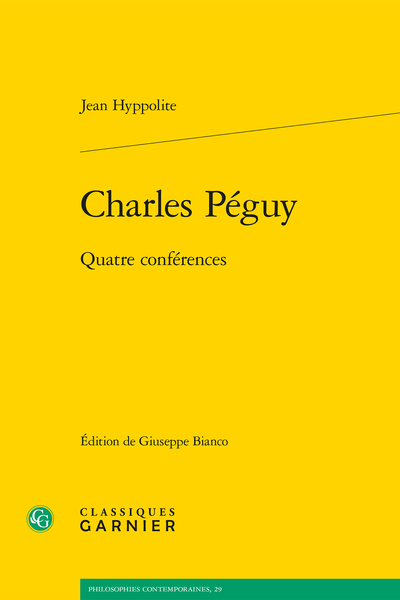
En 1954, Jean Hyppolite, professeur d’histoire de la philosophie à la Sorbonne, donne ces quatre conférences au Centre européen universitaire de Nancy. Il s’agit du seul travail qu’Hyppolite a consacré à l’auteur de Clio, et l’une des rares lectures philosophiques de Péguy.
In 1954, Jean Hyppolite, professor of the history of philosophy at the Sorbonne, gave these four lectures at the European University Center in Nancy. This is the only work Hyppolite devoted to the author of Clio, and all in all a rare philosophical reading of Péguy.
In May 1978, Foucault edited the memoir of a “hermaphrodite”, Herculine Barbin, for publication. In the dossier of documents appended to that text he says that “the question of strange destinies like these and which posed such problems for medicine and law since the sixteenth century will be treated in the volume of the History of Sexuality that will be devoted to hermaphrodites” (French p. 131, English p. 119).
That volume was never published. It was not listed in the original 1976 plan of future volumes, as outlined on the back cover of the first volume and elsewhere; nor was it in the final list of volumes announced in volumes two and three in 1984. In 1976 Foucault had promised a volume on Les Pervers – perverts or the perverse – which may have contained a discussion of these challenging bodies, but by 1978 he was talking of the book on hermaphrodites as a separate volume. This change must have happened around this time, because the listing in the 1977 preface to the German translation of the first volume, Sexualität und Wahrheit, which differs from the original French list, does not mention it.
In a posthumously published interview, from 29 May 1979 with Frank Mort and Roy Peters, Foucault is asked about the History of Sexuality series. He says he does not want to complete the five or six books originally envisioned, but has clearly not abandoned the project entirely. “Just now I am writing the second one about the Catholic Christian confessional, and also the third one on hermaphroditism” (“Foucault Recalled”, p. 12). Today, the term “hermaphrodite” is somewhat outdated as a reference to humans, and “intersex” is often used instead. But this is the term Foucault uses, referring to a range of historical cases, and I will follow his usage here. (For wider discussions, Alice Domurat Dreger, Hermaphrodites and the Medical Invention of Sex and Alex Sharpe, Foucault’s Monsters and the Challenge of Law are helpful.)
Foucault was asked to speak at a conference organised to commemorate 25 years of the homophile journal Arcadie in late May 1979, and chose to speak on the Barbin case. His paper did not appear in the proceedings, Le Regard des autres,published later that year. Instead, a short report previously published in the journal was included in its place. That report is cited by Didier Eribon in Michel Foucault et ses contemporains, and Foucault is reported as saying: “Pleasure is something which passes from one individual to another, it is not a secretion of identity. Pleasure has no passport, no identity card” (p. 271). This conference paper was developed into the introduction to the English translation of the Barbin memoir, dated to January 1980 (p. xvii), which was also published in French in Arcadie in November that year, and then reprinted in Dits et écrits in 1994. Eribon reports that André Baudry, founder of the journal, said Foucault did not want his original talk published in the proceedings, but wanted to continue working on it (Michel Foucault et ses contemporains, p. 272 n. 1).
It’s long been known that Foucault wrote another text on hermaphrodites, since the editors of Foucault’s 1974-75 course at the Collège de France, Les Anormaux, translated as Abnormal, had access to some unpublished material for their editorial work. In 1999 Valerio Marchetti and Antonella Salomoni say that a manuscript exists in Foucault’s papers. “To start with this manuscript seems to be the extension of the dossier on monsters. However, it soon becomes autonomous” (“Situation du cours”, p. 324; “Course Context”, p. 339). Foucault discusses hermaphrodites in that course, particularly in the lecture of 22 January 1975. The lecture discussed some cases, particularly Marie/Martin Lemarcis (or Le Marcis) and Anne/Jean-Baptiste Grandjean, which Foucault does not mention in the Introduction to the Barbin memoir.
The editors of the course say that in the lecture Foucault was drawing upon
a wide collection of data, bibliographies, and transcriptions preserved in a box file that we have been able consult thanks to the generosity of Daniel Defert, and which clearly indicate the plan of publication of an anthology of texts. The two cases inserted into the course Les Anormaux represent the most important emphases with regard to medico-legal discussion of bisexuality in the Modern Age (“Situation du cours”, p. 325; “Course Context”, p. 340).
As I discussed in Foucault’s Last Decadein 2016, though without access to unpublished material, there were several indications that Foucault wrote parts of different volumes of the original plan of the History of Sexuality, even if he published none of them. (I discussed this course’s analysis of hermaphrodites especially in Foucault’s Last Decade,pp. 12-14, and see pp. 50-51, 66; and much earlier with Sharon Cowan in “Words, Ideas, Desires”.) When I was researching and writing Foucault’s Last Decade, around 2013-15, there was very little unpublished material accessible in the archives. It was the work on the “Catholic Christian confessional”, originally on a much later period, which led Foucault further and further back to the early Church and then pagan antiquity. That research became the actually published volumes two, three in 1984 and – many years later – four. It’s not clear he would have returned to the earlier themes had he lived longer, though in 1983 he does suggest he might return to the material on the later church, saying to Hubert Dreyfus and Paul Rabinow he had “more than a draft of a book about sexual ethics in the sixteenth century” (Essential Works 1: Ethics, p. 255).
The Fonds Michel Foucault at the Collège de France is now fully available to researchers, and there are a lot of new documents to analyse. The other volumes of my series of books on Foucault made use of a lot of that material, including the texts from the 1950s and 1960s which have been published in recent years, but I’ve not systematically gone through the extensive manuscripts from the second half of the 1970s and the first half of the 1980s which are now available. Box 82 of the main fonds, NAF 28730, contains a manuscript on hermaphrodites, possibly initially planned to be a chapter within a volume on the perverse, but which seems to be at least the germ of the text Foucault mentions in 1978 and 1979. It seems the manuscript was put aside as the project shifted from a more thematic treatment of the subjects of sexuality to a more historical study that went back to early Christian texts and pagan antiquity.
This manuscript has now been published as a short book, Les Hermaphrodites. Though ultimately unfinished, it is a very interesting text by Foucault, even if his research took him in other directions and he seemingly never returned to it before his death. It is a short text of about 20,000 words, published with a similar amount of introductory and concluding material by the editors. Foucault’s text was written sometime between 1975 and 1978, as it connects to Les Anormaux and his publication of the case of Herculine Barbin. It postdates the lectures and predates the publication of the Barbin memoir, on the basis of textual evidence, as Arianna Sforzini indicates in her valuable introduction (p. 11).
This is the Foucault of Discipline and Punish or the first volume of the History of Sexuality, rather than the more austere and textual style of the later volumes. I know some people were disappointed that the fourth volume of the History of Sexuality was more like volumes two and three than volume one. This text is more like the mid-career work.It’s also quite a polished piece of writing – the editors say that as well as the manuscript, there is a typescript of quite a bit of the text (p. 41). Although the typescript has errors, its existence is a sign the writing was quite developed, since Foucault generally had texts typed only at a fairly late stage. Foucault provides quite a bit of detail on cases of hermaphrodites and the legal and medical discourse about them. It’s quite documentary, but it shows the shifts in understandings. Some of the cases are familiar from Les Anormaux, including Grandjean and Le Marcis; others are different. Foucault does not mention the Barbin case – presumably because it predates his discovery of that story.
A fuller discussion of all the implications of this text is beyond what I can do here, but I was particularly struck by the way Foucault relates these questions to notions of monstrosity and the fantastic, connecting his work, yet again, to that of Georges Canguilhem (pp. 53-54). Canguilhem’s discussion of monstrosity in Knowledge of Life Ch. 7 is one of Foucault’s references (on this, see Elden, Canguilhem, Ch. 6). There are also connections, not just to the History of Sexuality series, but to Foucault’s 1960s lectures on sexuality which were published and translated a few years ago, especially in relation to the discussions of biology. (For discussions of these lectures, see Moore and Elden, “Foucault’s 1960s Lectures on Sexuality” and The Archaeology of Foucault, Ch. 5.) It seems likely that in the discussions of biology he was reading his Collège de France colleague Étienne Wolff’s work too, especially Les Changements de sexeand La science des monstres.
The framing texts by Arianna Sforzini and Éric Fassin are really helpful. Sforzini situates the text within Foucault’s work, showing how it relates to other writings, and Fassin shows how it connects to debates in the more contemporary moment about sex, gender and sexuality. Fassin rightly notes that ‘gender’ is not a term used by Foucault, indicating that its use largely postdates his work (“Postface: Le sexe qui parle”, p. 134). Sforzini discusses both the archival traces and how they fit with published work. I know this period of Foucault’s career well, but I can imagine it would be even more useful for those who perhaps know just parts of the whole sexuality project. She also transcribes parts of another short text by Foucault, found in the same archival box (“Préface: Le chantier « hermaphrodite »”, pp. 32-33). Part of this text is very close to the report of the Arcadie conference:
Pleasure must be freed from the law of sexual identification. Why should the pleasure we experience be masculine or feminine… Pleasure happens, it passes between two, it flares and fades. It is event and invention. It is not the centre of an identity. Masculine/feminine pleasure: that makes no sense. Pleasure without an identity card; pleasure without a passport (NAF 28730, box 82, folder 7 quoted by Sforzini, “Préface”, p. 33).
It seems likely that this text was used by Foucault for the Arcadie conference, the recollection of which by an audience member is quoted by Eribon in Michel Foucault et ses contemporains (p. 271, translated above). Sforzini’s partial transcription helps to join up these different bits of evidence. It’s not clear, though, why this brief text wasn’t included in this short volume as a supplement to the longer manuscript, rather than just parts of it being quoted by Sforzini. [For more on the Arcadie conference, see here.]
It’s also worth noting that the French version of the preface to the Barbin memoir, as it appeared in Arcadie, was a little longer than the English version. Those short additions have never been translated. Dits et écrits text 287 provides the longer French version, marking the differences between it and the English. One of the two main additions is on the direction of conscience, providing a link between the interest in hermaphrodites and confession (Dits et écrits, Vol IV, p. 120). The other is about the complications of the Barbin case, suggesting that she “enjoyed being ‘other’”, but did not have the desire to become the “other sex” (Dits et écrits, Vol IV, p. 121). There is also a short piece containing some brief excerpts from an interview with Foucault in an Italian journal in 1978, at the time the Barbin memoir appeared in French. This is included as Dits et écrits text 237 as “Le mystérieux hermaphrodite”, translated back into French. This text has not been previously translated into English. In this interview, Foucault makes the point that:
In modern civilization, there is a requirement for a strict correspondence between anatomical sex, legal sex and social sex: these sexes must coincide and place us in one of two columns of society. Before the 17th century though, there was a fairly large margin of movement (Dits et écrits, Vol III, p. 624).
In this interview, Foucault makes some links between Christianity and the question of hermaphrodites, and says that “one of the main aspects that a history of hermaphroditism should elucidate” is the question “how did we arrive at this condemnation of two entirely distinct phenomena: hermaphroditism and homosexuality?” (p. 625). It’s a short but important text. A translation of these two texts – this short Italian interview and the longer version of the Barbin introduction – would be a useful addition to any future English translation of Les Hermaphrodites.
[Update 17 December 2025: The first edition of Herculine Barbin was published on 26 May 1978. Roland Barthes mentions it and the forthcoming volume on hermaphrodites in his Collège de France lecture of 3 June 1978: Le Neutre: Notes de cours au Collège de France 1977-1978, ed. Thomas Clerc, Paris: Seuil/IMEC, 2002,239; The Neutral: Lecture Course at the Collège de France (1977-1978), trans. Rosalind E. Krauss and Denis Hollier, New York: Columbia University Press, 2005, 191.]
References
Herculine Barbin dite Alexina B, ed. Michel Foucault, Paris: Gallimard, 1978; Herculine Barbin, Being the Recently Discovered Memoirs of a Nineteenth-century French Hermaphrodite, trans. Richard McDougall, New York: Pantheon, 1980.
Le Regard des autres: Actes du congrès international tenu de 24 au 27 mai 1979, Paris: Arcadie, 1979.
Georges Canguilhem, La connaissance de la vie, Paris: Vrin, 2nd revised editionn, 1965 [1952]; trans. Stefanos Geroulanos and Daniela Ginsburg, Knowledge of Life, New York: Fordham University Press, 2009.
Sharon Cowan and Stuart Elden, “Words, Ideas and Desires: Freud, Foucault and the Hermaphroditic Roots of Bisexuality”, Pli: Warwick Journal of Philosophy, Vol 13, 2002, 79-99.
Alice Domurat Dreger, Hermaphrodites and the Medical Invention of Sex,Cambridge, MA: Harvard University Press, 1998.
Stuart Elden, Foucault’s Last Decade, Cambridge: Polity, 2016.
Stuart Elden, Canguilhem, Cambridge: Polity, 2019.
Stuart Elden, The Archaeology of Foucault, Cambridge: Polity, 2023.
Didier Eribon, Michel Foucault et ses contemporains, Paris: Fayard, 1994.
Éric Fassin, “Postface: Le sexe qui parle”, in Michel Foucault, Les Hermaphrodites, eds. Henri-Paul Fruchaud and Arianna Sforzini, Paris: Gallimard, 2025, 121-53.
Michel Foucault, “Le mystérieux hermaphrodite”, trans. Christian Lazzeri, in Dits et écrits, eds. Daniel Defert and François Ewald, Paris: Gallimard, four volumes, 1994, Vol III, pp. 624-25.
Michel Foucault, “Introduction”, in Herculine Barbin, Being the Recently Discovered Memoirs of a Nineteenth-century French Hermaphrodite, trans. Richard McDougall, Brighton: Harvester, 1980.
Michel Foucault, “Le vrai sexe”, Arcadie 27 (323), 1980, 617-25; reprinted in Dits et écrits, eds. Daniel Defert and François Ewald, Paris: Gallimard, four volumes, 1994, Vol IV, 115-23.
Michel Foucault, “On the Genealogy of Ethics”, in Essential Works, eds. Paul Rabinow and James Faubion, trans. Robert Hurley and others, London: Allen Lane, 3 vols., 1997-2000, Vol 1, 253-80.
Michel Foucault, Les Anormaux: Cours au Collège de France, 1974-1975, eds. Valerio Marchetti and Antonella Salomoni, EHESS/Gallimard/Seuil, 1999, revised edition by Élisabetta Basso, Paris: Points, 2024; trans. Graham Burchell as Abnormal: Lectures at the Collège de France 1974–1975, London: Verso, 2003.
Michel Foucault, La Sexualité: Cours donné à l’université de Clermont- Ferrand (1964), suivi de Le Discours de la sexualité: Cours donné à l’université de Vincennes (1969), ed. Claude- Olivier Doron, Paris: EHESS/Gallimard/Seuil, 2018; Sexuality: The 1964 Clermont-Ferrand and 1969 Vincennes Lectures, trans. Graham Burchell, New York: Columbia University Press, 2021.
Michel Foucault, Les Hermaphrodites, eds. Henri-Paul Fruchaud and Arianna Sforzini, Paris: Gallimard, 2025.
Valerio Marchetti and Antonella Salomoni, “Situation du cours”, in Michel Foucault, Les Anormaux, eds. Valerio Marchetti and Antonella Salomoni, EHESS/Gallimard/Seuil, 1999, 315-37; “Course Context”, trans. Graham Burchell as Abnormal: Lectures at the Collège de France 1974–5, London: Verso, 2003, 331-56.
Alison Downham Moore and Stuart Elden, “Foucault’s 1960s Lectures on Sexuality”, Theory, Culture and Society 40 (1-2), 2023, 279-93.
Frank Mort and Roy Peters, ‘Foucault Recalled: Interview with Michel Foucault’, New Formations 55, 2005, 9-22.
Alex Sharpe, Foucault’s Monsters and the Challenge of Law, London: Routledge, 2010.
Arianna Sforzini, “Préface: Le chantier « hermaphrodite »”, in Michel Foucault, Les Hermaphrodites, eds. Henri-Paul Fruchaud and Arianna Sforzini, Paris: Gallimard, 2025, 7-39.
Étienne Wolff, Les Changements de sexe, Paris: Gallimard, 1946.
Étienne Wolff, La science des monstres, Paris: Gallimard, 1948.
Archives
Fonds Michel Foucault, NAF 28730, Bibliothèque nationale de France
This is the 44th post of a weekly series, where I post short essays with some indications of further reading and sources, but which are not as formal as something I’d try to publish more conventionally. They are usually tangential to my main writing focus, a home for spare ideas, asides, dead-ends and possible futures. I hope there is some interest in them. They are provisional and suggestions are welcome. A few, usually shorter, pieces in a similar style have been posted mid-week. This week I posted David Harvey in Paris: A Tribute for his 90th Birthday on 31 October 2025, to coincide with the anniversary itself.
The full chronological list of ‘Sunday histories’ is here, with a thematic ordering here.