Given all his other achievements, Edward Said’s role in bringing Foucault’s work to an anglophone audience is perhaps understated today. His 1971 essay “Abecedarium culturae”, in Northwestern’s literary journal TriQuarterly was a significant piece on so-called “structuralism”, and the following year’s “Michel Foucault as an Intellectual Imagination” was one of the first articles devoted to Foucault in the United States. It was possibly the first, apart from reviews. “Michel Foucault as an Intellectual Imagination” appeared as the first article in the launch issue of boundary 2, invited by William Spanos. “Abecedarium culturae” was reprinted in Modern French Criticism: From Proust and Valery to Structuralism, a collection edited by Foucault’s host for his visits to Buffalo, John K. Simon. Said’s 1975 book Beginnings has a chapter entitled “Abecedarium culturae” which takes material from both the earlier essays. [continues here]
This Element offers the first comprehensive study of Hegel’s views on European colonialism. In surprisingly detailed discussions scattered throughout much of his mature oeuvre, Hegel offers assessments that legitimise colonialism in the Americas, the enslavement of Africans, and British rule in India. The Element reconstructs these discussions as being held together by a systematic account of colonialism as racial domination, underpinned by central elements of his philosophy and situated within long-overlooked contexts, including Hegel’s engagement with British abolitionism and Scottish four-stages theories of social development. Challenging prevailing approaches in scholarship, James and Knappik show that Hegel’s accounts of issues like freedom, personhood and the dialectic of lordship and bondage are deeply entangled with his disturbing views on colonialism, slavery, and race. Lastly, they address Hegel’s ambivalent legacy, examining how British Idealists and others adopted his pro-colonial ideas, while thinkers like C. L. R. James and Angela Davis transformed them for anti-colonial purposes. This title is also available as open access on Cambridge Core.
Choice touches virtually every aspect of our lives, from what to buy and where to live to whom to love, what profession to practice, and even what to believe. But the option to choose in such matters was not something we always possessed or even aspired to. At the same time, we have been warned by everybody from marketing gurus to psychologists about the negative consequences stemming from our current obsession with choice. It turns out that not only are we not very good at realizing our personal desires, we are also overwhelmed with too many possibilities and anxious about what best to select. There are social costs too. How did all this happen? The Age of Choice tells the long history of the invention of choice as the defining feature of modern freedom.
Taking readers from the seventeenth century to today, Sophia Rosenfeld describes how the early modern world witnessed the simultaneous rise of shopping as an activity and religious freedom as a matter of being able to pick one’s convictions. Similarly, she traces the history of choice in romantic life, politics, and the ideals of human rights. Throughout, she pays particular attention to the lives of women, those often with the fewest choices, who have frequently been the drivers of this change. She concludes with an exploration of how reproductive rights have become a symbolic flashpoint in our contemporary struggles over the association of liberty with choice.
Drawing on a wealth of sources ranging from novels and restaurant menus to the latest scientific findings about choice in psychology and economics, The Age of Choice urges us to rethink the meaning of choice and its promise and limitations in modern life.
In a retrospective of his long career, first published in 2021, David Harvey made the following claim:
I have written quite a few books over the course of my academic career, beginning with Explanation in Geography (Harvey, 1969) and most recently Marx, Capital and the Madness of Economic Reason (Harvey, 2017). I am often asked which of these many books I consider to be the most important. My invariable answer is Limits to Capital (Harvey, 1982) and Paris, Capital of Modernity (Harvey, 2003), the first draft of which appeared in Consciousness and the Urban Experience (Harvey, 1985) (“Reflections on an Academic Life”, p. 2).
I wonder whether others were as surprised by this as me. Not by the inclusion of The Limits to Capital, which is arguably the most important book written by a geographer in my lifetime, but by its pairing with Paris, Capital of Modernity.
Today, 31 October 2025, David Harvey turns 90. To mark this anniversary, through October Verso have been running a series of pieces on his books, and I want this piece to be a minor additional tribute to his life and work, especially his writings on Paris. By Harvey and Paris, I mean his writings on this city, and particularly this book, rather than his links to French theorists or, as he describes it, his “frustrating sabbatical year in Paris in 1975-1976” (“Reflections on an Academic Life”, p. 3; though see Spaces of Capital, p. 12 which says it was 1976-77).
He explains the relation between Limits and Paris in an interesting and compelling way:
Having read Marx’s Eighteenth Brumaire of Louis Bonaparte and the Civil War in France, I thought it would be fascinating to read more about what happened to Paris between the revolution of 1848 and the Commune of 1871. I became particularly fascinated by the building and symbolism of the Basilica of Sacré Coeur and began a study of it more or less as an enjoyable side-line. There was something creepy about being inside that building and I was determined to find out what it was. And so the parallel historical-geographical study of urbanization that I planned shifted to Second Empire Paris, even as I ploughed ahead step by step with my Marx studies. The Paris project turned into a labor of love, a respite from the world particularly when everything else seemed to be going very badly. I relished spending summers in Paris reading all sorts of accounts and documents in the stunningly beautiful Biblioteque [sic] Historique de la Ville de Paris in the Marais.
Thus I arrived at the core of my interests: to redirect and advance Marx’s theoretical exploration of the laws of motion of capital in relation to a historical-geographical materialist enquiry into the transformation of Paris between 1848 and 1871. The Paris study was always in the back of my mind as I was writing Limits just as Limits was in my mind while exploring what happened in Second Empire Paris. Bouncing back and forth between the two perspectives was a thrilling intellectual experience. The “bouncing” was in part between theory and practices but it went far deeper than that: it was anchored by the sense of a contradictory unity between social relations in constant transformation on the ground and alien processes of capital accumulation and overaccumulation that rule the economic system as real abstractions. What I learned from doing these two studies in dialogue made the subsequent writing of The Condition of Postmodernity incredibly easy. What I learned from that whole experience has underpinned my work ever since (“Reflections on an Academic Life”, p. 4).
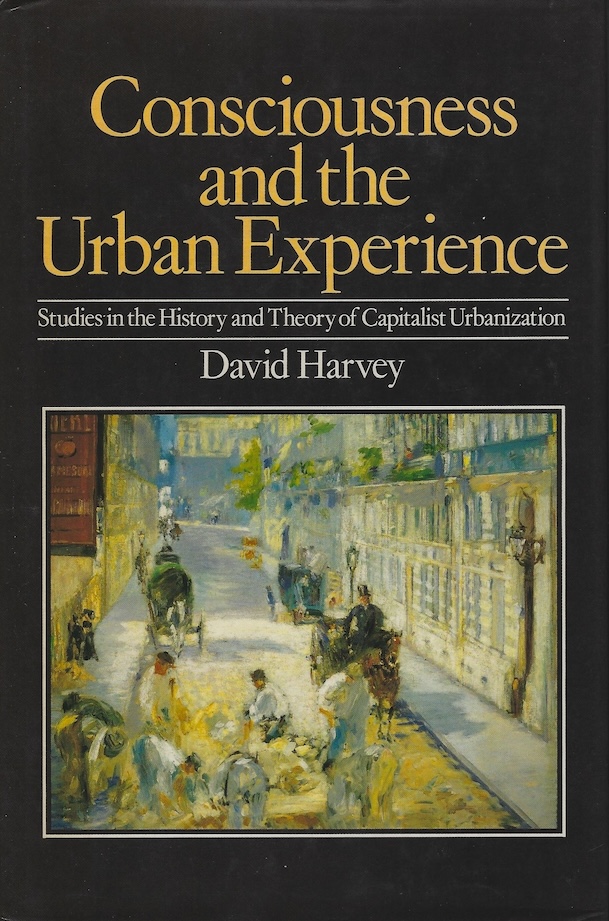
However, the pairing of Limits and Paris are of books almost two decades apart, when this discussion indicates their parallel production. I knew Harvey had written on Paris earlier in his career, as he indicates in this piece, but the original version of the essay is long out of print. It was originally published in one of two hardback volumes with The Johns Hopkins University Press and Basil Blackwell in 1985, a few years after The Limits to Capital (1982). Consciousness and the Urban Experience and The Urbanization of Capital wereboth subtitled Studies in the History and Theory of Capitalist Urbanization and clearly form a pair of connected studies. Neither was reprinted in paperback in the same form, but instead The Urban Experience, published in 1989, compiled several of the previously published essays. As he says in that book:
Consciousness and the Urban ExperienceParis, Capital of Modernity
I have chosen the essays for this paperback version with an eye to their theoretical coherence and utility in providing an interpretation of why the urban experience under capitalism takes the form it does. I have added one essay not included in the original volumes because I think it helps illustrate some of the ways in which the theory might be put to work to interpret recent trends. I also felt it useful to transform the original ‘Preface’ into a lengthier ‘Introduction’ and to engage in an extensive re-write of the essay on ‘The Urbanization of Consciousness’ which here appears as chapter 8. Otherwise, the original texts remain unchanged, except of minor alterations to ensure consistency and to eliminate duplication (The Urban Experience,Preface, p. ix).
Some of the essays from Consciousness and the Urban Experience and The Urbanization of Capital which not included in The Urban Experience have been reprinted elsewhere. “The Geography of Capitalist Accumulation: Towards a Reconstruction of the Marxian Theory” is included in Spaces of Capital in 2001, and by far the longest essay in Consciousness and the Urban Experience, “Paris, 1850-1870” (pp. 62-220), is the text reworked as the second part of the 2003 book Paris: Capital of Modernity.
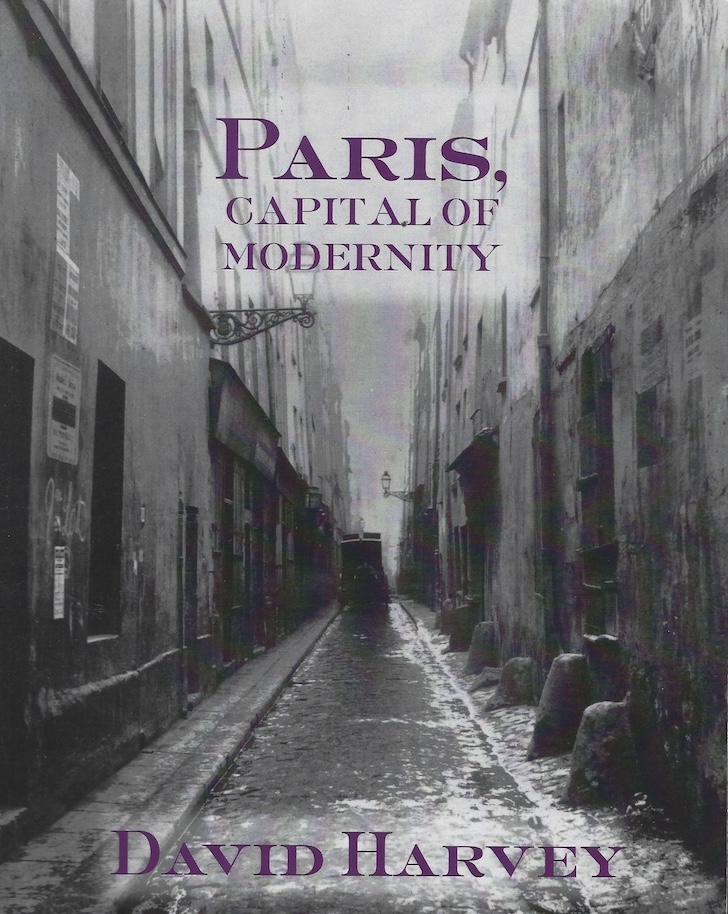
The original long essay, which could have easily been a short book on its own, is a historico-geographical analysis of a tumultuous period in the city, an example of historical-geographical materialism. Paris: Capital of Modernity also includes a reprint of “Monument and Myth: The Building of the Basilica of the Sacred Heart”, also taken from Consciousness and the Urban Experience, as Part III, though this essay had been included in The Urban Experience. Paris: Capital of Modernity starts with a new Introduction, and its Part I comprises “The Myths of Modernity: Balzac’s Paris”, previously published as two book chapters, and a new chapter “Dreaming the Body Politic: Revolutionary Politics and Utopian Schemes, 1830-1848” (see Paris: Capital of Modernity, p. 20).
When asked about the use of literature in his work on Paris, Harvey said that he had always been reading this material, but had never considered using it until this work: “Once I started to do so, I discovered how many historical ideas poetry or fiction can set alight. And once I made that turn, everything came flooding out”. He says this shift was partly because of the security of his academic position, but also partly the “pleasure of the texts themselves, after the hard grind of Limits” (Spaces of Capital, p. 12).
The themes are important, politically and geographically – the 1848 revolution and the reactionary birth of the Second Empire; Baron Haussmann’s transformation of the spaces of Paris; the Paris commune and its violent suppression; and the building of Sacré Coeur on its ruins. Harvey’s purpose is to show how the pivotal year of 1848 was anticipated by longer historical transformations, whether this is in literature, revolutionary politics or urban transformation. Modernity, as seen in these artistic, political and spatial forms, is not the break it is sometimes supposed to be, but a process, a modernization. This is viewed through the clash between a bourgeois, capitalist vision of property, the market and consumption, and a socialist vision of support, improvement and justice.
I don’t remember many reviews at the time of publication, and a quick search now does not produce many pieces. I’ve added references to a few below. And by Harvey’s standards, the citations of the Paris are more limited, though they are the sort of numbers most of us would be delighted by, of course.
As Patricia Tilburg said of the book, describing it as a work of synthesis, “Harvey’s ability to weave place and ideas is one of this eminently readable study’s greatest strengths” (p. 821). Harvey himself describes the book as synthetic, recognising how his book “depends heavily on archival work by others”, but (not entirely convincingly) claiming that because the archives have been “so richly mined” it was possible to use these secondary sources alone (p. 19). Richard A. Walker, in the Verso series for Harvey’s 90th birthday calls the Paris book “his finest piece of writing”. In that Verso series, Andy Merrifield has a much fuller discussion of the historical account of Paris. From a review at the time:
Paris: Capital of Modernity works in multiple registers. It is part urban history, part social history, part political history, and it is the book’s particular virtue to attempt a synthesis of them all. Something of the open-ended, multivalent character of the idea of modernity, however, is lost in the process. The modern has multiple political meanings. It takes a variety of cultural forms, depending on time and place. It has a productivist face as well as a spectacular one. It can be provincial as well as metropolitan. The meaning of the term “modernity” has been the subject of endless debate. Harvey weighs in with a particular take of his own, but it is worth remembering that his take is just one among many (Nord, p. 731).
The same year the Paris book appeared Harvey also published The New Imperialism, bringing his analyses into the present moment – it was one of the first books by a geographer engaging with the ‘war on terror’. Since then, his books have appeared at a regular rhythm of one every year or two – the companions to Marx’s Capital and the Grundrisse and a series on contemporary political economic issues. It’s been an astonishing run of publications in his 70s, 80s and now 90s, with The Story of Capital:What Everyone Should Know About How Capital Worksdue for publication in early 2026. But Harvey has never quite returned to the kind of historical-geographical materialism on display in his work on Paris.
References
Euan Hague, “Paris, Capital of Modernity. David Harvey”, Urban Geography 27 (3), 2006, 293-96.
David Harvey, The Limits to Capital, Oxford: Basil Blackwell, 1982.
David Harvey, Consciousness and the Urban Experience: Studies in the History and Theory of Capitalist Urbanization, Oxford: Basil Blackwell, 1985.
David Harvey, The Urbanization of Capital: Studies in the History and Theory of Capitalist Urbanization, Oxford: Basil Blackwell, 1985.
David Harvey, The Urban Experience, Baltimore: The Johns Hopkins University Press, 1989.
David Harvey, Spaces of Capital: Towards a Critical Geography, New York: Routledge, 2001.
David Harvey, Paris: Capital of Modernity, New York: Routledge, 2003.
David Harvey, The New Imperialism, London: Verso, 2003.
Philip Nord, “Paris: Capital of Modernity by David Harvey”, The Journal of Modern History 78 (3), 2006, 730-31.
Patricia Tilburg. “David Harvey, Paris, Capital of Modernity. New York: Routledge, 2003”, Comparative Studies in Society and History 50 (3), 2008, 820-21.
This piece is in the same style as the ‘Sunday histories‘ posts that I’ve been posting every week through 2025, though this is out of sequence because I wanted to post on Harvey’s birthday. The ‘Sunday Histories’ are short essays with some indications of further reading and sources, but which are not as formal as something I’d try to publish more conventionally. They are usually tangential to my main writing focus, a home for spare ideas, asides, dead-ends and possible futures. I hope there is some interest in them. They are provisional and suggestions are welcome. A few shorter pieces in a similar style have been posted mid-week. This Sunday’s post will be on Foucault’s recently published manuscript,Les Hermaphrodites [update: now available here].
The full chronological list of ‘Sunday histories’ is here, with a thematic ordering here.
Offers the first comprehensive study of Martin Heidegger’s five conversational texts.
Reading Martin Heidegger’s five conversational texts together for the first time, Heidegger’s Conversations elaborates not only what Heidegger thought but howhe did so by attending to the philosophical possibilities of the genre of these under-studied texts written between 1944 and 1954. Though he wrote little on the topic of teaching and learning explicitly, Katherine Davies shows Heidegger performed an implicit poetic pedagogy in his conversations that remains to be recognized. Heidegger launched an experimental attempt to enact a learning of non-representational, non-metaphysical thinking by cultivating a distinctly collaborative sensitivity to the call of the poetic. Davies illustrates how each conversation emphasizes a particular pedagogical element-non-oppositionality, making mistakes, thinking in community, poetic interpretation, and the dangers of such pedagogy-which together constitute the developmental arc of these texts. Whether Heidegger is revising or reinforcing his own earlier pedagogical practices, Davies argues that attending to the dramatic staging of the conversations offers a distinct vantage point from which to contend with Heidegger’s philosophy and politics in the post-war period.
Michel Foucault est un auteur polymorphe, qui a su toucher, par ses écrits et ses interventions, des publics très divers. On s’intéresse dans ce livre aux cours donnés au Collège de France, où Foucault enseigne de 1970 à 1984, et où s’élaborent des concepts qui ont fait sa renommée, comme ceux de biopouvoir, de gouvernementalité et de dire-vrai. Les dix études qui composent cet essai ne visent pas à reconstituer un système ni à proposer un glossaire exhaustif : on y suit une pensée au travail, sans chercher à gommer les difficultés qu’elle affronte, ni les déplacements qu’elle opère. Au gré de ses transformations, on circule au sein de champs multiples – de la pratique punitive aux conduites d’aveu, de la psychiatrie aux stratégies libérales et néolibérales –, et d’époques différentes – de l’Antiquité gréco-romaine à l’avènement de l’État moderne, en passant par le christianisme des débuts et l’Aufklärung. On interroge un cheminement construit, aigu et inquiet, dont l’horizon est éthique et l’enjeu politique : donner forme à l’art de gouverner, c’est garder vive l’actualité de la résistance aux pouvoirs.
Correcting the misunderstood role of maxims at the intersection of early science and literature
Eighteenth-century novels are full of maxims—pithy statements of received wisdom such as “necessity is the mother of invention” or “neither a borrower nor a lender be.” Maxims are ancient rhetorical forms, celebrated by no less an influential figure than Aristotle as powerful tools of persuasion. Critics have generally explained away their ubiquitous presence in eighteenth-century novels as a vestige of a premodern form. As Kelly Swartz explains, however, their presence illustrates an important yet often overlooked aspect of the novel’s relationship with the early empirical sciences.
Applying insights from Francis Bacon’s account of aphorizing as a method of scientific writing to works by Aphra Behn, Jonathan Swift, Samuel Richardson, and Jane Austen, Swartz shows how maxims functioned in a critical role that she calls “unknowing.” Such expressions, she argues, represented the not yet known as a way to inspire in readers a desire for ongoing, collective inquiry. Maxims also allowed these authors to invent unknowing fictional minds, at once attractive and vexing, ranging from the incoherent and banal to the unintelligibly rich. Maxims and the Mind thus offers new insight into the nature of the relationship between science and the early novel, emphasizing their shared interest in the representation of knowledge still awaiting discovery.
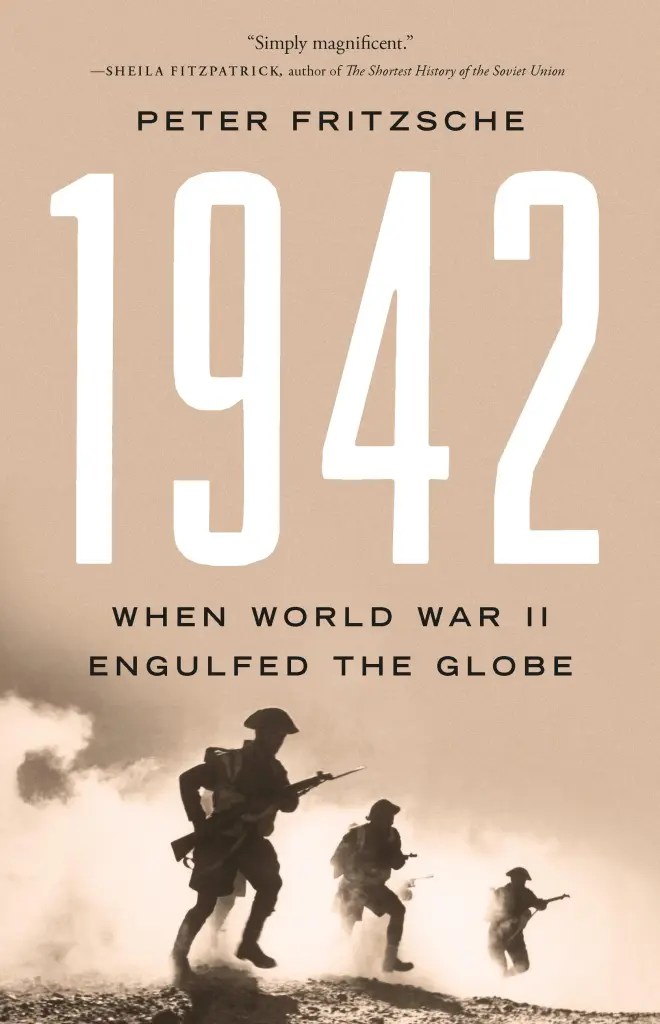
A penetrating history of the year World War II became a global conflict and humankind confronted both destruction and deliverance on a planetary scale, “offering an intriguing perspective on a world at war” (Richard Overy, New York Times–bestselling author of Blood and Ruins)
By the end of the Second World War, more than seventy million people across the globe had been killed, most of them civilians. Cities from Warsaw to Tokyo lay in ruins, and fully half of the world’s two billion people had been mobilized, enslaved, or displaced.
In 1942, historian Peter Fritzsche offers a gripping, ground-level portrait of the decisive year when World War II escalated to global catastrophe. With the United States joining the fight following Japan’s attack on Pearl Harbor, all the world’s great powers were at war. The debris of ships sunk by Nazi submarines littered US beaches, Germans marauded in North Africa, and the Japanese swept through the Pacific. Military battles from Singapore to Stalingrad riveted the world. But so, too, did dramas on the war’s home fronts: battles against colonial overlords, assaults on internal “enemies,” massive labor migrations, endless columns of refugees.
With an eye for detail and an eye on the big story, Fritzsche takes us from shipyards on San Francisco Bay to townships in Johannesburg to street corners in Calcutta to reveal the moral and existential drama of a people’s war filled with promise and terror.
Edward Baring is an intellectual historian of twentieth-century Europe and the Associate Professor of History and Human Values at Princeton University. He is the author of The Young Derrida and French Philosophy, 1945–1968 (Cambridge University Press, 2011) and Converts to the Real: Catholicism and the Making of Continental Philosophy (Harvard University Press, 2019). His new book, Vulgar Marxism: Revolutionary Politics and the Dilemmas of Worker Education, 1891–1931 (University of Chicago Press, forthcoming December 2025), explores the history of twentieth-century Marxist thought through the lens of worker education. The first part of the book describes the educational infrastructure built by the German Social Democratic Party from 1880 to 1914. Baring then shows how prominent intellectuals of the interwar period—Georg Lukács, Karl Korsch, Hendrik de Man, Antonio Gramsci, and José Carlos Mariátegui—situated their work in relation to worker education and the failure of European revolutions in 1918. Baring discussed his forthcoming book with Sam Franz and Véronique Mickisch for the JHI Blog.
The success of new far-right movements cannot be explained by fear or rage alone – the pleasures of aggression and violence are just as essential. As such, racism is particularly intense when it is erotically charged, migration presenting as a sexual threat to white women being one of many examples. Germany’s strikingly successful right-wing political party Alternative für Deutschland is, according to the historian Dagmar Herzog, characterized by this “sexy racism,” with its second main feature being that of an obsessive antidisability hostility – both elements resonating strongly with Nazism. In The New Fascist Body, Herzog connects her analysis of fascism’s libidinous energy with its animus against bodies perceived as imperfect. Only by studying the emotional and intellectual worlds of past fascisms can we understand and combat their current manifestations.
The book features an afterword by Alberto Toscano, author of Late Fascism: Race, Capitalism and the Politics of Crisis(Verso 2023).