Jenny Edkins and Maja Zehfuss (eds), Global Politics, third edition – Routledge, January 2019

9781138060296Jenny Edkins and Maja Zehfuss (eds), Global Politics, third edition – Routledge, January 2019

The third edition of Global Politics: A New Introduction continues to provide a completely original way of teaching and learning about world politics. The book engages directly with the issues in global politics that students are most interested in, helping them to understand the key questions and theories and also to develop a critical and inquiring perspective.

Completely revised and updated throughout, the third edition offers up-to-date examples engaging with the latest developments in global politics, including the Syrian war and the refugee crisis, fossil fuel divestment, racism and Black Lives Matter, citizen journalism, populism, and drone warfare.

Global Politics:

  • examines the most significant issues in global politics – from war, peacebuilding, terrorism, security, violence, nationalism and authority to poverty, development, postcolonialism, human rights, gender, inequality, ethnicity and what we can do to change the world;
  • offers chapters written to a common structure, which is ideal for teaching and learning, and features a key question, an illustrative example, general responses and broader issues;
  • integrates theory and practice throughout the text, by presenting theoretical ideas and concepts in conjunction with a global range of historical and contemporary case studies.

Drawing on theoretical perspectives from a broad range of disciplines, including international relations, political theory, postcolonial studies, sociology, geography, peace studies and development, this innovative textbook is essential reading for all students of global politics and international relations.

Posted in Jenny Edkins, Maja Zehfuss, Uncategorized | 2 Comments

Etienne Balibar, ‘Philosophies of the Transindividual: Spinoza, Marx, Freud’ and commentaries

Publication CoverEtienne Balibar’s essay ‘Philosophies of the Transindividual: Spinoza, Marx, Freud’ is translated in the current issue of Australasian Philosophical Review by Mark Kelly, and is published along with a number of commentaries and a response.

Posted in Etienne Balibar, Uncategorized | Leave a comment

Marcus Power, Geopolitics and Development – Routledge, 2019

9780415519571Marcus Power, Geopolitics and Development – Routledge, 2019

Unlike many Routledge titles, pleased to see this will be in paperback immediately.

Geopolitics and Development examines the historical emergence of development as a form of governmentality, from the end of empire to the Cold War and the War on Terror. It illustrates the various ways in which the meanings and relations of development as a discourse, an apparatus and an aspiration, have been geopolitically imagined and enframed.

The book traces some of the multiple historical associations between development and diplomacy and seeks to underline the centrality of questions of territory, security, statehood and sovereignty to the pursuit of development, along with its enrolment in various (b)ordering practices. In making a case for greater attention to the evolving nexus between geopolitics and development and with particular reference to Africa, the book explores the historical and contemporary geopolitics of foreign aid, the interconnections between development and counterinsurgency, the role of the state and social movements in (re)imagining development, the rise of (re)emerging donors like China, India and Brazil and the growing significance of South–South flows of investment, trade and development cooperation. Drawing on post-colonial and postdevelopment approaches and on some of the author’s own original empirical research, this is an essential, critical and interdisciplinary analysis of the complex and dynamic political geographies of global development.

Primarily intended for scholars and post-graduate students in the areas of development studies, development geography, political geography/geopolitics and international relations/politics, this book provides an engaging, invaluable and up-to-date resource for making sense of the complex entanglement between geopolitics and development, past and present.

Posted in Uncategorized | 1 Comment

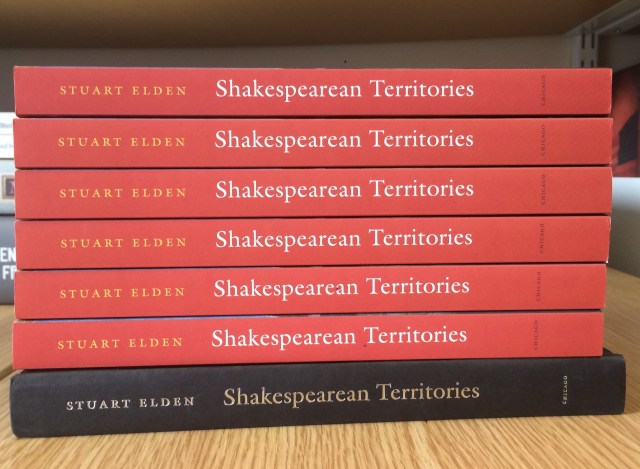
Shakespearean Territories, University of Chicago Press, 2018 – now available

STs.jpg

I’ve had an advance copy of Shakespearean Territories for a few weeks, but now have the warehouse copies, which means the book should be more widely available from usual booksellers in physical or e-book formats.

Shakespearean Territories cover - Copy

Shakespeare was an astute observer of contemporary life, culture, and politics. The emerging practice of territory as a political concept and technology did not elude his attention. In Shakespearean Territories, Stuart Elden reveals just how much Shakespeare’s unique historical position and political understanding can teach us about territory. Shakespeare dramatized a world of technological advances in measuring, navigation, cartography, and surveying, and his plays open up important ways of thinking about strategy, economy, the law, and colonialism, providing critical insight into a significant juncture in history. Shakespeare’s plays explore many territorial themes: from the division of the kingdom in King Lear, to the relations among Denmark, Norway, and Poland in Hamlet,  to questions of disputed land and the politics of banishment in Richard II. Elden traces how Shakespeare developed a nuanced understanding of the complicated concept and practice of territory and, more broadly, the political-geographical relations between people, power, and place. A meticulously researched study of over a dozen classic plays, Shakespearean Territories will provide new insights for geographers, political theorists, and Shakespearean scholars alike.

Jeff Malpas, University of Tasmania
“Shakespearean Territories is a truly groundbreaking volume that enriches our reading of Shakespeare at the same time as it illuminates our understanding of the nature and history of territory. An insightful and engrossing work, Shakespearean Territories demonstrates Elden’s unquestionable position as the most significant thinker of territory and the geographic working today—and in relation to the literary and dramatic no less than the political.”

Alexander Murphy, University of Oregon
“A work of meticulous scholarship, Shakespearean Territories teases out and explains a wide range of geographical themes present in Shakespeare’s plays with finesse and profound interpretation. Beyond the specific insights he offers on territory and geography as refracted through Shakespeare’s plays, Elden displays the substantial value of bridging literary and historical-geographical analysis.”

Garrett Sullivan, Penn State University
“Shakespearean Territories offers illuminating analyses of Shakespeare’s works that are immersed in relevant scholarship on the colonial, geophysical, and corporeal aspects of territory. This is a fascinating textual analysis that builds upon the concept of territory with Elden’s characteristic nuance and depth.”

Posted in Shakespearean Territories, Uncategorized, William Shakespeare | Leave a comment

Marie-Laure Massot, Arianna Sforzini and Vincent Ventresque, ‘Transcribing Foucault’s Handwriting with Transkribus’ – open access piece on Foucault’s archives

Marie-Laure Massot, Arianna Sforzini and Vincent Ventresque, ‘Transcribing Foucault’s Handwriting with Transkribus‘ (open access) – a fascinating report on the work being done with Foucault’s papers.


Posted in Michel Foucault, Uncategorized | Leave a comment

Design Agency within Earth Systems (Part 3) – Neil Brenner lecture and Stuart Elden commentary

Design Agency within Earth Systems (Part 3) – Neil Brenner lecture and Stuart Elden commentary. A discussion around the relation between the urban and territory.

Posted in Neil Brenner, terrain, Territory, Uncategorized | 1 Comment

Marcelo Hoffman, Militant Acts: The Role of Investigations in Radical Political Struggles – SUNY Press, Jan 2019

63478_covMarcelo Hoffman, Militant Acts: The Role of Investigations in Radical Political Struggles – SUNY Press, January 2019

Offers a history of the role of investigations in radical political struggles from the nineteenth century forward.

Militant Acts presents a broad history of the concept and practice of investigations in radical political struggles from the nineteenth century to the present. Radicals launched investigations into the conditions and struggles of the oppressed and exploited to stimulate their political mobilization and organization. These investigations assumed a variety of methodological forms in a wide range of geographical and institutional contexts, and they also drew support from the participation of intellectuals such as Marx, Lenin, Mao, Dunayevskaya, Foucault, and Badiou. Marcelo Hoffman analyzes newspapers, pamphlets, reports, and other source materials, which reveal the diverse histories, underappreciated difficulties, and theoretical import of investigations in radical political struggles. In so doing, he challenges readers to rethink the supposed failure of these investigations and concludes that the value of investigations in radical political struggles ultimately resides in the possibility of producing a new political “we.”

“The kind of archival and synthetic work on investigations that this book evinces has been accomplished nowhere else. Hoffman’s survey provides the reader with an understanding of how investigations fit into the theoretical practice of many important Marxist thinkers, along with an argument for their utility. Further, original insights into these thinkers, which enhance or even contradict our available understandings with better historical evidence, are offered.” — William S. Lewis, author of Louis Althusser and the Traditions of French Marxism

“Hoffman focuses on a distinctive, yet little recognized practice of resistance and shows how it impacts and is impacted by the theories of ideology and power in which it was employed. The scholarship is not only sound, but truly pathbreaking in its treatment of various traditions, languages, and even its usage of extremely diverse source materials.” — Kevin Thompson, DePaul University

Update: There is a review by Alex J Feldman in Contemporary Political Theory and one by Stevphen Shukaitis in Ephemera.

Posted in Alain Badiou, Karl Marx, Michel Foucault, Uncategorized | 1 Comment

Jenny Bauer and Robert Fischer (eds.) Perspectives on Henri Lefebvre Theory, Practices and (Re)Readings – De Gruyter 2018

9783110494983.jpgJenny Bauer and Robert Fischer (eds.) Perspectives on Henri Lefebvre Theory, Practices and (Re)Readings, De Gruyter, 2018

The articles take a decidedly interdisciplinary look at the opus of the French philosopher, sociologist and pioneer of spatial analysis Henri Lefebvre (1901-1991). His works are reflected upon from theoretical and practical perspectives by authors from various fields (literature, history, philosophy, sociology, ethnology) closely examining text references from Lefebvre.
Looks an interesting collection, but only in expensive hardback or e-book.


Posted in Uncategorized | Leave a comment

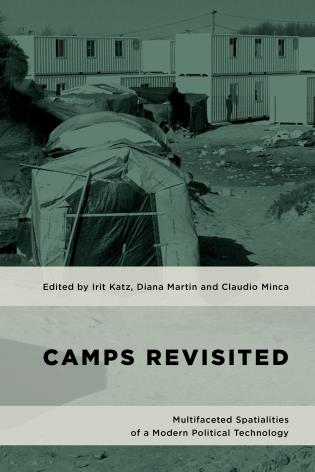
Irit Katz, Diana Martin and Claudio Minca (eds.) Camps Revisited: Multifaceted Spatialities of a Modern Political Technology – Rowman 2018
Irit Katz, Diana Martin and Claudio Minca (eds.) Camps Revisited: Multifaceted Spatialities of a Modern Political Technology – Rowman 2018

Facing the current growing global archipelago of encampments, this book project intends to develop a geographical reflection on ‘the camp’, as a modern institution and as a spatial bio-political technology.

This book focuses on past and present camp geographies and on the dispositifs that make them an ever-present spatial formation in the management of unwanted populations characterizing many authoritarian regimes as well as many contemporary democracies. It also offers and investigates possible ways to resist the present-day proliferating manifestations of camps and ‘camp thinking’, by calling for the incorporation of ‘camp studies’ into the broader field of political geography and to consider the geographies of the camp as constitutive of much broader modern geo-political economies.

By linking spatial theory to the geopolitical and biopolitical workings and practices of contemporary camps, the contributions in this collection argue that the camps seem to be here-to-stay, like a permanent/temporary presence giving shape to improvised, semi-structured and hyper-orderly structured spatialities in our cities and our countryside. Camps are also a specific response, for example, to the changing conditions of European borders due to the ‘refugee crisis’ and the rise of nationalism in many countries affected by such crisis.

Posted in Uncategorized | 1 Comment

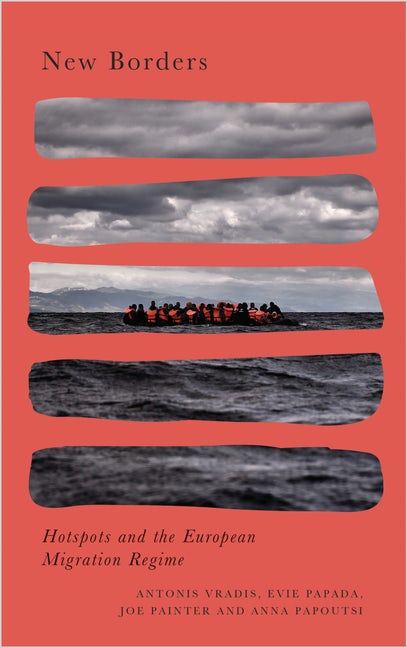
Antonis Vradis, Evie Papada, Joe Painter, Anna Papoutsi, New Borders: Hotspots and the European Migration Regime – Pluto 2018

Antonis Vradis, Evie Papada, Joe Painter, Anna Papoutsi, New Borders: Hotspots and the European Migration Regime – Pluto 2018

To many, a border is a geographical fact. But what happens when a border is subject to an emergency? Today, as millions are forced to migrate due to war, famine and political unrest, it is important to analyse how states use new bordering techniques to control populations.

New Borders focuses on the Greek island of Lesbos. Since 2015, the island has come under intense scrutiny as more than one million people have disembarked on its shores.

During this time, the authors spent two years studying the changing meanings and functions of the EU’s border. They observed how the reception of the refugees slid into detention and refuge became duress. Examining how and why this happened, they tackle questions on European policy, the securitisation of national and EU borders and the real impacts this has had on everyday life, determining who ‘belongs’ where and when.

Posted in Uncategorized | Leave a comment