Jenny Bauer and Robert Fischer (eds.) Perspectives on Henri Lefebvre Theory, Practices and (Re)Readings – De Gruyter 2018

9783110494983.jpgJenny Bauer and Robert Fischer (eds.) Perspectives on Henri Lefebvre Theory, Practices and (Re)Readings, De Gruyter, 2018

The articles take a decidedly interdisciplinary look at the opus of the French philosopher, sociologist and pioneer of spatial analysis Henri Lefebvre (1901-1991). His works are reflected upon from theoretical and practical perspectives by authors from various fields (literature, history, philosophy, sociology, ethnology) closely examining text references from Lefebvre.
Looks an interesting collection, but only in expensive hardback or e-book.


Posted in Uncategorized | Leave a comment

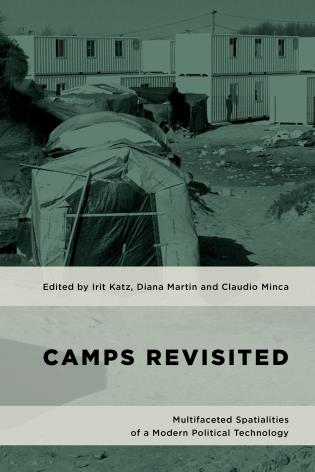
Irit Katz, Diana Martin and Claudio Minca (eds.) Camps Revisited: Multifaceted Spatialities of a Modern Political Technology – Rowman 2018

Irit Katz, Diana Martin and Claudio Minca (eds.) Camps Revisited: Multifaceted Spatialities of a Modern Political Technology – Rowman 2018

Facing the current growing global archipelago of encampments, this book project intends to develop a geographical reflection on ‘the camp’, as a modern institution and as a spatial bio-political technology.

This book focuses on past and present camp geographies and on the dispositifs that make them an ever-present spatial formation in the management of unwanted populations characterizing many authoritarian regimes as well as many contemporary democracies. It also offers and investigates possible ways to resist the present-day proliferating manifestations of camps and ‘camp thinking’, by calling for the incorporation of ‘camp studies’ into the broader field of political geography and to consider the geographies of the camp as constitutive of much broader modern geo-political economies.

By linking spatial theory to the geopolitical and biopolitical workings and practices of contemporary camps, the contributions in this collection argue that the camps seem to be here-to-stay, like a permanent/temporary presence giving shape to improvised, semi-structured and hyper-orderly structured spatialities in our cities and our countryside. Camps are also a specific response, for example, to the changing conditions of European borders due to the ‘refugee crisis’ and the rise of nationalism in many countries affected by such crisis.

Posted in Uncategorized | 1 Comment

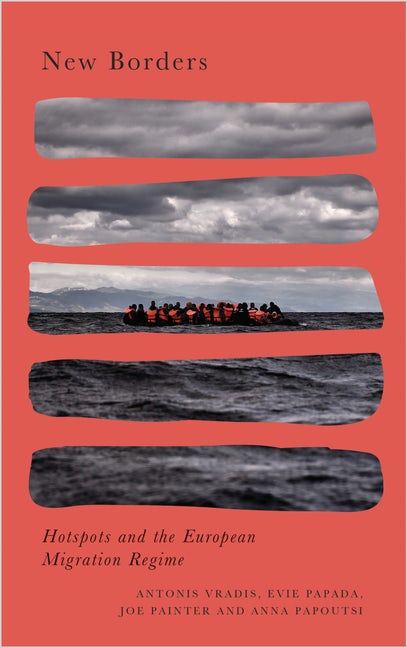
Antonis Vradis, Evie Papada, Joe Painter, Anna Papoutsi, New Borders: Hotspots and the European Migration Regime – Pluto 2018

Antonis Vradis, Evie Papada, Joe Painter, Anna Papoutsi, New Borders: Hotspots and the European Migration Regime – Pluto 2018

To many, a border is a geographical fact. But what happens when a border is subject to an emergency? Today, as millions are forced to migrate due to war, famine and political unrest, it is important to analyse how states use new bordering techniques to control populations.

New Borders focuses on the Greek island of Lesbos. Since 2015, the island has come under intense scrutiny as more than one million people have disembarked on its shores.

During this time, the authors spent two years studying the changing meanings and functions of the EU’s border. They observed how the reception of the refugees slid into detention and refuge became duress. Examining how and why this happened, they tackle questions on European policy, the securitisation of national and EU borders and the real impacts this has had on everyday life, determining who ‘belongs’ where and when.

Posted in Uncategorized | Leave a comment

‘Foucault before the History of Madness: lectures, translations, Nietzsche’ – audio recording of Sussex talk

Sussex posterThe audio recording of my talk on “Foucault before the History of Madness: lectures, translations, Nietzsche” given at the University of Sussex on 7 December 2018 is available here.

Many thanks to Bal Sokhi-Bulley and Anna Gurmucio Ramberg for the invitation, introduction and discussion. We talked about my book Foucault: The Birth of Power in a small discussion group first – there had been a reading group on the book this term – and then talked about the early Foucault for about an hour after my talk, but only the talk was recorded.

The talk was largely unscripted, and relied a lot on images – of books, archives, papers and so on – but I think it would be understandable without them. There is a lot more about the project here.

Posted in Friedrich Nietzsche, Michel Foucault, The Early Foucault, Uncategorized | 1 Comment

Books received – Derrida, Agamben, Delaporte, Jordan

Stanford.jpg

Some books in recompense for review work for Stanford University Press – Derrida’s Monolingualism of the Other and Paper Machine; Giorgio Agamben, The Use of Bodies; François Delaporte, Anatomy of the Passions and Mark D. Jordan, Convulsing Bodies: Religion and Resistance in Foucault.

Posted in François Delaporte, Giorgio Agamben, Jacques Derrida, Michel Foucault, Uncategorized | Leave a comment

materiali foucaultiani – new issue (2018)

A new issue of materiali foucaultiani – material in Italian, French and English

Clare O'Farrell's avatarFoucault News

materiali foucaultiani volume VI, number 11-12 (January-December 2017)

TABLE OF CONTENTS

Le confessioni della carne  (pp. 3-6)

Laura Cremonesi, Orazio Irrera, Daniele Lorenzini, Martina Tazzioli

FULL ARTICLE

Michel Foucault et la subjectivation

Introduzione. Soggettivazione e assoggettamento, a partire da Foucault  (pp. 9-14)

  Laura Cremonesi, Orazio Irrera, Daniele Lorenzini, Martina Tazzioli

FULL ARTICLE

Subjectivité et normativité chez Canguilhem et Foucault  (pp. 15-38)

  Pierre Macherey

FULL ARTICLE

N’être personne ! Variations sur les usages critiques de la fonction-sujet  (pp. 39-48)

Guillaume le Blanc

FULL ARTICLE

Le gouvernement du désir. Foucault à l’épreuve du libéralisme  (pp. 49-62)

Miguel de Beistegui

FULL ARTICLE

Sulle parrhèsia(e) di Foucault  (pp. 63-81)

  Étienne Balibar

FULL ARTICLE

Regimes of Visibility

The Dis-Time of Security and Visibility in Contemporary Governmentalities. An Interview with Didier Bigo  (pp. 83-92)

  Didier Bigo

FULL ARTICLE

Seeing and Saying. Foucault’s Analytic of Knowledge Production …

View original post 59 more words

Posted in Uncategorized | Leave a comment

David Beer, The Data Gaze: Capitalism, Power and Perception – Sage 2018 (Society and Space series)

92857_9781526436924David Beer, The Data Gaze: Capitalism, Power and Perception is now published. This is the latest book in the Sage Society and Space book series, which I edit.

A significant new way of understanding contemporary capitalism is to understand the intensification and spread of data analytics. This text is about the powerful promises and visions that have led to the expansion of data analytics and data-led forms of social ordering.

It is centrally concerned with examining the types of knowledge associated with data analytics and shows that how these analytics are envisioned is central to the emergence and prominence of data at various scales of social life.  This text aims to understand the powerful role of the data analytics industry and how this industry facilitates the spread and intensification of data-led processes. As such, The Data Gaze is concerned with understanding how data-led, data-driven and data-reliant forms of capitalism pervade organisational and everyday life.

Using a clear theoretical approach derived from Foucault and critical data studies the text develops the concept of the data gaze and shows how powerful and persuasive it is. It’s an essential and subversive guide to data analytics and data capitalism.

With characteristic eye for detail, Beer examines what we often overlook when talking about data: the values and ideals embedded in it by the industries that collect and process it, and how this affects our lives.

Mark D White
College of Staten Island/CUNY

David Beer’s The Data Gaze is a remarkable achievement. The demand for data is today’s ultimate appeal to truth, objectivity, and efficacy. Beer takes a step back, and questions how the appeal to data has gained such social currency. In meticulous and searching work, combining close attention to corporate data practices and theoretical rigor, he exposes the stakes of the data gaze’s demand for a total description of our actions, aspirations, potential, and politics. Before succumbing to the demand for ever more quantification and monitoring, policymakers and scholars would do well to read this insightful and important book.

Frank Pasquale
University of Maryland

The Data Gaze is a welcome diagnostic for the data and data analytics central to the functioning of contemporary capitalism and capitalist society. Finding inspiration in Foucault’s ‘clinical gaze’ Beer critically evaluates the visions, infrastructures and practices that facilitate what is said with data. It will be a vital resource for anyone who seeks to question the power to speak with our data.”

Mark Coté
King’s College London

More details on the series can be found here. Previously published titles are

Dan Bulley, Migration, Ethics and Power: Spaces Of Hospitality In International Politics

Marcus Doel, Geographies of Violence: Killing Space, Killing Time

Francisco Klauser, Surveillance and Space

Forthcoming volumes include (titles provisional)

Ross Exo Adams, Circulation and Urbanization

Shiloh Krupar and Greig Crysler, The Waste Complex: Capital \ Ecology \ Citizenship

Martina Tazzioli, Migrant Multiplicities and Singularities

Kirsten Simonsen and Lasse Koefoed, Geographies of Embodiment

If you’d like to discuss an idea for the series, please get in contact. While the books are not textbooks, they do need to be suitable for teaching, with a good possibility of adoption. Here’s the series description:

The Society and Space series explores the fascinating relationship between the spatial and the social. Each title draws on a range of modern and historical theories to offer important insights into the key cultural and political topics of our times, including migration, globalisation, race, gender, sexuality and technology. These stimulating and provocative books combine high intellectual standards with contemporary appeal for students of politics, international relations, sociology, philosophy, and human geography.

Posted in Society and Space, Uncategorized | 1 Comment

Books received – Agamben, Shakespeare, Lecourt, Bataille, Vitale, Zartaloudis, Massey

books.jpg

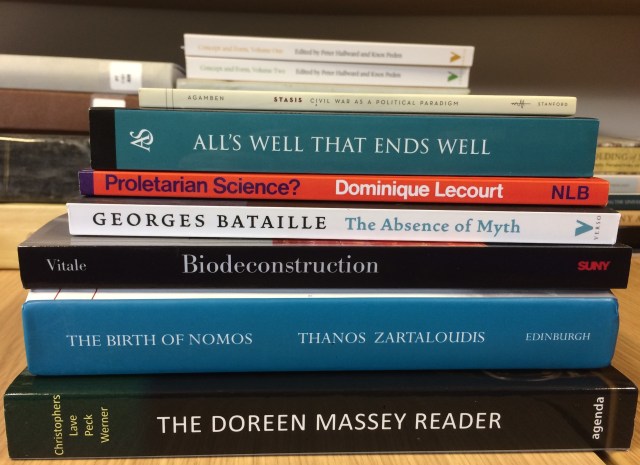
Giorgio Agamben, Stasis: Civil War as a Political Paradigm; All’s Well That Ends Well (the penultimate volume of the Arden Shakespeare, third series), Dominique Lecourt, Proletarian Science; Georges Bataille, The Absence of Myth; Francisco Vitale, Biodeconstruction: Jacques Derrida and the Life Sciences; Thanos Zartaloudis, The Birth of Nomos and The Doreen Massey Reader. Thanos very kindly sent me a copy of his book, and a couple were recompense for review work. The rest were bought, including two from the Verso sale (until Jan 1).

Posted in Doreen Massey, Georges Bataille, Giorgio Agamben, Jacques Derrida, Uncategorized, William Shakespeare | Leave a comment

Workshop on Rethinking the Sea in IR, Krakow 26-29 June 2019

Workshop on the Sea in IR, Krakow 26-29 June 2019 – flyer hereEWIS 2019 Rethinking the Sea in IR CfP.jpg

Posted in Uncategorized | Leave a comment

Elizabeth Grosz, The Incorporeal: Ontology, Ethics and the Limits of Materialism – Columbia UP 2018

51DoW-AjRTL._SX369_BO1,204,203,200_Elizabeth Grosz, The Incorporeal: Ontology, Ethics and the Limits of Materialism – Columbia University Press, 2018

Philosophy has inherited a powerful impulse to embrace either dualism or a reductive monism—either a radical separation of mind and body or the reduction of mind to body. But from its origins in the writings of the Stoics, the first thoroughgoing materialists, another view has acknowledged that no forms of materialism can be completely self-inclusive—space, time, the void, and sense are the incorporeal conditions of all that is corporeal or material. In The Incorporeal Elizabeth Grosz argues that the ideal is inherent in the material and the material in the ideal, and, by tracing its development over time, she makes the case that this same idea reasserts itself in different intellectual contexts.

Grosz shows that not only are idealism and materialism inextricably linked but that this “belonging together” of the entirety of ideality and the entirety of materiality is not mediated or created by human consciousness. Instead, it is an ontological condition for the development of human consciousness. Grosz draws from Spinoza’s material and ideal concept of substance, Nietzsche’s amor fati, Deleuze and Guattari’s plane of immanence, Simondon’s preindividual, and Raymond Ruyer’s self-survey or autoaffection to show that the world preexists the evolution of the human and that its material and incorporeal forces are the conditions for all forms of life, human and nonhuman alike. A masterwork by an eminent theoretician, The Incorporeal offers profound new insight into the mind-body problem.

Posted in Uncategorized | 1 Comment