Dawn Lyon, What is Rhythmanalysis? – Bloomsbury, November 2018

9781350018273.jpgDawn Lyon, What is Rhythmanalysis? – Bloomsbury, November 2018

In recent years, there has been growing interest in Henri Lefebvre’s posthumously published volume, Rhythmanalysis. For Lefebvre and subsequent scholars, rhythmanalysis is a research strategy which offers a means of thinking space and time together in the study of everyday life, and this remains its strength and appeal.

What is Rhythmanalysis? addresses the task of how to do rhythmanalysis. It discusses the history and development of rhythmanalysis from Lefebvre to the present day in a range of fields including cultural history and studies of place, work and nature. For Lefebvre, it is necessary to be ‘grasped by’ a rhythm at a bodily level in order to grasp it. And yet we also need critical distance to fully understand it. Rhythmanalysis is therefore both corporeal and conceptual. This book considers how the body is directly deployed as a research tool in rhythmanalytical research as well as how audio-visual methods can get at rhythm beyond the capacity of the senses to perceive it. In particular, the book includes detailed discussion of research on different forms of mobility – from driving to dancing – and on the social life of markets – from finance to fish.

Dawn Lyon highlights the gains, limitations and lively potential of rhythmanalysis for spatially, temporally and sensually attuned practices of research. This engaging text will be of interest to students and researchers in sociology, criminology, socio-legal studies, geography, urban studies, architecture, anthropology, economics and cultural studies.

Posted in Henri Lefebvre, Uncategorized | Leave a comment

Books received – Hollier, Bataille, Monk, Coleman & Agnew, Wahl

IMG_3796

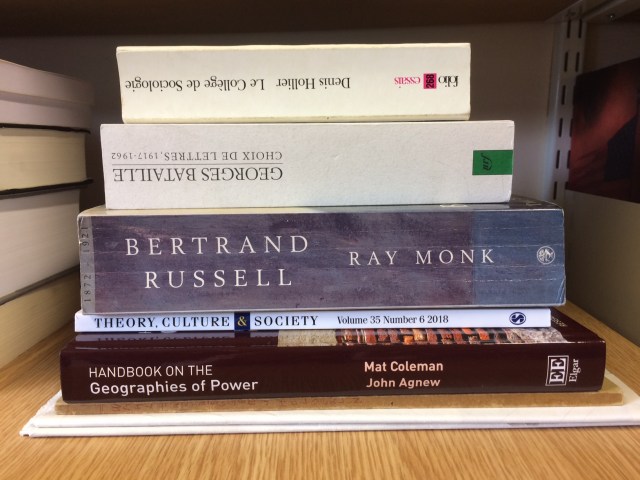
Denis Hollier, Le Collège de Sociologie; Georges Bataille, Choix de Lettres, 1917-1962; the first volume of Ray Monk’s life of Bertrand Russell, the new Theory, Culture & Society, the Handbook on the Geographies of Power, edited by Mat Coleman and John Agnew, and awahl lecture course by Jean Wahl. Most relate to the Foucault work, and were bought second-hand, though the Handbook is for review.


Posted in Georges Bataille, John Agnew, Michel Foucault, The Early Foucault, Theory, Culture and Society, Uncategorized | Leave a comment

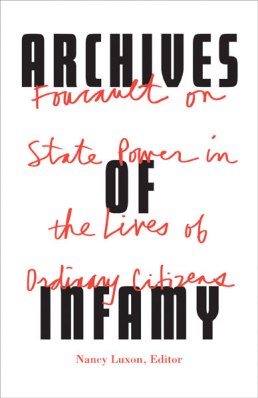
Nancy Luxon (ed.), Archives of Infamy: Foucault on State Power in the Lives of Ordinary Citizens – U Minnesota Press, 2019

imageNancy Luxon (ed.), Archives of Infamy: Foucault on State Power in the Lives of Ordinary Citizens – University of Minnesota Press, 2019

Expanding the insights of Arlette Farge and Michel Foucault’s Disorderly Families into policing, public order, (in)justice, and daily life

What might it mean for ordinary people to intervene in the circulation of power between police and the streets, sovereigns and their subjects? How did the police come to understand themselves as responsible for the circulation of people as much as things—and to separate law and justice from the maintenance of a newly emergent civil order? These are among the many questions addressed in the interpretive essays in Archives of Infamy.

Crisscrossing the Atlantic to bring together unpublished radio broadcasts, book reviews, and essays by historians, geographers, and political theorists, Archives of Infamy provides historical and archival contexts to the translation of Disorderly Families by Arlette Farge and Michel Foucault. This volume includes new translations of key texts, including a radio address Foucault gave in 1983 that explains the writing process for Disorderly Families; two essays by Foucault not readily available in English; and a previously untranslated essay by Farge that describes how historians have appropriated Foucault.

Archives of Infamy pushes past old debates between philosophers and historians to offer a new perspective on the crystallization of ideas—of the family, gender relations, and political power—into social relationships and the regimes of power they engender.

I have a piece in this entitled ‘Home, Street, City: Farge, Foucault and the Spaces of the Lettres de cachet‘ – preprint available here.

Posted in Arlette Farge, Michel Foucault, Uncategorized | 1 Comment

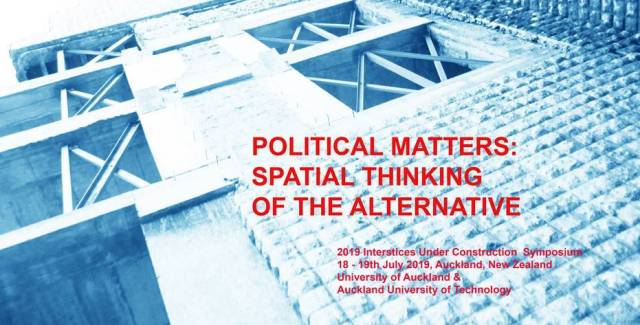
CFP: Political Matters: Spatial Thinking of the Alternative – 18-19 July 2019, Auckland, NZ

image002

Interstices Under Construction Symposium:

18 – 19th July 2019, Auckland, New Zealand

University of Auckland & Auckland University of Technology, New Zealand

Abstracts will be assessed by an academic committee appointed by the symposium organisers and then be subject to a double blind review process. Accepted abstracts will be published on the Interstices website: http://www.interstices.ac.nz/news-events/. Deadline 25 January 2019.

The symposium will be followed by a call for papers on the same topic for Issue 21 of Interstices: Journal of Architecture and Related Arts. The deadline for submission of 5000 words papers for issue 20 of Interstices will be, subject to review, on 1st October 2019, with the estimated publication in February 2020. For Journal’s submission guidelines see: https://www.interstices.ac.nz/information-for-contributors/guidelines-for-submissions/

Keynotes:

Professor Felicity Scott, GSAPP Columbia University, U.S.
Professor Ian Buchanan, University of Wollongong, Australia.
Bernard Khoury/DW5, Architect, Lebanon (TBC).

Convenors:

Farzaneh Haghighi, University of Auckland, New Zealand.
Nikolina Bobic, University of Plymouth, UK.
Andrew Douglas and Sue Hedges, Auckland University of Technology, New Zealand.

For more see: https://www.interstices.ac.nz/call-for-papers-7/

Image credit: Photo and design by Nikolina Bobic

Posted in Uncategorized | 1 Comment

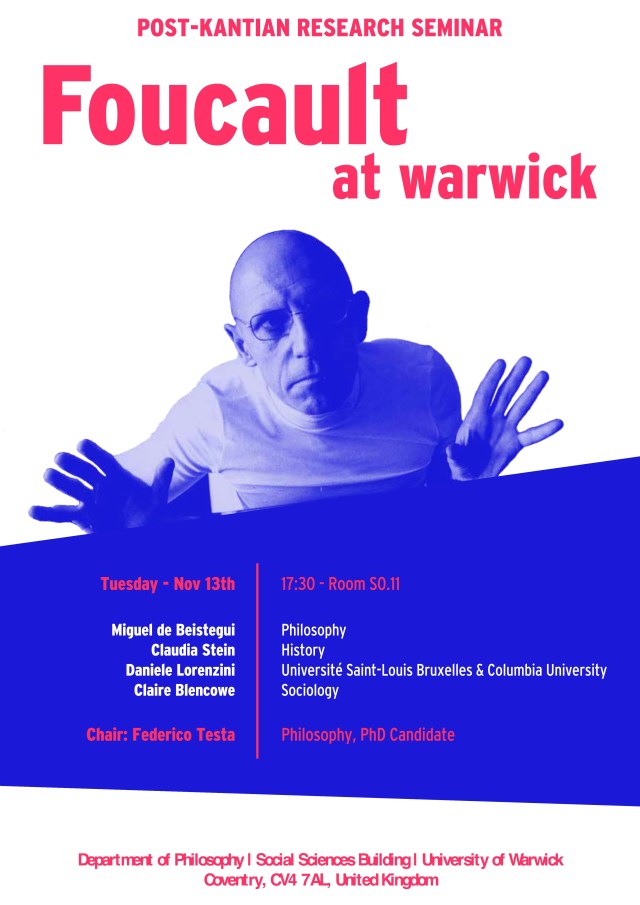
Foucault at Warwick – seminar on 13 November 2018 with Miguel de Beistegui, Claudia Stein, Daniele Lorenzini, Claire Blencoe and Federico Testa

Foucault at Warwick – seminar on 13 November 2018 with Miguel de Beistegui, Claudia Stein, Daniele Lorenzini and Claire Blencowe. Unfortunately this clashes with my MA class, so I’ll only be there for the first few minutes.

foucault at warwick.jpg

Posted in Conferences, Michel Foucault, Uncategorized | Leave a comment

David Harvey with Laura Flanders, lecture and discussion, October 2018

David Harvey with Laura Flanders – via davidharvey.org


Posted in Uncategorized | Leave a comment

Adrian Ivakhiv on Bruno Latour, Down to Earth: Politics in the New Climatic Regime (and the New York Times piece)

LatourAdrian Ivakhiv on Bruno Latour, Down to Earth: Politics in the New Climatic Regime at his Immanence blog – Latour’s Terrestrial Project.

Adrian links to The New York Times piece on Latour, which I should have linked to earlier.


Posted in Bruno Latour, terrain, Territory, Uncategorized | 1 Comment

Programme announced – 3rd International Conference for Carceral Geography

Carceral Geography conference, Liverpool, 17-18 December 2018

Jen Turner's avatarProf Dominique Moran

The programme for the 3rd International Conference for Carceral Geography, to be held at the University Liverpool, 17-18 December 2018, has been finalised, and is available here.

Registration for the conference is open via this online shop. Registration is free, and there are payable items of day catering and a conference dinner which can be optionally added. The last date for conference registration is 7th December 2018.

The conference theme of “counterpoints and counter-intuition” is intended encourage both a diversity of perspectives on the carceral, and to stimulate discussion of that which is or was unanticipated, had been unimagined, or was unforeseen.


We are delighted that Professor Dominique Moran (University of Birmingham) and Professor Chris Philo (University of Glasgow) will be joining us as keynote speakers at the conference. The conference will feature 8 paper sessions, with 29 papers from 39 authors from across the…

View original post 72 more words

Posted in Uncategorized | Leave a comment

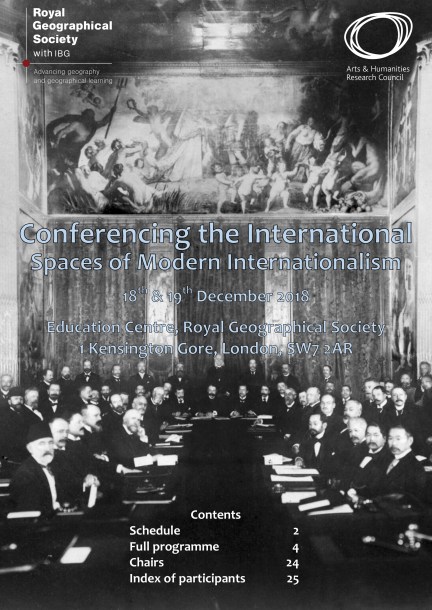
Conferencing the International: Spaces of Modern Internationalism – 18-19 Dec 2018, Royal Geographical Society, London

Conferencing the International Programme.jpgConferencing the International: Spaces of Modern Internationalism

18-19 December 2018, Royal Geographical Society, London

Over two days at the RGS, an interdisciplinary selection of expert speakers will discuss the nature of international conferences and the role that conferences have played – and continue to play – in shaping our understandings of modern internationalism. For the full programme, please see the link on the Eventbrite page (below).

The conference is free and open to all, but places are limited so advance registration is recommended:

Website: https://www.nottingham.ac.uk/research/groups/interwarconf/home.aspx

Blog: http://blogs.nottingham.ac.uk/interwarconferencing/

Twitter: @InterwarConf

Posted in Conferences, Uncategorized | Leave a comment

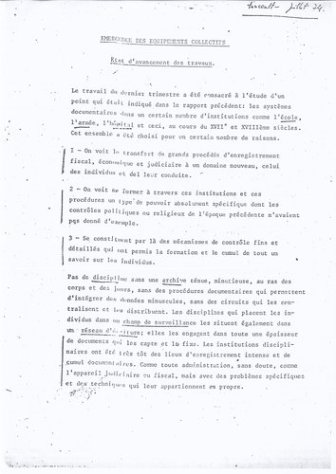
‘Émergence des equipment collectifs’ – a previously unpublished 1974 essay by Foucault, published online with introduction by Philippe Chevallier

arton737-81dd5
An unpublished piece by Foucault from 1974, “Émergence des equipment collectifs“, has recently been discovered and published online by Ici et Ailleurs, with an Introduction by Philippe Chevallier.

Philippe kindly sent me the essay a few days before publication, as it explicitly links to the work Foucault did with Guattari’s CERFI group – a link I’ve discussed in my books on Foucault. I’ve previously discussed the importance of Foucault’s collaborative projects on this site, and put together a bibliography of references, which can be found here. I’ve just added this essay.

With Philippe’s agreement and encouragement, I’m sharing below the brief note I sent him. there is more to be said about its content and connections, of course, and we hope that readers will follow up with comments on the Ici et ailleurs site:

Dear Philippe

My apologies for taking this time to have a chance to read it. It’s been a very busy start of term.
It’s an interesting text, though not especially new to people who have read Surveiller et punir, the CERFI reports and related materials. I think your introduction is very helpful, and I’m grateful you mentioned my two books in the revised version. I especially used the IMEC archive to situate the published materials in relation to the overall shape of the project. My books give all the details of the things that I found. I’d be happy to send you copies of both if they’d be of interest – either e-copies for you to consult now, or physical copies of the books if you can wait a little while. It would be a pleasure to share them.
The IMEC material is important, though I am fairly sure that this text is not found there. I did the research with the CERFI material many years ago, when the IMEC collection was still in Paris, though I have been back since it moved to Caen, to look at other material. One thing that seemed important to me, and might be worth mentioning in your Introduction, is that there was an important link between the work done in the CERFI projects and the Collège de France seminar. You indicate this in a note, but it might be more prominent. Once the Pierre Rivière collection was finished, I think that there is an important overlap between Foucault’s seminar and some of the work he does with CERFI. The reports link to Les machines à guerir, as you say, which is certainly in part of a seminar project, and there is a link too to the Politiques de l’habitat collection Foucault directed. We know so little about what Foucault did in those seminars, beyond the paragraphs in the course summaries.
I think both of your hypotheses are correct – Foucault used his name to help get some funding, but i do also think that his seminar influenced his own writing. There are some important links between work that happened collaboratively and later lectures and writings.
The title obviously links it to the CERFI work, but I wonder how we’d read it without that title – it doesn’t say much about the notion of ‘equipment collectifs’, and many of its themes connect to works published just under Foucault’s own name. I also see some links to the Rio medicine lectures of 1974, as well as Surveiller et punir and the CERFI projects. 1974 makes a lot of sense as its date.
You already mention many of the pieces listed here, but a few years ago I made a bibliography of Foucault’s Collaborative Projects. It may be of interest
Thanks so much for sharing this with me. I’ll look forward to seeing it published and will certainly share links on my blog. Please do let me know when it’s available.
with very best wishes
Stuart
Posted in Foucault's Last Decade, Foucault: The Birth of Power, Michel Foucault, Uncategorized | 5 Comments