Stefanos Geroulanos and Todd Meyers, The Human Body in the Age of Catastrophe: Brittleness, Integration, Science and the Great War – University of Chicago Press, 2018

9780226556451Stefanos Geroulanos and Todd Meyers, The Human Body in the Age of Catastrophe: Brittleness, Integration, Science and the Great War – University of Chicago Press, 2018

The injuries suffered by soldiers during WWI were as varied as they were brutal. How could the human body suffer and often absorb such disparate traumas? Why might the same wound lead one soldier to die but allow another to recover?

In The Human Body in the Age of Catastrophe, Stefanos Geroulanos and Todd Meyers uncover a fascinating story of how medical scientists came to conceptualize the body as an integrated yet brittle whole. Responding to the harrowing experience of the Great War, the medical community sought conceptual frameworks to understand bodily shock, brain injury, and the vast differences in patient responses they occasioned. Geroulanos and Meyers carefully trace how this emerging constellation of ideas became essential for thinking about integration, individuality, fragility, and collapse far beyond medicine: in fields as diverse as anthropology, political economy, psychoanalysis, and cybernetics.

Moving effortlessly between the history of medicine and intellectual history, The Human Body in the Age of Catastrophe is an intriguing look into the conceptual underpinnings of the world the Great War ushered in.

Posted in Uncategorized | 1 Comment

Default lecture capture: In defense of academic freedom, safety and well-being

Some interesting comments on lecture capture, from the human geographers at University of Edinburgh

Julie Cupples's avatarJulie Cupples

This is a submission based on the collated and collective views of the Human Geography Research Group (HGRG) in the School of Geosciences at the University of Edinburgh as our institution is considering adopting lecture capture by default. I am sharing it here as it might assist other academics who are confronting and concerned about mandatory lecture recording and it might help students to understand why default lecture recording is not necessarily in their interests.

The HGRG is strongly opposed to the policy of default recording on four main grounds:

  • Pedagogical reasons
  • Academic freedom
  • Staff well-being
  • Staff and student safety

Pedagogical reasons

We understand why stressed, anxious and highly indebted students might well believe that their interests are best served by having access to recordings of lectures, but it is our belief that for the majority of our students it will have a detrimental effect on their learning.

Many of…

View original post 2,067 more words

Posted in Uncategorized | Leave a comment

Anthem symplokē Studies in Theory – new book series

Anthem symplokē Studies in Theory – new book series. Enquiries to proposal@anthempress.com

Anthem Symploke Studies in Theory announcement.jpg

Posted in Publishing, Uncategorized | Leave a comment

Thomas Nail, Being and Motion – OUP, November 2018

9780190908911Thomas Nail, Being and Motion – OUP, November 2018

More than at any other time in human history, we live in an age defined by movement and mobility; and yet, we lack a unifying theory which takes this seriously as a starting point for philosophy. The history of philosophy has systematically explained movement as derived from something else that does not move: space, eternity, force, and time. Why, when movement has always been central to human societies, did a philosophy based on movement never take hold? This book finally overturns this long-standing metaphysical tradition by placing movement at the heart of philosophy.

In doing so, Being and Motion provides a completely new understanding of the most fundamental categories of ontology from a movement-oriented perspective: quality, quantity, relation, modality, and others. It also provides the first history of the philosophy of motion, from early prehistoric mythologies up to contemporary ontologies. Through its systematic ontology of movement, Being and Motion provides a path-breaking historical ontology of our present.

Thomas also has a new blog Philosophy of Movement

Posted in Uncategorized | Leave a comment

Federico Ferretti, Anarchy and Geography: Reclus and Kropotkin in the UK – Routledge 2018

9781138488120Federico Ferretti, Anarchy and Geography: Reclus and Kropotkin in the UK – Routledge 2018.

This book provides a historical account of anarchist geographies in the UK and the implications for current practice. It looks at the works of Frenchman Élisée Reclus (1830–1905) and Russian Pyotr Kropotkin (1842–1921) which were cultivated during their exile in Britain and Ireland.

Anarchist geographies have recently gained considerable interest across scholarly disciplines. Many aspects of the international anarchist tradition remain little-known and English-speaking scholarship remains mostly impenetrable to authors. Inspired by approaches in historiography and mobilities, this book links print culture and Reclus and Kropotkin’s spheres in Britain and Ireland. The author draws on primary sources, biographical links and political circles to establish the early networks of anarchist geographies. Their social, cultural and geographical context played a decisive role in the formation and dissemination of anarchist ideas on geographies of social inequalities, anti-colonialism, anti-racism, feminism, civil liberties, animal rights and ‘humane’ or humanistic approaches to socialism.

This book will be relevant to anarchist geographers and is recommended supplementary reading for individuals studying historical geography, history, geopolitics and anti-colonialism.

Looks good, although my usual complaints about Routledge’s prohibitive pricing apply – and seem even more of a problem given the topic of the book.

Posted in Uncategorized | 2 Comments

The Early Foucault Update 19: A Writing and Cycling Retreat in the Peak District

Top of Ewden Bank-Midhopestones Bank

Top of Ewden Bank/Midhopestones Bank on Mortimer Road – did this bit both ways (it’s horrible)

I’m just back from a couple of weeks in the Peak District, in the south near Bakewell and the north in Holmfirth. The idea was to have a consolidated period of work on this book. The internet connection was somewhere between poor and non-existent, which helped with the focus. I also did quite a bit of cycling, for which, aside from an Ordnance Survey map, my guides were Simon Warren’s Cycling Climbs books. While I was there I did 26 of his categorized climbs, only 6 of which I’d done before.

In terms of the writing I redrafted the section on Foucault’s early course on anthropology, based on my reading of the manuscript and student notes, helped enormously by a transcription of one set of these. I went over the discussion of the other early courses and think the section on them is probably as good as it can be in advance of their publication.

I then went back over all the early publications from 1954 to 1957, and am now fairly happy with the discussion of them. The new part written was a sustained discussion of the Binswanger introduction, and I also reworked the discussion of the Binswanger and von Weizsäcker translations. Rereading the Binswanger introduction in the light of the lecture courses was really helpful for me. The next task will be a discussion of the new parts of Maladie mentale et psychologie from 1962.

I also worked a little bit on the discussion of the 1964 abridgement of Histoire de la folie. When I wrote my PhD in the mid 1990s the full text was not in English, so I worked with the full French text as well as the Madness and Civilization translation. At the time I made notes on what was only in French, and what was translated. Although Madness and Civilization is not quite the same as the French abridged version, it’s close, and so my detailed notes from the time are a good start in the process of textual comparison. While for the discussion of the book itself, I’ll be using the full French text and the complete History of Madness translation, I also want to discuss the abridgement as an object of study in itself. There is also a very brief text by Foucault in the abridgement which I’d previously overlooked, but has an interesting remark in it.

I returned, again, to Didier Eribon’s Michel Foucault et ses contemporains, which for this period, has some valuable discussion of Foucault’s relations to Dumézil and Althusser. It’s a shame that we only have a translation of first edition of Eribon’s biography of Foucault, when there is much additional material in the later editions, and no translation at all of Michel Foucault et ses contemporains.

I also read two remarkable collections on Foucault and Derrida – Olivia Custer, Penelope Deutscher, and Samir Haddad (eds.), Foucault/Derrida Fifty Years Later: The Futures of Genealogy, Deconstruction, and Politics (Columbia University Press, 2016) and Yubraj Aryal, Vernon W. Cisney, Nicolae Morar and Christopher Penfield (eds.), Between Foucault and Derrida (Edinburgh University Press, 2016). I had thought the Foucault-Derrida ‘debate’ over the History of Madnesswas largely sterile, in that while it was interesting, there was little left to say. But both books convinced me there was more at stake. They alerted me to important textual issues in Derrida that I’d previously overlooked, and led me to further published or archival sources to consult. So I have drafted a short section on this, at the moment located in relation to the discussion of the different editions of Foucault’s text. I’m not quite clear where I should put this. This is because the debate straddles the years – Foucault’s book in 1961, Derrida’s critique in 1963, its republication in 1967, Foucault’s replies in 1972, and Derrida’s partial return to the topic in 1991. It could be in the chapter where I discuss the book and its reception; or perhaps in the chapter where I discuss the 1964 revision (there is an argument that some of the changes relate to this debate.) But equally the discussion may end up in the book on Foucault in the 1960s, even though it perhaps should have been in Foucault: The Birth of Power. In that book (p. 205 n. 20), I briefly mention the debate in relation to the 1972 revision of Histoire de la folie, which includes Foucault’s second response as an appendix, but I essentially thought there was no more for me to say than I did in my 2001 book Mapping the Present (pp. 189-90 n. 17). I’m not quite sure that this is the case.
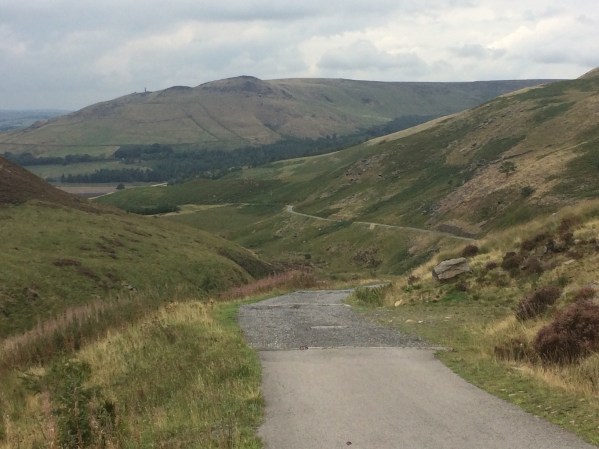
Chew Road

Chew Road from the reservoir – unsealed parts and drainage channels

The Derrida debate, and some other things I worked on, reinforced my sense that there is a book on Foucault in the 1960s to be written. I started to sketch out some ways in which I might do that.

It was a productive couple of weeks, and I am now looking forward to the next Paris visit where there are more things to follow up. In the meantime I’ll be trying to fix a few things I can resolve in London libraries. I also need to plan another trip to IMEC to consult some materials there, but that’s probably a bit further off.

The previous updates on this project are here; and the previous books Foucault’s Last Decade and Foucault: The Birth of Power are both available from Polity. My study of Canguilhem is forthcoming in early 2019, and is discussed a bit more here. Several Foucault research resources such as bibliographies, short translations, textual comparisons and so on are available here.

Posted in Cycling, Michel Foucault, The Early Foucault, Uncategorized | Leave a comment

Shakespeare and Derrida, 1 September 2018, Garrick’s Temple, Hampton – programme

Featured Image -- 34432Kingston Shakespeare Series Conference: Shakespeare and Derrida, 1 September 2018, Garrick’s Temple, Hampton – details here; full programme here. Registration required (£20).

Papers by Nicholas Royle, Tina Chanter, Christopher Prendergast, John Joughin, Andrew Cutrofello and Howard Caygill.

This is part of the Kingston Shakespeare Seminar – follow the blog here.

Posted in Conferences, Jacques Derrida, Uncategorized, William Shakespeare | 1 Comment

The 2018 Antipode RGS-IBG Lecture – “Trauma Geographies: Broken Bodies and Lethal Landscapes” by Derek Gregory

Details of Derek Gregory’s Antipode lecture this week, and a number of related papers made open access from the journal’s archive.

Update: Derek’s keynote (‘Sweet target, sweet child: Aerial violence and the imaginaries of remote warfare’) at the conference on Drone Imaginaries and Society at the University of Southern Denmark in June is now available online here. (via Geographical Imaginations)

https://youtu.be/zqMvgrInEts

Antipode Editorial Office's avatarAntipodeFoundation.org

The 2018 Antipode Royal Geographical Society (with the Institute of British Geographers) Lecture

Trauma Geographies: Broken Bodies and Lethal Landscapes

Derek Gregory
Peter Wall Institute for Advanced Studies and Department of Geography
University of British Columbia
Vancouver, BC, Canada

We’d be delighted if you could join us at the RGS-IBG annual international conference on Wednesday 29 August at Cardiff University for Derek Gregory’s Antipode Lecture, “Trauma Geographies: Broken Bodies and Lethal Landscapes”. The lecture starts at 16:50 (Shared Lecture Theatre, Sir Martin Evans Building), and will be followed by a reception sponsored by Wiley.

Elaine Scarry reminds us that even though “the main purpose and outcome of war is injuring” this “massive fact” can nevertheless “disappear from view along many separate paths”. This presentation traces some of those paths, exploring the treatment and evacuation of the injured and sick in three war zones: the Western Front in the First…

View original post 1,315 more words

Posted in Uncategorized | Leave a comment

Mattias Leanza review of Foucault’s Last Decade in Journal of the Royal Anthropological Institute (requires subscription)

9780745683911Mattias Leanza reviews Foucault’s Last Decade (Polity, 2016) in the Journal of the Royal Anthropological Institute (requires subscription). It’s a generous and positive review which ‘highly recommends’ the book.

All the reviews of this book, and of Foucault: The Birth of Power (Polity 2017) are listed here.

Posted in Foucault's Last Decade, Foucault: The Birth of Power, Michel Foucault, Uncategorized | Leave a comment

The Early Foucault update 18: back to work, and thinking about the 1960s

EF18.jpegIt’s taken longer than anticipated for me to return to the work on The Early Foucault. The last update was back in April. Through the spring the book on Canguilhem was drafted, revised and then submitted to Polity Press on 4 May. Following the reader reports the revision was sent off on 13 July, and the book is now in production with a scheduled publication in early 2019. Much of the research time in May and June was taken up with work on Shakespeare, part for some summary pieces about Shakespearean Territories (here and here), and some the continuation of a side-project of putting Foucault and Shakespeare in relation. It was only in late July, following a holiday, that I was really able to return to the work on the early Foucault.

The materials I’d drafted were in fairly good shape, although some sections are more note-like than finished prose. I reread everything, making some minor changes but overall I was quite pleased with how the pieces were shaping up. I was struck, again, with how limited the sources are for this period. In the later years, almost everything Foucault said was preserved in some form, and published either in his lifetime or posthumously, and there is extensive commentary. In this earlier period, before he was famous, he was rarely interviewed, lectures were not recorded, many materials were not preserved, and he published little. There are few people still alive who knew him in the 1950s. The archives help enormously, but often it’s a case of patching together the smallest bits of evidence, and weighing up sometimes conflicting sources.

A lot of time was taken up with some relatively small things. Foucault cites Roland Kuhn quite a bit in the early 1950s, but one I was interested in was not given a page reference. Finding that – in a two-part German article of 90 pages, when my only clue was Foucault’s own translation – took a while. Others were more mechanical – filling in all the references to an interview which had first appeared online, but is now more officially published in a book; chasing up references, including locating libraries that might have the text; double-checking the biographies for details, and so on. I have worked on the dating of the early publications before, which is an issue raised by all the biographers though is generally said to be unresolvable. But newly available material seems to clarify things, and I think I’ve constructed a plausible timeline, though this, as much else, is provisional.

When I proposed a book on the early Foucault to Polity in January 2017, I said that the timescale for completion would be dependent on the publication of some of his first lecture courses from the 1950s. Although we agreed a provisional deadline of December 2018, this was before I agreed to write a book on Canguilhem for them, and it was also subject to change based on the lecture schedule. Although the order of the publications is not yet clear, the first of the pre-Collège de France volumes will comprise two 1960s courses on sexuality from Clermont-Ferrand and Vincennes. It may be some time before the others appear – there are quite a few volumes planned. As such I’ve told Polity it is likely to be 2020 before I submit this manuscript.

But the plan for the publication of 1960s courses, including notably from his time in Tunisia, means that I’m beginning to think beyond The Early Foucault to the next, and last volume of my intellectual history of Foucault. These books have been written in the order they have because of the availability of material. The first to be written covered the final period – Foucault’s Last Decade – and was followed by one on the period immediately before – Foucault: The Birth of Power. The Early Foucault is the first in the sequence, and likely the third to be completed and published. The plan is to write one final book to complete the sequence, looking at 1962-69, the period between The Birth of the Clinic and The Archaeology of Knowledge. So as I continue work on The Early Foucault, I’m already seriously thinking about this book on ‘Foucault in the 1960s’.

I’m now away for two weeks on a writing/cycling ‘retreat’ – an extended form of what I tried out last September, and in the Peak District again. I’m hoping to clock up some miles, tackle some climbs, and make further progress on this book. I’ll be back in Paris in September to go over some archival materials again. Hopefully there will be a bit more substance in the next updates.


The previous updates on this project are here; and the previous books Foucault’s Last Decade and Foucault: The Birth of Power are both available from Polity. Canguilhem is forthcoming in early 2019, and is discussed a bit more here. Several Foucault research resources such as bibliographies, short translations, textual comparisons and so on are available here.

Posted in Canguilhem (book), Georges Canguilhem, Michel Foucault, Shakespearean Territories, The Early Foucault, Uncategorized, William Shakespeare | 5 Comments