Elaine Stratford, Home, Nature, and the Feminine Ideal: Geographies of the Interior and of Empire – Rowman, January 2019

5b46ee7ef5ba74183c269bfd.jpgElaine Stratford, Home, Nature, and the Feminine Ideal: Geographies of the Interior and of Empire – Rowman International, January 2019.

Take three things: the home, nature, and the feminine ideal—a notional and perfected femininity. Constitute them as inexorably and universally connected. Enrol them in diverse strategies and tactics that create varied anatomo-politics of the body and biopolitics of the population. Enlist those three things as the “handmaidens” of the government of individuals and groups, places and spaces, and comings and goings. Focus some effort on the periodical press, and on producing and disseminating narratives, discourses, and practices that relate specifically to health and well-being. Deploy those texts and shape those contexts in ways that affect flesh and bone, psychology and social conduct, and the spatial organization and relational dynamics of dwellings and streets, settlements and regions, and states and empires. Stretch these activities over the Anglophone world—from the epicentres of the United Kingdom and the United States to Australia or Canada, New Zealand or India—and extend their reach over the whole of the long nineteenth century. Such are the subjects of this work, in which Elaine Stratford draws from governmentality, the geohumanities, and geocriticism to converse with an extensive archive that profoundly shaped our engagements with home, nature, and the feminine ideal, deeply influenced our collective capacity to flourish, and powerfully constituted diverse geographies of the interior and of empire that still affect us.

Posted in Uncategorized | 1 Comment

Ian Klinke, Cryptic Concrete: : A Subterranean Journey Into Cold War Germany – RGS-IBG book series, April 2018

1119261031Ian Klinke, Cryptic Concrete: : A Subterranean Journey Into Cold War GermanyRGS-IBG book series, April 2018

Cryptic Concrete explores bunkered sites in Cold War Germany in order to understand the inner workings of the Cold War state.

  • A scholarly work that suggests a reassessment of the history of geo- and bio-politics
  • Attempts to understand the material architecture that was designed to protect and take life in nuclear war
  • Zooms in on two types of structures – the nuclear bunker and the atomic missile silo
  • Analyzes a broad range of sources through the lens of critical theory and argues for an appreciation of the two subterranean structures’ complementary nature

Chapter 1 available to download from the publisher; a bit more information on the RGS website.


Posted in Uncategorized | Leave a comment

James A. Tyner, The Politics of Lists: Bureaucracy and Genocide under the Khmer Rouge – West Virginia University Press, September 2018

tyner_politics_des_cov_sm_rgbJames A. Tyner, The Politics of Lists: Bureaucracy and Genocide under the Khmer Rouge – West Virginia University Press, September 2018

Scholars from a number of disciplines have, especially since the advent of the war on terror, developed critical perspectives on a cluster of related topics in contemporary life: militarization, surveillance, policing, biopolitics (the relation between state power and physical bodies), and the like. James A. Tyner, a geographer who has contributed to this literature with several highly regarded books, here turns to the bureaucratic roots of genocide, building on insight from Hannah Arendt, Zygmunt Bauman, and others to better understand the Khmer Rouge and its implications for the broader study of life, death, and power.

The Politics of Lists analyzes thousands of newly available Cambodian documents both as sources of information and as objects worthy of study in and of themselves. How, Tyner asks, is recordkeeping implicated in the creation of political authority? What is the relationship between violence and bureaucracy? How can documents, as an anonymous technology capable of conveying great force, be understood in relation to newer technologies like drones? What does data create, and what does it destroy? Through a theoretically informed, empirically grounded study of the Khmer Rouge security apparatus, Tyner shows that lists and telegrams have often proved as deadly as bullet and bombs.

Posted in Uncategorized | Leave a comment

The Doreen Massey Reader and Doreen Massey: Critical Dialogues – Agenda, 2018

97819111168379781911116868

The Doreen Massey Reader, edited by Brett Christophers, Rebecca Lave, Jamie Peck, Marion Werner and Doreen Massey: Critical Dialogues, edited by Marion Werner, Jamie Peck, Rebecca Lave, and Brett Christophers, Agenda, 2018

Here’s the description of the Reader:

Doreen Massey (1944–2016) changed geography. Her ideas on space, region, labour, identity, ethics and capital transformed the field itself, while also attracting a wide audience in sociology, planning, political economy, cultural studies, gender studies and beyond. The significance of her contributions is difficult to overstate. Far from a dry defence of disciplinary turf, her claim that “geography matters” possessed both scholarly substance and political salience.

Through her most influential concepts – such as power-geometries and a “global sense of place” – she insisted on the active role of regions and places not simply in bearing the brunt of political-economic restructuring, but in reshaping the uneven geographies of global capitalism and the horizons of politics. In capturing how global forces articulated with the particularities of place, Massey’s work, right up until her death, was an inspiration for critical social sciences and political activists alike. It integrated theory and politics in the service of challenging and transforming both.

This collection of Massey’s writings brings together for the first time the full span of her formative contributions, showcasing the continuing relevance of her ideas to current debates on globalization, immigration, nationalism and neoliberalism, among other topics. With introductions from the editors, the collection represents an unrivalled distillation of the range and depth of Massey’s thinking. It is sure to remain an essential touchstone for social theory and critical geography for generations to come.

And of Critical Dialogues:

These specially commissioned essays, many from some of Doreen Massey’s long-time interlocutors and collaborators, interrogate both the generative sources and the potential of Massey’s remarkably wide-ranging and influential oeuvre. They provide readers with an unparalleled assessment of the political and social context that gave rise to many of Massey’s key ideas and contributions – such as spatial divisions of labour, power-geometries, and a “global sense of place” – and how they subsequently travelled, and were translated and transformed, both within and outside of academia.

Looking forward, rather than merely backward, the collection also highlights some of the diverse ways in which Massey’s formulations and frameworks provide a basis for new interventions in contemporary debates over immigration, financialization, macroeconomic crises, political engagement beyond academia, North-South development cooperation, and more. The collection stands as a testament to the continuing relevance of Massey’s work across a wide range of fields and serves as an excellent companion to the volume of Massey’s own writings, The Doreen Massey Reader, published simultaneously and also compiled by the editors.

Posted in Doreen Massey, Uncategorized | Leave a comment

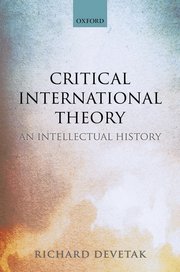
Richard Devetak, Critical International Theory: An Intellectual History – OUP, August 2018

9780198823568Richard Devetak, Critical International Theory: An Intellectual History – OUP, August 2018

Whether inspired by the Frankfurt School or Antonio Gramsci, the impact of critical theory on the study of international relations has grown considerably since its advent in the early 1980s. This book offers the first intellectual history of critical international theory.

Richard Devetak approaches this history by locating its emergence in the rising prestige of theory and the theoretical persona. As theory’s prestige rose in the discipline of international relations it opened the way for normative and metatheoretical reconsiderations of the discipline and the world. The book traces the lines of intellectual inheritance through the Frankfurt School to the Enlightenment, German idealism, and historical materialism, to reveal the construction of a particular kind of intellectual persona: the critical international theorist who has mastered reflexive, dialectical forms of social philosophy. . In addition to the extensive treatment of critical theory’s reception and development in international relations, the book recovers a rival form of theory that originates outside the usual inheritance of critical international theory in Renaissance humanism and the civil Enlightenment. This historical mode of theorising was intended to combat metaphysical encroachments on politics and international relations and to prioritise the mundane demands of civil government over the self-reflective demands of dialectical social philosophies. By proposing contextualist intellectual history as a form of critical theory, Critical International Theory defends a mode of historical critique that refuses the normative temptations to project present conceptions onto an alien past, and to abstract from the offices of civil government.

Posted in Uncategorized | Leave a comment

Verena Erlenbusch-Anderson, Genealogies of Terrorism: Revolution, State Violence, Empire – Columbia University Press, July 2018

9780231547178Verena Erlenbusch-Anderson, Genealogies of Terrorism: Revolution, State Violence, Empire, Columbia University Press, July 2018.

What is terrorism? What ought we to do about it? And why is it wrong? We think we have clear answers to these questions. But acts of violence, like U.S. drone strikes that indiscriminately kill civilians, and mass shootings that become terrorist attacks when suspects are identified as Muslim, suggest that definitions of terrorism are always contested. In Genealogies of Terrorism, Verena Erlenbusch rejects attempts to define what terrorism is in favor of a historico-philosophical investigation into the conditions under which uses of this contested term become meaningful. The result is a powerful critique of the power relations that shape how we understand and theorize political violence.

Tracing discourses and practices of terrorism from the French Revolution to late imperial Russia, colonized Algeria, and the post-9/11 United States, Erlenbusch examines what we do when we name something terrorism. She offers an important corrective to attempts to develop universal definitions that assure semantic consistency and provide normative certainty, showing that terrorism means many different things and serves a wide range of political purposes. In the tradition of Michel Foucault’s genealogies, Erlenbusch excavates the history of conceptual and practical uses of terrorism and maps the historically contingent political and material conditions that shape their emergence. She analyzes the power relations that make different modes of understanding terrorism possible and reveals their complicity in justifying the exercise of sovereign power in the name of defending the nation, class, or humanity against the terrorist enemy. Offering an engaged critique of terrorism and the mechanisms of social and political exclusion that it enables, Genealogies of Terrorism is an empirically grounded and philosophically rigorous critical history with important political implications.

1. The Trouble with Terrorism
2. The Emergence of Terrorism
3. State Terrorism Revisited
4. Terrorism and Colonialism
5. Reimagining Terrorism at the End of History
6. Towards a Critical Theory of Terrorism: Genealogy and Normativity

Inspired by Wittgenstein and Foucault, and contemporary debates about concepts, in this remarkable book Verena Erlenbusch-Anderson undertakes a significant examination of terrorism. Rather than assuming its meaning and looking for that in her sources, she instead allows a multifaceted understanding to emerge from a historical study of texts and practices. A powerful and urgent intervention for our troubled times. Stuart Elden, University of Warwick

This book is political philosophy at its best. It offers an instructive model of mobilizing philosophical genealogy for a critique of a highly-charged idea. It complicates the seeming obviousness with which the concept of ‘terrorism’ is today purveyed. Through meticulous historical and philosophical analysis, this book shows how the concept of terrorism came to be an explosive, dangerous, and contested political idea. Colin Koopman, University of Oregon

Verena Erlenbusch-Anderson’s careful genealogy of ‘terrorism’—tracking the term’s multiple and overdetermined meanings since its first appearance as a political concept in the late eighteenth century—powerfully shows us how we all too frequently ask the wrong questions about terrorism. This critical book offers a necessary corrective to how we think about terrorism, and it reshapes the grounds upon which we should have any meaningful debate about terrorism in the present moment. Andrew Dilts, Loyola Marymount University

Posted in Uncategorized | Leave a comment

Stuart Elden, ‘Why should people interested in territory read Shakespeare?’ – Territory, Politics, Governance, open access until end of September 2018

Publication CoverStuart Elden, ‘Why should people interested in territory read Shakespeare?‘ – Territory, Politics, Governance – open access until end of September 2018.

I shared this before, but the article is now open access. It’s a short piece which acts as a kind of preview of the forthcoming book Shakespearean Territories.

This paper argues that territory is more than a simple concept, and that William Shakespeare is a valuable guide to understanding its complexities. Shakespeare’s plays explore many aspects of geography, politics and territory. They include ideas about the division of kingdoms in King Lear, the struggle over its control in Macbeth and many of the English history plays, to the vulnerability of small territories with powerful neighbours in Hamlet. However, the plays also help us to understand the legal and economic issues around territory, of the importance of technical innovations around surveying and cartography, and the importance of landscapes and bodies. Shakespeare is especially interesting because debates in political theory at this time concerned a recognizably modern understanding, and European states were consolidating their own rule, marking boundaries and seizing colonial possessions. Shakespeare dramatizes many of these themes, from The Tempest to plays set in the Eastern Mediterranean such as Othello. Territory is a word, concept and practice, and their interrelation is explored with Shakespeare as a guide. This builds on the author’s previous work on territory, but also develops the understanding further, especially around the colonial, corporeal and geophysical. Historical work on our contemporary concepts can also be revealing of our present.


Posted in Shakespearean Territories, Territory, Uncategorized, William Shakespeare | Leave a comment

Thoughts on the History of Telos, 1968–2018

Some interesting reflections on the history of the Telos journal from Tim Luke.

Clare O'Farrell's avatarFoucault News

Thoughts on the History of Telos, 1968–2018
By Timothy W. Luke, Telos Wednesday, July 11, 2018

On June 8, 2018, Telos celebrated its fiftieth anniversary at a special event held in New York City. Speakers included Telos Press publisher Maria Piccone, Telos editors Russell Berman, Tim Luke, David Pan, and Adrian Pabst, as well as Jacob Siegel, who delivered a talk on “Telos, Post-liberal Politics, and a Veteran’s Reading of Ernst Jünger.” Videos of the event are available at the Telos-Paul Piccone Institute websiteTelos 183 (Summer 2018), our fiftieth anniversary issue, is available for purchase in our store. Presented below is a revised transcript of Tim Luke’s remarks at the anniversary event.

View original post

Posted in Uncategorized | Leave a comment

Cycling across borders – Slovenia, Austria, Italy

Just back from a week on holiday in Kranjska Gora, Slovenia. A little hiking but mainly cycling. Kranjska Gora is in the north-west of the country, close to the borders with Italy and Austria. I’ve crossed borders within the Schengen area before, of course, but never with the frequency I did on this trip – a couple of routes went through all three countries. There was a lot of climbing in the Julian Alps, including the Vršič Pass (also known as the Russian road), with 50 hairpins up and down, and the highest at 1611 metres, and the Wurzen Pass between Slovenia and Austria both ways. The Wurzen Pass from Austria to Slovenia was the hardest climb, with some long stretches of tough gradient, though doing that in a thunderstorm didn’t help.

KG.jpeg

With the Canguilhem book wrapped up just before I left, I’m now dealing with some small things and then, finally, back to the work on The Early Foucault.


Posted in Boundaries, Canguilhem (book), Cycling, Georges Canguilhem, Michel Foucault, The Early Foucault, Travel, Uncategorized | Leave a comment

Canguilhem – book for Polity’s Key Contemporary Thinkers series, forthcoming 2019

My study of Georges Canguilhem was resubmitted earlier this month. It’s now been accepted in final form and will appear in Polity’s Key Contemporary Thinkers series in early 2019.

As I’ve mentioned before, the book developed out of the work I’ve been doing on the very early Foucault. Here’s the book description:

Georges Canguilhem (1904-1995) was an influential historian and philosopher of science, as renowned for his teaching as for his writings. He is best known for his book The Normal and the Pathological, originally his doctoral thesis in medicine, but he also wrote a thesis in philosophy on the concept of the reflex, supervised by Gaston Bachelard. He was the sponsor of Michel Foucault’s doctoral thesis on madness. However, his work extends far beyond what is suggested by his association with these thinkers. Canguilhem also produced a series of important works on the natural sciences, including studies of evolution, psychology, vitalism and mechanism, experimentation, monstrosity and disease.

Stuart Elden discusses the whole of this important thinker’s complex work, including recently rediscovered texts and archival materials. Canguilhem always approached questions historically, examining how it was that we came to a significant moment in time, outlining tensions, detours and paths not taken. The first comprehensive study in English, this book is a crucial guide for those coming to terms with Canguilhem’s important contributions, and will appeal to researchers and students from a range of fields.

Here’s the table of contents:

Abbreviations

1. Foundations

2. The Normal and the Pathological

3. Philosophy of Biology

4. Physiology and the Reflex

5. Regulation and Psychology

6. Evolution and Monstrosity

7. Philosophy of History

8. Writings on Medicine

9. Legacies

Timeline

Foucault and Canguilhem

Jean Hyppolite, Michel Foucault, Georges Canguilhem, Dina Dreyfus, 1965 (source: Institut national de l’audiovisuel, via Foucault Blog)

Posted in Canguilhem (book), Gaston Bachelard, Georges Canguilhem, Jean Hyppolite, Michel Foucault, The Early Foucault, Uncategorized | 1 Comment