
 Verso Radical Thinkers set 16 –
Göran Therborn, From Marxism to Post-Marxism?
Ernst Bloch, On Karl Marx
Erica Benner, Really Existing Nationalisms
Agnes Heller, The Theory of Need in Marx
Verso Radical Thinkers set 16 –
Göran Therborn, From Marxism to Post-Marxism?
Ernst Bloch, On Karl Marx
Erica Benner, Really Existing Nationalisms
Agnes Heller, The Theory of Need in Marx
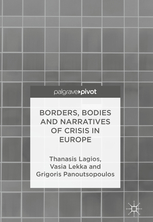 Thanasis Lagios, Vasia Lekka and Grigoris Panoutsopoulos, Borders, Bodies and Narratives of Crisis in Europe, now published with Palgrave Pivot.
This book addresses two interrelated discourses of crisis in contemporary Europe: the migrant crisis vs. the economic crisis. The chapters shed light on the thread that links these two issues by first examining immigration and the transformations regarding its control and administration via border technologies, as well as on the centrality of the body as a means and carrier of border within contemporary biopolitical societies. In a second step, the authors proceed to a genealogy of the current discourses regarding the financial and political crisis through a Foucauldian and Lacanian perspective, focusing on the co-articulation of scientific knowledge and biopolitical power in Western societies.
Thanks to Marcelo Hofman for the link. A shame about the price though.
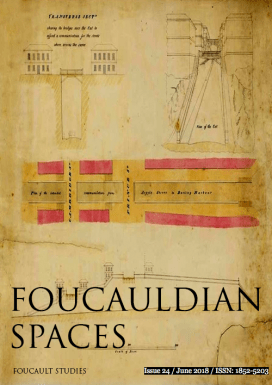 Foucault Studies 24 published – with new Foucault translation, feature on Foucaudian Spaces, and my review of the Subjectivity and Truth lecture course.
Editorial
| Editorial – Special Issue, Foucauldian Spaces
Sverre Raffnsøe |
PDF
1-5 |
Section in collaboration with Foucault Circle
| Introductory Essay: Foucauldian Spaces
Dianna Taylor, Joanna Crosby |
PDF
6-11 |
Articles
| South Africa as postcolonial heterotopia: The racialized experience of place and space
Charles Villet |
PDF
12-33 |
| The 2015 Baltimore Protests: Human Capital and the War on Drugs
Joanna Crosby |
PDF
34-57 |
| Foucault’s functional justice and its relationship to legislators and popular illegalism
Sylvain Lafleur |
PDF
58-76 |
| Round Table Discussion with Lynne Huffer, Steven Ogden, Paul Patton, and Jana Sawicki
Lynne Huffer, Steven Ogden, Paul Patton, Jana Sawicki |
PDF
77-101 |
| Monsters of Sex: Michel Foucault and the Problem of Life
Sarah K. Hansen |
PDF
102-124 |
| From the End of Man to the Art of Life: Rereading Foucault’s Changing Aesthetics
Kenneth Berger |
PDF
125-150 |
| Governing the Voice: A Critical History of Speech-Language Pathology
Joshua St. Pierre, Charis St. Pierre |
PDF
151-184 |
Translations
| Introduction: The Analytic Philosophy of Politics
Giovanni Mascaretti |
PDF
185-187 |
| The Analytic Philosophy of Politics
Giovanni Mascaretti, Michel Foucault |
PDF
188-200 |
Book Reviews
| Subjectivity and Truth review
Stuart Elden |
PDF
201-205 |
| The multiple Foucault and the Modern/Colonial International
Victor Coutinho Lage |
PDF
206-210 |
| Mariana Valverde, Michel Foucault
Christian Hammermann |
PDF
211-212 |
| Richard A. Lynch: Foucault’s Critical Ethics
Oscar Larsson |
PDF
213-216 |
 Radical Philosophy 2.02 published – open access
Five theses on sabotage in the shadow of fossil capital
Jeff Diamanti and Mark Simpson
Powerless companions or fellow travellers?
Human rights and the neoliberal assault on postcolonial economic justice
Jessica Whyte
What are popular economies? Some reflections from Argentina
Verónica Gago
Between subject and citizen:
On Etienne Balibar’s foundations for philosophical anthropology
Warren Montag
The methodological is political: What’s the matter with ‘analytic feminism’
Alice Crary
The becoming-black of the world? On Achille Mbembe’s Critique of Black Reason
David Marriott
Beyond failure and success: Revolutions and the politics of endurance
Walid el Houri
Left-wing populism
Interview with Éric Fassin
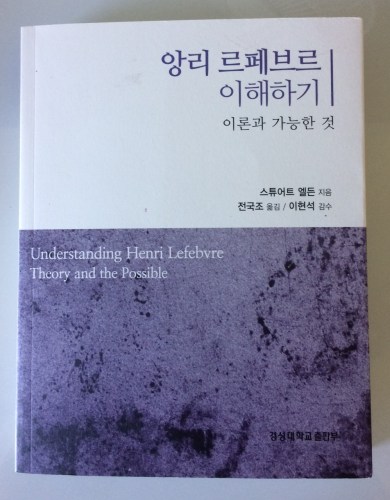 My 2004 book Understanding Henri Lefebvre: Theory and the Possible has been published in Korean translation by Kyungsung University Press. My two recent Foucault books are also forthcoming in Korean with Nanjing Publishing House.
(If anyone has a link to the Korean webpage for the book, please add in comments.) [Update: this is a link to the Korean edition]
The text is the same as the original edition, except for a brief new preface. Since that text isn’t available anywhere else, I’ve put the English version below:
Preface to the Korean edition
I began reading Henri Lefebvre almost twenty-five years ago, as I began my PhD thesis at Brunel University. My supervisor, Mark Neocleous, suggested I should read Lefebvre’s The Production of Space, recently translated into English, alongside the work I was doing on Michel Foucault. I remember a lecture I attended by Edward Soja in which he discussed Lefebvre, and that was also a great inspiration, even though I disagreed with much of what he said. I wrote initial pieces on Lefebvre at the time, though the submitted PhD only discussed Nietzsche, Heidegger and Foucault. The book which came from that thesis, Mapping the Present, focused just on Heidegger and Foucault.
My first conference presentation, in 1997, was on Lefebvre, at the University of Manchester. I remember being asked by the chair afterwards if my PhD thesis was on this topic. When I replied that it was not, he said this was good to hear, “because Lefebvre won’t get you anywhere”. While Lefebvre is certainly not the only thing I’ve worked on, this was not the case. Working on Lefebvre has led to several projects, speaking invitations and many friendships and collaborations. The most important of these initially was another conference encounter, where I met Eleonore Kofman. We began a conversation and she invited me to join her and Elizabeth Lebas on their next collection of Lefebvre’s writings. They had edited and translated Writings on Cities a couple of years before, and were planning a more general collection of his work. Eleonore and Elizabeth thought it would be helpful to have a political theorist join them, especially to work on the section on Marxism and philosophy. This was the book that became Key Writings, eventually published in 2003. In parallel with that book I produced my study of Lefebvre, the book translated here, Understanding Henri Lefebvre.
Since then most of my work on Lefebvre has been editing his work in English translation. I worked with Gerald Moore on the translation of his last book, published posthumously, Rhythmanalysis. Neil Brenner and I then brought together a selection of his political writings in the collection State, Space, World, for which Gerald worked as a translator. The long introduction to that book, and a standalone essay on Lefebvre’s thoughts on state, space and territory, both co-authored with Neil, are the last substantial pieces I have written on Lefebvre. The essay, in particular, was crucial in working through Lefebvre’s ideas on territory in dialogue with Neil, a topic which has been the focus of much of my own work. Since then, I have been working with Verso for some of Lefebvre’s philosophical writings, editing the translation of his Metaphilosophy and writing an introduction, and advising on future books, of which the next will be Hegel, Marx, Nietzsche. I also wrote a brief preface to the translation of Marxist Thought and the City. My current project is working with Adam David Morton on a collection of Lefebvre’s writings on rural questions.
Unlike other thinkers I have worked on, the written traces of Lefebvre has remained much the same. Heidegger’s collected edition, the Gesamtausgabe will stretch to over 100 volumes, only a small fraction of which were published in his lifetime. Foucault’s lecture courses, individual lectures and papers and, most recently, the fourth volume of his History of Sexuality mean that there is more and more material to take into account. With Lefebvre, this is not the case. He published much more in his lifetime than either Heidegger or Foucault, but very little has appeared since his death. Rhythmanalysis appeared very soon after he died, and in 2002 Méthodologie des sciences. Both of these were discussed in Understanding Henri Lefebvre. The research of Łukasz Stanek unearthed the manuscript Towards an Architecture of Enjoyment, as well as many shorter pieces of which I was unaware, and Lefebvre’s doctoral thesis on peasant communities in the Pyrenees has now been published. But there is not the range of material published posthumously there has been for many other thinkers. Whatever material still exists remain largely unknown. There is no archive of Lefebvre’s work accessible, save for the few traces found in the Columbia University library papers of his long-term collaborator Norbert Guterman. His lecture courses, drafts, and whatever other riches there might be remain in private hands.
As such, if I was to write this book again today I would not change a great deal. I would do more to integrate the rural research of his doctoral thesis into the account in Chapter 4. In that same chapter I would likely say more about his engagement with spatial practitioners – architects and planners – in the light of Stanek’s pioneering work. When I wrote the book the only other book length studies of Lefebvre were Rémi Hess’s biography and the English-language study by Rob Shields. There are now books by Sue Middleton, Benjamin Fraser, Chris Butler, Andy Merrifield, Nathaniel Coleman, Laurence Costes and Hugues Lethierry, along with several edited collections, as well as wide range of articles. I would do more to take into account these different interpretations and appropriations. Many more translations of Lefebvre are now available in a wide range of global languages, testament to his enduring appeal and use.
Lefebvre was a thinker of specific place and time, though his work has proved influential in a range of other contexts and disciplines far beyond his own practice in philosophy and sociology. I very much hope that this guide proves useful to his readers in Korea.
Call for Papers: Third Meeting of the Critical Genealogies Workshop
University of Oregon in Eugene, OR
May 9–11, 2019
The Critical Genealogies Workshop provides a space of collaboration and experimentation for scholars who deploy genealogy in order to investigate problematizations of the contemporary. The purpose of the event is to present in-progress genealogical work so as to thematize and reflect on larger questions of research design, strategy, and structure and practical questions about conducting genealogical research.
We seek submissions from scholars from any disciplinary or field background who deploy genealogical methods and practices in their work: previous events have included scholars from Philosophy, Political Science, History, Media Studies, and other backgrounds. Approaching genealogy largely through the lens of Foucault and Nietzsche, we also welcome other genealogical approaches of diverse inspiration. Above all, we endeavor to take seriously Foucault’s challenges to inherited practices of philosophical critique by taking up genealogy to interrogate the history of the present.
The format of the workshop involves pre-circulation of in-progress work. This will be a pre-read event; participants are expected to share their papers by March 2019 and are expected to read papers from other participants prior to arrival. Concurrent sessions will feature paper presentations consisting of two sets of brief commentaries (5 minutes each) followed by group discussion (35 minutes). The event will also feature a plenary roundtable on method and research design as well as a methods workshop session.
Please send an abstract of no more than 750 words in “.pdf” format to the event co-directors Verena Erlenbusch-Anderson (University of Memphis), Colin Koopman (University of Oregon), and Bonnie Sheehey (University of Oregon) at criticalgenealogies@gmail.com by Nov. 2, 2018. Indicate “Critical Genealogies Workshop submission” in the subject line. Decisions will be conveyed by Dec. 15, 2018.
Logistical information about accommodations & transportation will be provided with program decisions. There will be no registration fees associated with this event.
For further information see our website (criticalgenealogies.weebly.com) or contact CGW co-founders Verena Erlenbusch-Anderson (vrlnbsch@memphis.edu) and Colin Koopman (koopman@uoregon.edu).
Also at Progress in Political Economy, Oliver Mispelhorn on J.K. Gibson-Graham
I first became aware of the work of J.K. Gibson-Graham a few years ago, when a friend recommended that I read their seminal work The End of Capitalism (As We Knew It): A feminist Critique of Political Economy. Being instantly fascinated by what the book suggested, I bought a copy and began reading. Upon first attempt, however, I found it impenetrable. Over a year later, on second attempt, I managed to get through the book cover to cover. I found it an incredibly engaging and stimulating read. This is where Julie Graham and Katherine Gibson lay out their ontological and discursive agenda: [continues here]
Adam David Morton on Victor Serge – a Progress in Political Economy blogpost linked to a new article.
One of the most striking features of Victor Serge’s writings has to be the way he captures spatial arbiters that shape the practices of empowerment and containment within the territorial form of the city. As argued in my latest journal article published here in Annals of the American Association of Geographers, flowing across his documentary or witness novels, his political writings, his poetry, or his memoirs as a revolutionary is a sense of the political processes shaping urban society, the space of the city, and the possibilities of revolution rising up from the streets. My argument in the article, drawing from Henri Lefebvre, is that this is nowhere more evident than in his novels Conquered City [1932] and The Case of Comrade Tulayev [1942]. [continues here]
Although the Shakespeare Territories book is coming out in a few months, I’ve been back working on Shakespeare. Initially this was for a summary article of the book’s argument for a short article for Territory, Politics, Governance, which should be published fairly soon. Then it has been for the third in what is becoming a sequence of pieces on Foucault and Shakespeare – the others were on ceremony (open access) and madness (forthcoming). This new piece is on contagion, for a conference organised by the Kingston Shakespeare seminar on 23 June. I’ve enjoyed returning to Shakespeare again for this new piece, which has a long discussion of Troilus and Cressida, and a shorter one of All’s Well That Ends Well – two plays I only mentioned briefly in Shakespearean Territories. I’ll also be a speaking about Shakespeare at an event organised by Warwick and RADA for sixth-form students on 29 June. I’ll be presenting about four scenes with a territorial focus, and then the students will work on the scenes and perform them. The plan is to do the opening scenes of King Lear and Hamlet, the map division scene from Henry IV, Part 1 and the Venetian Council scene from Othello.
The main task for the first part of the summer will be revising the Canguilhem manuscript. This was a challenging book to write, and there is still work to do. I need to resubmit in mid-July with a view to the book being published in 2019. The Lefebvre work is also now back in progress, after long being stalled due to things outside my control.
The aim then will be to return to The Early Foucault, as there is certainly a lot I still want to do. But the Lille and ENS courses from the early 1950s are planned for publication and I think it makes sense to wait for this, although I have read them in manuscript. They are dense and difficult texts, and the editors will doubtless provide a lot of value in their work. I’m imagining that my work will run ahead of the publishing schedule, with a least one volume of 1960s material likely to appear first in the new sequence of courses. So I will likely have to leave a near-complete manuscript until the publishing catches up. I also want to have an extended period of time in Uppsala, working with the Bibliotheca Walleriana which Foucault used in the mid-late 1950s, and I’m thinking of ways to do that.
I have few talks scheduled for the next academic year, though the ones that will require new material are not for a while. As well as a proper holiday this summer, I also have a couple of weeks away where I plan to combine work with cycling in a more interesting area. I’m hoping some of that time can be spent reading – and reading where I am not intending that to be immediately useful. In recent years the time for reading generally and widely seems to be continually shrinking – everything seems to be instrumental for what I am working on at that time. I’m hoping to break that pattern and make time to read important but non-essential things.
I’ve also been conscious that this blog has been much less active in recent months, and that what I have posted has been largely notices. Perhaps I will have some time to do something about this, although I’m noticing lots of the blogs I follow have become less active and that other platforms, notably Twitter, seem to be taking over some of this work for academics.

Logistical Worlds (sent by the publisher), Gaston Bachelard, The Dialectic of Duration, Michel Serres, The Birth of Physics, Laura Cremonesi et al eds, Foucault and the Making of Subjects (all recompense for review work), Miguel de Beistegui, The Government of Desire: A Genealogy of the Liberal Subject (from Miguel), and Veronica Strang et al. eds., From the Lighthouse: Interdisciplinary Reflections on Light (which I endorsed).

