Foucault’s Confessions of the Flesh – audio recording of talk at Goldsmiths, 9 May 2018

hs-iv.jpgI gave a talk about Foucault’s Les aveux de la chair on May 9th at the Centre for Philosophy and Critical Thought, Goldsmiths University. Full details here.

The talk was based on my review essay on the book, published on the Theory, Culture & Society website. If you’ve read that review, then there is little in the talk beyond it, but since a couple of people asked, an audio recording of the talk is available here.


In February 2018 the fourth volume of Michel Foucault’s History of Sexuality was finally published. Les Aveux de la chair [Confessions of the Flesh] was edited by Frédéric Gros, and appeared in the same Gallimard series as volumes 1, 2 and 3. The book treats the early Christian Church Fathers of the 2nd-5th century. This talk will discuss the book in relation to Foucault’s other work, showing how it sits in sequence with volumes 2 and 3, but also partly bridges the chronological and conceptual gap to volume 1. It will discuss the state of the book and whether it should have been published, despite Foucault’s stipulation of ‘no posthumous publications’. It will outline the contents of the book, which is in three parts on the formation of a new experience, on virginity and on marriage. There are also some important supplementary materials included. The talk will discuss how it begins to answer previously unanswered questions about Foucault’s work, and will also say something about how the book might be received and discussed.
Posted in Foucault's Last Decade, Michel Foucault, Uncategorized | 3 Comments

Derrida’s Margins: Inside the personal library of Jacques Derrida

downloadDerrida’s Margins: Inside the personal library of Jacques Derrida

For Jacques Derrida (1930-2004), reading was an active process: he read texts by thinkers like Rousseau, Heidegger, Lévi-Strauss, Hegel, and Husserl with a writing utensil in hand.  As Derrida affirmed in a late interview, the books in his personal library bear the “traces of the violence of pencil strokes, exclamation points, arrows, and underlining.”

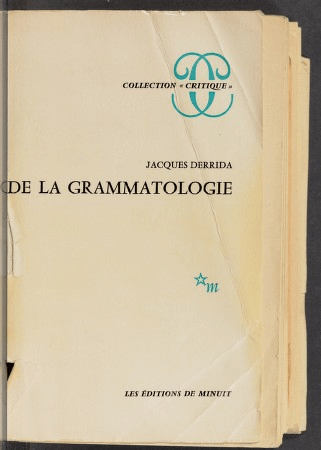
Derrida’s Margins invites scholars to investigate these markings while unpacking the library contained within each of Derrida’s published works, beginning with the landmark 1967 text De la grammatologie (Of Grammatology).  Additional Derrida works will be added as the project continues.

The website catalogues each reference (quotation, citation, footnote, etc.) in De la grammatologie and allows users to explore Derrida’s personal copies of the texts he cites. Due to copyright restrictions, only annotated pages corresponding to references in De la grammatologie are shown here; users may also view external images of each book as well as images of the numerous insertions (post-it notes, bookmarks, calendar pages, index cards, correspondence, notes, etc.) Derrida tipped in to his books.

The website includes the following sections, accessible via the links in the four corners of this page: Derrida’s Library, where users may browse or search Derrida’s copies of the books referenced in De la grammatologieReference List, where users may browse or search the nearly one thousand references to other texts found in the pages of De la grammatologie; Interventions, where users may browse or search Derrida’s annotations, marginalia, and markings that correspond to the references in De la grammatologie; and Visualization, which provides users with alternative ways of exploring the references in De la grammatologie.  Users may search a particular section or the entire site at any time by using the search field at the top of every page.  

The Library of Jacques Derrida is housed at Princeton University Library’s Rare Books and Special Collections.

Posted in Jacques Derrida, Uncategorized | 4 Comments

David Beer on the process of writing The Data Gaze: Capitalism, Power and Perception

92857_9781526436924The next book in the Society and Space book series will be David Beer, The Data Gaze: Capitalism, Power and Perception. Dave has an interesting post on the process of writing the book at Medium.

A significant new way of understanding contemporary capitalism is to understand the intensification and spread of data analytics. This text is about the powerful promises and visions that have led to the expansion of data analytics and data-led forms of social ordering.

It is centrally concerned with examining the types of knowledge associated with data analytics and shows that how these analytics are envisioned is central to the emergence and prominence of data at various scales of social life.  This text aims to understand the powerful role of the data analytics industry and how this industry facilitates the spread and intensification of data-led processes. As such, The Data Gaze is concerned with understanding how data-led, data-driven and data-reliant forms of capitalism pervade organisational and everyday life.

Using a clear theoretical approach derived from Foucault and critical data studies the text develops the concept of the data gaze and shows how powerful and persuasive it is. It’s an essential and subversive guide to data analytics and data capitalism.

Posted in Society and Space, Uncategorized | Leave a comment

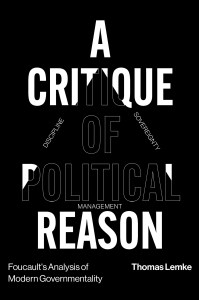
Thomas Lemke, A Critique of Political Reason: Foucault’s Analysis of Modern Governmentality – forthcoming with Verso in January 2019

Lemke---Critique-of-Political-Reason-c0bda97e498ee06279c0258d0e2577ecAlso with Verso, the long overdue translation of Thomas Lemke, A Critique of Political Reason: Foucault’s Analysis of Modern Governmentality – forthcoming in January 2019.

Lemke offers the most comprehensive and systematic account of Michel Foucault’s work on power and government from 1970 until his death in 1984. He convincingly argues, using material that has only partly been translated into English, that Foucault’s concern with ethics and forms of subjectivation is always already integrated into his political concerns and his analytics of power. The book also shows how the concept of government was taken up in different lines of research in France before it gave rise to “governmentality studies” in the anglophone world. A Critique of Political Reason provides a clear and well-structured exposition that is theoretically challenging but also accessible for a wider audience. Thus, the book can be read both as an original examination of Foucault’s concept of government and as a general introduction to his “genealogy of power’.

Posted in Michel Foucault, Uncategorized | 2 Comments

Deborah Cook, Adorno, Foucault and the Critique of the West – forthcoming with Verso, October 2018

Cook---Critical-Matrix-3461dfcb5160dd47c54bad815441e71c.jpg

Adorno, Foucault and the Critique of the West by Deborah Cook, forthcoming with Verso, October 2018

Adorno, Foucault, and the Critique of the West argues that critical theory continues to offer valuable resources for critique and contestation during this turbulent period in our history. To assess these resources, it examines the work of two of the twentieth century’s more prominent social theorists: Theodor W. Adorno and Michel Foucault. Although Adorno was situated squarely in the Marxist tradition that Foucault would occasionally challenge, Cook demonstrates that their critiques of our current predicament are complementary in important respects. Among other things, they converge in their focus on the historical conditions—economic in Adorno and political in Foucault—that gave rise to the racist and authoritarian tendencies that continue to blight the West. But this book will also show that as Adorno and Foucault plumb the economic and political forces that have shaped our identities, they offer remarkably similar answers to the perennial question: What is to be done?

Reviews

“Foucault’s relation to the Frankfurt School and the work of one of its key theorists was long overdue a critical reappraisal. Neither reducing one thinker to the other, not drawing artificial lines between traditions, this is bold and thoughtful contribution to this valuable work. It should be required reading and the basis of wide critical engagement.”

Posted in Michel Foucault, Uncategorized | 1 Comment

Thoughts on borders

Christopher Smith on borders in the ancient world

Christopher Smith's avatarAnatomies of Power

For reasons both of a peripatetic existence, of the places in which that has taken place, and a growing concern in the relationship between power and the capacity to make definitions, topographic and otherwise, I have been thinking about borders, and what Greek and Roman antiquity might contribute to such a contested concept.

  1. The ubiquity of borders

Borders and boundaries have been ubiquitous.  We have seen the moment when the period since the fall of the Berlin Wall exceeded the time of its existence.  The most contentious remaining element of the current negotiations between the UK and Europe revolves around a border we thought we had almost eradicated.  Boundaries from picket lines to barbed wire lines to threatened walls have etched their cartographic existence into geographic memory, whilst metaphoric red lines and hostile environments have contributed to devastating psychological and physical damage.
berlin-1647098__480
A world without borders is barely conceivable in…

View original post 1,899 more words

Posted in Uncategorized | 1 Comment

American Book Review theme on Critical Lives – including piece by me on Foucault

A theme section of American Book Reviewpdfimage.png has just been published. Edited by Robert T. Tally Jr., it includes reviews of a number of recent biographies of social theorists and philosophers – Freud, the Frankfurt School, Habermas, Schmitt, Deleuze, Barthes, Hall and others.

I have a piece in there entitled ‘Do we need a new biography of Michel Foucault?‘ which is in place of a review, since there have been no new biographies since Eribon, Macey and Miller in the 1990s. I reflect on those biographies, and the later editions of Eribon’s biography, in the light of the research I’ve done for my Foucault books and newly available materials.

The issue is subscription only, but I’m happy to share my piece.


Posted in Michel Foucault, Uncategorized | Leave a comment

Keith Ansell-Pearson, Bergson reviewed at NDPR

9781350043947Keith Ansell-Pearson, Bergson: Thinking Beyond the Human Condition (Bloomsbury, 2018) is reviewed at NDPR by Donald A. Landes. Here’s the publisher description:

A thought-provoking contribution to the renaissance of interest in Bergson, this study brings him to a new generation of readers. Ansell-Pearson contends that there is a Bergsonian revolution, an upheaval in philosophy comparable in significance to those that we are more familiar with, from Kant to Nietzsche and Heidegger, that make up our intellectual modernity.

The focus of the text is on Bergson’s conception of philosophy as the discipline that seeks to ‘think beyond the human condition’. Not that we are caught up in an existential predicament when the appeal is made to think beyond the human condition; rather that restricting philosophy to the human condition fails to appreciate the extent to which we are not simply creatures of habit and automatism, but also organisms involved in a creative evolution of becoming.

Ansell-Pearson introduces the work of Bergson and core aspects of his innovative modes of thinking; examines his interest in Epicureanism; explores his interest in the self and in time and memory; presents Bergson on ethics and on religion, and illuminates Bergson on the art of life.

Posted in Uncategorized | Leave a comment

Foucault and Shakespeare – symposium at Garrick’s Temple, 23 June 2018

garricks-temple-sept-3-2016.jpgFoucault and Shakespeare – symposium at Garrick’s Temple, 23 June 2018

David Garrick built his Shakespeare Temple beside the Thames at Hampton in 1755 as a place where ‘the thinkers of the world’ would meet to reflect on the plays. He hoped Voltaire would come. Now the Kingston Shakespeare Seminar is realising the great actor’s vision, with a series of symposia on Shakespeare in Philosophy. Each of these Saturday events features talks by leading philosophers and Shakespeare scholars, coffee and tea in the riverside garden designed by Capability Brown, and lunch at the historic Bell Inn.

I’ll be one of the speakers at this event, with other contributions from Tom Brockelman, Jonathan Dollimore, Kélina Gotman, Jennifer Rust, Duncan Salkeld and Richard Wilson. I’ll be speaking about ‘Foucault, Shakespeare, Contagion’, which is mainly through a discussion of Troilus and Cressida.

To register, go to the Eventbrite page; more details here.

Posted in Michel Foucault, Uncategorized, William Shakespeare | 1 Comment

Recent reviews of my Foucault books – Mike Gane, JM Moore and Nancy Luxon

Foucault: The Birth of Power is reviewed by Nancy Luxon in Perspectives in Politics, and by JM Moore in Justice, Power and Resistance. That book, and Foucault’s Last Decade are also discussed in a review essay by Mike Gane in Cultural Politics, which also looks at two of Foucault’s courses. The Gane essay is critical, the Moore one is very positive, while the Luxon is positive but opens up some issues about how we might use Foucault too. The Moore one is open access, the others are behind pay-walls.

I’m not going to get into a bigger debate, especially with Gane, where there are clearly fundamental disagreements. But I will point out a few things. If I had wanted to write a book about how to use Foucault, then I would have tried to do that. I’ve been clear all along that I’m trying to write intellectual history. It’s interesting that Moore, who seems most involved in using Foucault in his own work with prisoners, found the book of worth for that project. In terms of the project of a socialist governmentality, what I think I do is to show the evidence for what Foucault had in mind, combining archives, interviews and other reports. I’d hope that was some use to someone interested in taking up the idea. I think Gane is wrong to say that the archives hold no interest. He takes a wilfully wrong-headed reading of my text to get there, suggesting that I was annoyed a box didn’t contain what I thought, when the point was to say the materials related to no previously-known project, which I then discuss. I’m prepared to accept I don’t make the importance of the archives as clear as I’d like. But to say there is nothing of interest there is just nonsense. Also, the idea that we already had most of the insights of Les Aveux de la chair before it was actually published seems wrong. Now the book is published, people can decide for themselves. My initial take is here.

Finally, while Luxon’s review begins and ends with the location of the Foucault archive, his papers are not actually at the newer BnF building – the Mitterand site – but at the older Richelieu one some miles away in the centre of Paris. Foucault spent a huge amount of his working life at the Richelieu library, which used to be the main site, so I think it’s actually entirely fitting that his papers ended up there, even if he got fed up with the library late in life, and moved to the Dominican Saulchoir library.

All the other reviews of these books are linked from this page.

Posted in Foucault's Last Decade, Foucault: The Birth of Power, Michel Foucault, Uncategorized | 1 Comment