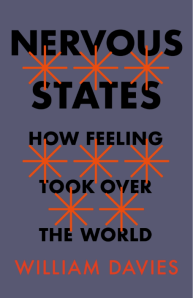
William Davies, Nervous States: How Feeling Took Over the World – forthcoming in September 2018 with Penguin

cover.jpg.rendition.460.707William Davies, Nervous States: How Feeling Took Over the World

In this age of emotional political conflict, there is less and less to agree upon. Experts are no longer respected as impartial; public debate is reduced to attack and counter-attack; the boundary between facts and propaganda seems to be dissolving. We live in a world not quite at war but nor exactly at peace.

How did things reach this point, and what can we do about it? In this enlightening, far-reaching and provocative book, William Davies explores how physical and emotional feeling came to reshape our world today, destabilising governments and placing us all on high-alert. Drawing on a 400-year history of scientific and political ideas, he shows how our sensations were once treated with suspicion, before being seized enthusiastically as a path to mass mobilisation in war.

As we enter a new technological and political era, this book reveals the origins of the nervous states in which we now live.

Posted in Uncategorized | 1 Comment

Stuart Schrader, ‘Henri Lefebvre, Mao Zedong, and the Global Urban Concept’

Stuart Schrader, ‘Henri Lefebvre, Mao Zedong, and the Global Urban Concept’ at Global Urban History.

Global urban history takes three primary forms. One is to direct the analytic gaze beyond Euro-America, to cities that were once “off the map” of urban studies. Another is to study the interconnections among far-flung cities. Extensive commercial, cultural, and intellectual networks that underpin “globalization” have long been grounded in cities. With the increasing popularity of global and world history, it makes sense to emphasize the centrality of cities and the unique role they play in globalization. A third form is to analyze the history of an uneven global urban fabric. Works like Carl Nightingale’s Segregation or Mike Davis’s Planet of Slums analyze how the form of the urban changes as it also “globalizes.” In this post, I delve into this third mode of global urban history.

Urban Revolution CoverThe theoretical innovation that allows us to conceive of an uneven global urban fabric itself has an intellectual history. One important genealogy draws us back to the French social theorist Henri Lefebvre, particularly his work on space and the urban in the late 1960s and early 1970s. He is a key figure who inspired the “spatial turn” in the humanities and social sciences. Yet what inspired Lefebvre to develop a global urban concept, and to whom was it addressed? [continues here]

Posted in Uncategorized | 1 Comment

Pod save Austria: Addresses on the State of the Nation(s), 14-20 May 2018

I’ll be speaking at this event, with my talk on 19 May on the topic of ‘Terror and the State of Territory’. Gudrun Harrer and Saskia Stachowitsch will be responding. My talk will draw on previous work on territory, both political and historical-conceptual, with some reference to more recent events and my work on terrain.

Talks in the series will be in English and German. There is an English version of the programme here. I’ll share the recording when available.

POD_exportPod save Austria
Addresses on the State of the Nation(s)

May 14-20, 2018, daily at 6pm (CET)
Live from the studio at “Bau.Stelle Parlament“, Vienna

Live radio and public recording of a podcast series
on www.festwochen.at, http://radioee.net, Radio Orange 94.0
and selected audio stations in Vienna

Pod Save Austria, a performative installation between radio art and podcast, revives the radio tradition of political invocations of community. The starting point is the observation that sovereignty today appears to be diffusing and is increasingly producing porous nation-states. But the autonomy of the subjects is also caught in dense networks of technicalities and mega-structures that operate in the background. In a series of public talks in this rhetoric that formerly served to represent governments, thinkers, artists and political activists attempt to find partial sovereignties in the face of collapsing worlds.

With: Sabeth Buchmann, Dipesh Chakrabarty, Kai van Eikels, Stuart Elden,
Elena Esposito, Paul Feigelfeld, Martin Gasteiner, Ulrike Guérot, Gudrun Harrer, Elisabeth Holzleithner, Eva Horn, Ivan Krastev, Daniel Loick, Fred Luks, Niccoló Milanese, Gerald Nestler, radioee.net, Shalini Randeria, Katrin Solhdju, Saskia Stachowitsch, Friedrich Tietjen, Joseph Vogl.

Programme:
http://www.festwochen.at/en/programme/detail/pod-save-austria/
https://www.facebook.com/events/2081064318773788/

Podcasts will be online on May 28, 2018.

Posted in terrain, Territory, Terror and Territory, The Birth of Territory, Uncategorized | Leave a comment

Not talking in Warwick and Leuven on Foucault

Since I’ve mentioned that there would be talks in Warwick and Leuven on Foucault later this month, I should now say that neither will be happening, or at least not yet. Details of all future talks are here, and I’ll post more if rescheduled.

Posted in Michel Foucault, Uncategorized | Leave a comment

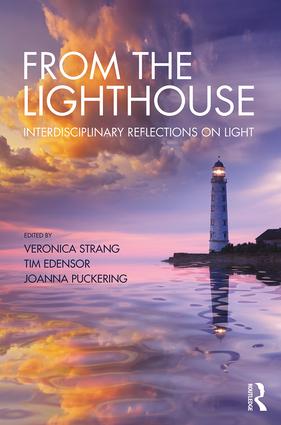
From the Lighthouse: Interdisciplinary Reflections on Light, edited by Veronica Strang, Tim Edensor, and Joanna Puckering


9781472477354From the Lighthouse: Interdisciplinary Reflections on Light, edited by Veronica Strang, Tim Edensor, and Joanna Puckering – now out with Routledge.

What is a lighthouse? What does it mean? What does it do? This book shows how exchanging knowledge across disciplinary boundaries can transform our thinking. Adopting an unconventional structure, this book involves the reader in a multivocal conversation between scholars, poets and artists. Seen through their individual perspectives, lighthouses appear as signals of safety, beacons of enlightenment, phallic territorial markers, and memorials of historical relationships with the sea. However, the interdisciplinary conversation also reveals underlying and sometimes unexpected connections. It elucidates the human and non-human evolutionary adaptations that use light for signalling and warning; the visual languages created by regularity and synchronicity in pulses of light; how lighthouses have generated a whole ‘family’ of related material objects and technologies; and the way that light flows between social and material worlds.


Posted in Uncategorized | 1 Comment

Les aveux de la chair: Comment la libido a-t-elle été inventée ? (2018)

Discussion of Foucault’s History of Sexuality volume IV, with editor Frédéric Gros.

Clare O'Farrell's avatarFoucault News

Comment la libido a-t-elle été inventée ? Les aveux de la chair

podcast

Comment notre sexualité en est-elle venu à faire la vérité sur nous-mêmes ? Et comment est-elle devenue coupable à travers les aveux de la chair ? Foucault interroge « ce moment où, dans l’histoire de la subjectivité, on va dire : pour savoir qui tu es, interroge d’abord ta sexualité. ». Le dernier tome de l’Histoire de la Sexualité présenté par Frédéric Gros.

View original post

Posted in Uncategorized | Leave a comment

Bibliography of Foucault’s shorter writings in English translation (2018)

Richard Lynch’s very useful bibliography has been updated.

Clare O'Farrell's avatarFoucault News

Editor: Richard Lynch has updated his bibliography of Foucault’s shorter writings in English translation. You can find the bibliography on the resources pages of Foucault News.

You can also find other bibliographies on the resources pages:

If there is material missing please let me know, either via email or via the comments sections on the relevant pages.

View original post

Posted in Uncategorized | Leave a comment

Couze Venn, After Capital – now out with Sage

90453_9781526450135Couze Venn, After Capital – now out with Sage

The present crisis of capitalism has a history. A history of the private accumulation of wealth through property regimes which allow increasing commodification and the privatisation of resources: from land to knowledge and even to life itself. Understanding that history may allow us to imagine alternatives after Capital which are no longer private but common.

After Capital explores this history, showing how the economy is linked to environmental damage, climate change, resource depletion, and to massive inequality. It takes the reader from liberalism to neoliberalism, from climate change to the Anthropocene, and shows how this history is inextricably the history of colonialism. It is a rich and detailed narrative of capitalism over the last 200 years, that explains its texture and its neoliberal endgame.

This discussion frames speculation on what postcapitalist societies could be, with regimes of private accumulation replaced by a politics and ethics of a democratic and ecologically- grounded Commons.

This extraordinary work synthesises, extends and originates a vast range of scholarship and critical thought. In doing so, it offers the most concise yet most comprehensive account of the crisis of our times, and of the very nature of capitalism as such, to have been produced for many years. Couze Venn is one of the great unsung intellectual heroes of our age; how many other thinkers are able to synthesise post-structuralist philosophy and postcolonial theory with Marxist political economy and critical ecology, without a trace of superficiality in their approach to any of these sources? How many would even dare to try? This is an invaluable book for anyone who wants to think politically about the state of the world today, inside or outside the academy, in any discipline.

Jeremy Gilbert, University of East London.


After Capital takes the risky path that our bleak circumstances demand. This thoughtful and learned intervention boldly spells out protocols for a new way of living. Moving between critique and urgent, unsentimental speculation, Couze Venn identifies the novel habits required to sustain life beyond the war, waste and squalor of contemporary capitalism.

Paul Gilroy, Kings College, University of London.


A tour de force. It is difficult to overstate the importance of this book- not only for the present but for many generations to come.

Valerie Walkerdine. Cardiff University.


I could not recommend a better book to those interested not only in the interdependence of the multiple crises (environmental, economic and political) that we are currently entangled in, but also in alternative visions for the future. After Capital is outstanding scholarship that daringly and passionately articulates new conceptual frameworks that makes clear the potential of a post-capitalist and post-anthropocentric cosmopolitics of the commons to make life after capital something to look forward to.

Dr Tiziana Terranova, University of Naples, L’Orientale.


With typical depth and thoughtfulness, Couze Venn explores and untangles the intricately woven and mammoth issues that we face today.

Erudite and scholarly, these pages are a revelation and guide in our complex and uncertain times.

Dr Dave Beer, Reader, York University


Posted in Uncategorized | Leave a comment

Canguilhem, Œuvres complètes Tome V : Histoire des sciences, épistémologie, commémorations 1966-1995 – delayed again (now September 2018)

9782711623648.jpgGeorges Canguilhem, Œuvres complètes Tome V : Histoire des sciences, épistémologie, commémorations 1966-1995 was originally due to appear in January 2018. It has slipped three times – to March, to May and is now listed for September.

Quelque cent vingt écrits publiés de 1966 à 1995 composent ce tome V des Œuvres complètes de Georges Canguilhem.
Une cinquantaine furent de ceux qui établirent sa réputation comme historien des sciences et comme épistémologue. D’autres, souvent passés plutôt inaperçus, éclairent les voies par lesquelles, instruit des avancées de la biologie moléculaire, Canguilhem crut devoir mener le réexamen de sa philosophie biologique. Plusieurs écrits montrent combien Canguilhem, à contre-courant des naturismes en vogue, avait le souci de mener et de poursuivre une réflexion éthique sur les questions de la technique et de la médecine. Dans nombre de notices ou de discours touchant des collègues ou d’amis disparus, nombreux dans ce tome V, il relève les exigences intellectuelles et morales qui animèrent leur vie. Le lecteur reconnaïtra que ces exigences furent également les siennes, loin des facilités de la mondanité philosophique.
Textes édités, introduits et annotés par Camille Limoges

I’d really hoped that this would be published before I submitted my Canguilhem book. Not only would it have helped locate some hard-to-find pieces, it would have substantially reduced the references if I could refer to so many pieces in a single source. Volumes I and IV are already published, and II and III will comprise the books Canguilhem published in his lifetime, all of which are easily available. Having Volume V will therefore mean easy access to all the published works. The planned Volume VI will be a biography, bibliography, index and some other things.

I can only imagine the rights issues that go into a project of this kind, given the diverse plans Canguilhem published. But it is still really frustrating.
Posted in Canguilhem (book), Georges Canguilhem, Uncategorized | Leave a comment

Katherine Gibson: First Take Back the Night, Now Take Back the Economy (video)

Katherine Gibson’s (Western Sydney University) inaugural Women in Geographical and Earth Sciences Lecture at the University of Glasgow (March 2018).

First Take Back the Night, Now Take Back the Economy: Feminist and Queer Strategies for Imagining and Enacting Other Possible Worlds

via Katherine Gibson: First Take Back the Night, Now Take Back the Economy

Posted in Uncategorized | 1 Comment