
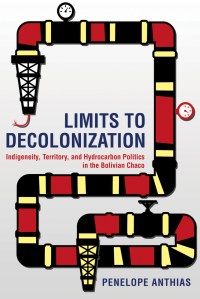
Penelope Anthias, Limits to Decolonization: Indigeneity, Territory, and Hydrocarbon Politics in the Bolivian Chaco

80140100747480LPenelope Anthias, Limits to Decolonization: Indigeneity, Territory, and Hydrocarbon Politics in the Bolivian Chaco – now out with Cornell University Press. This is the first volume in a new series, Land: New Perspectives on Territory, Development, and Environment, edited by Wendy Wolford.

Penelope Anthias’s Limits to Decolonization addresses one of the most important issues in contemporary indigenous politics: struggles for territory. Based on the experience of thirty-six Guaraní communities in the Bolivian Chaco, Anthias reveals how two decades of indigenous mapping and land titling have failed to reverse a historical trajectory of indigenous dispossession in the Bolivian lowlands. Through an ethnographic account of the “limits” the Guaraní have encountered over the course of their territorial claim—from state boundaries to landowner opposition to hydrocarbon development—Anthias raises critical questions about the role of maps and land titles in indigenous struggles for self-determination.

Anthias argues that these unresolved territorial claims are shaping the contours of an era of “post-neoliberal” politics in Bolivia. Limits to Decolonization reveals the surprising ways in which indigenous peoples are reframing their territorial projects in the context of this hydrocarbon state and drawing on their experiences of the limits of state recognition. The tensions of Bolivia’s “process of change” are revealed, as Limits to Decolonization rethinks current debates on cultural rights, resource politics, and Latin American leftist states. In sum, Anthias reveals the creative and pragmatic ways in which indigenous peoples contest and work within the limits of postcolonial rule in pursuit of their own visions of territorial autonomy.

“With this book Penelope Anthias has the potential to shape scholarly debates around indigenous struggles, neoliberalism, and postcolonial rule in important ways. Limits to Decolonization is a thoughtful challenge to the prevailing scholarship.”

– Aaron Bobrow-Strain, Associate Professor of Politics, Whitman College

Limits to Decolonization is a sensitive account of a peoples’ struggle for land and livelihood against the weight of centuries of colonialism and the power of the new extractivism. It is a great piece of work.”

 – Bret Gustafson, Associate Professor of Sociological Anthropology, Washington University

“Anthias offers an entirely new and compelling account of the relations between hydrocarbons, identity, and space. Ethnographically rich, historically framed, and theoretically sophisticated, Limits to Decolonization is a provocative and powerful account of contemporary extractivism, movements from below and the operations of power in indigenous struggles.”

– Michael J. Watts, Class of 63 Professor, University of California, Berkeley

Thanks to Mara Duer for telling me about this book.

Posted in Uncategorized | Leave a comment

David Macey, The Lives of Michel Foucault – to be reissued by Verso in 2019, with Afterword by Stuart Elden

Macey---Lives-of-Foucault-(dragged)-650f6b95125d9c2c43a563be8ebe9690.jpgDavid Macey’s biography, The Lives of Michel Foucault will appear in a reissued edition with Verso in January 2019, with an afterword by me.

Update: now published. Verso site.

When he died of an AIDS-related condition in 1984, Michel Foucault had become the most influential French philosopher since the end of World War II. His powerful studies of the creation of modern medicine, prisons, psychiatry, and other methods of classification have had a lasting impact on philosophers, historians, critics, and novelists the world over. But as public as he was in his militant campaigns on behalf of prisoners, dissidents, and homosexuals, he shrouded his personal life in mystery. In The Lives of Michel Foucault — written with the full cooperation of Daniel Defert, Foucault’s former lover — David Macey gives the richest account to date of Foucault’s life and work, informed as it is by the complex issues arising from his writings. In this new edition, Foucault scholar Stuart Elden has contributed a new afterword assessing the contribution of the biography in the light of more recent literature.

Posted in Michel Foucault, Uncategorized | 1 Comment

Catherine Millot, Life with Lacan reviewed by Stuart Jeffries in The Spectator

lacanThe English translation of Catherine Millot, Life with Lacan is reviewed by Stuart Jeffries in The Spectator
The review is open access. Here’s Polity’s description of the book.

‘There was a time when I felt that I had grasped Lacan’s essential being from within – that I had gained, as it were, an apperception of his relation to the world, a mysterious access to that intimate place from which sprang his relation to people and things, and even to himself. It was as if I had slipped within him.’

In this short book, Catherine Millot offers a richly evocative reflection on her life as analysand and lover of the greatest psychoanalyst since Freud. From time in Paris to his country house in Guitrancourt, Millot provides unparalleled insight into Lacan’scharacter as well as his encounters with other major European thinkers of the time. She also sheds new light on key themes, including Lacan’s obsession with the Borromean knot and gradual descent into silence, all enlivened by her unique perspective.

This beautifully written memoir, awarded the Prix de littérature André-Gide, will be of interest to anyone wishing to understand the life and character of a thinker who continues to exert a wide influence in psychoanalysis and across the humanities and social sciences.

Posted in Jacques Lacan, Uncategorized | Leave a comment

Andreas Bieler and Adam David Morton, Global Capitalism, Global War, Global Crisis – now out with Cambridge
9781108452632Andreas Bieler and Adam David Morton, Global Capitalism, Global War, Global Crisis – now out with Cambridge University Press

This book assesses the forces of social struggle shaping the past and present of the global political economy from the perspective of historical materialism. Based on the philosophy of internal relations, the character of capital is understood in such a way that the ties between the relations of production, state-civil society, and conditions of class struggle can be realised. Conceiving the internal relationship of global capitalism, global war, global crisis as a struggle-driven process is a major contribution of the book providing a novel intervention on debates within theories of ‘the international’. Through a set of conceptual reflections, on agency and structure and the role of discourses embedded in the economy, class struggle is established as our point of departure. This involves analysing historical and contemporary themes on the expansion of capitalism through uneven and combined development (global capitalism), the role of the state and geopolitics (global war), and conditions of exploitation and resistance (global crisis). The conceptual reflections and thematic considerations raised earlier in the book are then extended in a series of empirical interventions. These include a focus on the ‘rising powers’ of the BRICS (global capitalism), conditions of the ‘new imperialism’ (global war), and the financial crisis since the 2007–8 Great Recession (global crisis). As a result of honing in on the internal relations of global capitalism, global war, global crisis the final major contribution of the book is to deliver a radically open-ended dialectical consideration of ruptures of resistance within the global political economy.

  • Provides the definitive account of the internal relations of global capitalism, global war, global crisis shaping contemporary world order
  • Makes a major intervention in debates across the social sciences from a historical materialist perspective
  • Delivers key insights on the expansion of capitalism through uneven and combined development (global capitalism), the role of the state and geopolitics (global war), and conditions of exploitation and resistance (global crisis)

‘A glorious debate on ways of seeing capital and state hegemony as relational and material, from global capitalism in China, to global war in Iraq and the new Bomb-and-Build imperialism, to global crisis in the Eurozone. Andreas Bieler and Adam Morton deliver a rigorous and uncompromising geopolitical text. They also honour the insights of ecological and reproduction feminists on appropriation-accumulation by non-economic means-identifying expanded forms of class struggle emergent today in the grassroots contestation of neoliberalism.’ Ariel Salleh, University of Sydney

‘Marx’s dialectics prioritise the relational and evolving qualities of literally everything over the logically separate and static parts into which most people divide our world. The authors of this book give dialectics the attention it deserves in understanding global capitalism, taking you on a mind-stretching voyage you do not want to miss. Highly recommended.’ Bertell Ollman, New York University

‘As tensions and confrontations rise, it is incumbent upon us to understand the intrinsic relations of global capitalism, global war, and global crisis. Feminist political economists share with historical materialists the concern for the increasing reach of capitalist exploitation within households, states, at the border and in zones of conflict and post-conflict. A holistic, explanatory account has never been more important and Andreas Bieler and Adam Morton have produced that account for our time. All serious analysts of world order looking for answers about ‘how we got here’ and ‘where we are going’ should take heed.’ Jacqui True, Monash University, Melbourne

‘Andreas Bieler and Adam Morton offer an original, tightly-argued and extraordinarily rich analytical panorama of the emergence and unevenness of global capitalism, the geopolitical conflicts entailed, and its crisis conditions provoking sources of resistance. The ground-breaking approach developed in this book will shape debates in and beyond political economy for years to come.’ Alfredo Saad-Filho, School of Oriental and African Studies, University of London

Posted in Adam David Morton, Uncategorized | 1 Comment

Michel Foucault -Mariana Valverde (2017)

This looks an important study of Foucault and law, though another very expensive hardback from Routledge.

Clare O'Farrell's avatarFoucault News

Mariana Valverde, Michel Foucault, Routledge, 2017

This book explores the theoretical contribution of Michel Foucault to the fields of criminology, law, justice and penology. It surveys both the ways in which the work of Foucault has been applied in criminology, but also how his work can be used to understand and explain contemporary issues and policies. Moreover, this book seeks to dispel some of the common misconceptions about the relevance of Foucault’s work to criminology and law.

Mariana Valverde clearly explains the insights that Foucault’s rich body of work provides about different practices found in the fields of law, security, justice, and punishment; and how these insights have been used or could be used to understand and explain issues and policies that Foucault himself did not write about, including those that had not yet emerged during his lifetime.

Drawing on key texts by Foucault such as Discipline and Punish…

View original post 64 more words

Posted in Uncategorized | Leave a comment

Society and Space book series update – published and forthcoming titles


Three books have been published so far in the Society and Space book series I edit with Sage:

Dan Bulley, Migration, Ethics and Power: Spaces Of Hospitality In International Politics

Marcus Doel, Geographies of Violence: Killing Space, Killing Time

Francisco Klauser, Surveillance and Space

Two books are now in production and should be out this year

David Beer, The Data Gaze

Ross Exo Adams, Circulation and Urbanization

I’m also very pleased to say that there several books under contract, including (titles provisional) –

Shiloh Krupar and Greig Crysler, The Waste Complex: Capital \ Ecology \ Citizenship

Martina Tazzioli, Migrant Multiplicities and Singularities

Kirsten Simonsen and Lasse Koefoed, Geographies of Embodiment

Some other proposals are under development. If you’d like to discuss an idea for the series, please get in contact. While the books are not textbooks, they do need to be suitable for teaching, with a good possibility of adoption. Here’s the series description:

The Society and Space series explores the fascinating relationship between the spatial and the social. Each title draws on a range of modern and historical theories to offer important insights into the key cultural and political topics of our times, including migration, globalisation, race, gender, sexuality and technology. These stimulating and provocative books combine high intellectual standards with contemporary appeal for students of politics, international relations, sociology, philosophy, and human geography.

Posted in Society and Space, Uncategorized | 1 Comment

Interview with Rebecca Adler-Nissen at E-IR

Interview with Rebecca Adler-Nissen at E-IR

Rebecca Adler-Nissen is a Professor in the Department of Political Science, University of Copenhagen. Her research focuses on International Relations, diplomacy, European integration and social media as well as fieldwork, participant observation and anthropological methods. She currently directs an ERC-funded project DIPLOFACE, exploring the relationship between confidential negotiations and public display and a project on Digital Disinformation. She is a former Head of Section in the Danish Ministry of Foreign Affairs, a member of the European Council on Foreign Relations (ECFR) and she has been a visiting research fellow at the Centre for International Security Studies (University of Sydney), the Centre for International Peace and Security Studies (McGill University/Université de Montréal) and the European University Institute in Florence. Her most recent book is the prize-winning Opting Out of the European Union: Diplomacy, Sovereignty and European Integration. [continues here]

Posted in Uncategorized | Leave a comment

Derek Gregory, Trauma Geographies – Antipode lecture, RGS-IBG, August 2018

Derek Gregory will give the Antipode lecture at the RGS-IBG conference in August 2018. The title is ‘Trauma Geographies’ and he says a bit about it here.

Posted in Uncategorized | Leave a comment

Yanis Varoufakis, Shaking the Superflux: Shakespeare, economics, and the possibility of justice – 6th Annual Shakespeare Rose Lecture (video)

Thanks to dmf for sharing the video of the lecture – I shared the transcript yesterday. it’s an audience recording, and not great quality, but the audio is decent.

Posted in Uncategorized | Leave a comment

Yanis Varoufakis, Shaking the Superflux: Shakespeare, economics, and the possibility of justice – 6th Annual Shakespeare Rose Lecture (transcript)

In March, Yanis Varoufakis, gave the 6th Annual Shakespeare Lecture at the Rose Theatre Kingston. Entitled “Shaking the Superflux: Shakespeare, economics, and the possibility of justice”, a transcript is available here.

Posted in Politics, Uncategorized, William Shakespeare | 3 Comments