Luce Irigaray – seminar with PhD researchers, Warwick, 10-16 June 2018

Invitation to the Seminar of
LUCE IRIGARAY
10th-16th June 2018
(arriving on 10th June and departing after individual meetings on 16th June)
University of Warwick, UK

The history of the seminar
Since 2003, Luce Irigaray has held a seminar with researchers doing their PhD on her work. This way, they have the opportunity to receive personal teaching from Luce Irigaray and to exchange ideas, methods and experiences between them. The seminar was welcomed by the University of Nottingham during the first three years (see Luce Irigaray: Teaching edited by Luce Irigaray with Mary Green, Continuum, London & New York, 2008) by the University of Liverpool the fourth year, by Queen Mary, University of London, the fifth year, by the Goodenough College of London the sixth year, by the University of Nottingham the seventh year; it was co-hosted by the University of the West of England and the University of Bristol the eighth year and hosted by the University of Bristol the ninth, tenth and eleventh years. The seminar will take place at the University of Warwick in 2018 (papers of participants in these seminars are gathered in two volumes Building a New World (Palgrave 2015, edited by Luce Irigaray and Michael Marder) and Towards a New Human Being (edited by Luce Irigaray with Mahon O’ Brien and Christos Hadjioannou, to be delivered in March 2018 to the publisher).

More details here

Posted in Luce Irigaray, Uncategorized | Leave a comment

Mimi Sheller to give the Society and Space lecture at the 2018 American Association of Geographers conference

This is another lecture I’m sorry to miss – Mimi Sheller to give the Society and Space lecture at the 2018 American Association of Geographers conference

We are delighted to announce that Mimi Sheller, Professor of Sociology and Director of the Center for Mobilities Research and Policy at Drexel University, will give the Society and Space lecture at the 2018 AAG meeting in New Orleans.

The talk is titled “Caribbean Futures in the Offshore Anthropocene: Debt, Disaster, and Duration,” and is scheduled for Wednesday April 11th from 3:20pm to 5pm in Napoleon C3 of the Sheraton Hotel (3rd floor). Sharlene Mollett, Beverley Mullingsand Marion Werner will act as respondents, and here is the abstract:

“The devastating impacts of Hurricanes Irma and Maria across the Caribbean (wiping out homes and farms, roads and bridges, ports and airports, electricity and communications infrastructure, and water, food, fuel, and medical provisioning systems, especially in Barbuda, Dominica, Puerto Rico, St Martin/St Maarten, and parts of the British and US Virgin Islands) are haunting reminders and urgent harbingers of a world of climate disaster, halting recovery, and impossible futures. Being at the leading edge of the global capitalist exploitation of people and other living and non-living beings in a world-spanning system of vast inequity and severe injustice, Caribbean thinkers, writers, poets, philosophers, activists, and artists have long lived with, dwelt upon, and offered answers to the problem of being human after Man, as Sylvia Wynter puts it. The question is: what kinds of human, non-human, and island futures can exist here? This talk will address the uneven origins, experiences, and outcomes of Caribbean climate collapse in the disjuncture between four spatio-temporal realities: 1) the extended mobilities of “planetary urbanization” with its Caribbean-based operational landscapes of oil extraction, refining, and primary mining; 2) the accelerated mobilities of “virtual islands” of tourist fantasy, tax havens, offshore banking, financialized debt, vulture hedge funds, and cyber-property markets; 3) the decelerating “islanding effect” of politically fragmented poverty, public debt, austerity, borders, and external humanitarian aid systems; and lastly 4) the durational mobilities of Amerindian survival, Maroon escape, socialist experiments, cultural survival, and diaspora solidarity.”

Posted in Uncategorized | Leave a comment

The 2018 Antipode AAG Lecture – “Between the Wage and the Commons: Directions for a New Feminist Agenda” by Silvia Federici

I’m not going to the AAG this year, but this looks a really interesting lecture (and Antipode usually film the lectures). There are also a sequence of linked papers made open access.

Antipode Editorial Office's avatarAntipodeFoundation.org

The 2018 Antipode AAG Lecture

Between the Wage and the Commons: Directions for a New Feminist Agenda

Silvia Federici (Hofstra University, New York)

The 2018 Antipode AAG Lecture will take place on Wednesday 11th April between 5:20pm and 7:00pm in Galerie 1 on the 2nd floor of the Marriott French Quarter (555 Canal St, New Orleans, LA 70130). The Lecture will be followed by a drinks reception sponsored by Antipode’s publisher, Wiley.

Reflecting on the objectives of the 1970s international campaign for wages for housework, Silvia Federici examines the main changes that have occurred in the organization of reproductive work during the last four decades and the struggles that women worldwide are making to resist the destruction of their social and ecological environment and construct a more just and cooperative society.

Silvia Federici is Professor Emerita of New College, Hofstra University. Born in Italy, Silvia travelled to…

View original post 985 more words

Posted in Uncategorized | Leave a comment

Architectural History and Theory workshop at Columbia University and library research at Yale

Arrived in the US last night – my first visit for a while – to take part in an Architectural History and Theory workshop at Columbia University. It’s a small workshop with PhD students, discussing my writing and current research. The idea is that we discuss my work on territory – particularly in relation to Shakespeare and terrain – in the first part, and then the work on Foucault in the second part. It’s a short visit, but I’m spending the first couple of days at Yale University to use the library and one of their collections in particular, and then will probably use the remaining work time in New York to use the wonderful library at Columbia.

[Update: the workshop is closed – just for Columbia PhD students]

Posted in Uncategorized | 1 Comment

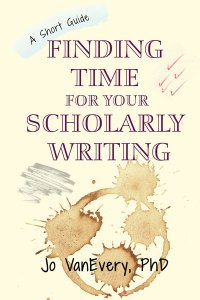
Jo van Every, Finding Time for your Scholarly Writing – new short guide

I’ve mentioned Jo van Every’s work before in relation to writing and time-management. She has a new guide out – Finding Time for your Scholarly Writing. Jo kindly sent me an advance e-copy. I already try to write every day, or at least move the writing forward by doing something towards it, so much of this was familiar and reinforcing what I do. But the discussion of how to do a bit, even if you only have a few minutes a day for it, was useful.

cover_md

Finding Time for your Scholarly Writing addresses the problem of juggling writing alongside your other responsibilities. I identify three kinds of time: full days, longish sessions, and short snatches. In this Short Guide, I explain what kinds of writing you can do in each, and suggest ways of combining the three to ensure that you make the best use of the time available at different points in the academic year.

The ebook will be published on 16 April 2018 and available from several online retailers. Preorders are now available from SOME retailers. I anticipate publishing a paperback (ISBN 978-1-912040-70-4) as well. This should be available by early May and can be ordered from my website (jovanevery.ca/books) or through local bookshops.

Posted in Uncategorized, Writing | Leave a comment

Heidegger and his Politics at Philosophy Now

Thoughts on Heidegger’s Black Notebooks

Peter Gratton's avatarPHILOSOPHY IN A TIME OF ERROR

A nice round-up of Heidegger scholars on what to make of The Black Notebooks and the relation of his politics to his fundamental ontology. Each thinker contributed but a paragraph or two and gets straight to the point. Contributors include Iain Thomson, Babette Babich, and Jack Caputo.

View original post

Posted in Uncategorized | Leave a comment

Books received – Mitchell, Delaporte, Malpas

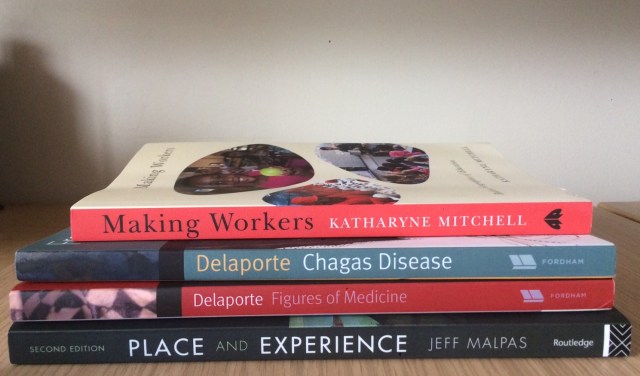
IMG_3235

Two books by François Delaporte – Figures of Medicine and Chagas Disease -and two books I mentioned earlier – Jeff Malpas, Place and Experience A Philosophical Topography, second edition and Katharyne Mitchell, Making Workers: Radical Geographies of Education. At the moment I’m planning a brief discussion of Delaporte in the last chapter of my book on Canguilhem.

Posted in Canguilhem (book), François Delaporte, Jeff Malpas, Uncategorized | 1 Comment

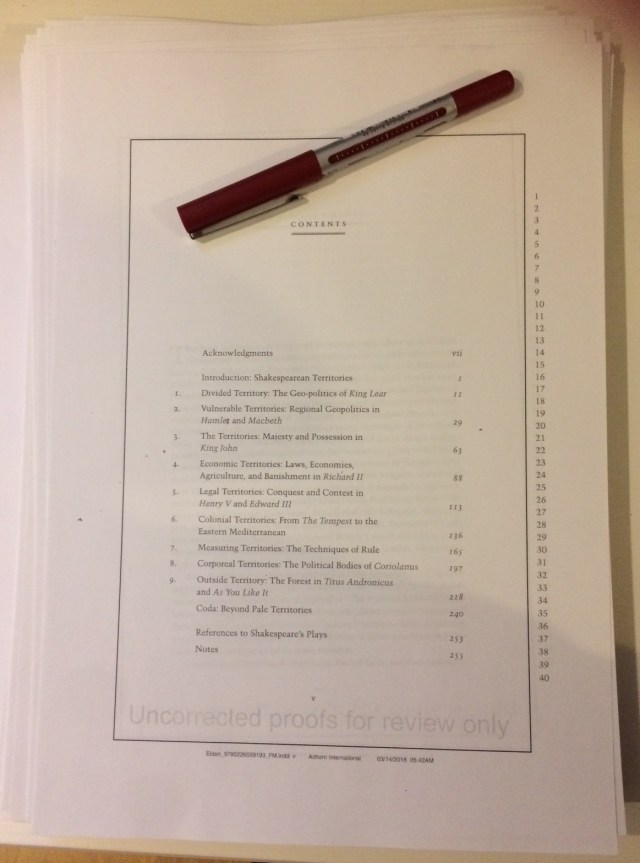
It’s that time again… proofreading Shakespearean Territories

proofs.jpeg

Last stage of my work for Shakespearean Territories – the book will be published in October 2018 by University of Chicago Press.

Posted in Publishing, Shakespearean Territories, Uncategorized, William Shakespeare | Leave a comment

The History of Political Thought in the Age of Ideologies, 1789-1989 – Queen Mary, 31 May-1 June 2018

The History of Political Thought in the Age of Ideologies, 1789-1989 – Queen Mary, 31 May-1 June 2018. Free but registration required.

Historians of political ideas since the late 1960s have advocated focussing on authorial intentions instead of tracing the progress of “unit ideas” or the transmission of disembodied concepts. Yet historical practice has not always followed methodological injunctions. Nowhere is this more the case than in the period following the French Revolution. Capacious political movements are assumed to dominate the nineteenth and twentieth centuries, giving rise to a procession of abstract ideologies. Yet is it plausible to think of the era as inhabited by such continuous “discourses”, let alone as being characterised in terms of a clash between them? This conference is intended to probe the durability of ideas that are standardly assumed to traverse the ages while sustaining the integrity of their meaning.

The conference also aims to examine how the epoch is generally presented. In what sense can the period be described as an “age of ideologies” if its constitutive doctrines are disassembled into a succession of speech-acts? In 1982 Karl Dietrich Bracher described the twentieth century as a “Zeit der Ideologien”. Yet this conception already had interesting precedents by the time he wrote, having been applied to the nineteenth century by Reinhart Koselleck in 1959. Koselleck’s depiction has a longer pedigree still, looking back to nineteenth century accounts of the legacy of the enlightenment. Thus, in the wake of the French Revolution, the idea emerged that an era of hostile ideologies had succeeded an older age of religious strife. In exploring how we might best write the history of political thought after 1789, this conference will examine common depictions of the period as living in the shadow of revolutionary upheaval that unleashed an enduring contest between opposing principles.

The speakers at the conference include Peter Ghosh (Oxford), Niklas Olsen (Copenhagen), Greg Conti (Cambridge), Gareth Stedman Jones (QMUL), Emily Jones (Cambridge), Jennifer Pitts (Chicago), William Selinger (Harvard), Maurizio Isabella (QMUL), Stuart Jones (Manchester), Andrew Sartori (NYU), Eva Hausteiner (Bonn), Leslie Butler (Dartmouth), Georgios Varouxakis (QMUL), Duncan Kelly (Cambridge), Anne-Sophie Chambost (Université Jean Monnet Saint-Etienne), Rachel Hoffman (Cambridge), Quentin Skinner (QMUL), Udi Greenberg (Dartmouth), Julia Nicholls (KCL), and Richard Bourke (QMUL).

Posted in Uncategorized | Leave a comment

Jeff Malpas, Place and Experience A Philosophical Topography, second edition now published

9781138291430Jeff Malpas, Place and Experience A Philosophical Topography, second edition now published.

The first edition of Place and Experience established Jeff Malpas as one of the leading philosophers and thinkers of place and space and provided a creative and refreshing alternative to prevailing post-structuralist and postmodern theories of place. It is a foundational and ground-breaking book in its attempt to lay out a sustained and rigorous account of place and its significance.

The main argument of Place and Experience has three strands: first, that human being is inextricably bound to place; second, that place encompasses subjectivity and objectivity, being reducible to neither but foundational to both; and third that place, which is distinct from, but also related to space and time, is methodologically and ontologically fundamental. The development of this argument involves considerations concerning the nature of place and its relation to space and time; the character of that mode of philosophical investigation that is oriented to place and that is referred to as ‘philosophical topography’; the nature of subjectivity and objectivity as inter-related concepts that also connect with intersubjectivity; and the way place is tied to memory, identity, and the self. Malpas draws on a rich array of writers and philosophers, including Wordsworth, Kant, Proust, Heidegger and Donald Davidson.

This second edition is revised throughout, including a new chapter on the consequences of the human embeddedness in place, especially as this relates to the ethical and politics, and a new foreword by Edward Casey. It also includes a new set of additional features, such as chapter summaries, illustrations, annotated further reading, and a glossary, which make this second edition more useful to teachers and students alike.

“The new edition of this pioneering book remains at the forefront of philosophical engagements with place and space. Profound and challenging, as well as engagingly written, it moves seamlessly across registers – from Proust and Wordsworth to taxi driver knowledge, from Heidegger to analytic philosophy. This is a fundamental work for philosophers, geographers and all those concerned with the question of human experience.” – Stuart Elden, University of Warwick, UK and Monash University, Australia

“This expanded and revised edition of Place and Experience signifies the enduring importance of Malpas’s path-breaking contributions to place and space studies. Eminently readable, full of compelling and illustrative examples, and authoritatively argued, the book masterfully articulates the deep integration of place to human experience.” – Janet Donohoe, University of West Georgia, USA

“This important and now classic book is a crucial contribution to our understanding of the deep connections between place and all things human. Transcending disciplinary boundaries, Place and Experience offers valuable lessons for architects, urban and environmental designers, and all those willing to challenge the seeming inevitability of homogeneous space and placelessness brought about by our technological civilization.” – Alberto Pérez-Gómez, McGill University, Canada

“Ever since Plato, an abiding methodological conceit of philosophy has been to separate conceptual questions from empirical conceptions. Jeff Malpas challenges this conceit. In drawing on literature, anthropology, psychology, and the history of science, as well as philosophy, he opens up new paths and possibilities for thinking seriously about embodied human being in the world and its prospects in difficult times.” – Richard Eldridge, Swarthmore College, USA

“This is a book filled with provocative ideas about agency, locality, self, spatiality, past and person. It also established Jeff Malpas as a pre-eminent philosopher of place. If you want to understand the complex unity of place, there is no better book with which to begin.” – Edward Relph, University of Toronto, Canada

“Jeff Malpas’s beautiful work about place has fed the architecture of my own creative work for many years now. This splendid new edition of his classic text spans from the past of our memories to the future we already live in – thanks to globalization and that thing we call “connectedness” – urging us to more properly locate our thoughts, our actions and our experiences so that we might locate, more entirely, ourselves. A nourishing, inspiring and important book.” – Ashley Hay, author of A Hundred Small Lessons

Posted in Immanuel Kant, Jeff Malpas, Martin Heidegger, Uncategorized | Leave a comment