Architectural History and Theory workshop at Columbia University and library research at Yale

Arrived in the US last night – my first visit for a while – to take part in an Architectural History and Theory workshop at Columbia University. It’s a small workshop with PhD students, discussing my writing and current research. The idea is that we discuss my work on territory – particularly in relation to Shakespeare and terrain – in the first part, and then the work on Foucault in the second part. It’s a short visit, but I’m spending the first couple of days at Yale University to use the library and one of their collections in particular, and then will probably use the remaining work time in New York to use the wonderful library at Columbia.

[Update: the workshop is closed – just for Columbia PhD students]

Posted in Uncategorized | 1 Comment

Jo van Every, Finding Time for your Scholarly Writing – new short guide

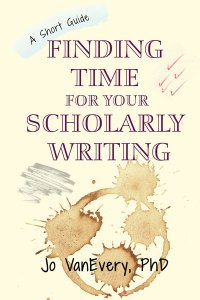
I’ve mentioned Jo van Every’s work before in relation to writing and time-management. She has a new guide out – Finding Time for your Scholarly Writing. Jo kindly sent me an advance e-copy. I already try to write every day, or at least move the writing forward by doing something towards it, so much of this was familiar and reinforcing what I do. But the discussion of how to do a bit, even if you only have a few minutes a day for it, was useful.

cover_md

Finding Time for your Scholarly Writing addresses the problem of juggling writing alongside your other responsibilities. I identify three kinds of time: full days, longish sessions, and short snatches. In this Short Guide, I explain what kinds of writing you can do in each, and suggest ways of combining the three to ensure that you make the best use of the time available at different points in the academic year.

The ebook will be published on 16 April 2018 and available from several online retailers. Preorders are now available from SOME retailers. I anticipate publishing a paperback (ISBN 978-1-912040-70-4) as well. This should be available by early May and can be ordered from my website (jovanevery.ca/books) or through local bookshops.

Posted in Uncategorized, Writing | Leave a comment

Heidegger and his Politics at Philosophy Now

Thoughts on Heidegger’s Black Notebooks

Peter Gratton's avatarPHILOSOPHY IN A TIME OF ERROR

A nice round-up of Heidegger scholars on what to make of The Black Notebooks and the relation of his politics to his fundamental ontology. Each thinker contributed but a paragraph or two and gets straight to the point. Contributors include Iain Thomson, Babette Babich, and Jack Caputo.

View original post

Posted in Uncategorized | Leave a comment

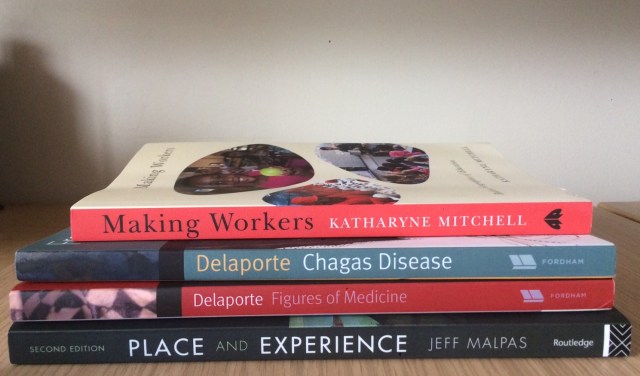
Books received – Mitchell, Delaporte, Malpas

IMG_3235

Two books by François Delaporte – Figures of Medicine and Chagas Disease -and two books I mentioned earlier – Jeff Malpas, Place and Experience A Philosophical Topography, second edition and Katharyne Mitchell, Making Workers: Radical Geographies of Education. At the moment I’m planning a brief discussion of Delaporte in the last chapter of my book on Canguilhem.

Posted in Canguilhem (book), François Delaporte, Jeff Malpas, Uncategorized | 1 Comment

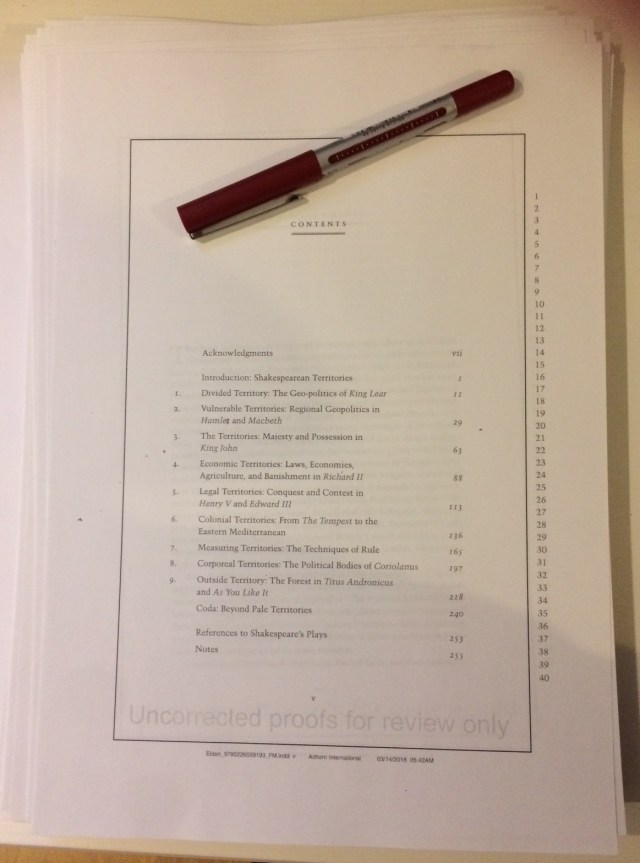
It’s that time again… proofreading Shakespearean Territories

proofs.jpeg

Last stage of my work for Shakespearean Territories – the book will be published in October 2018 by University of Chicago Press.

Posted in Publishing, Shakespearean Territories, Uncategorized, William Shakespeare | Leave a comment

The History of Political Thought in the Age of Ideologies, 1789-1989 – Queen Mary, 31 May-1 June 2018

The History of Political Thought in the Age of Ideologies, 1789-1989 – Queen Mary, 31 May-1 June 2018. Free but registration required.

Historians of political ideas since the late 1960s have advocated focussing on authorial intentions instead of tracing the progress of “unit ideas” or the transmission of disembodied concepts. Yet historical practice has not always followed methodological injunctions. Nowhere is this more the case than in the period following the French Revolution. Capacious political movements are assumed to dominate the nineteenth and twentieth centuries, giving rise to a procession of abstract ideologies. Yet is it plausible to think of the era as inhabited by such continuous “discourses”, let alone as being characterised in terms of a clash between them? This conference is intended to probe the durability of ideas that are standardly assumed to traverse the ages while sustaining the integrity of their meaning.

The conference also aims to examine how the epoch is generally presented. In what sense can the period be described as an “age of ideologies” if its constitutive doctrines are disassembled into a succession of speech-acts? In 1982 Karl Dietrich Bracher described the twentieth century as a “Zeit der Ideologien”. Yet this conception already had interesting precedents by the time he wrote, having been applied to the nineteenth century by Reinhart Koselleck in 1959. Koselleck’s depiction has a longer pedigree still, looking back to nineteenth century accounts of the legacy of the enlightenment. Thus, in the wake of the French Revolution, the idea emerged that an era of hostile ideologies had succeeded an older age of religious strife. In exploring how we might best write the history of political thought after 1789, this conference will examine common depictions of the period as living in the shadow of revolutionary upheaval that unleashed an enduring contest between opposing principles.

The speakers at the conference include Peter Ghosh (Oxford), Niklas Olsen (Copenhagen), Greg Conti (Cambridge), Gareth Stedman Jones (QMUL), Emily Jones (Cambridge), Jennifer Pitts (Chicago), William Selinger (Harvard), Maurizio Isabella (QMUL), Stuart Jones (Manchester), Andrew Sartori (NYU), Eva Hausteiner (Bonn), Leslie Butler (Dartmouth), Georgios Varouxakis (QMUL), Duncan Kelly (Cambridge), Anne-Sophie Chambost (Université Jean Monnet Saint-Etienne), Rachel Hoffman (Cambridge), Quentin Skinner (QMUL), Udi Greenberg (Dartmouth), Julia Nicholls (KCL), and Richard Bourke (QMUL).

Posted in Uncategorized | Leave a comment

Jeff Malpas, Place and Experience A Philosophical Topography, second edition now published

9781138291430Jeff Malpas, Place and Experience A Philosophical Topography, second edition now published.

The first edition of Place and Experience established Jeff Malpas as one of the leading philosophers and thinkers of place and space and provided a creative and refreshing alternative to prevailing post-structuralist and postmodern theories of place. It is a foundational and ground-breaking book in its attempt to lay out a sustained and rigorous account of place and its significance.

The main argument of Place and Experience has three strands: first, that human being is inextricably bound to place; second, that place encompasses subjectivity and objectivity, being reducible to neither but foundational to both; and third that place, which is distinct from, but also related to space and time, is methodologically and ontologically fundamental. The development of this argument involves considerations concerning the nature of place and its relation to space and time; the character of that mode of philosophical investigation that is oriented to place and that is referred to as ‘philosophical topography’; the nature of subjectivity and objectivity as inter-related concepts that also connect with intersubjectivity; and the way place is tied to memory, identity, and the self. Malpas draws on a rich array of writers and philosophers, including Wordsworth, Kant, Proust, Heidegger and Donald Davidson.

This second edition is revised throughout, including a new chapter on the consequences of the human embeddedness in place, especially as this relates to the ethical and politics, and a new foreword by Edward Casey. It also includes a new set of additional features, such as chapter summaries, illustrations, annotated further reading, and a glossary, which make this second edition more useful to teachers and students alike.

“The new edition of this pioneering book remains at the forefront of philosophical engagements with place and space. Profound and challenging, as well as engagingly written, it moves seamlessly across registers – from Proust and Wordsworth to taxi driver knowledge, from Heidegger to analytic philosophy. This is a fundamental work for philosophers, geographers and all those concerned with the question of human experience.” – Stuart Elden, University of Warwick, UK and Monash University, Australia

“This expanded and revised edition of Place and Experience signifies the enduring importance of Malpas’s path-breaking contributions to place and space studies. Eminently readable, full of compelling and illustrative examples, and authoritatively argued, the book masterfully articulates the deep integration of place to human experience.” – Janet Donohoe, University of West Georgia, USA

“This important and now classic book is a crucial contribution to our understanding of the deep connections between place and all things human. Transcending disciplinary boundaries, Place and Experience offers valuable lessons for architects, urban and environmental designers, and all those willing to challenge the seeming inevitability of homogeneous space and placelessness brought about by our technological civilization.” – Alberto Pérez-Gómez, McGill University, Canada

“Ever since Plato, an abiding methodological conceit of philosophy has been to separate conceptual questions from empirical conceptions. Jeff Malpas challenges this conceit. In drawing on literature, anthropology, psychology, and the history of science, as well as philosophy, he opens up new paths and possibilities for thinking seriously about embodied human being in the world and its prospects in difficult times.” – Richard Eldridge, Swarthmore College, USA

“This is a book filled with provocative ideas about agency, locality, self, spatiality, past and person. It also established Jeff Malpas as a pre-eminent philosopher of place. If you want to understand the complex unity of place, there is no better book with which to begin.” – Edward Relph, University of Toronto, Canada

“Jeff Malpas’s beautiful work about place has fed the architecture of my own creative work for many years now. This splendid new edition of his classic text spans from the past of our memories to the future we already live in – thanks to globalization and that thing we call “connectedness” – urging us to more properly locate our thoughts, our actions and our experiences so that we might locate, more entirely, ourselves. A nourishing, inspiring and important book.” – Ashley Hay, author of A Hundred Small Lessons

Posted in Immanuel Kant, Jeff Malpas, Martin Heidegger, Uncategorized | Leave a comment

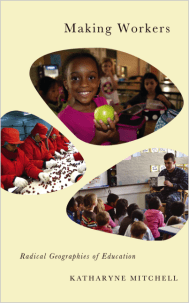
Katharyne Mitchell, Making Workers: Radical Geographies of Education – now out with Pluto

9780745399850.jpeKatharyne Mitchell, Making Workers: Radical Geographies of Education – now out with Pluto books.

As globalisation transforms the organisation of society, so too is its impact felt in the classroom. Katharyne Mitchell argues that schools are spaces in which neoliberal practices are brought to bear on the lives of children. Education’s narratives, actors and institutions play a pivotal role in the social and political formation of youth as workers in a capitalist economy.

Mitchell looks at the formation of student identity and allegiance –as well as spaces of resistance. She investigates the transition to educational narratives emphasising flexibility and strategic global entrepreneurialism and examines the role of education in a broader political project of producing new generations of economically insecure but compliant workers.

Scrutinising the impact of an influx of new actors, practices and policies, Mitchell argues that public education is the latest institution to embrace the neoliberal logic of ‘choice’ – pertaining to schools, faculty, and curricula – that, if unchallenged, will lead to further incursions of the market and increased socioeconomic inequality.

‘Katharyne Mitchell’s Making Workers is an exemplary analysis of the structural forces, networks, discourses, and practices shaping educational systems from compulsory education through to higher education, including life-long learning. Given the importance of education systems to the production of citizens as well as the work-force, Mitchell’s book is a must-read for all interested in the future of economy and society’ – Kris Olds, Professor, Department of Geography, University of Wisconsin-Madison

‘A beautifully written and highly engaging account of neoliberalism and its still unfolding capture of our public educational institutions, teachers and students… This book should be at the top of the reading list for all who wish to understand the impacts of the last forty years of transformation in education as well as those who wish to join the struggle to save our schools and our children’ – Sallie A. Marston, Professor, School of Geography and Development and Director, Community and School Garden Program, University of Arizona

Good to see that Pluto now provide a free e-book with the hardcopy – Verso have done this for some time, but still puzzled more publishers don’t do this.

Posted in Uncategorized | Leave a comment

Books received – Delaporte, Lecourt, Ginestier, Eribon, Lichnerowicz, Perroux and Gadoffre

Some second-hand books for the Canguilhem and Foucault work

IMG_3211.JPG

Posted in Canguilhem (book), Gaston Bachelard, Georges Canguilhem, Michel Foucault, The Early Foucault, Uncategorized | Leave a comment

Three really interesting looking books from Routledge – but three completely obscene prices

Three really interesting looking books from Routledge – but three completely obscene prices.

MorinKaren Morin, Carceral Space, Prisoners and Animals – £105 or £76.50 e-book

Carceral Space, Prisoners and Animals explores resonances across human and nonhuman carceral geographies. The work proposes an analysis of the carceral from a broader vantage point than has yet been done, developing a ‘trans-species carceral geography’ that includes spaces of nonhuman captivity, confinement, and enclosure alongside that of the human. The linkages across prisoner and animal carcerality that are placed into conversation draw from a number of institutional domains, based on their form, operation, and effect. These include: the prison death row/ execution chamber and the animal slaughterhouse; sites of laboratory testing of pharmaceutical and other products on incarcerated humans and captive animals; sites of exploited prisoner and animal labor; and the prison solitary confinement cell and the zoo cage. The relationships to which I draw attention across these sites are at once structural, operational, technological, legal, and experiential / embodied. The forms of violence that span species boundaries at these sites are all a part of ordinary, everyday, industrialized violence in the United States and elsewhere, and thus this ‘carceral comparison’ amongst them is appropriate and timely.

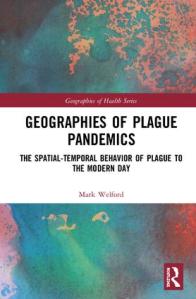
WelfordMark Welford, Geographies of Plague Pandemics – £105 or £35.99 e-book

Geographies of Plague Pandemics synthesizes our current understanding of the spatial and temporal dynamics of plague, Yersinia pestis. The environmental, political, economic, and social impacts of the plague from Ancient Greece to the modern day are examined. Chapters explore the identity of plague DNA, its human mortality, and the source of ancient and modern plagues. This book also discusses the role plague has played in shifting power from Mediterranean Europe to north-western Europe during the 500 years that plague has raged across the continent. The book demonstrates how recent colonial structures influenced the spread and mortality of plague while changing colonial histories. In addition, this book provides critical insight into how plague has shaped modern medicine, public health, and disease monitoring, and what role, if any, it might play as a terror weapon.

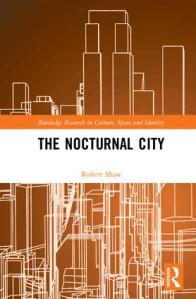
ShawRobert Shaw, The Nocturnal City – £105 (no e-book listed)

Night is a foundational element of human and animal life on earth, but its interaction with the social world has undergone significant transformations during the era of globalization. As the economic activity of the ‘daytime’ city has advanced into the night, other uses of the night as a time for play, for sleep or for escaping oppression have come increasingly under threat.

This book looks at the relationship between night and society in contemporary cities. It identifies that while theories of ‘planetary urbanization’ have traced the spatial spread of urban forms, the temporal expansion of urban capitalism has been less well mapped. It argues that, as a key part of planetary being, understanding what goes on at night in cities can add nuance to debates on planetary urbanization.

A series of practices and spaces that we encounter in the night-time city are explored. These include: the maintenance and repair of infrastructure; the aesthetics of the urban night; nightlife and the night-time economy; the home at night; and the ecologies of the urban night. Taking these forward the book will ask whether the night can reveal some of the boundaries to what we call ‘the urban’ in a world of cities, and will call for a revitalized and enhanced ‘nightology’ to study these limits.

Now I don’t want to just single out Routledge, since there are other offenders, but these prices are just ridiculous. The books are short too – 176, 156 and 126 pages. What a terrible shame for these authors to have worked so hard on these books, each of which deserves a much wider audience than these prices will allow.

Posted in Publishing, Uncategorized | 7 Comments