Gastón Gordillo, Terrain as insurgent weapon: An affective geometry of warfare in the mountains of Afghanistan

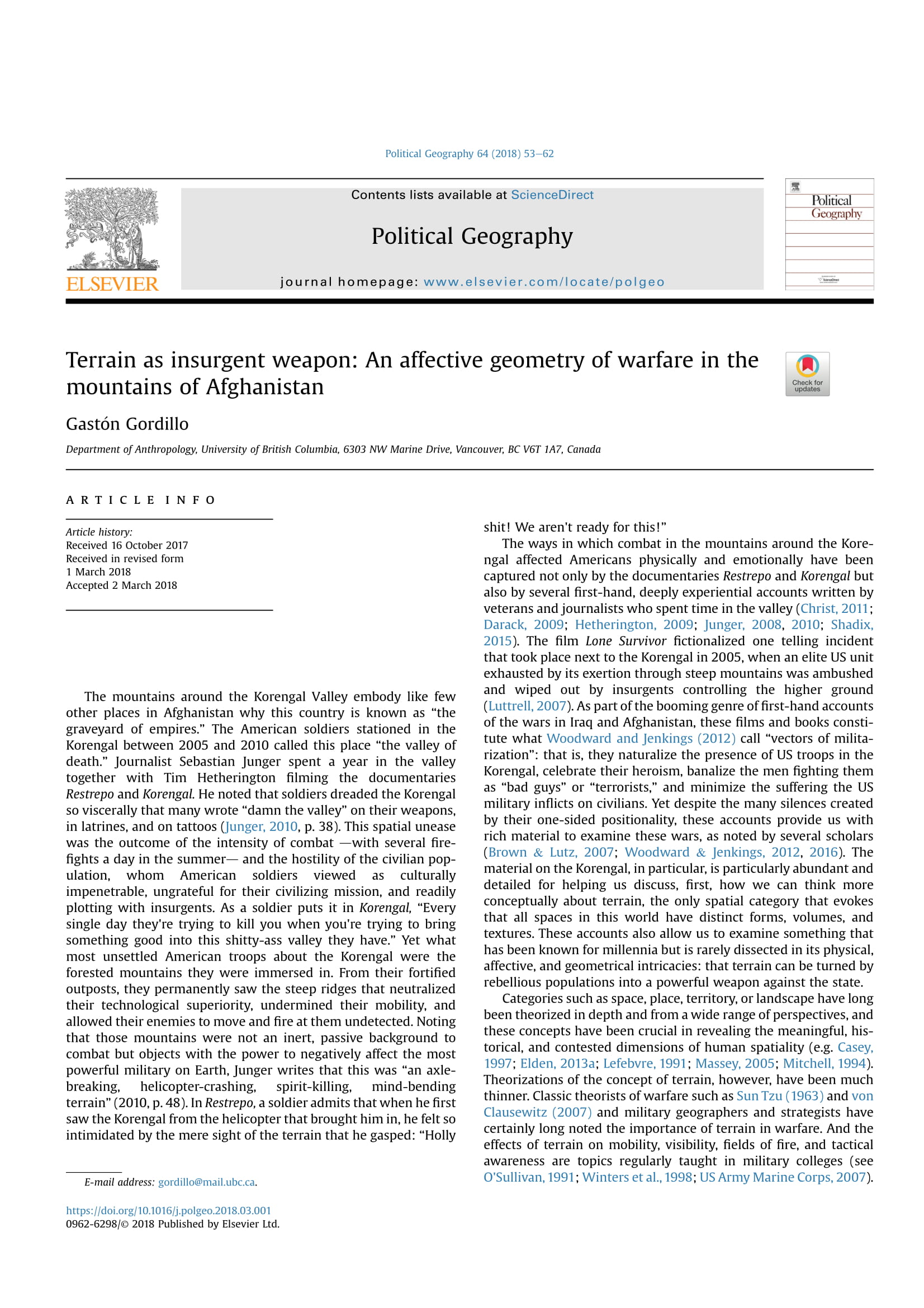
GordilloGastón Gordillo, “Terrain as insurgent weapon: An affective geometry of warfare in the mountains of Afghanistan“, Political Geography (requires subscription – first page available to preview or click on the image). No abstract, so I’ve taken this summary from Derek Gregory’s Geographical Imaginations site.

My argument…   is that the irreducibility of terrain can be best examined through the bodily experiences, affects, and agency of the human actors engaging it da lens I call an affective geometry. This is not the Euclidian or Cartesian geometry of mathematized grids, coordinates, and straight lines abstracted from bodies and affects. This is the qualitative, non-linear geometry conceptualized by Spinoza (1982), attentive to how bodies affect and are affected by other bodies in a multiplicity of ways, which range from negative ways that may diminish the body’s capacity to act to positive ways that may expand the body’s powers for action.

In analyzing how bodies are affected by and affect terrain, an affective geometry can be seen as a materialist phenomenology that conceives of human bodies in their subjective interiority and dispositions and also as mobile, self-propelling bodies that in situations of combat dand as long as they remain able bodiesd walk, run, climb rocks, duck on the ground, fall in ditches, shoot, feel exhausted hiking a mountain, and feel pain if hit by gunfire.

Gastón and I have been in dialogue for some time about ‘terrain’, and we organised two AAG conference sessions on this a few years ago before he visited Warwick to discuss some of his work with colleagues and PhD researchers. Great to see this piece as a continuation of the conversation.


Posted in Gaston Gordillo, terrain, Uncategorized | 2 Comments

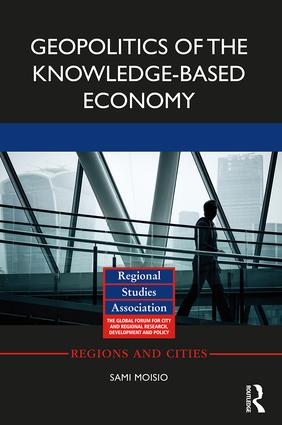
Sami Moisio, Geopolitics of the Knowledge-Based Economy – now out with Routledge

9781138821996Sami Moisio, Geopolitics of the Knowledge-Based Economy – now out with Routledge. Only a very expensive hardback or e-book at this stage, unfortunately. If you buy via Routledge, code FLR40 will give a 20% discount (Flyer – Geopolitics of the Knowledge-Based Economy).

We live in the era of the knowledge-based economy, and this has major implications for the ways in which states, cities and even supranational political units are spatially planned, governed and developed. In this book, Sami Moisio delves deeply into the links between the knowledge-based economy and geopolitics, examining a wide range of themes, including city geopolitics and the university as a geopolitical site. Overall, this work shows that knowledge-based “economization” can be understood as a geopolitical process that produces territories of wealth, security, power and belonging.

This book will prove enlightening to students, researchers and policymakers in the fields of human geography, urban studies, spatial planning, political science and international relations.

Posted in Uncategorized | 1 Comment

Territory Beyond Terra – reflections on the Rowman International blog

593b8b09f5ba741adc68db03.jpgTerritory Beyond Terra was published earlier this month. Edited by Kimberley Peters, Philip Steinberg and Elaine Stratford, the book has a series of essays which look at elements, environments and edges to challenge and extend our understanding of territory.

There are a series of reflections on the Rowman International blog from the book’s contributors. I wrote a preface to the book.

Posted in Philip Steinberg, Territory, Uncategorized | Leave a comment

Review essay of Foucault, Les Aveux de la chair in Theory, Culture and Society (open access)

BHI_Foucault_Le_souci_Plat.inddMy review essay of the fourth volume of Foucault’s History of Sexuality, Les aveux de la chair is now available in Theory, Culture and SocietyThe essay will appear in the annual review of the journal later this year, but this version is open access.

Almost thirty-four years after his death, the book Foucault was working on even in hospital is finally published. Histoire de la sexualité 4: Les aveux de la chair, edited by Frédéric Gros, appeared on 8 February 2018 with Gallimard, in the Bibliothèque des Histoires series in which the first three volumes had appeared. The back cover simply has the line of René Char that also appeared on volumes II and III. “The history of men is the long succession of synonyms of the same term [vocable]. To contradict them is a duty”. Can we read this book in straight-forward continuity with those other volumes, completing the sequence of studies? How finished a book was it, and should it have been published despite Foucault’s stipulation of ‘no posthumous publications’? What does the book contain, and how does it help resolve previously unanswered questions about Foucault’s work? How might it be received and discussed? I will try to address these questions in this essay. [continues here]


Posted in Michel Foucault, My Publications, Theory, Culture and Society, Uncategorized | 2 Comments

Bernard E. Harcourt, “The Barbarism of Alabama’s Botched Execution”

Bernard E. Harcourt, “The Barbarism of Alabama’s Botched Execution” in The New York Review of Books.

A powerful and disturbing piece about the attempted execution of Doyle Lee Hamm earlier this month.

Posted in Bernard E. Harcourt, Uncategorized | Leave a comment

Hayden White (1928-2018)

A tribute to Hayden White, who died recently

Clare O'Farrell's avatarFoucault News

Essay on the death of Hayden White
Scott McLemee, Inside Higher Ed, March 9, 2018.

The author of Metahistory, one of the most influential books in the humanities over the past four decades, died Monday. Scott McLemee takes him out of the poststructuralist pigeonhole.

Pursuing such a line of thought meant turning to sources outside history as a profession. The usual shorthand here is to say that White’s thinking converged with the work of structuralist and poststructuralist theorists in Europe — and indeed, White published one of the earliest papers on Michel Foucault to appear in an Anglophone journal. But emphasizing the French connection seriously understates the distinctiveness of the conceptual tool kit he put together. To analyze the modes of storytelling historians found themselves using to narrate the past, he borrowed from Northrop Frye’s The Anatomy of Criticism. For insights into historians’ rhetorical patterns, he turned to Kenneth Burke’s…

View original post 39 more words

Posted in Uncategorized | Leave a comment

LSE Impact Blog – “Six academic writing habits that will boost productivity” (plus other links)

LSE Impact Blog – “Six academic writing habits that will boost productivity

I’m not sure by the notion of ‘productivity’, but there is some good advice here. Here are the headlines:

  1. They “time-block” their writing in advance
  2. They set themselves artificial deadlines
  3. They deliberately seek “flow” (but don’t push themselves if they can’t find it)
  4. They design accountability structures around themselves
  5. They use small steps and short deadlines to tackle large projects
  6. They “write their way” out of their blocks

On the last point, see this useful post at Explorations of Style. Jo van Every continues to provide useful advice. See, for example, Is this Real Writing or procrastination? and Incorporating writing into your workload: The Research Day (an excerpt from her next book).

This Twitter thread also has some useful suggestions:

For an extensive set of links and discussions see the archive of posts from this site on this page.

Posted in Uncategorized, Writing | 4 Comments

Foucault: The Birth of Power reviewed by Audrey Borowski in Politics, Religion & Ideology

Foucault-The-Birth-of-Power-coverMy 2017 book Foucault: The Birth of Power is generously reviewed by Audrey Borowski in Politics, Religion & Ideology (requires subscription).

Links to other reviews and discussions of this book, and its companion Foucault’s Last Decade are archived here.


Posted in Foucault's Last Decade, Foucault: The Birth of Power, Michel Foucault, Uncategorized | 2 Comments

Helena Sheehan and Sheamus Sweeney, The Wire and the World

Helena Sheehan and Sheamus Sweeney, The Wire and the World

Very interesting piece in Jacobin about the TV series, ten years after the final episode. Contains spoilers, of course, if you’ve not yet got through all the seasons…

Posted in Uncategorized | Leave a comment

“Up in smoke: should an author’s dying wishes be obeyed?” – The Guardian

Piece in The Guardian – Up in smoke: should an author’s dying wishes be obeyed?

Includes some discussion of Foucault, including a link to their recent piece about History of Sexuality volume IV being published. But the main purpose is to discuss a number of literary figures – Sylvia Plath, T.S. Eliot, Ted Hughes, and so on.

Posted in Uncategorized | Leave a comment