
Helena Sheehan and Sheamus Sweeney, The Wire and the World
Very interesting piece in Jacobin about the TV series, ten years after the final episode. Contains spoilers, of course, if you’ve not yet got through all the seasons…
Helena Sheehan and Sheamus Sweeney, The Wire and the World
Very interesting piece in Jacobin about the TV series, ten years after the final episode. Contains spoilers, of course, if you’ve not yet got through all the seasons…
Piece in The Guardian – Up in smoke: should an author’s dying wishes be obeyed?
Includes some discussion of Foucault, including a link to their recent piece about History of Sexuality volume IV being published. But the main purpose is to discuss a number of literary figures – Sylvia Plath, T.S. Eliot, Ted Hughes, and so on.
A pile of recently received books – Georges Dumézil, Entretiens avec Didier Eribon; Georges Canguilhem, Études d’histoire et de philosophie des sciences; Thomas Nail, Lucretius I: An Ontology of Motion; Orazio Irrera & Salvo Vaccaro, La pensée politique de Foucault, José Luis Villacañas & Rodrigo Castro (eds.), Foucault y la Historia de la Filosofía; Michel Foucault, Subjectivity and Truth; Zbigniew Kotowicz, Gaston Bachelard: A Philosophy of the Surreal; Jean-François Braunstein; Daniele Lorenzini; Ariane Revel; Judith Revel and Arianna Sforzini (eds.), Foucault(s) and Roland Bleiker (eds.), Visual Global Politics.
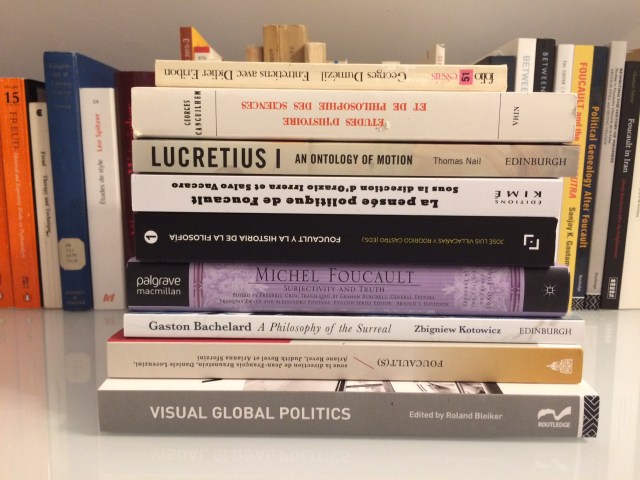
Roland Bleiker’s edited collection and Thomas Nail’s ambitious study were sent by the publishers, Subjectivity and Truth is a review copy (review forthcoming in Foucault Studies), the book on Bachelard was pre-ordered in recompense for review work, and the Spanish collection was a gift from Rodrigo Castro. The Canguilhem book I had already in an earlier edition, but this one has an additional essay in it. Most connect to the current work on Foucault and Canguilhem.
 A new book by friend and Warwick colleague Ben Clift – The IMF and the Politics of Austerity in the Wake of the Global Financial Crisis – is now out with OUP.
 Not much is known about Foucault’s time in Hamburg in 1959-60, except that he was working on his translation of Kant’s Anthropology at this time. The preface to History of Madness was also written there. A new piece in German by Rainer Nicolaysen looks at this period in detail, via Foucault Blog
Foucault in Hamburg: Anmerkungen zum einjährigen Aufenthalt 1959/60
.
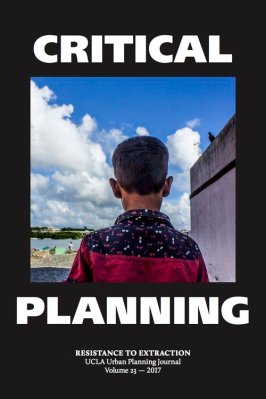 Critical Planning – new issue with tributes to Jacqueline Leavitt and Ed Soja, and a number of stand-alone pieces (open access). Thanks to Kenton Card for the link.
The Critical Zone of Science and Politics: An Interview with Bruno Latour in Los Angeles Review of Books
Interview with Jacques Bidet about Foucault and Marx
Jacques Bidet – Foucault with Marx, translated by Steven Corcoran (Zed Books, 2016, La fabrique, Paris, 2015)
In lieu of a review of Bidet’s book Foucault with Marx, we got in touch with him to discuss the way the text seems timely, now, in 2018. Here is the core of our dialogue:
SH: It seems to me that Foucault has been given a different share recently, or allotment, among ‘the left’ in Britain certainly.
JB: Foucault indeed leaves several legacies. From the perspective of my book, which confronts its topicality with that of Marx, we can see that he shows a theoretical and critical creativity which continues today to manifest its fertility/fecundity on several fields, and with different posterities.
First, on the domain of sex and gender relations, on which Marxism itself could only manifest a limited relevance because those issues remain outside of a possible grip of its…
View original post 1,557 more words
Pleased to be able to share the cover of my forthcoming book Shakespearean Territories – due out in October 2018 with University of Chicago Press.

As many people will recognise, the image is a detail of ‘the Ditchley Portrait‘ of Queen Elizabeth at the National Portrait Gallery.
You can read more about the book here. At the moment the only bookstore to have it listed is Blackwell’s.
Here’s the table of contents:
Introduction: Shakespearean Territories
- Divided Territory: The Geo-politics of King Lear
- Vulnerable Territories: Regional Geopolitics in Hamlet and Macbeth
- The Territories: Majesty and Possession in King John
- Economic Territories: Laws, Economies, Agriculture and Banishment in Richard II
- Legal Territories: Conquest and Contest in Henry V and Edward III
- Colonial Territories: From The Tempest to the Eastern Mediterranean
- Measuring Territories: The Techniques of Rule
- Corporeal Territories: The Political Bodies of Coriolanus
- Outside Territory: The Forest in Titus Andronicus and As You Like It
Coda: Beyond Pale Territories
Update: The publisher description is now live and reads:
A large part of Shakespeare’s enduring appeal comes from his engagement with contemporary social and political issues. The modern practice of territory as a political concept and technology that emerged during Shakespeare’s life did not elude his profound political-geographical imagination. In Shakespearean Territories, Stuart Elden reveals through close readings of the plays just how much Shakespeare’s unique historical position, combined with his imagination and political understanding, can teach us about territory. Throughout his prolific career as a playwright, Shakespeare dramatized a world filled with technological advances in measuring, navigation, cartography, military operations, and surveying. His tragedies and histories—and even several of his comedies—open up important ways of thinking about strategy, economy, the law, and the colonial, providing critical insight into a significant juncture in history. Shakespeare’s plays explore many territorial themes: from the division of the kingdom in King Lear to the relations among Denmark, Norway, and Poland in Hamlet; from the Salic Law in Henry V to questions of disputed land and the politics of banishment in Richard II. Elden traces how Shakespeare developed a nuanced understanding of the complicated concept and practice of territory and, more broadly, the political-geographical relations between people, power, and place.
A meticulously researched study of over a dozen classic plays, Shakespearean Territories will provide new insights for geographers, political theorists and Shakespearean scholars alike.


