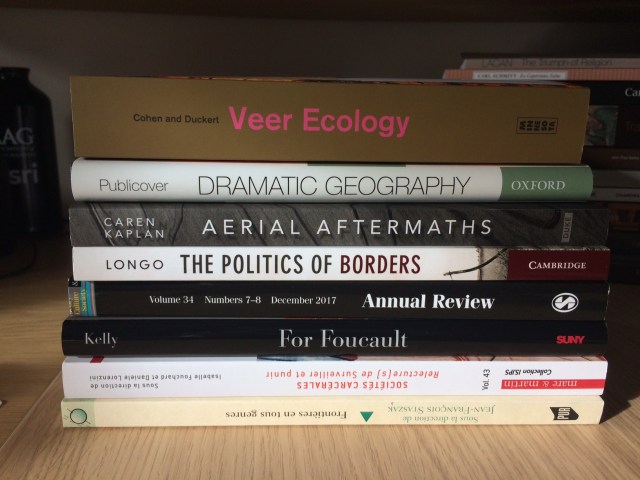
I began 2018 with some shorter pieces to write, which took me away from the focus on The Early Foucault, even though two of them were on Foucault. First was a piece for the American Book Review, which is hosting a set of pieces on ‘Critical Lives’, edited by Robert Tally. I was asked to write something on Foucault, but while with most of the other pieces there is a new biography to review, that isn’t the case here – Miller and Macey’s biographies appeared 25 years ago, while the English translation of Eribon’s book is older still. Eribon’s biography has however appeared in two new editions in French, with additional material. I wrote a piece about how the posthumous publications by Foucault have added to the story we know of his work and, to a much lesser extent, of his life. This short piece should be out soon.
After some other, unconnected work, I then returned to Foucault, to write an afterword to a new edition of David Macey’s The Lives of Michel Foucault. As with the piece for the American Book Review, I reflect on the posthumous publications and how these fill in much of the detail about Foucault’s work. But even though Macey did not have access to this material, it is astonishing how he is often able to sketch out what it contains in miniature. I’ve been using Macey extensively for my Foucault work for many years – I first picked up a copy about a year after it was published, early in my PhD – and it remains a crucial reference. There is very little in there that I’d suggest was wrong. The key thing that he didn’t anticipate – and nobody did at the time – was the extensive publication programme that would begin with the lecture courses in 1997. Macey himself translated the first of the Collège de France courses, ‘Society Must be Defended’ in 2003. There are now so many volumes of material that my afterword merely tries to summarise how these fill in much detail. As part of my work for this I met with Macey’s widow, Margaret Atack, who generously allowed me to consult some of his papers. One of the many highlights of the book is his extensive interviews with people who knew Foucault – teachers, students, friends and others. Correspondence, notes and some transcripts are preserved. The new edition of the book should be out with Verso later this year or early next, and I’ll post more when formally announced.
With those writing tasks complete, at the end of January I headed back to Paris for a more extensive archive visit. The first week I was back at the Foucault archive at the Bibliothèque Nationale, and the second at the Canguilhem archive at the ENS. I also made several visits to the Mitterand site of the BnF, and a couple to the Bibliothèque Saint-Geneviève, both to check some of the journals and books that are hard to find in the UK.
At the Foucault archive, I continued working on the manuscripts of his Lille lecture courses from the early 1950s, many of which were also delivered at the ENS. There is a wealth of material here, and Foucault wrote the lectures out much more fully than he did his later courses, and even included footnoted references. There are courses on psychology and philosophical anthropology which provide a lot more detail than any of his publications from the 1950s. The three main courses preserved are effectively draft books.
There are issues of dating that arise here, and it’s really hard to tell if all the material in a course was there when the course was first delivered. With one course, for example, it was delivered in Lille and then a course on a related topic a couple of years later at the ENS. It seems likely that Foucault reused the manuscript of the course for its later delivery. We have what seems to be the Lille course preserved, and there are some student notes from when it was given at the ENS, and these accord with each other quite well. But there is a section of the course which treats a specific thinker and if it does date from the first delivery in Lille, would upset a well-rehearsed timeline for Foucault – found in accounts by Foucault’s friends at the time, and reinforced by the biographies and Defert’s Chronology. But it seems equally possible that this part was added to the course at a later date, most likely for its reuse in Paris. If that was the case, then the chronology we have can be preserved. But it is a somewhat cyclical argument: the established chronology suggests this discussion cannot date from first delivery; seeing it as a later addition supports that timeline. At the moment I cannot work out how to resolve it one way or the other.
I’d already worked on Foucault’s other courses in Lille a little on previous visits, but now I’ve sketched out a discussion of them in for this book. I really hope that these courses will be published before I complete this book, as these are difficult and dense manuscripts. Foucault provides more references to his text than he does for his Collège de France courses, and the texts themselves are more fully worked out prose than the sometimes skeletal notes from later lectures. But even so, the editorial labours involved will be extensive, and I really do want to see what is made of them. One of the folders comprises a lot of additional material, loose sheets, some grouped together and some not, which seem to be individual lectures from this period rather than parts of entire courses. Many are more schematic than the complete lecture manuscripts. None are dated. Some of the titles accord with student notes that I’ve seen in other archives, so I can make some links, but much remains uncertain.
I also consulted a box of material which relates to an even earlier period, when Foucault was a student, and which contains the typescript of a text long thought lost – his 1949 thesis on Hegel’s Phenomenology of Spirit. It’s a long and detailed text, and exists in two copies – both slightly incomplete, but able to supplement each other. That this was preserved at all was news to me until just a few weeks ago. To my further surprise, the box also contained his plan, a synopsis, the manuscript of some sections, and some working notes. The thesis was directed by Jean Hyppolite, and Foucault uses Hyppolite’s translation of the Phenomenology, and is clearly influenced by his Genesis and Structure book. But there are references to many of Hegel’s other works, including some of the more obscure writings, to the tradition before him, and to a fair range of secondary literature. I will have to find room in the book to discuss this.
At the Canguilhem archive, I worked on some of his lecture courses, though these are much less worked through than Foucault’s, and harder to reconstruct. There are good reasons why these are not being published although he, like Foucault, did not want posthumous publications. Often the material is most interesting to see what he was teaching, and how these linked to his publications. Many of the essays in his later books are based on lectures given outside Paris, some of which directly relate to his day job. I was able to do some work piecing together a chronology of his teaching career which should be useful for the book. Having access to Canguilhem’s own library was also really useful in checking a few references and verifying things.

Foucault conference, day three at the Sorbonne
My time in Paris was somewhat disrupted by the weather – first the Seine flooding some RER stations, and then the snow which closed some transport and libraries. So I didn’t quite finish all the work I’d hoped here. I’ll have to head back at some point in the next few months. While I was here I also attended the conference on Foucault’s Les aveux de la chair. This felt like an important event in the posthumous reception of Foucault. The book itself was published just before I left Paris and I’ve been sharing various links about news reports and some early reviews. When I return to the UK I’ll first be speaking about the Shakespearean Territories book at a workshop at Queen Mary, which is part of a visit organized around the work of Charles Maier. I’ll next be speaking about the Foucault work in Madrid in March and Warwick and Leuven in May. Details of forthcoming talks are here. I have a short book review to finish, and will also write something on Les aveux de la chair, but the main writing focus now for the next few months is the Canguilhem book.
The previous updates on this project are here; and the previous books Foucault’s Last Decade and Foucault: The Birth of Power are both available from Polity. Several Foucault research resources such as bibliographies, short translations, textual comparisons and so on are available here. On the related Canguilhem book project, see this page.
 Michel Foucault, l’Iran et le pouvoir du spirituel – previously unpublished 1979 interview in Bibliobs (requires subscription). A shorter version is published in the print version of L’Obs, 8 February 2018.
 14 February 2018,