Video: Angela Davis — Abolition Feminism: Theories and Practices for Our Time

In December, Angela Davis delivered the annual Nicos Poulantzas Memorial Lecture at the Nicos Poulantzas Institute in Athens.

In the talk, Davis recounts the historical background to the development of the anti-racist, Marxist feminisms she calls “abolition feminism,” and unpacks some of their political and intellectual implications. Watch a full video of her presentation below.


(via the Verso blog)

Posted in Uncategorized | Leave a comment

Forms of Living book series with Fordham University Press

Forms of Living book series with Fordham University Press

Edited by Stefanos Geroulanos, New York University, and Todd E. Meyers, New York University-Shanghai

In the introduction to Knowledge of Life, Georges Canguilhem writes that knowledge and life do not assume a hierarchical order, one preceding or constituting the other. Instead, Canguilhem argues that knowledge and life come to rest upon one another, even in moments when one seems to unmake or undo the other. Life is imbued with thought, entangled with it, and in the end, undiminished by it. Life–its subjects, forms, peoples, and geographies (both real and imagined, and regardless of scale)–can no longer (if ever) be thought of as singular.

In the tightly woven lattice of knowledge and life is found a common conceptual space for anthropology, history, biology, philosophy, art, and medicine. The Forms of Living series seeks to provide an outlet for theoretically and methodologically rigorous writing theorized and articulated through various disciplines, frames, and attempts. Thus the series promotes translations of important works in languages other than English, organizes edited volumes serving as introductions to scholars not well known to Anglo-American audiences, and delivers original and provocative writing from renowned scholars as well as first-time authors. By connecting works that may not otherwise be read alongside one another, Forms of Living eavesdrops on conversations already occurring between scholars, and begins new conversations on what is at stake between knowledge and life and the forms each takes.

Posted in Uncategorized | Leave a comment

Foucault on Power and Government (2016)

Paul Patton on Foucault, Power and Government

Clare O'Farrell's avatarFoucault News

Paul Patton, Foucault on Power and Government
Full text available on academia.edu

Abstract:
Foucault’s lectures in 1976 open with the statement of an intellectual crisis. They proceed to a series of questions about the nature of power and the ways that he has conceived of it up to this point: what is power? How is it exercised? Is it ultimately a relation of force? Only some of these questions are answered in the course of these lectures. His answer to the conceptual questions about the nature of power and the appropriate means to analyze it is not forthcoming until after the discovery of ‘governmentality’ in 1978 and his lectures on liberal and neoliberal governmentality in 1979. This talk aims to retrace his answers to these questions in the light of the published lectures and to examine the consequences of these answers for his overall approach to the analysis power, and…

View original post 86 more words

Posted in Uncategorized | Leave a comment

Books received – Connolly, Scarry, Elborough & Gordon, Lefebvre, Bracke

IMG_3059.JPG

William Connolly, Aspirational Fascism: The Struggle for Multifaceted Democracy under Trumpism; Elaine Scarry, The Body in Pain; Travis Elborough and Helen Gordon, Being a Writer; Henri Lefebvre, Key Writings and Astrid Bracke, Climate Crisis and the 21st-Century British Novel. The Lefebvre book is a re-edition of the 2003 book which I co-edited, the first book of Lefebvre’s with which I was involved and a really significant moment in my career. Scarry was in part-recompense for review work; Bracke was kindly sent by the press.

Posted in Henri Lefebvre, Uncategorized, William E Connolly | Leave a comment

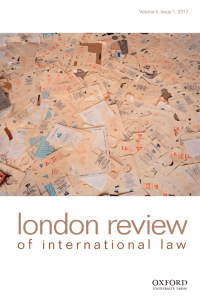
Legal terrain: the political materiality of territory – LRIL lecture now published

The article has now appeared in Vol 5 No 2 of the journal. https://doi.org/10.1093/lril/lrx008 It is subscription only, but as before if you’d like a copy please email me.

stuartelden's avatarProgressive Geographies

m_lril_5_1cover‘Legal terrain—the political materiality of territory’ – my London Review of International Law lecture is now published. The journal requires subscription, but if you’d like a copy and can’t access through an institution, please email me.

This lecture sketches the contours of a political -legal theory of terrain. It argues that terrain is a useful concept to think the materiality of territory. Terrain is where the geopolitical and the geophysical meet, and it is therefore a helpful concept to make political -legal understandings of territory better account for the complexities of the geophysical.

The video of the lecture is also available online.

View original post

Posted in Uncategorized | Leave a comment

Times Higher Education letter on Shrinking Pensions in UK universities

There is a letter in the Times Higher Education about ‘Shrinking Pensions’. I was pleased to be asked to be one of the signatories. If you are a UCU member in the UK, and haven’t yet voted in the pension ballot, please do so today – deadline is tomorrow. For a ballot to be valid there needs to be a 50% turnout in each branch.

We write as senior academics to express our concern about the proposal from Universities UK to end guaranteed pension payments in the Universities Superannuation Scheme (“UUK reforms ‘will cut USS pensions by up to 40 per cent’”, News, 30 November).

The USS is the main pension scheme for academic and related staff in the pre-92 institutions and, since its foundation, has provided a decent income in retirement for hundreds of thousands of people. In a sector where many would earn more working in the private sector, the USS pension has provided compensation for relatively modest salaries and has acted as a magnet for talented overseas staff.

The UUK proposals mean the replacement of guaranteed pensions with a defined contribution scheme that will be wholly dependent on movements in stocks and shares. First Actuarial estimates that a typical lecturer will receive £208,000 less under the proposals than presently. For universities that rely on the USS to help recruit and retain staff this will be a disaster, with lecturers enjoying retirement income of an estimated £400,000 less than their colleagues in the rival Teachers’ Pension Scheme, which mainly enrols staff in post-92 universities.

Young university staff work hard yet have endured years of pay restraint and casual contracts, while watching many at the top enjoy great rewards. Now that the USS – arguably the best aspect of the employment package – is at risk, we want to stand shoulder to shoulder with all our colleagues, and especially the next generation, to defend our profession.

Posted in Uncategorized, Universities | 1 Comment

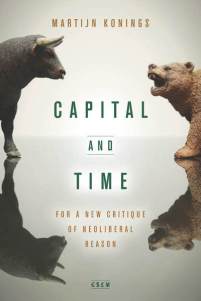
Martijn Konings, Capital and Time For a New Critique of Neoliberal Reason – now out with Stanford University Press

pid_29233.jpgMartijn Konings, Capital and Time For a New Critique of Neoliberal Reason – now out with Stanford University Press

Critics of capitalist finance tend to focus on its speculative character. Our financial markets, they lament, encourage irresponsible bets on the future that reflect no real underlying value. Why is it, then, that opportunities for speculative investment continue to proliferate in the wake of major economic crises? To make sense of this, Capital and Time advances an understanding of economy as a process whereby patterns of order emerge out of the interaction of speculative investments.

Progressive critics have assumed that the state occupies a neutral, external position from which it can step in to constrain speculative behaviors. On the contrary, Martijn Konings argues, the state has always been deeply implicated in the speculative dynamics of economic life. Through these insights, he offers a new interpretation of both the economic problems that emerged during the 1970s and the way that neoliberalism responded to them. Neoliberalism’s strength derives from its intuition that there is no position that transcends the secular logic of risk, and from its insistence that individuals actively engage that logic. Not only is the critique of speculation misleading as a general approach; it is also incapable of recognizing how American capitalism has come to embrace speculation and has thus been able to generate new kinds of order and governance.

Martijn writes:

The book is available in an affordable paperback version, and the two attached flyers (one for direct orders from Stanford University Press, and the other for orders from the UK-based Combined Academic Publishers) offer an additional discount.

Please also note that the book appears in a new series, Currencies: New Thinking for Financial Times. Several other titles are scheduled to appear in the near future, and we’re keen to hear from authors whose work fits with the aims of the series.


Posted in Uncategorized | Leave a comment

Jeff Malpas, Place and Experience A Philosophical Topography, 2nd Edition coming in March 2018

9781138291430Jeff Malpas, Place and Experience A Philosophical Topography, second edition coming in March 2018.

The first edition of Place and Experience established Jeff Malpas as one of the leading philosophers and thinkers of place and space and provided a creative and refreshing alternative to prevailing post-structuralist and postmodern theories of place. It is a foundational and ground-breaking book in its attempt to lay out a sustained and rigorous account of place and its significance.

The main argument of Place and Experience has three strands: first, that human being is inextricably bound to place; second, that place encompasses subjectivity and objectivity, being reducible to neither but foundational to both; and third that place, which is distinct from, but also related to space and time, is methodologically and ontologically fundamental. The development of this argument involves considerations concerning the nature of place and its relation to space and time; the character of that mode of philosophical investigation that is oriented to place and that is referred to as ‘philosophical topography’; the nature of subjectivity and objectivity as inter-related concepts that also connect with intersubjectivity; and the way place is tied to memory, identity, and the self. Malpas draws on a rich array of writers and philosophers, including Wordsworth, Kant, Proust, Heidegger and Donald Davidson.

This second edition is revised throughout, including a new chapter on the consequences of the human embeddedness in place, especially as this relates to the ethical and politics, and a new foreword by Edward Casey. It also includes a new set of additional features, such as chapter summaries, illustrations, annotated further reading, and a glossary, which make this second edition more useful to teachers and students alike.

Posted in Edward Casey, Jeff Malpas, Uncategorized | Leave a comment

Marshall Sahlins & David Graeber, On Kings – open access e-book

9780986132506On Kings by Marshall Sahlins & David Graeber (Hau Press, distributed University of Chicago Press, 2017, 534 pp.) is available as open access pdf in this link; physical copy to buy here.

In anthropology as much as in popular imagination, kings are figures of fascination and intrigue, heroes or tyrants in ways presidents and prime ministers can never be. This collection of essays by two of the world’s most distinguished anthropologists—David Graeber and Marshall Sahlins—explores what kingship actually is, historically and anthropologically. As they show, kings are symbols for more than just sovereignty: indeed, the study of kingship offers a unique window into fundamental dilemmas concerning the very nature of power, meaning, and the human condition.
Reflecting on issues such as temporality, alterity, piracy, and utopia—not to mention the divine, the strange, the numinous, and the bestial—Graeber and Sahlins explore the role of kings as they have existed around the world, from the BaKongo to the Aztec to the Shilluk and beyond. Richly delivered with the wit and sharp analysis characteristic of Graeber and Sahlins, this book opens up new avenues for the anthropological study of this fascinating and ubiquitous political figure.


Posted in Uncategorized | 2 Comments

Maja Zehfuss, War and the Politics of Ethics – now out with OUP

9780198807995.jpgMaja Zehfuss, War and the Politics of Ethics – now published with Oxford University Press. [Update: jumped the gun here – will actually be published in February 2018]

Contemporary Western war is represented as enacting the West’s ability and responsibility to help make the world a better place for others, in particular to protect them from oppression and serious human rights abuses. That is, war has become permissible again, indeed even required, as ethical war. At the same time, however, Western war kills and destroys. This creates a paradox: Western war risks killing those it proposes to protect.

This book examines how we have responded to this dilemma and challenges the vision of ethical war itself, exploring how the commitment to ethics shapes the practice of war and indeed how practices come, in turn, to shape what is considered ethical in war. The book closely examines particular practices of warfare, such as targeting, the use of cultural knowledge, and ethics training for soldiers. What emerges is that instead of constraining violence, the commitment to ethics enables and enhances it. The book argues that the production of ethical war relies on an impossible but obscured separation between ethics and politics, that is, the problematic politics of ethics, and reflects on the need to make decisions at the limit of ethics.

Posted in Maja Zehfuss, Uncategorized | Leave a comment