Times Higher Education letter on Shrinking Pensions in UK universities

There is a letter in the Times Higher Education about ‘Shrinking Pensions’. I was pleased to be asked to be one of the signatories. If you are a UCU member in the UK, and haven’t yet voted in the pension ballot, please do so today – deadline is tomorrow. For a ballot to be valid there needs to be a 50% turnout in each branch.

We write as senior academics to express our concern about the proposal from Universities UK to end guaranteed pension payments in the Universities Superannuation Scheme (“UUK reforms ‘will cut USS pensions by up to 40 per cent’”, News, 30 November).

The USS is the main pension scheme for academic and related staff in the pre-92 institutions and, since its foundation, has provided a decent income in retirement for hundreds of thousands of people. In a sector where many would earn more working in the private sector, the USS pension has provided compensation for relatively modest salaries and has acted as a magnet for talented overseas staff.

The UUK proposals mean the replacement of guaranteed pensions with a defined contribution scheme that will be wholly dependent on movements in stocks and shares. First Actuarial estimates that a typical lecturer will receive £208,000 less under the proposals than presently. For universities that rely on the USS to help recruit and retain staff this will be a disaster, with lecturers enjoying retirement income of an estimated £400,000 less than their colleagues in the rival Teachers’ Pension Scheme, which mainly enrols staff in post-92 universities.

Young university staff work hard yet have endured years of pay restraint and casual contracts, while watching many at the top enjoy great rewards. Now that the USS – arguably the best aspect of the employment package – is at risk, we want to stand shoulder to shoulder with all our colleagues, and especially the next generation, to defend our profession.
Posted in Uncategorized, Universities | 1 Comment

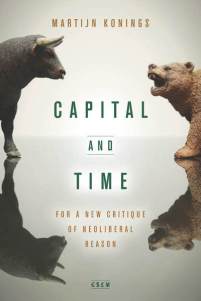
Martijn Konings, Capital and Time For a New Critique of Neoliberal Reason – now out with Stanford University Press

pid_29233.jpgMartijn Konings, Capital and Time For a New Critique of Neoliberal Reason – now out with Stanford University Press

Critics of capitalist finance tend to focus on its speculative character. Our financial markets, they lament, encourage irresponsible bets on the future that reflect no real underlying value. Why is it, then, that opportunities for speculative investment continue to proliferate in the wake of major economic crises? To make sense of this, Capital and Time advances an understanding of economy as a process whereby patterns of order emerge out of the interaction of speculative investments.

Progressive critics have assumed that the state occupies a neutral, external position from which it can step in to constrain speculative behaviors. On the contrary, Martijn Konings argues, the state has always been deeply implicated in the speculative dynamics of economic life. Through these insights, he offers a new interpretation of both the economic problems that emerged during the 1970s and the way that neoliberalism responded to them. Neoliberalism’s strength derives from its intuition that there is no position that transcends the secular logic of risk, and from its insistence that individuals actively engage that logic. Not only is the critique of speculation misleading as a general approach; it is also incapable of recognizing how American capitalism has come to embrace speculation and has thus been able to generate new kinds of order and governance.

Martijn writes:

The book is available in an affordable paperback version, and the two attached flyers (one for direct orders from Stanford University Press, and the other for orders from the UK-based Combined Academic Publishers) offer an additional discount.

Please also note that the book appears in a new series, Currencies: New Thinking for Financial Times. Several other titles are scheduled to appear in the near future, and we’re keen to hear from authors whose work fits with the aims of the series.


Posted in Uncategorized | Leave a comment

Jeff Malpas, Place and Experience A Philosophical Topography, 2nd Edition coming in March 2018

9781138291430Jeff Malpas, Place and Experience A Philosophical Topography, second edition coming in March 2018.

The first edition of Place and Experience established Jeff Malpas as one of the leading philosophers and thinkers of place and space and provided a creative and refreshing alternative to prevailing post-structuralist and postmodern theories of place. It is a foundational and ground-breaking book in its attempt to lay out a sustained and rigorous account of place and its significance.

The main argument of Place and Experience has three strands: first, that human being is inextricably bound to place; second, that place encompasses subjectivity and objectivity, being reducible to neither but foundational to both; and third that place, which is distinct from, but also related to space and time, is methodologically and ontologically fundamental. The development of this argument involves considerations concerning the nature of place and its relation to space and time; the character of that mode of philosophical investigation that is oriented to place and that is referred to as ‘philosophical topography’; the nature of subjectivity and objectivity as inter-related concepts that also connect with intersubjectivity; and the way place is tied to memory, identity, and the self. Malpas draws on a rich array of writers and philosophers, including Wordsworth, Kant, Proust, Heidegger and Donald Davidson.

This second edition is revised throughout, including a new chapter on the consequences of the human embeddedness in place, especially as this relates to the ethical and politics, and a new foreword by Edward Casey. It also includes a new set of additional features, such as chapter summaries, illustrations, annotated further reading, and a glossary, which make this second edition more useful to teachers and students alike.

Posted in Edward Casey, Jeff Malpas, Uncategorized | Leave a comment

Marshall Sahlins & David Graeber, On Kings – open access e-book

9780986132506On Kings by Marshall Sahlins & David Graeber (Hau Press, distributed University of Chicago Press, 2017, 534 pp.) is available as open access pdf in this link; physical copy to buy here.

In anthropology as much as in popular imagination, kings are figures of fascination and intrigue, heroes or tyrants in ways presidents and prime ministers can never be. This collection of essays by two of the world’s most distinguished anthropologists—David Graeber and Marshall Sahlins—explores what kingship actually is, historically and anthropologically. As they show, kings are symbols for more than just sovereignty: indeed, the study of kingship offers a unique window into fundamental dilemmas concerning the very nature of power, meaning, and the human condition.
Reflecting on issues such as temporality, alterity, piracy, and utopia—not to mention the divine, the strange, the numinous, and the bestial—Graeber and Sahlins explore the role of kings as they have existed around the world, from the BaKongo to the Aztec to the Shilluk and beyond. Richly delivered with the wit and sharp analysis characteristic of Graeber and Sahlins, this book opens up new avenues for the anthropological study of this fascinating and ubiquitous political figure.


Posted in Uncategorized | 2 Comments

Maja Zehfuss, War and the Politics of Ethics – now out with OUP

9780198807995.jpgMaja Zehfuss, War and the Politics of Ethics – now published with Oxford University Press. [Update: jumped the gun here – will actually be published in February 2018]

Contemporary Western war is represented as enacting the West’s ability and responsibility to help make the world a better place for others, in particular to protect them from oppression and serious human rights abuses. That is, war has become permissible again, indeed even required, as ethical war. At the same time, however, Western war kills and destroys. This creates a paradox: Western war risks killing those it proposes to protect.

This book examines how we have responded to this dilemma and challenges the vision of ethical war itself, exploring how the commitment to ethics shapes the practice of war and indeed how practices come, in turn, to shape what is considered ethical in war. The book closely examines particular practices of warfare, such as targeting, the use of cultural knowledge, and ethics training for soldiers. What emerges is that instead of constraining violence, the commitment to ethics enables and enhances it. The book argues that the production of ethical war relies on an impossible but obscured separation between ethics and politics, that is, the problematic politics of ethics, and reflects on the need to make decisions at the limit of ethics.

Posted in Maja Zehfuss, Uncategorized | Leave a comment

Dario Melossi and Massimo Pavarini, The Prison and the Factory (40th Anniversary Edition)

9781137565891Dario Melossi and Massimo Pavarini’s classic book The Prison and the Factory has been reissued as a 40th Anniversary Edition.

This new edition of The Prison and the Factory, a classic work on radical criminology, includes two new, long essays from the authors and a foreword from Professor Jonathan Simon (UC Berkeley). In the two essays, Melossi and Pavarini reflect on the origins, development and fortune of The Prison and the Factory in relation to the debates surrounding mass incarceration that have taken place since this book was first published 40 years ago. The reputation of the original work has long been established worldwide, and this updated version will be of very special interest to scholars of the criminal justice system, penology, and Marxist theory.

This seminal book examines the links between the development of capitalist political economy and changing forms of social control. Melossi and Pavarini analyse the connection between the creation of penal institutions and regimes in Europe and the USA, and the problems generated by the emergence of capitalist soci
al relations. They provide a thorough neo-Marxist view of emergent capitalism and the penal mechanisms which are constructed to deal with the problem of labour.

Contemporary to but independent from the work of Michel Foucault, Melossi and Pavarini combine research on the development of penal philosophies and institutions with a rigorous account of changing forms of capital accumulation, focusing on the use, and the problem, of labour under capitalist relations.

Posted in Uncategorized | Leave a comment

Rob Kitchin, Rules for making decisions on requests for academic work

Rob Kitchin, Rules for making decisions on requests for academic work Some very interesting discussion of how to decide what to do, and what not to do,

Last week I posted on my personal blog about the volume of requests I receive to undertake work beyond my allocated load as directed by university managers. Such work includes reviewing for journals and grant agencies, writing references and external examining, serving on advisory boards and working with local communities, and contributing papers to special issues or delivering invited talks.

While undertaking all these tasks are expected of academics as part of their normal load, constituting service work and an important part of the exchange economy of academia (Elden 2008), it is usually undertaken at their discretion. Key questions then are: what requests for labour to accept? What is an acceptable/sensible load? These questions become more pressing as the number of requests increases as an individual’s profile and academic network develop.

Most academics, I sense, find it quite difficult to evaluate and manage requests, and to say ‘no’ to many of them. In part this is because we are trying to balance a sense of obligation to participate in the exchange economy (especially if we know the person making the request), with a strategic approach to career development, and a need for personal well-being. Certainly, I struggle in deciding which requests to accept, and even though I do say ‘no’ to a lot of requests I still feel I take on too much and struggle to deliver on my promises (I typically receive about one new request a day beyond existing commitments).

On social media I was asked about how I go about making decisions on what requests to undertake and how I manage the workload. I didn’t have a ready answer because I’ve never formulated a strategy for decision-making or managing commitments. Instead, I have been using a rough set of unarticulated rules of thumb. It was also suggested that it might be useful for academics to be mentored with regards to dealing with requests.

In an effort to provide some mentoring advice, but also to try and formalise my own rules of thumb, I thought it might be useful to consider how best to deal with external requests for academic labour. [continues here]

Posted in Uncategorized | Leave a comment

Pluto Books Radical Geography series – 50% off and Danny Dorling introduction

Pluto Books Radical Geography series is on sale, with 50% off the three books in the series – Katharyne Mitchell, Making Workers; Stephen Crossley, In their Place and Paul Routledge, Space Invaders. One of the series editors, Danny Dorling, has an introduction here: What is Radical about Geography?

Posted in Uncategorized | 1 Comment

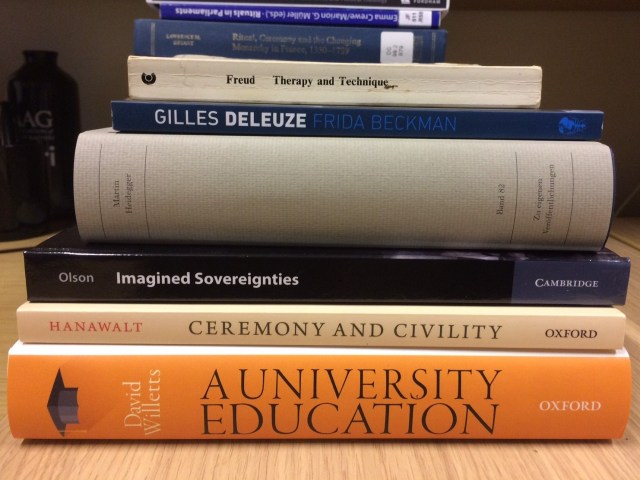
Books received – Freud, Beckman on Deleuze, Heidegger, Olson, Hanawalt, Willetts

books

Freud’s Therapy and Technique; Frida Beckman’s Gilles Deleuze; the latest volume of Heidegger’s Gesamtausgabe; Kevin Olson’s Imagined Sovereignties: The Power of the People and Other Myths of the Modern Age; Barbara Hanawalt’s Ceremony and Civility: Civic Culture in Late Medieval London; and David Willett’s A University Education. The OUP books were recompense for review work.

Posted in Gilles Deleuze, Martin Heidegger, Politics, Sigmund Freud, Uncategorized, Universities | Leave a comment

Metamodernism: Historicity, Affect, and Depth after Postmodernism – now out with Rowman and Littlefield

9781783489619 (1)Metamodernism: Historicity, Affect, and Depth after Postmodernism, edited by Robin van den Akker, Alison Gibbons and Timotheus Vermeulen, now out with Rowman and Littlefield

Metamodernism: Historicity, Affect, Depth brings together many of the most influential voices in the scholarly and critical debate about post-postmodernism and twenty-first century aesthetics, arts and culture. By relating cutting-edge analyses of contemporary literature, the visual arts and film and television to recent social, technological and economic developments, the volume provides both a map and an itinerary of today’s metamodern cultural landscape. As its organising principle, the book takes Fredric Jameson’s canonical arguments about the waning of historicity, affect and depth in the postmodern culture of western capitalist societies in the twentieth century, and re-evaluates and reconceptualises these notions in a twenty-first century context. In doing so, it shows that the contemporary moment should be regarded as a transitional period from the postmodern and into the metamodern cultural moment.

Acknowledgements / 1. Periodising the 2000s, or, the emergence of metamodernism, Robin van den Akker and Timotheus Vermeulen / Section I: Historicity / 2. Metamodern Historicity, Robin van den Akker / 3. The metamodern, the quirky, and the challenge of categorization, James MacDowell / 4. Toni Morrison’s Beloved and the Rise of Historioplastic Metafiction, Josh Toth / 5. Super-hybridity: Non-simultaneity, political power, and multipolar conflict, Jorg Heiser / 6. The Cosmic Artisan: Mannerist Virtuosity and Contemporary Crafts, Sjoerd van Tuinen / Section II: Affect / 7. Metamodern Affect, Alison Gibbons / 8. Four Faces of Post-Irony, Lee Konstantinou / 9. Radical Defenselessness: A new sense of self in the work of David Foster Wallace, Nicoline Timmer / 10. Contemporary Autofiction and Affect, Alison Gibbons / 11. The Joke that Wasn’t funny anymore: Empathy in Contemporary Sitcoms, Gry Rustad and Kai Schwind / Section III: Depth / 12. Metamodern Depth or ‘Depthiness’, Timotheus Vermeulen / 13. Reconstructing Depth: Authentic Fiction and Responsibility, Irmtraud Huber and Wolfgang Funk / 14. Between truth, sincerity and satire: Post-truth politics and the rhetoric of authenticity, Sam Browse / 15. Notes on Performatist Photography: Experiencing beauty and transcendence after postmodernism, Raoul Eshelman / Epilogue / 16. Thoughts on writing about art after postmodernism, James Elkins / References / Index / Contributor Information

Posted in Uncategorized | Leave a comment