Richard C. Powell, Studying Arctic Fields: Cultures, Practices and Environmental Sciences – now out with MQUP

9780773551138.jpgRichard C. Powell, Studying Arctic Fields: Cultures, Practices and Environmental Sciences – now out with McGill-Queen’s University Press.

In recent years the circumpolar region has emerged as the key to understanding global climate change. The plight of the polar bear, resource extraction debates, indigenous self-determination, and competing definitions of sovereignty among Arctic nation-states have brought the northernmost part of the planet to the forefront of public consideration. Yet little is reported about the social world of environmental scientists in the Arctic. What happens at the isolated sites where experts seek to answer the most pressing questions facing the future of humanity?

Portraying the social lives of scientists at Resolute in Nunavut and their interactions with logistical staff and Inuit, Richard Powell demonstrates that the scientific community is structured along power differentials in response to gender, class, and race. To explain these social dynamics the author examines the history and vision of the Government of Canada’s Polar Continental Shelf Program and John Diefenbaker’s “Northern Vision,” combining ethnography with wider discourses on nationalism, identity, and the postwar evolution of scientific sovereignty in the high Arctic. By revealing an expanded understanding of the scientific life as it relates to politics, history, and cultures, Studying Arctic Fields articulates a new theory of field research.

Advocating for a greater appreciation of science in the remote parts of the world, Studying Arctic Fields is an innovative approach to anthropology, environmental inquiry, and geography, and a landmark statement on Arctic science as a social practice.

Introduction
1. Scientific Sovereignty, Nordicity, and the Canadian Nation
2. Between Observation and Experiment in Arctic Fieldwork
3. Base Cultures: The Spatial Organization of a Research Station
4. Performing the Arctic Scientific Human
5. Canada Day in Qausuittuq: Dramatizing Inuit Encounters
6. Emotional Practices and Play: The Quotidian Provenance of Logistics
7. Hidden Voices? Competing Visions and the Everyday Governance of Arctic Science
Epilogue: Requiem for a Canadian Arctic? | 188


Posted in Uncategorized | 1 Comment

Books received – Soussloff and Favreau on Foucault, Kleinberg, Gandal, Höfele, Flynn on Sartre, Withers

books Jan 1.png

Some recently received books – Catherine M. Soussloff, Foucault on Painting; Jean-François Favreau, Vertiges de l’écriture : Michel Foucault et la littérature (1954-1970); Ethan Kleinberg, Haunting History: For a Deconstructive Approach to the Past; Keith Gandal, The Gun and the Pen: Hemingway, Fitzgerald, Faulkner, and the Fiction of Mobilization; Andreas Höfele, Stage, Stake, and Scaffold: Humans and Animals in Shakespeare’s Theatre and No Hamlets: German Shakespeare from Nietzsche to Carl Schmitt; Thomas Flynn, Sartre: A Philosophical Biography; Charles W. Withers, Zero Degrees: Geographies of the Prime Meridian. The OUP books were recompense for review work.

Posted in Friedrich Nietzsche, Jean-Paul Sartre, Michel Foucault, Territory, Uncategorized, William Shakespeare | 2 Comments

Matthew Longo, Politics of Borders: Sovereignty, Security, and the Citizen after 9/11 – now out with CUP

9781316622933.jpgMatthew Longo, Politics of Borders: Sovereignty, Security, and the Citizen after 9/11 – now out with Cambridge University Press.

Borders sit at the center of global politics. Yet they are too often understood as thin lines, as they appear on maps, rather than as political institutions in their own right. This book takes a detailed look at the evolution of border security in the United States after 9/11. Far from the walls and fences that dominate the news, it reveals borders to be thick, multi-faceted and binational institutions that have evolved greatly in recent decades. The book contributes to debates within political science on sovereignty, citizenship, cosmopolitanism, human rights and global justice. In particular, the new politics of borders reveal a sovereignty that is not waning, but changing, expanding beyond the state carapace and engaging certain logics of empire.

  • Presents a radical new way to understand borders that reveals how contemporary borders are increasingly bi-nationally administered institutions
  • Provides a new way to understand sovereignty that is evolving alongside globalization
  • Recasts the relationship between sovereignty and security
  • Evaluates the normative challenges of cross-border collaboration, and suggests solutions in the language of citizenship
Table of Contents

Introduction
1. Borders: thick and thin
Part I. The Perimeter:
2. The wall and its shadow: security in the borderlands
3. Co-bordering: one border, two sovereigns?
4. A global question: co-bordering, cosmopolitanism, and the spectre of empire
Part II. The Ports of Entry:
5. The tiniest constable: big data, security, and the politics of identification
6. Sovereignty, security, and the politics of trust
7. Into the digital dark: data, the global firewall, and the future of security.

Posted in Boundaries, Politics, Territory, Uncategorized | Leave a comment

Reassessing the Trump presidency, one year on – forum in Political Geography (open access)

Reassessing the Trump presidency, one year on – forum in Political Geography with Philip E.Steinberg, Sam Page, Jason Dittmer, Banu Gökariksel, Sara Smith, Alan Ingram and Natalie Koch

Posted in Uncategorized | Leave a comment

Alex Danchev on research and French archives and libraries

9781611454963-frontcover.jpgJust finished reading Alex Danchev’s very interesting Georges Braque: A Life. Among other things, I was struck by just how much archival work he did. Here’s his comment from the acknowledgements on research and French archives:
Researching is adventuring into the unknown. Blandine Chambost has been my skirmisher, interpreter, and conductor into the strange ways of French archives (‘What proof do you have, monsieur, that we hold these papers?’) and the Byzantine workings of the Bibliothèque Nationale, ‘which in both its entire layout and its near-ludicrous internal regulation seeks to exclude the reader as a potential enemy’, as the late W.G. Sebald so aptly remarked (p. 412).

Posted in Uncategorized | Leave a comment

Henri Lefebvre, The Survival of Capitalism – how to reconstruct an English version of the French text

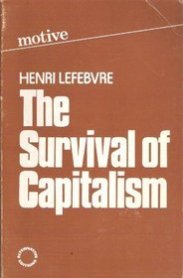
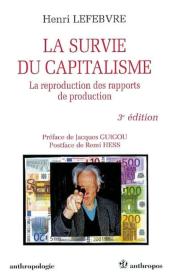
SC Fr.jpgSC EngHenri Lefebvre’s 1973 book La survie du capitalisme: La reproduction des rapports de production (Anthropos, third edition 2002) was one of the relatively few of his books which was translated within a few years of its initial publication. Many of Lefebvre’s books appeared in translation only decades afterwards, or await translation. This translation appeared in 1976 as The Survival of Capitalism: Reproduction of the Relations of Production, by Frank Bryant with Allison and Busby. It is long out of print, but there are scans online (i.e. here).

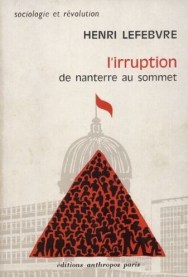
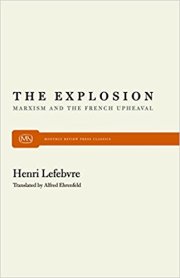
L'irruption 1stThe ExplosionBut the French and the English translation are not the same. The reason is that the French text reused parts of one of Lefebvre’s earlier books, L’irruption de Nanterre au sommet (Anthropos 1968, 2nd edition, Syllepse 1998). Because that book had been translated by Alfred Ehrenfeld as The Explosion: Marxism and the French Upheaval (Modern Reader, 1969), the decision was made not to translate most of the overlapping material. The result, however, is that the English reader of The Survival of Capitalism reads a different book, one which is less immediately political. The difference is not noted in the English text.
The full discussion is here; but what follows is the summary. In order to read the book as Lefebvre intended you’d need to move between the two English books – The Survival of Capitalism (SC) and The Explosion (Ex) – and read things in this order.

Introduction/The Discovery (SC Ch 1)
I. Reproduction of the relations of production (SC Ch. 2)
II. Is the working class revolutionary? (SC Ch. 3)
III. Ideologies of growth (SC Ch. 4)
IV. Contestation, Spontaneity, Violence (Ex Ch 7)
V. Strategies for Outflanking and the Outflanking of Strategies (Ex Ch 8)
VI. On Dual Power (Ex Ch. 9)
VII. On Self-Management (Ex Ch. 10 or first half of SC Ch. 5)
VIII. The World Situation (Ex Ch. 11)
IX. Urban Phenomena (Ex Ch. 12)
X. Mutation (Ex Ch. 13)
XI. Alternative or Alibi? (Ex Ch. 14 or second half of SC Ch. 5)
XII. Old and New Contradictions: Theses and Hypotheses (Ex Ch 15)
XIII. The Twofold Status of Knowledge (Social and Theoretical) (Ex Ch 16)

Survival of Capitalism Ch. 5 ‘Alternatives’ is the only overlap between that book and The Explosion. A comparison of those two translations would be instruction to see how Ehrenfield and Bryant have translated the same terms. Combining two translations to read a single French book needs to be done with care, but this shows how to construct an English version of the book Lefebvre intended.

My guide to where to start with reading Lefebvre in English is here.

Thanks to Martin Jones for the idea for this post.

Posted in Henri Lefebvre, Uncategorized | Leave a comment

302 interviews with philosophers at 3am Magazine

End times philosophy interviews: the first 302

Thematically organised interviews at 3am Magazine. Thanks to David Beer for the link.

Posted in Uncategorized | Leave a comment

For a Marxist Poetics of Science: An Interview with Esther Leslie

For a Marxist Poetics of Science: An Interview with Esther Leslie at the Verso blog or in Historical Materialism

In this career-spanning interview with George Souvlis, Esther Leslie discusses Walter Benjamin, animated film, the history of color, the Historical Materialism project, and the commemoration of the revolutionary past.

Posted in Uncategorized | 1 Comment

Figure/Ground interview with Leonard Lawlor

Figure/Ground interview with Leonard Lawlor – lots of good discussion of European philosophy, including Deleuze, Derrida, Foucault, Heidegger and Lyotard. Also some interesting comments about writing:

What advice would you give to young graduate students and aspiring university professors?

I don’t want to just speak in clichés and truisms here. But, obviously, hard work is the key to any success. Thankfully, I have some comments that are less of a cliché. Three things really helped me reach the level of success that I’ve had (modest success, of course). First, while still a graduate student, I realized that, when I was struggling with ideas and with writing about them, the best way to make progress was simply to write. Writing allowed me to understand the ideas better, and even when my writing was confused, at least I had some raw material on which I could work. My advice is: don’t be afraid to write when you are struggling with the ideas. If you wait for comprehension in advance of writing, you’ll never get anything done. Second, when I was a beginning assistant professor, I worked on research projects successively. I finished one project prior to starting another. After I was promoted to associate professor, I realized that I was working too slowly. Then I started to work on projects in tandem, which resulted in me publishing three books almost simultaneously over 2002-2003. The advice is: try to work on projects simultaneously. Third, the other piece of advice I would give is take advantage of other traditions in philosophy. I benefitted greatly from the analytic philosophy courses I was required to take at Stony Brook. But, I especially benefitted from the excellent analytic philosophers I had as colleagues (Terry Horgan, John Tienson, Mark Timmons, and David K. Henderson) at the University of Memphis, where I taught for 19 years. Through the way my analytic colleagues approached philosophical questions, I learned that making sharp differences and thoroughly dissecting concepts allows one to think more clearly. Making differences and dissecting concepts of course is not all the work of philosophy. But, doing so lays the groundwork for the genuine work of philosophy which is creativity. Here, of course, I am thinking of Deleuze’s definition of philosophy as the creation of concepts.

Thanks to Graham Harman (who takes exception to some comments on Meillassoux, object-orientated philosophy and the new materialism) for the link.

Posted in Gilles Deleuze, Graham Harman, Jacques Derrida, Michel Foucault, Quentin Meillassoux, Uncategorized | Leave a comment

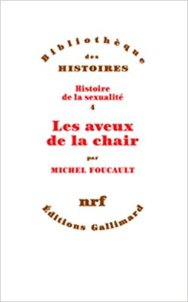
Foucault, Les aveux de la chair – Gallimard page and a few more details

HS IVMichel Foucault, Les aveux de la chair, the fourth volume of his History of Sexuality, is scheduled for publication in February 2018. The Gallimard page now has a few more details, including its length at 448 pages (volumes II and III, in the same Gallimard series, are each less than 300 pages), and this description:

Les aveux de la chair, qui paraît aujourd’hui comme le quatrième et dernier volume de L’histoire de la sexualité, est en réalité le premier auquel Michel Foucault s’était consacré après La volonté de savoir(1976) qui constituait l’introduction générale de l’entreprise. Il s’attachait aux règles et doctrines du christianisme élaborées du Ile au IVe siècles par les Pères de l’Église.
Au cours de son travail, Michel Foucault s’était persuadé que l’essentiel de ces règles et doctrines était un héritage remanié des disciplines de soi élaborées par les philosophes grecs et latins de l’Antiquité classique et tardive. Cest à leur analyse qu’il s’est courageusement appliqué, pour aboutir en 1984 à la publication simultanée de L’usage des plaisirs et du Souci de soi.
Louvrage est donc un premier jet auquel Foucault comptait se remettre au moment de sa mort. La réunion des quatre volumes de Dits et Écrits (1954-1988) publiés en 1994, puis celle des treize volumes des Cours au Collège de France en ont retardé l’édition et la mise au point dont s’est chargé Frédéric Gros, l’éditeur des œuvres de Michel Foucault dans la Bibliothèque de la Pléiade.
Tel quel, cet ouvrage constitue un état très élaboré de la pensée de l’auteur et peut-être le cœur même de l’entreprise, la partie à laquelle il attachait assez d’importance pour se lancer dans l’aventure.

I previously posted about this, with some answers to some frequently asked questions.

Posted in Michel Foucault, Uncategorized | 1 Comment